
Published: March 2020 | Last Updated:April 2026
© Copyright 2026, Reddog Consulting Group.

TL;DR:
- Most CPG websites fail to meet core Web Vitals, negatively impacting conversions and revenue.
- Prioritize server infrastructure and speed optimization over frontend tweaks for meaningful site performance gains.
- Continuous monitoring and multichannel alignment are essential for sustainable growth and profitability.
Your CPG brand’s website is either working for you or against you, and the margin between those two outcomes is thinner than most founders realize. Only 48% of Shopify stores meet all Core Web Vitals on mobile, and slow sites lose up to 53% of visitors before a single product page loads. For brands scaling across Amazon, direct-to-consumer (DTC), wholesale, and retail simultaneously, that performance gap compounds fast. This checklist walks you through the exact steps to establish baselines, fix what’s broken, align your channels, and build a system that keeps improving. Each section is built around what actually moves revenue for CPG brands at your stage.
| Point | Details |
|---|---|
| Set performance benchmarks | Define and track the most important speed and usability benchmarks for scalable growth. |
| Prioritize site speed fixes | Start with server and infrastructure upgrades before tackling frontend tweaks and mobile optimizations. |
| Centralize multichannel operations | Streamline inventory, branding, and support across all channels for maximum revenue impact. |
| Monitor and refine regularly | Schedule recurring reviews and audits to catch new issues and unlock compounding gains. |
| Expert perspective matters | Industry insights reveal that continuous improvement—especially server-first tactics—beats one-off optimizations. |
Before you touch a single line of code or swap out a plugin, you need to know where you actually stand. Most CPG operators skip this step and jump straight to tweaks. That’s how you end up spending weeks on frontend polish while your server response time quietly kills conversions.
Start with Google’s Core Web Vitals, the three metrics that define how users experience your site in real conditions. Core Web Vitals benchmarks for ecommerce are: Largest Contentful Paint (LCP) under 2.5 seconds, Interaction to Next Paint (INP) under 200 milliseconds, and Cumulative Layout Shift (CLS) under 0.1. LCP measures how fast your main content loads. INP measures how quickly your site responds to clicks and taps. CLS measures whether page elements jump around as the page loads, which frustrates users and kills trust.
Here’s how these benchmarks break down in practice:
| Metric | Good | Needs work | Poor |
|---|---|---|---|
| LCP | Under 2.5s | 2.5s to 4.0s | Over 4.0s |
| INP | Under 200ms | 200ms to 500ms | Over 500ms |
| CLS | Under 0.1 | 0.1 to 0.25 | Over 0.25 |
The revenue impact of these numbers is not theoretical. Site speed improvements of just one second can lift sales by approximately 2%, and a 100-millisecond delay in load time can reduce conversions by 7%. For a brand doing $2M in annual DTC revenue, that 7% drag is $140,000 per year sitting on the table.
Here’s what to benchmark first:
Use these numbers to build your baseline. Check ecommerce site benchmarks against industry averages so you know how competitive your starting point actually is. If you’re already pulling together a broader growth checklist for CPG brands, these performance metrics belong at the top.
Pro Tip: Run your benchmarks on real mobile devices, not just desktop emulation. Google’s PageSpeed Insights uses field data from actual users, which is far more accurate than simulated tests.
With your benchmarks locked in, the optimization work can begin. The most important thing to understand here is sequencing. Most brands rush to compress images or minify JavaScript first. Those are useful, but they’re secondary gains. The biggest speed wins come from your server infrastructure.
Here’s the right order of operations:
These five steps, applied in order, address site speed performance at the infrastructure level before touching the frontend. That’s the sequence that actually sticks.
For CPG brands with large product catalogs, your product detail pages carry the most weight. A PDP with uncompressed lifestyle photography and unoptimized video assets can clock in at 8 to 12MB per load. That’s a conversion killer on mobile, where most CPG shoppers now browse. Audit those pages first using Google PageSpeed Insights, GTmetrix, or Semrush Site Audit.

Once your core pages are clean, extend the same audit to your ecommerce tech stack. Redundant apps, bloated themes, and third-party scripts from old integrations all add load time. A quarterly script audit alone can recover 300 to 500ms on many Shopify stores.
Pro Tip: Don’t optimize in isolation. Pair speed fixes with SEO quick wins like structured data and title tag improvements. Google rewards fast, well-structured pages with better rankings, which compounds your traffic gains over time.
Continuous monitoring beats a one-time fix every time. Set up automated alerts in your analytics platform for any page that drops below your LCP threshold. That way you catch regressions before they cost you sales.
Your website doesn’t exist in a vacuum. For CPG brands operating across DTC, Amazon, Walmart, and retail, every channel either reinforces or undermines the others. Optimization isn’t just a website project. It’s a channel alignment project.
Multichannel sellers earn 190% more revenue than single-channel sellers. That number reflects the compounding effect of reaching customers wherever they shop, but only if your brand experience is consistent and your operations can support it.
Here’s what a unified multichannel foundation actually requires:
Here’s how channel priorities typically compare for CPG brands at the $1M to $10M stage:
| Channel | Margin potential | Control level | Optimization focus |
|---|---|---|---|
| DTC website | High | Full | Speed, UX, conversion |
| Amazon FBA | Medium | Partial | Listings, reviews, ads |
| Walmart WFS | Medium-low | Partial | Content, pricing, fulfillment |
| Wholesale/retail | Variable | Low | Sell-through, placement |
Use multichannel optimization strategies to prioritize where your effort goes based on margin contribution, not just revenue volume. A channel that drives 30% of your sales but 10% of your profit deserves less optimization investment than one with the inverse ratio.
Pro Tip: Consolidate customer service into a single platform like Gorgias or Zendesk. When support tickets from Amazon, your DTC site, and retail all land in one place, you spot product and fulfillment issues faster and resolve them before they compound.
For deeper guidance on omnichannel merchandising best practices, the principles of consistent presentation and channel-appropriate content apply whether you’re on a digital shelf or a physical one.
Setting up a solid foundation is step one. Keeping it performing as you scale is the harder, more important work. Most CPG brands do a big optimization push, see gains, and then let the site drift for six to twelve months. By then, new apps have slowed the store, rankings have shifted, and conversion rates have quietly eroded.
Build a recurring audit rhythm instead:
Brand operators who monitor metrics and refine regularly see compounding gains. A 2% conversion improvement in Q1 stacks with a 1.5% gain in Q2, and those numbers build on each other across the year.
Continuous monitoring over one-time fixes is the only approach that holds up at scale. As you add channels, SKUs, and traffic volume, the complexity of your site grows. What passed a speed audit at $500K in revenue may fail at $5M.
Use dashboards that pull data from Google Analytics 4, your marketplace seller accounts, and your inventory platform into a single view. That’s where you’ll catch the margin leaks and traffic drops that individual platform dashboards hide. For practical frameworks on increasing ecommerce sales and sustaining that growth, the monitoring layer is what separates brands that plateau from brands that compound.
Pro Tip: Pair your site audit calendar with your Amazon listing optimization review schedule. Running both on the same cadence saves time and helps you spot cross-channel patterns in customer behavior.
Here’s the uncomfortable truth: most optimization guides lead with frontend tactics because they’re easy to visualize and sell. Compress your images. Add a CDN. Use WebP. Those are real improvements, but they’re the second layer of the problem, not the first.
We’ve worked with CPG brands that spent months chasing frontend scores while running on shared hosting with a 600ms TTFB. Every frontend gain they made was being eaten by server latency before it reached the customer. The server-first approach is the one that actually moves the needle, and it’s the one most operators skip because it feels less tangible.
The second thing most guides miss is that multichannel complexity changes your optimization priorities entirely. A DTC-only brand can obsess over homepage conversion rate. A brand running DTC plus Amazon plus two regional retail chains has to think about which channel is leaking margin and why. That’s a different question, and it requires a data strategy that connects site performance to channel-level profitability.
The brands we see scale cleanly are the ones who treat optimization as an ongoing operational discipline, not a project. They build profitable ecommerce tech stacks that support monitoring at scale, and they review the numbers on a cadence, not just when something breaks.
This checklist gives you the framework. Executing it across Amazon, DTC, Walmart, and wholesale simultaneously is where most CPG brands need structured support.
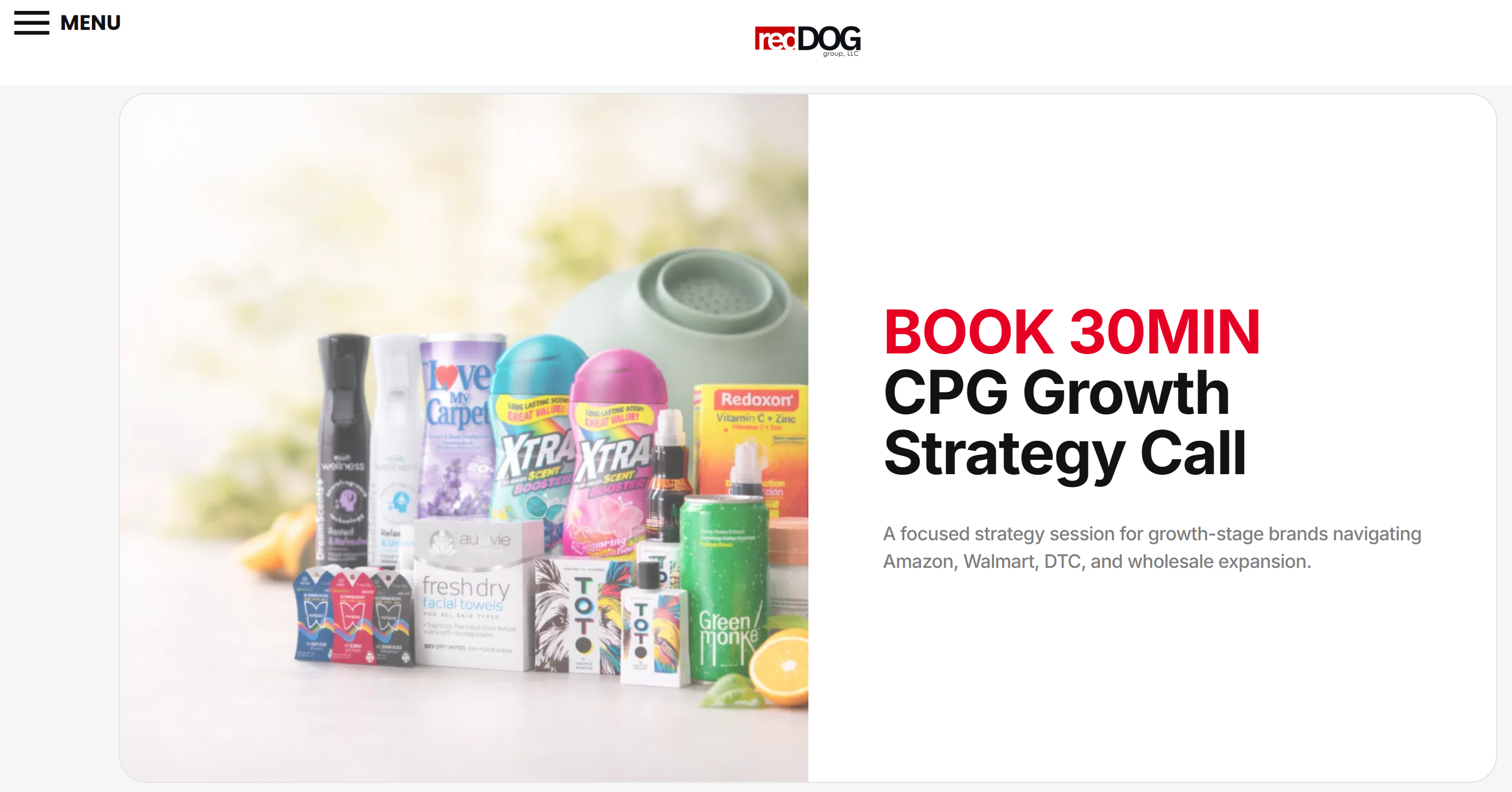
At RedDog Group, we work with CPG brands in the $500K to $20M range to build optimization systems that are grounded in margin, not just traffic. Whether you need Amazon optimization consulting to improve your marketplace performance or a full CPG retail growth solution that spans every channel, we build the strategy around what actually contributes to your bottom line. If you’re ready to stop guessing and start scaling with clarity, let’s talk.
Focus on Core Web Vitals benchmarks: Largest Contentful Paint (LCP) under 2.5s, Interaction to Next Paint (INP) under 200ms, and Cumulative Layout Shift (CLS) under 0.1 for optimal performance.
Google PageSpeed, GTmetrix, and Semrush Site Audit are industry favorites for speed, usability, and SEO checks across your key pages.
Review your checklist at least quarterly and after any major site or channel changes. Continuous monitoring is what separates brands that sustain gains from those that plateau.
Multichannel sellers earn 190% more than single-channel sellers and build resilience by diversifying sales and marketing touchpoints across platforms.
Leave a comment: