
Published: March 2020 | Last Updated:April 2026
© Copyright 2026, Reddog Consulting Group.

TL;DR:
- Operational inefficiencies in CPG quietly reduce margins despite revenue growth.
- Unified data, automation, and integrated platforms enable 5%+ annual productivity gains.
- Streamlining improves fulfillment, reduces stockouts, and enhances omnichannel profitability.
Most CPG founders chasing growth are unknowingly leaving margin on the table through operational drag they can’t see. Stockouts, misaligned promotions, siloed data, and slow response to channel shifts quietly erode profitability while revenue climbs. The pressure is real: CPG brands need 5% or more in annual productivity gains just to stay competitive in a market where pricing power is limited and shelf space is contested. Traditional playbooks built around travel freezes and headcount reductions won’t get you there. What will is a fundamentally different way of running your operation.
| Point | Details |
|---|---|
| Inefficiency is costly | Operational inefficiency erodes profit margins and limits channel growth for CPG brands. |
| Streamlining delivers outsized gains | Integrated operations unlock 5%+ annual productivity gains—far above standard cost-cutting. |
| Unified data is crucial | Centralizing and connecting data across platforms is foundational for omnichannel profitability. |
| Action beats intention | Leaders who systematically simplify and unify processes outperform reactive competitors. |
Inefficiency in CPG is rarely one big problem. It’s a hundred small ones, each bleeding margin in ways that don’t show up cleanly on a P&L. Stockouts cost you sales and shelf credibility. Excess inventory ties up cash and drives up 3PL storage fees. Promotional execution gaps mean you’re spending on trade dollars that never convert. And lagging data means by the time you see the problem, the window to fix it has closed.
The CPG industry faces 5% or greater annual productivity requirements in a climate where traditional cost-cutting measures return only around 2%. That gap between what brands need and what blunt cuts deliver is where operational inefficiency quietly wins.
Here’s a simplified view of what that gap looks like in practice:
| Approach | Typical annual gain | Operational risk |
|---|---|---|
| Traditional cost-cutting | ~2% | High, reactive |
| Integrated streamlining | 5%+ | Lower, proactive |
| Growth-at-all-costs | Variable | Very high |
The hidden costs of operational drag go beyond what most operators track. Consider:
For brands scaling across multiple channels, these issues compound. A fulfillment delay that’s a minor inconvenience on DTC can trigger a Walmart OTIF penalty that costs thousands. Poor supply chain optimization across channels doesn’t just hurt one revenue stream. It undermines your entire omnichannel position.
Strong supply chain management factors are what separate brands that scale from those that stall. Efficiency isn’t a back-office concern. It’s a competitive edge.
Streamlining gets misunderstood constantly. It’s not about cutting people or stacking more software tools on top of broken processes. Real streamlining means unifying your data, automating repeatable workflows, and eliminating the silos between sales, supply chain, and finance that slow everything down.

Traditional cost-cutting yields only about 2% in annual gains, while integrated platforms and process automation consistently deliver the 5% or more that brands actually need. The contrast matters because too many operators reach for piecemeal digital tools thinking they’ve solved the problem, when all they’ve done is add complexity.
Here’s how piecemeal tooling compares to an integrated approach:
| Feature | Piecemeal tools | Unified platform |
|---|---|---|
| Data visibility | Fragmented | Real-time, centralized |
| Workflow automation | Partial | End-to-end |
| Cross-channel insights | Manual | Automated |
| Decision speed | Days | Hours |
Successful CPG operators build around a core set of integrated capabilities:
Working with skilled data consultants helps brands avoid the trap of building data infrastructure that looks impressive but doesn’t inform actual decisions. The goal is always actionable clarity, not a dashboard nobody opens.
Building integrated omnichannel workflow strategies is the foundation that makes everything else scalable. Without it, every new channel you add multiplies your operational surface area and your risk.
Pro Tip: Before adding any new technology, map your current workflow and identify where decisions are delayed or data is manually transferred. Fix the process first, then find the tool that supports it.
When CPG operations are genuinely streamlined, the benefits aren’t theoretical. They show up in margin, in retailer scorecards, and in your ability to move fast when market conditions shift.
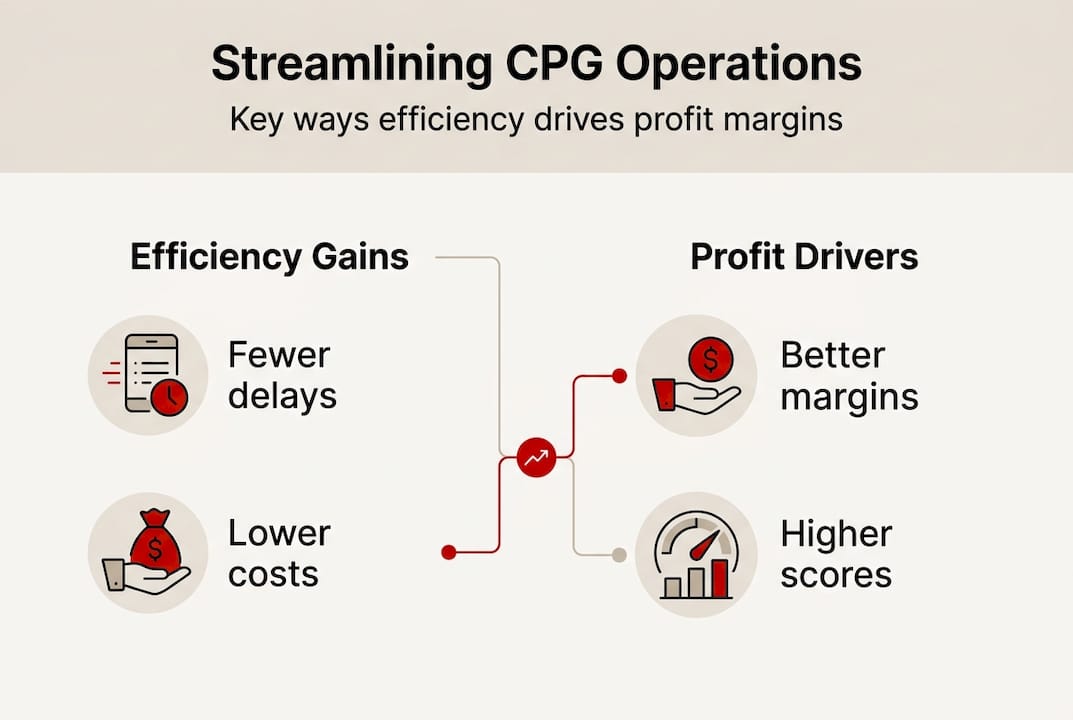
The most immediate win for most brands is OTIF improvement. On-Time-In-Full delivery performance directly affects your standing with Walmart, Target, and major distributors. Penalties for missing OTIF can range from 1% to 3% of invoice value per shipment. Multiply that across hundreds of purchase orders and you have a meaningful drag on contribution margin that streamlined fulfillment eliminates.
Streamlining also improves OTIF, reduces stockouts, and enables more effective promo execution across retail channels. These aren’t incremental gains. They’re structural improvements that compound over time.
Here are the core financial benefits operators consistently report:
“Operational visibility isn’t a reporting exercise. It’s the mechanism by which CPG brands convert channel complexity into margin clarity.”
A solid importance of a data strategy underpins all of this. Without a clear data foundation, even well-intentioned streamlining efforts produce noise rather than signal.
For founders managing Amazon FBA alongside wholesale and DTC, a fulfillment optimization guide is one of the most practical starting points to identify where operational friction is costing you margin right now.
Knowing that streamlining matters is not the same as knowing where to start. Most founders who struggle with this aren’t lacking ambition. They’re lacking a clear sequence. Here’s a practical framework to get moving without overwhelming your team.
Data unification and integrated platforms are the starting point for omnichannel CPG success, not an end goal to reach someday. Treat it as infrastructure, not a luxury.
Leveraging AI for operational efficiency can accelerate several of these steps, particularly around demand forecasting and inventory optimization, but only after your data foundation is solid.
Common pitfalls to avoid: don’t launch a new ERP or WMS during peak season, don’t skip the process mapping step, and don’t assume software alone will fix a workflow problem.
Pro Tip: Start with pilot initiatives on your most predictable SKUs. Once you’ve proven the process improvement works at small scale, rollout becomes far less risky and more defensible to your team.
Exploring website optimization best practices and a solid conversion rate optimization guide can help ensure your DTC channel performs in step with your improved operational backend.
Here’s what we see consistently working with CPG brands across revenue stages: the operators who outperform aren’t the ones with the biggest marketing budgets or the most SKUs. They’re the ones who’ve made operational speed, data fluency, and channel visibility their primary competitive lever.
Conventional growth-at-all-costs thinking is fundamentally misaligned with the current CPG environment. Adding distribution points without fixing fulfillment reliability just amplifies the problem. Launching new products without integrated demand signals burns cash instead of building momentum.
The brands winning right now treat efficiency as the foundation, not a finishing touch. They know their contribution margin by channel. They catch OTIF risks before they become penalties. They execute promotions that actually convert because their data tells them what’s working in real time.
Evaluating top omnichannel platforms is one practical step toward building the infrastructure that makes this possible. But the mindset shift matters more than the tool. When operational clarity becomes your strategic priority, profitability follows.
Operational transformation doesn’t have to be a guessing game. Reddog Group works directly with CPG founders and operators in the $500K to $20M revenue range to identify where efficiency gaps are hurting margin and what to fix first.
We bring a contribution-margin-first lens to every engagement, whether that means untangling Amazon FBA fee drag, reducing Walmart WFS compression, or building the cross-channel data clarity your team needs to make faster decisions. If you’re ready to move from reactive to intentional, explore our CPG retail growth offer and let’s talk about where your operation has the most to gain.
It means integrating data, processes, and technology to remove redundancies and eliminate workflow silos. Streamlined operations are about unifying workflows and automating decisions, not just slashing costs.
Operational streamlining can deliver 5% or more in annual productivity gains, compared to roughly 2% from traditional cost-cutting alone.
Focus first on supply chain visibility, real-time inventory management, and promotional execution. These three areas consistently deliver the greatest impact on profitability across retail channels.
Unified platforms centralize data and automate workflows so decisions happen faster and with better accuracy. Integrated platforms are foundational to omnichannel CPG success and margin clarity.
Leave a comment: