
Published: March 2020 | Last Updated:April 2026
© Copyright 2026, Reddog Consulting Group.

TL;DR:
- Sales enablement is a strategic, ongoing system that equips sales teams with content and coaching. It reduces rep friction and improves multichannel retail success in CPG brands. Both seller and buyer enablement are essential for comprehensive growth.
Most CPG founders and sales leaders either confuse sales enablement with sales training or assume it only applies to large enterprise teams with dedicated departments. Neither is true. Sales enablement is a discipline that directly shapes how well your reps sell across Amazon, Walmart, regional distributors, and brick-and-mortar retail simultaneously. If your team walks into a buyer meeting without the right pitch deck, lacks current pricing data, or cannot articulate your trade promotion structure on the spot, that is an enablement problem. This article breaks down what sales enablement actually is, how it applies to CPG brands navigating multichannel retail, and what you can do about it today.
| Point | Details |
|---|---|
| Sales enablement defined | Sales enablement equips sellers with content, training, and tools to drive retail growth. |
| Distinct from sales ops | Enablement focuses on execution and seller capability, not just process optimization. |
| CPG needs tailored enablement | Multichannel friction and regulatory complexity make enablement vital for CPG brands. |
| Seller and buyer enablement | Successful brands empower both sellers and buyers for maximum impact across channels. |
| Action drives results | Effective sales enablement hinges on practical adoption and retail-ready insights. |
Sales enablement gets thrown around a lot, but the real definition is more precise than most founders realize. Sales enablement is the strategic discipline of equipping revenue-facing teams with the information, content, training, tools, and processes they need to engage buyers and close deals effectively. That word strategic matters. Enablement is not a one-time training session or a folder of sell sheets on Google Drive. It is an ongoing, structured effort to ensure your sellers always have what they need, when they need it, in the format that works for each selling situation.
The confusion usually comes from conflating enablement with related but distinct functions. Sales ops designs and optimizes the systems and processes that run your sales engine, while enablement focuses on seller capability, execution guidance, and adoption of the actual selling motion. Think of it this way: sales ops builds the road, enablement teaches your team how to drive on it efficiently and confidently.
Sales training is another common mix-up. Training is an event. Enablement is a system. Training happens at onboarding or quarterly. Enablement runs continuously, adapting content and coaching to what reps actually need in the field right now.
Here is a quick comparison to clarify:
| Function | Core focus | Primary outcome | Example in CPG |
|---|---|---|---|
| Sales enablement | Seller capability and content access | Higher conversion and adoption | Retailer-specific playbooks and coaching |
| Sales operations | Systems, process, and data | Efficiency and forecast accuracy | CRM setup, pipeline reporting, territory planning |
| Sales training | Skill and knowledge transfer | Baseline competency | New rep onboarding, product knowledge sessions |
For CPG brands, retail merchandising strategies and channel-specific execution are deeply intertwined with how enablement is structured. A sell-in pitch for a regional grocery chain looks nothing like an Amazon vendor negotiation or a DTC email campaign strategy.
Typical enablement assets that CPG sales teams rely on include:
Building this infrastructure takes deliberate effort, but once it exists, it changes how fast and effectively your team can move. Applying sales optimization tactics means little if your reps cannot access or execute the right content at the right moment.
With the foundation established, let’s dig deeper into what sales enablement includes and how CPG brands can tailor these components for multichannel retail.
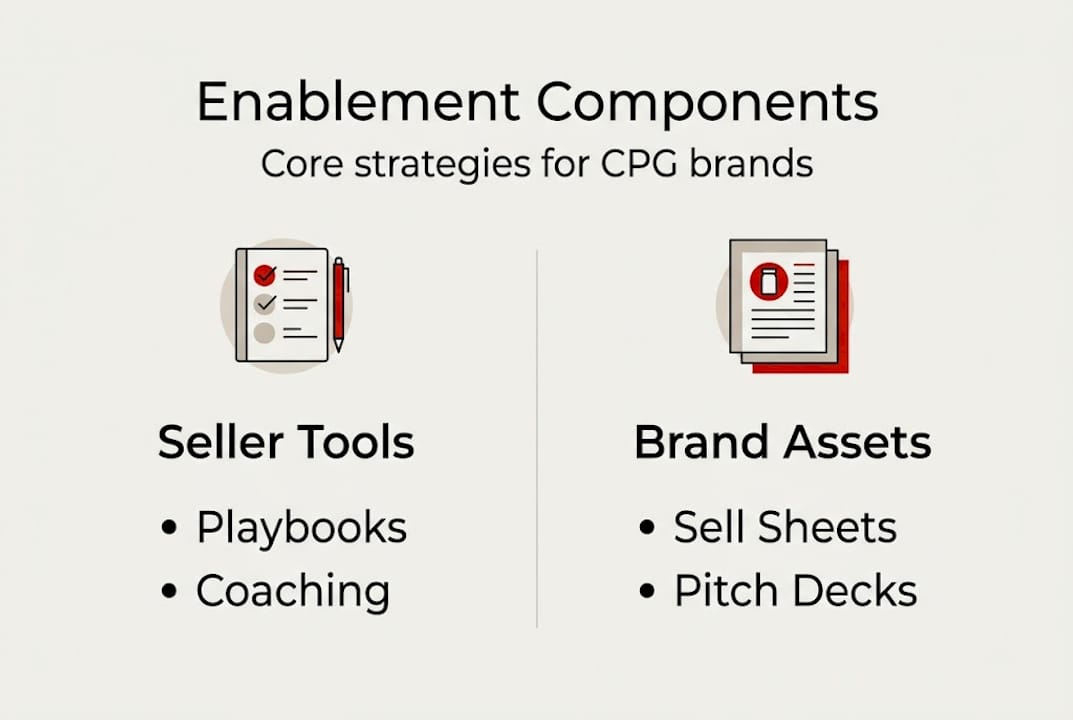
Components frequently called out include content repositories and playbooks, onboarding and continuous coaching, and enablement technology that supports adoption and usability. For CPG brands specifically, each of these components carries unique weight because your sellers are often navigating multiple channels, multiple buyers, and rapidly changing product catalogs at the same time.
Content repositories are the foundation. Your pitch decks, sell sheets, brand standards, and category data need to live somewhere your reps can actually find them in under two minutes. A well-organized repository reduces the time reps spend searching for materials and increases the time they spend actually selling. Organize content by channel first, then by SKU or category, and always flag expiration dates on time-sensitive files like promo calendars.

Playbooks and lightning guides are the tools that tell reps exactly what to say, what to show, and how to handle objections for specific selling scenarios. A new product launch playbook for a regional distributor should look very different from one built for an Amazon vendor manager meeting. The more specific and retailer-tailored your playbooks are, the more effective they become in the field.
Coaching and ongoing training is where most CPG brands underinvest. Reps need real-time feedback tied to specific accounts and deals, not generic quarterly training sessions. Platforms that allow managers to review call recordings, score conversations, and provide coaching notes at scale make this feasible even for lean sales teams.
Here is a snapshot of enablement technology adoption patterns worth knowing:
| Enablement component | CPG adoption rate | Cross-industry average | Gap |
|---|---|---|---|
| Content repositories | 58% | 71% | 13 points behind |
| Coaching platforms | 41% | 62% | 21 points behind |
| CRM with enablement integration | 49% | 67% | 18 points behind |
| Playbook tools | 36% | 54% | 18 points behind |
CPG brands consistently trail other industries in technology adoption across every enablement category. That gap represents both a vulnerability and an opportunity.
Here is how to build a CPG enablement program from scratch:
Your SEO content strategy for digital channels and your web design and sales assets both feed into the buyer-facing side of your enablement program, so align them with your internal selling tools from the start.
Pro Tip: The most expensive enablement investment is the tool your reps never open. Before selecting any platform, run a usability test with two or three of your actual field reps. If they cannot figure out how to access a sell sheet in under 90 seconds, the tool will fail regardless of its feature set.
Once the enablement program is in place, CPG brands encounter specific friction points where sales enablement can be a genuine differentiator.
Sales enablement reduces rep friction while scaling coaching and keeping content current, especially where trade and off-invoice complexity, regulation, and multi-retailer execution make getting the right answer at the right time genuinely difficult. That sentence captures exactly why CPG is harder than most industries to enable well.
Here are the top four friction challenges CPG sellers face in the field:
Statistically, the challenge is significant. In a survey of 634 U.S. B2B sales managers conducted by Mindtickle, CPG brands reported higher rates of rep-level content failure than any other industry surveyed. Reps either could not find the right content or were using outdated materials during active selling conversations. Those moments of friction directly reduce your win rate and slow sell-through.
For brands scaling on Amazon marketplace or working with Amazon SEO consultants to grow digital shelf presence, enablement also extends to ensuring your internal teams understand how to articulate marketplace strategy to retail buyers who may see Amazon as a channel conflict threat.
Pro Tip: Prioritize enablement platforms that let your marketing team push content updates directly to the sales repository without IT involvement. When a retailer changes a promotional calendar or a compliance requirement shifts, your reps need updated materials within hours, not weeks.
Beyond equipping your sales teams, you also have to think about the buyer’s journey. These are two distinct but complementary disciplines.
Sales enablement is seller-facing, while buyer enablement focuses on equipping buyers with the tools and expertise they need to complete purchasing tasks during independent evaluation. In multichannel CPG retail, this distinction matters more than most brands realize. Retail buyers, distributors, and even end consumers increasingly research and evaluate independently before engaging a sales rep. If your brand does not have the right materials in the right places during that evaluation phase, you lose influence before the conversation even starts.
| Dimension | Seller enablement | Buyer enablement |
|---|---|---|
| Primary audience | Your sales reps and account managers | Retail buyers, distributors, and end consumers |
| Core objective | Equip reps to sell more effectively | Help buyers make confident, informed decisions |
| Key assets | Playbooks, CRM data, coaching, sell sheets | Category sell sheets, comparison guides, ROI calculators, case studies |
| Measurement | Rep adoption, win rate, pipeline velocity | Buyer engagement, self-service content usage, deal cycle length |
“The brands that win retail shelf space in 2026 are not just the ones with the best product. They are the ones whose buyers had every question answered before the pitch meeting even started.”
For CPG brands navigating complex buyer journeys across multiple channels, practical buyer enablement actions include:
Understanding growth consulting principles helps CPG brands see that seller and buyer enablement are two sides of the same revenue equation. Ignoring either one leaves money on the table.
Here is what we have observed working directly with growth-stage CPG brands: most founders treat sales enablement as something they will build after they hit a certain revenue threshold. That thinking costs them deals right now.
Enablement does not require a dedicated department or enterprise software budget. It requires process discipline, content that actually reflects how your buyers make decisions, and a feedback loop between your reps and the people creating the materials. The brands that scale retail fastest are the ones that treat every lost deal as an enablement audit. Why did the rep lack the right information? What content was missing or outdated? What objection were they unprepared for?
The biggest pitfall we see is over-investment in technology and under-investment in behavioral adoption. A CRM no one uses and a content repository no one opens are not enablement. They are expensive line items. Real enablement happens when reps change how they prepare for calls, how they handle objections, and how they follow up.
Pro Tip: Measure your enablement program by its impact on retail sell-through and account retention, not by the number of training sessions completed or content assets created. Activity metrics make enablement feel productive. Outcome metrics tell you if it actually is. Connecting your ecommerce marketing solutions to your offline enablement strategy is where real multichannel momentum comes from.
If the gap between where your sales enablement program is today and where it needs to be feels wide, you are not alone. Most growth-stage CPG brands have never formally built one. They have pieces: a sell sheet here, a deck there, maybe an old onboarding document no one reads. Turning those scattered assets into a working system that actually drives retail growth is exactly where structured outside guidance accelerates results.
At RedDog Group, we work with CPG brands in the $500K to $20M revenue range to build structured, margin-focused growth programs that include sales enablement as a core component. Whether you are scaling across Amazon, expanding into regional wholesale, or preparing for a major retail pitch, our CPG retail growth offer gives you a practical starting point built around your specific channels, margins, and sales motion. Explore what a structured approach to CPG retail growth looks like for your brand.
Sales ops designs and optimizes the systems and processes behind your sales function, while sales enablement focuses directly on seller capability, execution guidance, and adoption of the selling motion. Both matter, but they solve different problems.
Sales enablement reduces rep friction by ensuring reps always have current, channel-specific content and the coaching they need to navigate trade complexity, compliance requirements, and retailer-specific conversations effectively.
Core components include content repositories, playbooks, onboarding programs, continuous coaching platforms, and CRM systems with enablement integration that supports daily rep adoption.
Yes. Buyer enablement equips buyers with the tools and information they need to complete evaluation tasks independently, while sales enablement is focused on equipping your internal selling team to engage and convert those buyers.
Leave a comment: