
Published: March 2020 | Last Updated:April 2026
© Copyright 2026, Reddog Consulting Group.

TL;DR:
- Modern AI chatbots effectively recover abandoned carts and increase order values.
- They integrate real-time data and understand multi-turn, context-aware interactions.
- Achieving strategic ROI requires ongoing optimization, proper escalation design, and ethical transparency.
Chatbots can recover 10-25% of abandoned carts while cutting support tickets by up to 50%, yet most CPG brands still treat them as a fancy FAQ widget bolted onto the corner of their website. That’s a costly misread. Today’s AI-powered chatbots are strategic revenue tools capable of recovering lost sales, personalizing the shopping experience, and reducing operational overhead simultaneously. If you manage a multichannel brand, understanding what modern chatbots can actually do, and where they consistently fail, is essential to turning them into a measurable growth lever rather than a sunk technology cost.
| Point | Details |
|---|---|
| Chatbots have evolved | Modern AI chatbots deliver real business results far beyond simple scripted help. |
| ROI is provable | Chatbots drive measurable uplift in cart recovery, order values, and ticket reduction. |
| Hybrid support is essential | Combining AI for routine tasks and humans for complex issues keeps customers satisfied and loyal. |
| Execution trumps installation | Brands must continuously tune, train, and measure chatbot performance to realize high ROI. |
Early ecommerce chatbots were painfully rigid. They operated on decision trees, meaning every possible customer question had to be anticipated and scripted in advance. Ask anything outside the predefined menu and the bot would loop you back to a dead end or dump you into a generic “contact us” response. For CPG brands with large, complex product catalogs, seasonal inventory changes, and diverse customer questions across multiple channels, those rule-based bots were more irritating than helpful.
The shift to AI changed everything. Modern chatbots use NLP and large language models to understand customer intent, not just keywords. They recognize context, follow multi-turn conversations, and interpret ambiguous phrasing. A shopper who types “do you have that protein bar in the smaller size” no longer hits a wall. The bot understands the reference, checks live inventory, and responds with accurate options.
One of the most important technical advances for ecommerce is Retrieval-Augmented Generation, or RAG. RAG allows an AI chatbot to pull real-time, brand-specific data, such as product specs, stock levels, or shipping timelines, rather than relying solely on what it learned during training. This matters enormously for product accuracy. Without RAG, a chatbot might confidently give outdated pricing or recommend a discontinued SKU. With it, the bot grounds its answers in your actual catalog data at the moment of the conversation.
Modern chatbots also connect directly to your tech stack through APIs. They integrate with Shopify, Walmart Seller Center, Amazon, and third-party logistics platforms to surface real order statuses, trigger cart recovery sequences, and flag fulfillment exceptions without a human touching anything.
Key leaps in chatbot capability relevant to ecommerce:
| Feature | Old rule-based chatbots | Modern AI chatbots |
|---|---|---|
| Understanding | Keyword matching only | Intent and context understanding |
| Scripting | Fully manual, rigid trees | Dynamic, generative responses |
| Integration | Minimal or none | Live API hooks to cart, inventory, tracking |
| Sales impact | Near zero | Measurable AOV lift and cart recovery |
| Handling new queries | Fails or loops | Adapts and responds accurately |
“AI-powered chatbots in ecommerce now handle real-time interactions integrated directly with inventory systems, reducing support ticket volume and cutting average response time dramatically.”
This evolution is directly relevant to AI in ecommerce for CPG brands navigating multichannel complexity. The chatbot your competitor deployed two years ago is almost certainly less capable than what is available today, and the gap is widening fast. For brands operating a hybrid omnichannel model, this level of integration is the bridge between fragmented customer touchpoints and a coherent buying experience.
Knowing chatbots are smarter is one thing. Knowing exactly where to deploy them for measurable returns is what separates strategic operators from brands that just install a widget and wait.
| Application | What the chatbot does | Business metric |
|---|---|---|
| Cart recovery | Sends proactive message when cart is abandoned | 10-25% recovery rate |
| Guided selling | Asks preference questions and recommends products | Higher conversion, lower return rate |
| Upsell and cross-sell | Surfaces complementary products at checkout | 10-30% AOV lift |
| Order tracking | Pulls live shipment data and responds instantly | 40-50% ticket reduction |
| Returns and exchanges | Initiates return flows and collects reason codes | Faster resolution, lower agent load |
Proactive chatbot engagement can recover 10-25% of abandoned carts, and contextual upselling drives an average AOV lift of 10-30%. Those are not small numbers. On a DTC store generating $2M annually, a 15% cart recovery rate with a 15% AOV increase can translate to hundreds of thousands in incremental revenue.
How to set up a proactive cart recovery sequence:
Guided selling is particularly powerful for CPG brands with complex product lines or ingredient-sensitive shoppers. A chatbot that asks a few qualifying questions, such as dietary preference, use case, or pack size, can dramatically reduce decision paralysis and improve match quality. Better matched products mean fewer returns and higher repeat purchase rates.

Pro Tip: Timing matters more than most brands realize. A 60-90 second delay after cart abandonment is optimal because many shoppers are still on-site weighing the decision. A message that fires too fast feels surveillance-like; too slow loses the window entirely. Start with 75 seconds and run an A/B test against a 3-minute delay to find your conversion peak.
For brands focused on ecommerce merchandising best practices, chatbot-driven upsells are essentially a real-time merchandising layer operating at scale. Unlike static product recommendation widgets, chatbots can respond to what a customer just said or asked, making the upsell contextual rather than algorithmic. For deeper guidance on maximizing chatbot-driven conversions, our conversion rate optimization tips and increasing conversion rates resources walk through testing frameworks and funnel design that complement these tools.
Here is something the vendors selling chatbot software rarely emphasize: no chatbot handles everything well. Complex returns, subscription billing disputes, allergic reaction concerns, or damaged shipment claims require human judgment, empathy, and often policy authority. The brands that experience chatbot failure almost always made the same mistake: they expected the bot to replace humans rather than complement them.
Research confirms that 89% of consumers prefer a hybrid AI-human support model, and 86% of complex interactions still require escalation to a human agent. That is not a technology shortcoming. It is a design requirement. Your chatbot infrastructure should treat escalation as a first-class feature, not an afterthought.
Top failure points when handoffs are mishandled:
Poor handoffs directly increase abandonment. Shoppers who feel passed around without resolution do not just leave the chat. They leave the brand. This is especially damaging in the CPG space where purchase decisions are often repeat and relationship-driven.
Pro Tip: Design your escalation trigger to include a context handoff summary. When the bot routes to a human agent, it should automatically share a brief transcript and the issue category. A simple message like “Transferring you now. Here is a summary of your conversation so you will not need to repeat anything” signals competence and reduces customer frustration by 30-40% in most implementations.
Hybrid retail for SMBs demands this kind of operational precision because your support team is rarely large enough to absorb the gaps a poorly designed bot creates. Train your AI on real support transcripts from your brand, not just generic customer service data. Your shoppers ask product-specific questions using brand-specific language, and a bot trained on general ecommerce data will miss those nuances repeatedly. Within a well-designed multichannel growth workflow, the chatbot functions as a first-pass filter that handles routine volume so your human team can focus on high-stakes interactions that actually protect customer lifetime value.
The practical team design implication: a well-tuned AI chatbot should handle 60-90% of incoming contacts autonomously. That means a brand generating 500 support tickets per week could reduce human-handled volume to 50-200 tickets, freeing team capacity for outreach, reviews management, and wholesale partner support.
Getting chatbots right is harder than most implementation guides admit. There are real failure modes that erode customer trust, damage brand perception, and can expose your brand to compliance risks.
Agentic AI experiences that act on behalf of customers, such as placing orders, processing returns, or applying discounts, require explicit user consent and security guardrails. A chatbot that initiates a charge, changes an order, or issues a refund without clear confirmation steps is not just a poor experience. It is a liability.
Common chatbot mistakes that undermine ROI:
Service quality dimensions like understandability and humanness are statistically significant predictors of customer satisfaction and brand loyalty in chatbot interactions. Specifically, understandability carries a beta coefficient of 0.354, making it one of the strongest predictors of a customer’s intent to switch brands after a poor chatbot experience. What this means practically is that if your bot gives unclear, confusing, or contradictory answers, customers do not just abandon the chat. They reconsider the entire brand relationship.
This is a design consideration most teams overlook. Brands obsess over chatbot feature sets while neglecting response clarity. A bot that gives a vague answer to “what is your return policy for opened products” is doing measurable brand damage, even if it is technically functional.
The ethical dimension matters more in 2026 than it did even two years ago. Customers are more aware that they are talking to AI. Disclosure is not just best practice. In many jurisdictions it is becoming a regulatory expectation. Consent flows for transaction-level actions, clear identification of the AI nature of the interaction, and robust error-handling protocols are not optional features. They are the floor of responsible deployment.
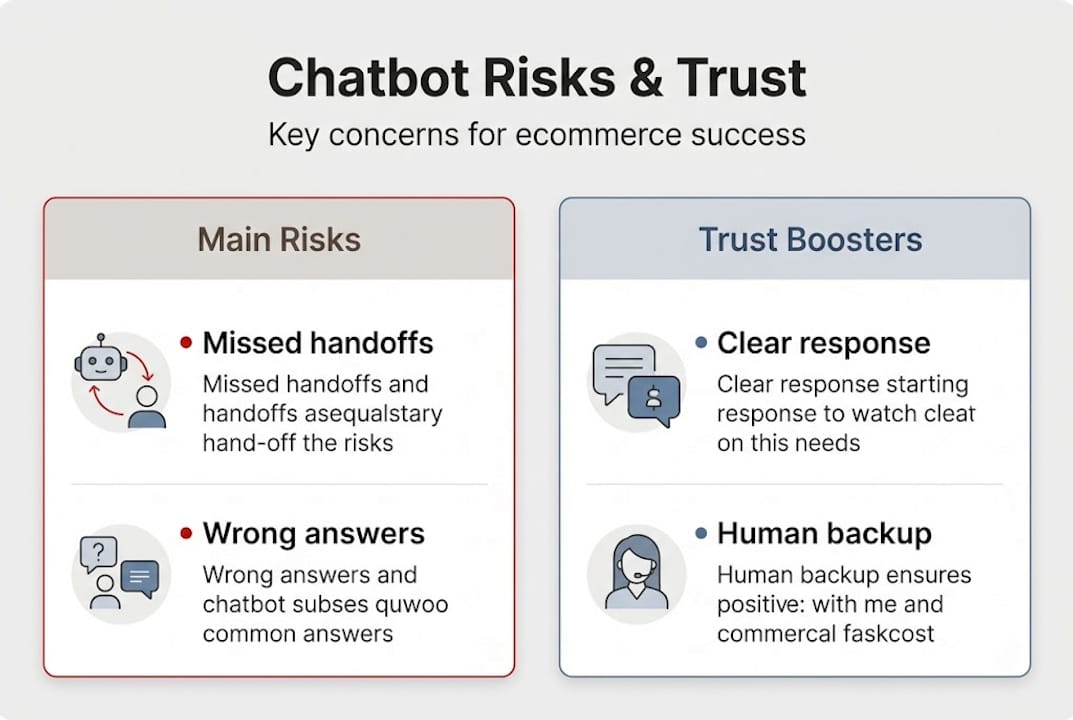
Connecting this to optimizing your ecommerce site overall: chatbot quality is a site-level trust signal. Shoppers who have a poor chatbot experience frequently do not return. Treat the bot’s language, accuracy, and escalation design with the same rigor you apply to your product listings and checkout flow.
Most brands we see have one of two chatbot problems. Either they installed something two years ago and never touched it again, or they keep adding features without measuring what is actually driving results. Neither approach is strategic.
The real value of a chatbot emerges when your team treats it as a living asset. That means reviewing support transcripts monthly, refreshing scripts after product launches or policy changes, and tracking escalation rates as a performance metric rather than a nuisance statistic. A bot that pushes 40% of conversations to humans is telling you something. Listen to it.
We also see brands measuring the wrong things. Open rate on recovery messages is not the number. Revenue recovered per initiated session is. If you are not connecting chatbot activity to your ecommerce growth strategy at the contribution-margin level, you are flying blind. A chatbot that recovers carts but promotes a product with a 15% margin adds less value than one recovering higher-margin SKUs with targeted messaging.
The question worth asking honestly: are you treating your chatbot as an evolving strategic tool, or did you set it and forget it the week after launch?
If this article clarified how much value is sitting untouched in your current chatbot setup, the next step is building a strategy that connects chatbot performance to your actual margin outcomes.
At RedDog Group, we help CPG brands translate chatbot potential into measurable channel-level results. We audit your current setup, identify where revenue is leaking through poor escalation or untrained flows, and design a chatbot strategy aligned with your omnichannel growth plan. Whether you are on Shopify, Amazon, Walmart, or scaling through wholesale, we can help you operationalize what you just read. Reach out to RedDog Group to start a conversation about turning your chatbot from a widget into a growth engine.
Chatbots excel at order tracking, cart recovery, inventory checks, product recommendations, and routine customer service inquiries that follow predictable patterns and do not require policy judgment or empathy.
Proactive chatbots recover 10-25% of carts on average and can boost average order value by 10-30% through contextual upsell and cross-sell prompts delivered at the right moment in the shopping session.
A hybrid approach delivers the best outcomes, as 89% prefer hybrid AI-human support, but 86% of complex issues still require escalation to a human agent for satisfactory resolution.
The biggest risks are poor handoff execution, security gaps in transaction flows, and bots that generate inaccurate responses, all of which directly reduce customer trust and increase brand switching intent.
Brands maximize ROI by training on real transcripts, refreshing scripts after product or policy changes, and measuring chatbot performance at the revenue and margin level rather than just ticket volume.
Leave a comment: