
Published: March 2020 | Last Updated:February 2026
© Copyright 2026, Reddog Consulting Group.

Managing retail fulfillment can feel like a nonstop balancing act for Texas CPG brands selling on Amazon and Walmart. Every decision matters when your revenue relies on getting the right products to customers quickly and accurately. Understanding the core concepts of retail fulfillment empowers your team to align order processing, inventory management, and shipping methods for consistent growth and margin protection. This guide uncovers best practices and proven models so you can minimize costs, avoid common pitfalls, and keep your customers coming back.
| Point | Details |
|---|---|
| Importance of Efficient Fulfillment | Retail fulfillment connects businesses to consumers, relying on synchronized operations across inventory management, order processing, and logistics. |
| Adoption of Technology | Utilizing technological innovations, such as real-time tracking and predictive analytics, is essential for enhancing speed and accuracy in fulfillment processes. |
| Margin Management Risks | Businesses face various margin risks from supply chain disruptions and labor costs, requiring proactive monitoring and strategic financial management. |
| Avoid Common Pitfalls | Common risks in fulfillment include inventory mismanagement and poor order tracking; addressing these can enhance customer satisfaction and brand reputation. |
Retail fulfillment represents the critical operational process that transforms customer orders into delivered products. At its core, the process connects businesses with consumers through a strategic sequence of inventory management, order processing, and shipping logistics. Supply chain management principles drive these complex operational workflows that determine a brand’s ability to meet customer expectations efficiently.
The fundamental components of retail fulfillment include several interconnected stages:
Successful retail fulfillment requires synchronized decisions across multiple business functions. Efficient demand forecasting enables brands to anticipate customer needs, optimize inventory levels, and minimize storage costs. Modern retail strategies integrate traditional inventory management with advanced digital technologies to enhance operational precision.
Technological innovations are transforming retail fulfillment, enabling brands to create more responsive and customer-centric supply chains. Emerging technologies like real-time tracking, automated warehouse systems, and predictive analytics help businesses streamline their operational workflows and reduce potential margin erosion.
Pro Tip: Regularly audit your fulfillment processes to identify potential efficiency gaps and implement continuous improvement strategies.
Retail fulfillment models have evolved dramatically, offering businesses multiple strategic approaches to delivering products efficiently. Distribution strategies now encompass a diverse range of operational frameworks designed to meet varying consumer demands and product characteristics.
The primary retail fulfillment models include:
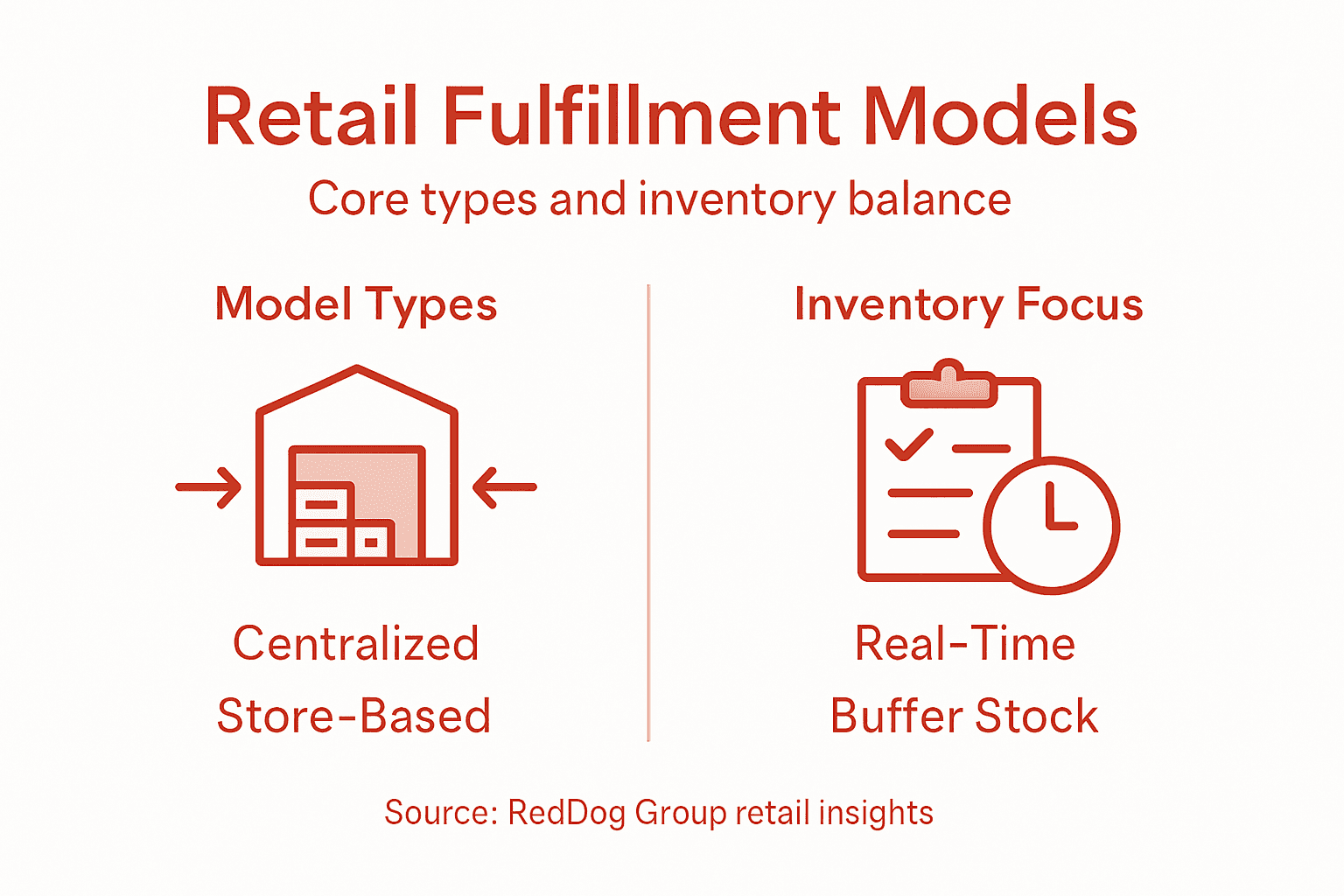
Store-based fulfillment strategies have emerged as powerful alternatives to traditional centralized models. Approaches like ship-from-store and click-and-collect enable retailers to optimize inventory utilization, reduce shipping costs, and enhance delivery speed. These hybrid models allow businesses to transform physical stores into dynamic distribution points.
Here’s a side-by-side look at the main retail fulfillment models and their ideal uses:
| Fulfillment Model | Key Strength | Best Use Case |
|---|---|---|
| Distribution Center | Handles high order volume | Regional/national retail shipments |
| Fulfillment Center | Fast e-commerce processing | Online order fulfillment |
| Dark Store | Supports rapid order prep | Urban delivery and pick-up |
| Micro-Fulfillment Center | Enables fast local delivery | High-density urban neighborhoods |
| Crowdsourced Warehousing | Increases flexibility | Seasonal or irregular demand |
Modern retail fulfillment requires sophisticated inventory management techniques. Retailers must carefully balance centralized and decentralized approaches, considering factors like demand variability, product type, and regional logistics infrastructure. The most successful brands develop flexible, technology-enabled fulfillment strategies that can adapt quickly to changing market conditions.
Pro Tip: Regularly analyze your fulfillment model’s performance metrics to identify potential optimization opportunities and minimize operational inefficiencies.
Retail fulfillment represents a sophisticated operational sequence that transforms customer orders into successfully delivered products. Retail logistics process involves multiple interconnected stages designed to ensure accuracy, efficiency, and customer satisfaction.
The key steps in the fulfillment process include:
Order processing strategies require meticulous attention to detail and technological integration. Modern fulfillment systems leverage advanced software platforms that enable real-time inventory tracking, automated routing, and seamless communication across multiple operational touchpoints. These technological innovations help businesses minimize errors, reduce processing times, and enhance overall customer experience.

Successful fulfillment demands synchronized coordination between multiple business functions. Retailers must develop robust systems that balance speed, accuracy, and cost-effectiveness. This requires continuous investment in technology, staff training, and operational infrastructure that can adapt quickly to changing market demands and consumer expectations.
Pro Tip: Implement a comprehensive performance tracking system to monitor each fulfillment stage and identify potential optimization opportunities.
Retail fulfillment margins face increasingly complex challenges that demand strategic financial management. Retail margin pressures emerge from multiple interconnected economic factors that can significantly erode profitability if not carefully navigated.
Key margin risk factors include:
Tariff-related margin challenges can trigger significant financial strain, with many US retailers experiencing margin declines between 1-5%. These pressures compel businesses to develop more sophisticated SKU-level profitability tracking and implement agile sourcing strategies that maintain competitive positioning.
Successful margin management requires a holistic approach that integrates technological innovation, operational flexibility, and disciplined financial planning. Retailers must continuously monitor cost structures, leverage data analytics for predictive insights, and develop adaptive strategies that can quickly respond to market fluctuations. This demands ongoing investment in advanced tracking systems, strategic sourcing, and dynamic pricing models.
Compare margin risk factors and typical mitigation tactics in retail fulfillment:
| Margin Risk Factor | Example Impact | Typical Mitigation Practice |
|---|---|---|
| Supply Chain Disruptions | Delivery delays increase costs | Diversify suppliers and routes |
| Tariff Fluctuations | Increased import expenses | Flexible, multi-country sourcing |
| Inventory Carrying Costs | Higher storage expenditures | Advanced demand forecasting |
| Shipping and Handling Fees | Reduced net margin | Negotiate bulk carrier contracts |
| Labor Cost Variations | Unstable operating expenses | Invest in automation and scheduling tools |
Pro Tip: Implement quarterly margin audits to proactively identify and mitigate potential revenue leakage across your fulfillment ecosystem.
Retail fulfillment success hinges on avoiding critical operational mistakes that can dramatically undermine customer satisfaction and brand reputation. Order accuracy challenges represent one of the most significant risks in modern retail logistics, with potential to erode customer loyalty and long-term revenue potential.
Key fulfillment pitfalls to be aware of include:
Omnichannel strategy failures often stem from underinvestment in integrated technological infrastructure and a lack of customer-centric operational culture. Successful retailers must develop robust systems that provide seamless, transparent experiences across multiple sales channels, ensuring consistent quality and reliability.
Addressing these pitfalls requires a comprehensive approach that combines technological innovation, strategic planning, and a relentless focus on customer experience. Brands must invest in advanced tracking systems, develop clear communication protocols, and create flexible processes that can adapt to changing market demands and customer expectations.
Pro Tip: Conduct monthly cross-functional fulfillment audits to identify and proactively address potential operational bottlenecks before they impact customer satisfaction.
Struggling to turn complex retail fulfillment processes into profitable growth? The challenges outlined in “Retail Fulfillment Explained: Unlocking Margin and Growth” such as margin compression, inventory mismanagement, and operational inefficiencies can leave emerging consumer packaged goods brands feeling overwhelmed. If you want to master concepts like SKU-level profitability, demand forecasting, and omni-channel distribution strategies you need a partner who understands these hurdles deeply and offers tailored solutions.
At RedDog Group, we specialize in helping CPG brands decode the complexity of retail fulfillment by focusing on contribution-margin-first strategies, marketplace economics, and operational clarity. Our expertise in navigating Amazon FBA fees, Walmart WFS margin pressures, 3PL storage costs, and regional distribution networks empowers you to stop guessing which fulfillment investments truly pay off. With our proven approach, you can identify hidden margin leaks and optimize inventory velocity while preparing for profitable retail expansion.
Elevate your fulfillment game today Retail Fulfillment Explained: Unlocking Margin and Growth can be your gateway to data-driven decisions and measurable results.
Enhance your operational precision
Take control over your retail fulfillment challenges now with RedDog Group’s expert guidance. Visit RedDog Group to start building a scalable, margin-focused growth plan that bridges digital marketplaces and brick-and-mortar success.
Retail fulfillment is the operational process that converts customer orders into delivered products. It is crucial because it directly impacts customer satisfaction and a brand’s ability to meet consumer expectations efficiently.
The main steps in the retail fulfillment process include order placement, order confirmation, inventory check, picking, packing, shipping, tracking, delivery, and returns management. Each step is essential for ensuring accuracy and efficiency in delivering products to customers.
Technological innovations like real-time tracking, automated warehouse systems, and predictive analytics enhance the precision of retail fulfillment operations, helping businesses streamline workflows, reduce errors, and improve overall customer experience.
Common pitfalls in retail fulfillment include inventory mismanagement, poor order tracking, inconsistent product substitutions, slow returns processing, technology integration failures, and inefficient packaging. Avoiding these pitfalls is critical for maintaining customer satisfaction and brand reputation.
Leave a comment: