
Published: March 2020 | Last Updated:March 2026
© Copyright 2026, Reddog Consulting Group.

Scaling a CPG brand online sounds straightforward until you’re staring at three different dashboards, a shrinking margin, and a promotional calendar that conflicts with itself. The real challenge is not getting your products listed on Amazon or Walmart. It is keeping profit intact while growing across multiple channels without letting one undercut another. Brands that crack this problem do not just grow revenue. They build sustainable, margin-positive operations that compound over time. This article walks you through the exact frameworks, marketplace strategies, and pricing disciplines that separate brands scaling profitably from those spinning their wheels.
| Point | Details |
|---|---|
| Omnichannel wins | Blending Amazon, Walmart, and DTC boosts revenue, margin, and customer value for CPG brands. |
| Integration is critical | Unified sales channels and consistent pricing eliminate profit-draining inefficiency and channel conflict. |
| Profit clarity matters | Contribution margin tracking and regular data reviews drive sustainable growth and higher net margins. |
| Optimize top SKUs first | Focusing efforts on best-performing products accelerates growth and simplifies expansion. |
Before you optimize anything, you need a clear picture of what online growth actually looks like for a CPG brand at your stage. The numbers are compelling. Multi-channel brands generate up to 190% more revenue than single-channel operators, and omnichannel integration yields 15 to 25% higher customer lifetime value compared to siloed strategies. That is not a marginal improvement. That is a structural advantage.
On the margin side, e-commerce net margins average 10% for CPG brands, with top performers reaching 20%. The gap between average and excellent comes down to a few key levers.
| Metric | Average CPG brand | Top-performing CPG brand |
|---|---|---|
| E-commerce net margin | 10% | 20% |
| Customer LTV | $45 to $80 | $120 to $200 |
| Channel ROI (blended) | 2.1x | 4.5x |
| Inventory turnover | 4x per year | 8x per year |
Stat to know: Brands using unified inventory and AI-driven demand planning consistently outperform peers on both margin and stockout prevention.
The biggest profit levers for CPG brands online are:
If you want to drive omnichannel sales effectively, start by benchmarking where you stand against these numbers today.
Once you understand the opportunity, the next priority is building a channel foundation that does not leak profit. Channel integration across DTC, Amazon, and Walmart is essential to avoid siloed inefficiencies and cannibalization. Without it, you end up with your own channels competing against each other on price.

Start by distinguishing direct from indirect channels. Direct channels (your DTC website) give you full pricing control and customer data. Indirect channels (Amazon, Walmart, wholesale) offer reach but require guardrails. The Direct vs Indirect Channel Matrix helps you assign roles to each channel so they complement rather than conflict.
| Factor | Siloed channels | Integrated channels |
|---|---|---|
| Gross margin | Lower (price wars) | Higher (MAP enforced) |
| Customer LTV | Fragmented | Unified and growing |
| Operational complexity | High | Streamlined |
| Promo coordination | Inconsistent | Aligned across channels |
Here are the exact steps to integrate your channels:
Pro Tip: Align your promotional calendars before you run any major sale. Mismatched promos across Amazon, Walmart, and your DTC site can trigger automatic price matching, margin erosion, and even retail penalties from brick-and-mortar partners.
Not every marketplace deserves your attention right now. The right mix depends on your category, your operational capacity, and where your target customer actually shops. Here are the core platforms worth evaluating:
| Platform | Monthly traffic | Avg. commission | Key performance demand |
|---|---|---|---|
| Amazon | 2.5B+ visits | 8 to 15% | IPI score, review velocity |
| Walmart | 100M+ visits | 6 to 15% | 95% OTD, 2% cancel rate |
| TikTok Shop | 150M+ US users | 5 to 8% | Content velocity, GMV targets |
| DTC site | Owned traffic | 0% (platform) | CAC, conversion rate |
Walmart’s seller standards are strict. A 2% cancellation rate threshold and 95% on-time delivery requirement are non-negotiable. Missing these metrics directly impacts your Sales Rewards eligibility and listing visibility. See the full breakdown in our selling on Walmart Marketplace guide.
DTC yields 30 to 50% higher margins versus wholesale, but customer acquisition costs are significantly higher. The optimal play is a hybrid model: use Amazon and Walmart to acquire new customers at scale, then convert them to your DTC channel for retention and margin improvement. For a direct comparison, see our Walmart vs Amazon comparison breakdown.
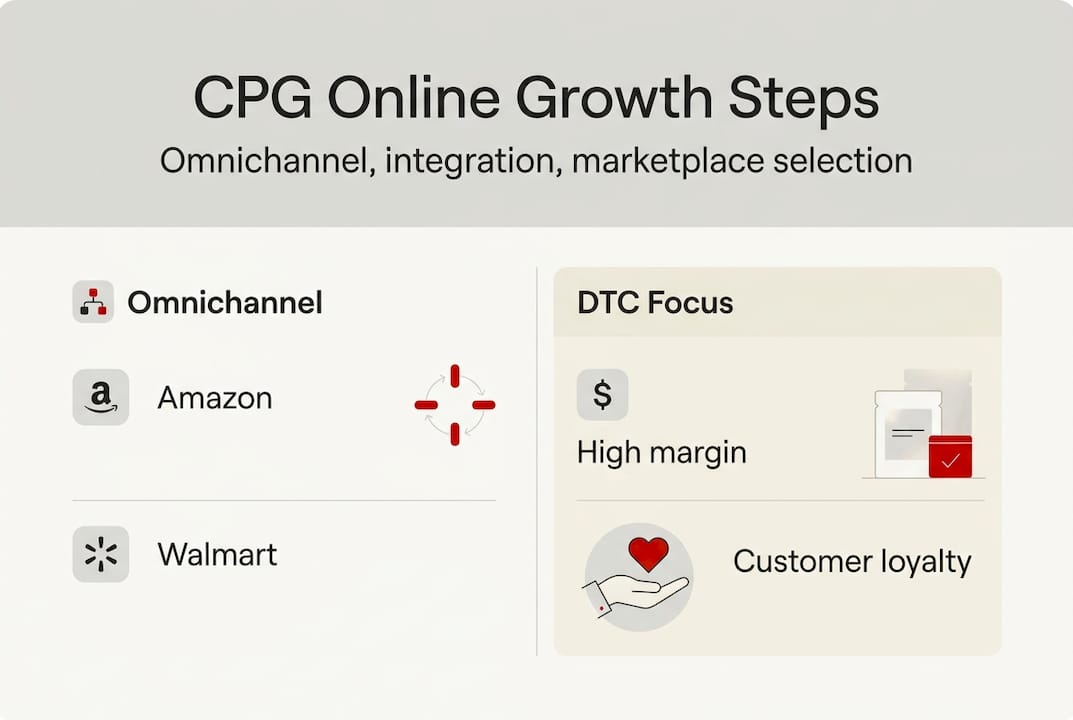
Pro Tip: Do not try to optimize every SKU on every platform at once. Start with your top 20% of SKUs by revenue and get those listings, pricing, and fulfillment dialed in first. Then expand.
Pricing is where most CPG brands leave money on the table. Not because they price too low, but because they price without data. Data-first pricing means analyzing promo penetration, running elasticity testing, and using simulators before you commit to a price point or discount depth.
Here is a practical pricing process to follow:
Common margin killers to watch:
Stat to know: DTC gross margins typically run 55 to 70%, while marketplace net margins after fees and ads often land at 10 to 15%. Knowing this gap is what drives smart channel allocation decisions.
If you are navigating Amazon’s fee structure specifically, working with someone who can find an Amazon consultant with CPG-specific experience can save you significant margin in year one.
Setting up your channels and pricing is not a one-time event. The brands that sustain growth are the ones that build a rhythm of review and optimization into their operations. AI-enabled OMS and forecasting tools optimize inventory and avoid costly stockouts, but they only work if someone is actually reviewing the outputs.
The KPIs that matter most at your stage:
Optimization actions to run on a rolling basis:
To boost LTV and conversions over time, connect your marketplace data back to your DTC customer profiles so you can identify which acquisition channels produce your highest-value repeat buyers.
Pro Tip: Set a recurring calendar reminder for a quarterly channel review. Block two hours, pull your contribution margin by channel, check platform scorecards, and flag any pricing or inventory issues. Catching problems early costs far less than fixing them after they compound.
The frameworks in this article work. But executing them across Amazon, Walmart, DTC, and wholesale simultaneously is a different challenge entirely, especially when you are also managing operations, cash flow, and a growing team.
RedDog Group works with CPG brands in the $500K to $20M revenue range to build exactly this kind of structured, margin-first growth engine. As omnichannel growth experts, we bring the marketplace economics, pricing discipline, and channel integration frameworks that help you scale without eroding profit. Whether you need a full omnichannel strategy, Amazon or Walmart optimization, or a contribution margin audit, we can help you identify where margin is leaking and build a plan to fix it. Reach out to schedule a strategy session and see what profitable online growth actually looks like for your brand.
Start with Amazon and Walmart for reach and new customer acquisition, then build your DTC site for repeat sales and higher margins. Walmart’s 100M+ monthly visits combined with Amazon’s scale and your own DTC channel creates the optimal growth foundation.
Enforce MAP policies and price parity across every channel and align your promotional calendars so no platform undercuts another. Consistent pricing is the single most effective guardrail against cannibalization.
E-commerce net margins average 10% for CPG brands, with top performers reaching 20% by optimizing channel mix, reducing fulfillment costs, and enforcing pricing discipline.
Review your pricing and promotional strategy at least quarterly, and track contribution margin per channel monthly to catch margin compression before it becomes a structural problem.
A unified OMS and AI forecasting system are the foundation. Add robust analytics for platform scorecards and contribution margin tracking, and you have the core stack needed to scale profitably across channels.
Leave a comment: