
Published: March 2020 | Last Updated:April 2026
© Copyright 2026, Reddog Consulting Group.

TL;DR:
- Operational readiness is crucial for profitable marketplace growth, focusing on fulfillment, inventory, and metrics.
- Data-driven segmentation and omnichannel integration enhance margins by targeting the right audiences across channels.
- Smarter pricing, inventory optimization, and retail media strategies drive sustainable, value-based growth.
Scaling a CPG brand profitably across Amazon, Walmart, and DTC channels in 2026 is not a matter of listing more products and running ads. Marketplace algorithms have grown sharper, buyer expectations have shifted, and the cost of poor operational performance now shows up directly in your contribution margin. For brands doing $500K to $20M in revenue, the gap between growing fast and growing profitably comes down to execution discipline across a handful of critical levers. This guide walks through those levers in sequence, from operational readiness through pricing, segmentation, and retail media, giving you a framework you can act on immediately.
| Point | Details |
|---|---|
| Benchmark your marketplace | Meeting key benchmarks is essential for CPG marketplace profitability. |
| Integrated segmentation wins | Combining data-driven segmentation with omnichannel strategy unlocks sustainable growth. |
| Optimize pricing and inventory | Dynamic pricing and inventory optimization directly boost your marketplace margin. |
| Leverage retail media and AI | Retail media and AI personalization drive ROI beyond traditional discounting. |
| Value beats price wars | Long-term growth comes from value, not just competing on price. |
Before you invest in growth, you need to know whether your operation can support it. Marketplace platforms reward consistency. Slip below their performance thresholds and you lose the Buy Box, get suppressed in search, or face account suspension. None of those outcomes are recoverable quickly, and all of them destroy margin.
Effective marketplace management starts with knowing the numbers that matter. Walmart holds sellers to specific standards: cancellation below 2%, delivery above 95%, valid tracking over 99%, and refund rates under 0.5%. Amazon runs a parallel set of metrics through its Seller Central dashboard. These are not aspirational targets. They are the floor.
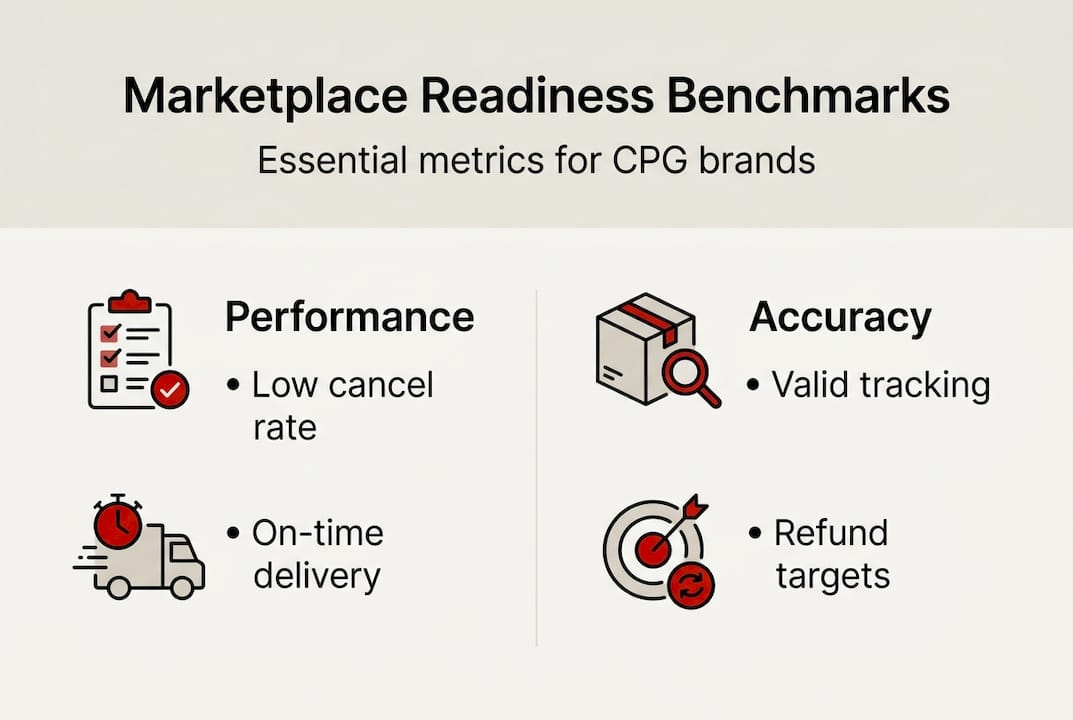
| Metric | Walmart benchmark | Amazon benchmark |
|---|---|---|
| Cancellation rate | Below 2% | Below 2.5% |
| On-time delivery | Above 95% | Above 97% |
| Valid tracking rate | Above 99% | Above 95% |
| Refund or return rate | Below 0.5% | Below 10% (category varies) |
Most brands that fail these benchmarks have an upstream problem, not a marketplace problem. The issue usually lives in their fulfillment strategy: slow pick-and-pack times, carrier selection that inflates transit days, or an inventory management process that cannot handle demand spikes.
Here is a quick operational readiness checklist before you push for growth:
Pro Tip: Track your cancellation rate and valid tracking rate weekly, not monthly. By the time a monthly report flags a problem, you may have already tripped a platform warning. Set internal alert thresholds 20% tighter than the platform’s published limits so you have a buffer to correct before it costs you.
Operational readiness is not glamorous, but it is the single most reliable predictor of whether a growth push will be profitable or punishing.
Once the operational foundations are in place, it is time to engineer marketplace growth from the ground up, starting with segmentation and integrating your channels.

Most CPG brands treat their customer base as one audience. That is a margin mistake. Data-driven segmentation and omnichannel integration drive value-based growth because they let you allocate spend where it actually converts, not where it just generates impressions.
Customer segmentation for marketplaces means going beyond age and zip code. You want behavioral signals: purchase frequency, basket size, repurchase interval, and category adjacency. A buyer who reorders your protein powder every 28 days is worth three times the ad spend of someone who bought once during a promotion. Treat them differently.
| Approach | High-touch segmentation | Basic demographic targeting |
|---|---|---|
| Data inputs | Purchase behavior, LTV, repurchase rate | Age, gender, location |
| Ad targeting | SKU-level, audience-specific creative | Broad category ads |
| Margin impact | Higher conversion, lower CAC | Higher spend, lower ROI |
| Scalability | Compounds over time | Plateaus quickly |
Omnichannel integration is the other half of this equation. Your Amazon storefront, Walmart seller page, DTC site, and retail shelf are not separate businesses. They are one brand with multiple entry points. When those channels share data, inventory, and customer experience logic, you stop cannibalizing yourself and start compounding growth.
Explore omnichannel integration and marketplace strategy examples to see how leading CPG brands structure this in practice. The core requirements for integration are:
Brands that nail segmentation and integration do not just grow faster. They grow with better margins because they stop wasting budget on audiences and channels that do not convert.
Segmentation and integration drive growth; now, let’s amplify profitability through smarter pricing and inventory moves.
Dynamic pricing, inventory optimization, and attribution-linked campaigns are essential for Walmart CPG marketplace profitability, and the same logic applies across Amazon and DTC. Static pricing is a slow margin leak. You are either leaving money on the table during peak demand or getting undercut when competitors discount.
Here is how to implement dynamic pricing without triggering a race to the bottom:
Pro Tip: The most overlooked pricing lever is not the retail price. It is the relationship between your price, your ad spend, and your net margin after fees. Use inventory efficiency tips to model the true cost of holding excess stock, then price accordingly. Carrying 90 days of inventory when 45 days is sufficient is a hidden tax on your cash flow.
Warning: Chasing a competitor’s price cut without checking your own margin math is how brands end up growing revenue while shrinking profit. A 10% price drop on a product with 30% gross margin wipes out a third of your margin dollars. Before you match a competitor’s discount, run the numbers.
Inventory optimization ties directly into pricing. Demand forecasting by season, channel, and SKU lets you increase ecommerce sales without the twin risks of stockouts and overstock penalties. If you are comparing Walmart vs Amazon for your next channel push, inventory velocity and fee structures should drive that decision, not just traffic volume.
After optimizing price and inventory, the next lever is amplifying brand reach and measurable impact through retail media and AI.
Retail media and AI personalization deliver value beyond price-driven growth because they move buyers through the funnel without requiring you to discount your way to conversion. Walmart Connect and Amazon Sponsored Products are the two largest retail media networks in U.S. ecommerce, and both now offer audience targeting that goes well beyond keyword matching.
AI personalization means showing segment-specific creative and offers to the right buyer at the right moment. A repeat buyer sees a loyalty-focused message. A lapsed buyer sees a reactivation offer. A new-to-brand buyer sees your core value proposition. This is not complicated to execute, but it requires the segmentation work from the previous section to already be in place.
Here are the steps for attribution setup and campaign success:
The brands seeing the strongest business growth strategies in 2026 are those treating retail media as a margin tool, not a visibility tool. They know exactly what each ad dollar returns and they optimize accordingly. Review Walmart Marketplace CPG profitability frameworks to see how attribution-linked campaigns fit into a full-channel margin model.
Here is the uncomfortable truth most marketplace consultants will not tell you: the brands that win long-term on Amazon and Walmart are not the cheapest ones. They are the most operationally disciplined ones with the clearest customer value proposition.
We have worked with CPG brands that cut prices aggressively to chase marketplace rank. Short-term, their sales volume went up. Medium-term, their margins collapsed, their ad spend increased to defend position, and they ended up in a cycle where growth required constant discounting. That is not a business. That is a treadmill.
The brands that consistently outperform use marketplace management insights to build value, not just volume. Here is what they do differently:
The shift from price-first to value-first thinking is not philosophical. It is financial. When your brand stands for something specific and delivers a consistent experience across every channel, you earn repeat buyers who are less price-sensitive. That is where sustainable margin lives.
Putting these strategies into practice requires more than a checklist. It requires the right data, the right tools, and someone who has navigated the specific economics of Amazon FBA fees, Walmart WFS margin compression, and omnichannel channel conflict before.
RedDog Group works with CPG brands in the $500K to $20M revenue range to build structured, margin-focused growth plans across omnichannel marketplace growth channels. Whether you need to tighten your operational benchmarks, build a segmentation model, or launch a retail media program that actually pays for itself, our Amazon growth consulting team brings the analytical rigor and channel-specific experience to move fast without burning margin. If you are ready to grow profitably, not just quickly, let’s talk.
Marketplace benchmarks include cancellation rates below 2%, on-time delivery above 95%, valid tracking over 99%, and refund rates under 0.5%. Meeting these consistently is the baseline for maintaining marketplace visibility and profitability.
Dynamic pricing helps CPG brands maximize margin by adapting prices in real time based on demand, inventory levels, and competitor activity. The key is setting firm price floors so discounting never erodes your contribution margin.
Retail media and AI personalization increase value by improving targeting, customer engagement, and the ROI of marketplace campaigns. They work best when built on top of strong customer segmentation data.
Omnichannel integration requires connecting inventory, data, and customer experience across marketplace and retail platforms. The goal is a unified system where every channel informs and reinforces the others rather than competing for the same buyer.
Leave a comment: