
Is Selling on Amazon Worth It for Your Omnichannel Brand?
Posted on
For most brands, selling on Amazon can be an incredibly powerful growth lever, but let’s be clear: it's not a golden ticket. Think of it as opening a store in the world’s busiest shopping mall. You get immediate access to millions of customers, but you pay a premium for that traffic through fees, advertising, and operational complexity. Success isn't guaranteed; it's engineered.
The Real Question: Is Amazon Worth It for Your Brand?
Deciding whether to sell on Amazon requires looking past the massive sales potential and honestly asking if your business model can survive—and thrive—in its demanding ecosystem. It’s less about the platform's general value and more about its specific fit for your products, your margins, and your long-term omnichannel goals.
The opportunity is undeniable. Brands get instant access to a massive, high-intent audience actively searching for products to buy. This can accelerate growth in a way that building a direct-to-consumer channel from scratch simply can’t match.
The financial impact is huge, with third-party sellers now driving over 60% of Amazon’s total product sales. Global sales by these sellers have soared, which just goes to show the immense profitability waiting for brands that get it right. You can discover more insights about Amazon's marketplace scale and see how third-party sellers are fueling its growth.
Balancing Opportunity with Operational Reality
But all that access comes at a price. Your brand has to navigate a complex fee structure, intense competition, and the constant battle to protect your brand identity from unauthorized resellers and copycats. Success isn't just about listing a product; it’s about strategically managing every lever available, from fulfillment methods to advertising campaigns.
This simple decision tree illustrates the core financial question every brand must answer before even thinking about launching.
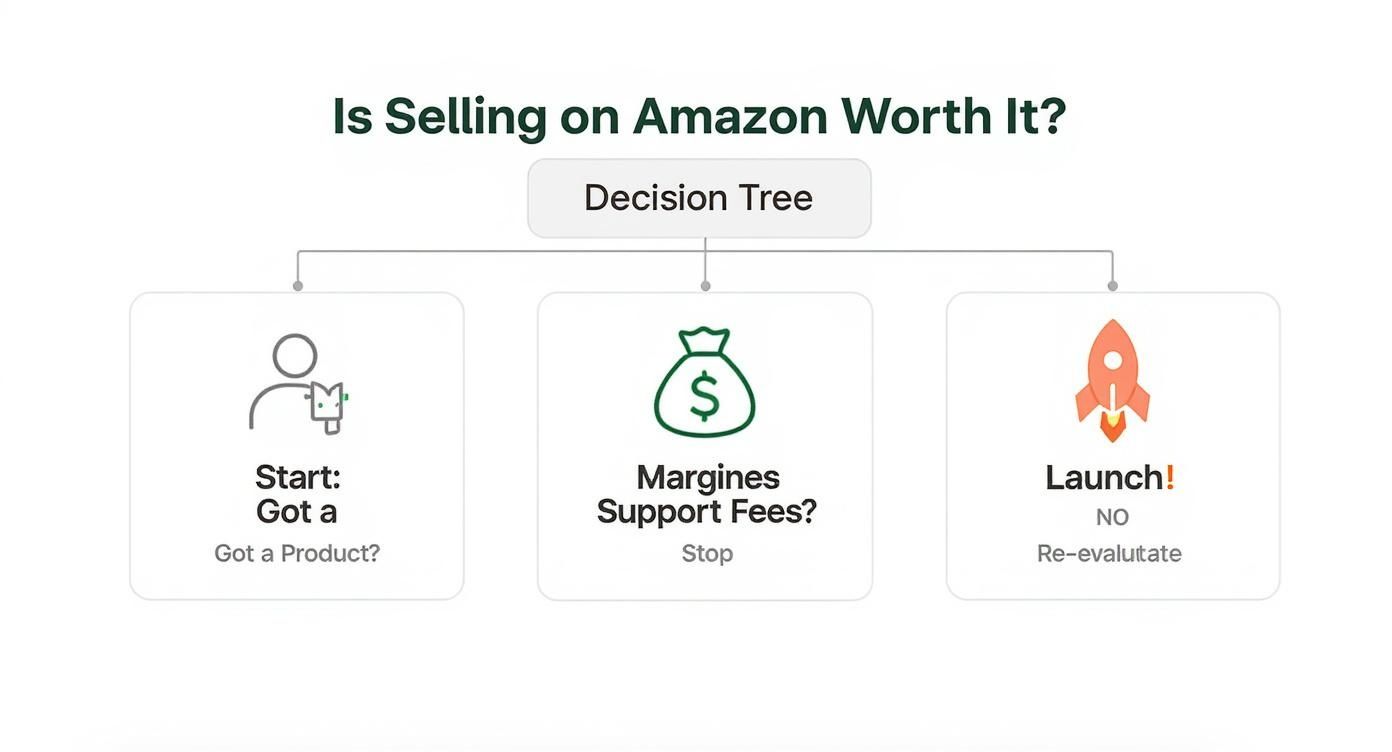
As you can see, it all boils down to one critical component: profit margin. If your margins can't support Amazon's fees and advertising costs, the channel simply isn't viable without making some serious strategic adjustments.
The core question is simple: Can your margins support the cost of doing business on Amazon? Answering this with a data-backed 'yes' is the first step in building a profitable, scalable presence on the world's largest marketplace.
To help you find that answer, this guide provides a complete framework. We'll break down the essential factors that determine whether selling on Amazon is a worthwhile investment for your brand, including:
- Marketplace Economics: A clear breakdown of all the costs involved, from referral fees to advertising spend.
- Fulfillment Strategy: Choosing between Fulfillment by Amazon (FBA) and Fulfillment by Merchant (FBM).
- Brand Control: Navigating the competitive landscape while protecting your brand’s integrity.
By the end, you'll have the clarity to move forward with a solid foundation, ready to optimize your strategy and amplify your growth.
Amazon Selling At a Glance Decision Matrix
Before we dive deep, here's a quick summary of the primary pros and cons to consider when evaluating if selling on Amazon is right for your brand. This table helps frame the trade-offs you'll be making.
| Factor | Key Advantage (Pro) | Key Disadvantage (Con) |
|---|---|---|
| Audience Reach | Immediate access to millions of high-intent Prime shoppers. | Extremely high competition in nearly every category. |
| Growth Potential | Unmatched potential for rapid sales velocity and brand visibility. | Dependent on Amazon's algorithm and policies for success. |
| Brand Control | Tools like A+ Content and Brand Registry offer protection. | Risk of unauthorized resellers, price erosion, and listing hijackers. |
| Profit Margins | High sales volume can offset lower per-unit margins. | Numerous fees (referral, FBA, storage, ads) can erode profitability. |
| Operational Lift | Fulfillment by Amazon (FBA) handles logistics, shipping, and returns. | FBA adds significant costs and requires strict inventory management. |
| Customer Data | Access to basic sales data and performance metrics. | Amazon owns the customer relationship and limits direct communication. |
This matrix highlights the central tension of selling on Amazon: massive opportunity versus significant operational costs and risks. The rest of this guide will help you figure out which side of the scale your brand lands on.
Deconstructing the True Cost of Selling on Amazon
To figure out if selling on Amazon is truly worth it, you have to look past your product's sticker price and get a handle on the platform's unique economic landscape. Profitability starts here.
Think of it like renting prime retail space in the world's busiest mall. You don't just pay rent; you're also on the hook for utilities, maintenance, and marketing to draw people into your specific store. Amazon's fee structure is a lot like that, with different costs covering your access to their massive customer base, logistics network, and digital shelf space.
Ignoring these costs is the fastest way to become an "Amazon charity"—moving tons of product but keeping almost none of the revenue. Building a profitable foundation for your Amazon channel means taking a clear-eyed look at every single line item that chips away at your net margin.
The Core Costs of Marketplace Access
Before you even sell a single unit, Amazon takes its cut. These are the non-negotiable costs of doing business on the platform.
- Referral Fees: This is Amazon's commission, charged on every single sale. It typically runs from 8% to 15%, depending on your product category. For a $30 item in a 15% category, Amazon immediately pockets $4.50 right off the top.
- Subscription Fees: For any serious brand, the Professional selling plan is a must. This costs a flat $39.99 per month and unlocks access to advertising, reporting, and other essential tools.
These are just the entry fees. The next layer of costs is all about how you actually get your products into your customers' hands.
The Price of Convenience: Fulfillment and Advertising
Your fulfillment method is one of the biggest levers you can pull to manage your costs. Whether you let Amazon handle it or do it yourself, there’s a price tag attached.
Fulfillment Fees (FBA)
Fulfillment by Amazon (FBA) is the popular choice where you pay Amazon to store your inventory, then pick, pack, and ship orders, and even handle customer service. The fees are calculated based on your product's size and weight. It's incredibly convenient, but these costs add up fast. They include:
- FBA Fulfillment Fee: A per-unit cost that covers the entire shipping process.
- Monthly Inventory Storage Fees: You're charged based on the physical volume your products take up in their warehouses.
- Long-Term Storage Fees: These are penalties for inventory that sits around for too long, designed to encourage quick turnover.
If you choose to fulfill orders yourself (FBM), it's critical to master accurately calculating shipping charges to protect your profit margins.
Advertising Costs (PPC)
In today's crowded marketplace, you can't just list a product and expect it to sell. Organic visibility isn't enough anymore—you have to pay to play. Amazon Pay-Per-Click (PPC) has become an essential investment to get your products seen.
A common mistake is viewing advertising as an optional expense. On Amazon, it’s a core operational cost, just like shipping or referral fees. A profitable launch requires a dedicated ad budget from day one.
A key metric to live by is your Advertising Cost of Sale (ACoS), which measures your ad spend relative to the sales those ads generate. If you spend $10 on ads to bring in $100 in sales, your ACoS is 10%. Keeping this metric in check is fundamental to ensuring your ad spend drives profitable growth, not just empty revenue.
Calculating Your True Net Margin
So, with all these variables floating around, how do you figure out what you're actually making? You need a straightforward formula to establish your financial baseline.
Here’s a simplified breakdown to estimate your net profit per unit:
Sale Price- Cost of Goods Sold (COGS)- Amazon Referral Fee (~15%)- FBA Fees (or Your Own Shipping Costs)- Advertising Spend (Your Target ACoS %)= Estimated Net Profit
Let's plug in some numbers for a small, lightweight product to see how this works in the real world:
| Metric | Amount | Description |
|---|---|---|
| Sale Price | $25.00 | The price the customer pays. |
| COGS | -$7.00 | Your cost to manufacture the item. |
| Referral Fee | -$3.75 | Amazon's 15% commission. |
| FBA Fees | -$4.50 | Estimated fulfillment and storage cost. |
| Ad Spend | -$2.50 | Assuming a 10% ACoS. |
| Net Profit | $7.25 | Your estimated profit per sale. |
| Net Margin | 29% | (Net Profit / Sale Price) |
A 29% net margin might look pretty healthy, but remember, this is before you account for returns, overhead, or any other business expenses. This calculation is all about getting that baseline financial clarity. It tells you exactly how much room you have to compete, run promotions, and ultimately, grow your brand profitably on the platform.
Choosing Your Fulfillment Strategy: FBA vs. FBM
How you get your products to customers is one of the biggest decisions you’ll make on Amazon. It directly shapes your costs, customer experience, and ultimately, your profitability. Think of it like this: do you hand over your entire warehousing and shipping operation to a global expert, or do you manage it all yourself?
Each path comes with powerful perks and serious trade-offs. The choice boils down to two core models: Fulfillment by Amazon (FBA) and Fulfillment by Merchant (FBM). Getting this right is a foundational step in building a profitable brand on the platform.
Fulfillment by Amazon (FBA): The Power of Outsourcing
With FBA, you ship your inventory to Amazon’s massive fulfillment centers, and they handle the rest. They store your products, pick and pack orders as they come in, and ship them to the customer. Amazon also takes care of all customer service and returns for FBA orders.
The single greatest advantage here is that your products automatically get the Amazon Prime badge. This is a massive trust signal that unlocks access to free, two-day shipping for millions of Prime members. For many brands, that badge alone is enough to dramatically boost conversion rates and sales. You’re essentially plugging your business into Amazon’s world-class logistics network.
Of course, this convenience isn't free. FBA fees can get complicated, covering everything from the storage space your products occupy to the final weight of the shipped package. These costs can quickly eat into the margins of large, heavy, or slow-moving items.
Fulfillment by Merchant (FBM): Control and Flexibility
Fulfillment by Merchant is exactly what it sounds like—you, the merchant, handle everything yourself. When an order comes through on Amazon, you’re responsible for storing your inventory, packing the order, and shipping it directly to the customer. You also manage all the customer service and returns.
FBM gives you total control. You can use your own branded packaging, slip in marketing inserts, and manage inventory across all your sales channels (like your own website) from a single stock pool. This model is often a much better financial fit for brands selling:
- Large or heavy products: You can avoid the steep FBA fees tied to size and dimensional weight.
- Slow-moving items: This prevents you from getting hit with Amazon's long-term storage penalties.
- Customized or handmade goods: It allows for the unique handling and personalization that FBA can’t offer.
The biggest trade-off? No automatic Prime badge. While you can apply for the Seller Fulfilled Prime program, the performance standards are incredibly strict and very difficult for most businesses to maintain consistently.
To help you visualize the differences, here’s a side-by-side comparison of the two models.
Fulfillment Model Comparison: FBA vs. FBM
| Feature | Fulfillment by Amazon (FBA) | Fulfillment by Merchant (FBM) |
|---|---|---|
| Prime Eligibility | Automatic Prime badge | Must qualify for strict Seller Fulfilled Prime program |
| Logistics Management | Handled entirely by Amazon (storage, packing, shipping) | Managed by you or a 3PL partner |
| Customer Service | Managed by Amazon for fulfillment-related issues | Your responsibility |
| Fees | Fulfillment fees, monthly storage fees, long-term storage fees | Amazon referral fee, plus your own shipping and storage costs |
| Inventory Control | Sent to Amazon's network; less direct control | Full control over inventory location and multi-channel fulfillment |
| Branding | Standard Amazon packaging | Custom branded packaging and inserts allowed |
| Best For | Fast-moving, standard-sized items; sellers wanting convenience | Oversized, slow-moving, or high-margin items; sellers wanting control |
This table makes it clear that the best choice depends entirely on your product, margins, and operational capabilities.
The decision between FBA and FBM isn't just about logistics; it's a strategic choice that defines your cost structure and customer promise. FBA buys you speed and the Prime badge, while FBM offers control and margin protection for specific product types.
And the landscape keeps evolving. Sellers now have to consider newer options like Amazon's 'Buy with Prime' program, which brings Prime benefits to your own D2C site, blurring the lines between channels. For a closer look at how the FBA system works from the inside, our complete guide on Fulfillment by Amazon explained is a great next step.
In the end, many of the most successful brands don’t pick just one. They use a hybrid strategy—placing their fast-moving, standard-sized bestsellers in FBA to capture Prime demand, while using FBM for larger, specialized, or multi-channel products. Optimizing your fulfillment isn't a one-time decision; it's about continuously aligning your products with the most profitable path to your customer.
The Unmatched Opportunity of Amazon's Global Reach

After you’ve done the math on the costs, the single biggest reason brands put up with Amazon’s complexities comes down to one thing: its enormous, ready-to-buy customer base. The whole “is it worth it?” debate usually starts by weighing the fees against this incredible opportunity for growth.
Think about what it takes to build an audience for a direct-to-consumer website. It can take years and a massive marketing budget. On Amazon, you get to plug your products directly into one of the most powerful retail engines on the planet. It's a strategic trade-off: you follow their rules and pay their fees, and in return, you get immediate access to a river of high-intent shoppers.
Tapping into a Global Marketplace
The sheer scale of Amazon’s audience is hard to fully grasp. We're not just talking about website visitors; we're talking about a massive community of people who have been conditioned to search, click, and buy. The entire ecosystem is built on trust, convenience, and speed—assets your brand gets to leverage from day one.
The numbers really drive this home. There are over 9.7 million Amazon sellers worldwide, but the customer side is where it gets truly staggering. Amazon has an estimated 321 million users globally, with around 208 million of them right here in the U.S. This network gives you a direct line to a giant pool of shoppers actively searching for products just like yours. You can learn more about the global scale of Amazon's marketplace to see just how deep this opportunity runs.
Think of Amazon not just as another sales channel, but as a search engine for products. Customers don’t go there to browse casually; they arrive with a specific need and a strong intent to make a purchase.
This built-in demand is what makes the platform so powerful for growing a brand. You aren’t just listing a product; you’re putting it right in front of millions of people at the exact moment they’re ready to pull out their wallets.
From Foundation to Amplification
This access is the ultimate expression of our Foundation → Optimization → Amplification growth framework. Getting your foundation right—calculating margins, picking a fulfillment strategy—sets the stage. Optimization is about dialing in your listings and ad campaigns. But Amazon’s global reach is where the real amplification kicks in.
Just consider the alternative. To get that kind of visibility on your own, you'd need a monumental investment in:
- SEO and Content Marketing: Years of grinding to rank on Google for competitive product keywords.
- Paid Social and Search Ads: A huge budget just to acquire traffic from platforms like Meta and Google.
- Brand Building: A significant PR and marketing spend to create the kind of trust Amazon instantly provides with its A-to-z Guarantee and Prime badge.
Amazon shortcuts this entire process. It’s a fast track to a level of market penetration that would otherwise be out of reach for most brands. It lets you focus on making great products while it handles the herculean task of attracting the world’s shoppers.
This is the core value proposition. The platform's fees and rules are the price of admission to a marketplace with unrivaled scale. For brands with the right product and strategy, that potential for top-line growth is what ultimately makes the whole thing worthwhile.
Navigating Competition and Protecting Your Brand
The sheer size of Amazon's customer base is a massive draw, but it comes with an equally intense level of competition. Answering "is selling on Amazon worth it?" means being brutally honest about this reality. The platform isn’t a quiet boutique; it's a crowded, noisy bazaar where every brand is fighting for the same customer's attention.
Success here demands more than just a great product. You need a smart, proactive strategy to stand out and a defensive plan to protect your brand’s integrity. Simply launching your products and hoping for the best is a recipe for failure. You're stepping into an ecosystem where competitors are constantly tweaking prices, running aggressive ad campaigns, and racing to collect reviews. You can't afford to be passive.
Analyzing the Competitive Landscape
Before you can even think about winning, you have to understand the game. Sizing up the competition in your category isn't just a suggestion—it's a foundational step. This isn't just about knowing who your rivals are; it's about dissecting their tactics so you can build a smarter strategy from day one.
Here’s what you need to keep a close eye on:
- Pricing Strategies: Are competitors in a race to the bottom, or are they holding the line on price? Knowing this helps you position your own products without gutting your margins.
- Review Velocity: How quickly are the top sellers racking up customer reviews? This is a huge indicator of their sales volume and customer satisfaction, and it directly fuels their ranking in search results.
- Listing Quality: Take a hard look at the top-performing listings. Are they loaded with high-quality images, video, and A+ Content? This sets the bar for what customers expect. You have to meet it—and then exceed it.
The Hidden Risks to Your Brand Equity
Beyond the head-to-head competition, the open nature of the marketplace creates some serious risks for your brand's reputation and value. Without a solid protective strategy, you can quickly lose control, leading to problems that destroy customer trust and bleed your bottom line dry.
Amazon is not a 'set it and forget it' channel. It demands constant vigilance to safeguard your brand from unauthorized sellers, counterfeiters, and price erosion that can devalue your products overnight.
These threats are very real and can spiral out of control fast. Unauthorized third-party sellers can "hijack" your listings, selling your products without permission—often at a steep discount. This kicks off price erosion, making it impossible for you or your authorized retail partners to hold a consistent price point across all channels. Even worse, counterfeit products can flood the market under your brand name, leading to a wave of negative reviews and doing long-term damage to your hard-earned reputation.
Your Foundational Tool for Brand Protection
So, how do you fight back? Your single most powerful weapon is Amazon Brand Registry. This program is the bedrock of brand protection on the platform, giving you the control needed to build and defend your presence. It’s a free service for any brand with a registered trademark, and frankly, enrolling should be a non-negotiable first step.
Getting into Brand Registry is about more than just playing defense; it’s about unlocking the tools you need to create a premium brand experience. For a deeper dive into the specific benefits, our guide on what is Amazon Brand Registry covers everything you need to know.
Once you’re enrolled, you get access to a whole suite of features designed to put you back in the driver's seat:
- Accurate Brand Representation: You become the official source of truth for your product listings, which helps stop incorrect details from popping up on your pages.
- Powerful Search and Reporting Tools: Brand Registry gives you advanced tools to hunt down and report potential intellectual property violations, from counterfeit products to trademark infringements.
- Proactive Brand Protection: Amazon uses the information you provide to proactively remove suspected infringing or inaccurate content, automating a huge chunk of your defensive work.
- Access to A+ Content: This feature lets you beef up your product detail pages with rich text, images, and comparison charts, helping you tell your brand story and seriously boost conversion rates.
Ultimately, protecting your brand on Amazon is an active, ongoing job. It starts with understanding the competitive environment and then using foundational tools like Brand Registry to build a defensive moat around your products. This approach ensures that the brand equity you work so hard to build offline is preserved—and even strengthened—online.
Partnering for Growth: When to Hire an Amazon Agency

Running an Amazon channel can quickly become a full-time job, pulling your focus away from the rest of your business. While most brands start out managing it in-house, there’s a tipping point where the question "is selling on Amazon worth it?" turns into "is managing Amazon myself worth it?"
This is usually when bringing in an expert omnichannel agency stops being a line-item expense and becomes a strategic move. It's the shift from just reacting to daily problems to proactively building long-term, profitable growth on the platform.
Identifying the Triggers for a Partnership
So, how do you know when it’s time to call in the experts? The signs are usually pretty clear and almost always tied to your performance metrics.
- Stagnating Sales: Your growth has flatlined. The tactics that got you here are no longer pushing the needle forward.
- Rising Ad Costs: Your ad spend keeps climbing, but your sales aren’t following suit. Your return on investment is shrinking.
- Resource Constraints: Your team is stretched thin, juggling listing optimization, inventory forecasting, and campaign management, but never having enough time to do any of it well.
When you spend more time putting out fires—like dealing with surprise listing suspensions or runaway storage fees—than you do on actual growth strategy, it's a massive red flag. A good agency doesn’t just manage your account; they turn it from a time sink back into a growth engine.
A real growth partner does more than just tweak listings. They build a unified strategy that connects your Amazon presence to your entire retail ecosystem, ensuring your brand story and pricing are consistent no matter where customers find you. This is where our Foundation → Optimization → Amplification framework comes into play.
From Foundational Work to Full Amplification
A great agency partner always starts by shoring up your Foundation. This means perfecting your product listings, making sure Brand Registry is locked down for protection, and dialing in your fulfillment strategy.
Next, they drive Optimization. This is the deeper work—advanced PPC management to improve your ACoS, sophisticated inventory planning to sidestep stockouts and fees, and non-stop data analysis to uncover hidden opportunities.
Finally, they push for Amplification. Once the channel is stable and optimized, the focus shifts to scaling up. This could mean expanding into new Amazon marketplaces, launching products with a battle-tested playbook, or integrating your Amazon data with your wider marketing efforts.
The results speak for themselves. With expert management, the average annual sales per seller on Amazon jumped from $250,000 to $290,000—a 16% year-over-year increase. These numbers prove that brands with a sharpened strategy aren't just getting by; they're pulling ahead with significantly higher sales. You can dig into more seller growth trends on AMZ Prep.
If these challenges sound familiar and you're ready to unlock your brand's true potential on the platform, exploring Amazon consulting services is the logical next step.
Common Questions About Selling on Amazon
Even after weighing the pros and cons, most brands still have a few lingering questions holding them back. Getting clear, straightforward answers to these common hurdles is the final step in deciding if Amazon is really worth it.
How Much Money Do I Need to Start Selling on Amazon?
There’s no magic number here, but showing up underfunded is a surefire way to fail. Your initial investment isn’t just about buying inventory—it’s about financing a launch strong enough to get noticed.
A smart starting budget needs to cover a few key things:
- Professional Seller Plan: This is non-negotiable. At $39.99 per month, it unlocks the essential tools you need, like advertising and reporting.
- Initial Inventory: You need enough stock to handle the first wave of sales without going out of stock. Nothing kills momentum faster.
- Foundational Assets: Think professional product photography, official GS1 UPC codes, and any branding materials you’ll need for your listings.
- Launch Advertising Budget: You have to spend money to make money. A dedicated ad budget is critical for getting your first sales, generating reviews, and climbing the search rankings.
We usually tell brands to have at least $3,500 to $5,000 ready to go. This gives you a solid cushion to cover all the basics and fund a launch campaign that gives your products a fighting chance right out of the gate.
Can I Sell on Amazon Without Using FBA?
Absolutely. It’s called Fulfillment by Merchant (FBM), and it means you handle everything—storing your inventory, picking, packing, and shipping orders directly to customers. For certain businesses, it’s a fantastic option.
FBM makes the most sense for brands that already have their own logistics figured out, sell oversized or heavy products, or want complete control over the unboxing experience. You get to use your own custom packaging and manage inventory across all your sales channels from one place.
The biggest trade-off? You don’t automatically get the Prime badge, and that can be a major hit to your conversion rates. You can, however, apply for the Seller Fulfilled Prime program, but be warned: you have to consistently meet Amazon’s incredibly strict shipping and performance metrics.
What Are the Most Profitable Categories on Amazon?
This is easily one of the most common questions we get, but it’s focused on the wrong thing. Profitability on Amazon isn’t about the category—it’s about product differentiation, smart sourcing, and how intense the competition is.
Sure, categories like Home & Kitchen, Electronics, and Health & Personal Care move a ton of volume. But they’re also drowning in competition. Success isn't about jumping into a "hot" category; it's about carving out a defensible niche within one.
The real secret is finding a sub-category where your brand offers something unique, tells a compelling story, and—most importantly—can maintain healthy profit margins after Amazon takes its cut and you’ve paid for ads.
Ready to stop guessing and start growing? The complexities of Amazon are manageable when you have the right partner. RedDog Group builds data-driven strategies that turn marketplace potential into measurable revenue. Let’s Talk Growth.
Leave a comment: