
Is Amazon FBA Worth It for Your Brand in 2024?
Posted on
For growing brands, the big question—is Amazon FBA worth it—usually boils down to a simple trade-off: Are the fees and loss of control worth the access to Amazon's massive fulfillment machine and customer base?
The short answer is yes, but only for the right products and the right growth strategy. It’s a powerful tool for scaling your online channel, but your profitability hinges entirely on knowing your numbers and integrating FBA into a broader omnichannel plan.
The Bottom Line on FBA Profitability
Fulfillment by Amazon (FBA) is much more than a shipping service; it’s a strategic lever for growth. When you hand over your logistics—warehousing, picking, packing, shipping, and customer service—to Amazon, you instantly plug into an operational scale that would take years and millions to build on your own. This is the core value, and the first thing to consider when deciding if FBA fits your goals.
That operational muscle translates directly into Prime eligibility, a massive driver for converting customers. Shoppers trust the Prime badge and the promise of fast, reliable delivery it carries. For many brands, that badge alone justifies the cost because it can dramatically increase sales velocity and visibility in a crowded marketplace, creating measurable results.
The question then shifts from "if" it works to "how" to make it work for your bottom line.
Realistic Profit Expectations
Profit is the ultimate scorecard. While you hear stories of overnight millionaires, the reality for most brands is a grind of careful calculations and smart planning. The goal isn't just to sell on Amazon; it's to build a sustainable, profitable sales channel that supports overall brand growth.
Here's a quick look at what successful Amazon sellers are actually experiencing.
Amazon FBA At a Glance
The numbers show that FBA is a viable path to profitability for brands that plan ahead and manage their costs effectively.
| Metric | Statistic | What This Means for Your Brand |
|---|---|---|
| First-Year Profitability | 64% of sellers | Newcomers with a solid plan can achieve profitability quickly. |
| Typical Profit Margins | 11% to 25% for 46% of sellers | A healthy, measurable margin is achievable if you manage fees and ad spend. |
| Average Monthly Earnings | <$1,000 for 48% of sellers | Competition is high; a strong foundation is key before you scale. |
These figures, especially the detailed insights on the Amazon seller success rate, prove that while the opportunity is real, so is the competition. Success requires more than just listing a product.
FBA should be viewed as an amplification tool. It takes a solid product with proven demand and pours fuel on the fire. Without a strong product-market fit (the Foundation), FBA simply amplifies your losses through storage and fulfillment fees.
Key Factors Driving Profitability
Success with FBA isn’t random. It’s the direct result of optimizing a few key variables that impact your bottom line. Before you even think about shipping inventory to an Amazon fulfillment center, you need a firm grip on these factors:
- Product Margins: Can your pricing absorb FBA fees, referral fees, and advertising costs and still leave a healthy profit? Lightweight, standard-size items are almost always the most cost-effective.
- Sales Velocity: How fast do your products actually sell? FBA punishes slow-moving inventory with long-term storage fees, making high turnover critical for staying in the black.
- Operational Readiness: Are your products prepped and labeled according to Amazon’s notoriously strict requirements? One mistake here leads to costly delays and unplanned service fees you never budgeted for.
Ultimately, FBA is worth it when it’s part of a well-defined growth plan. It gives you the operational power to reach more customers faster, but only a sound strategy ensures you do it profitably.
How Amazon FBA Actually Works for Your Brand
So, is FBA really worth it? Before you can answer that, you need to understand what you’re actually signing up for. At its core, FBA means you’re handing over your entire physical logistics—from storing products to shipping orders and even handling returns—to Amazon.
Think of it as plugging your brand directly into one of the world's most powerful fulfillment machines. Instead of you or your team packing boxes, negotiating with carriers, and answering late-night "where's my order?" emails, Amazon does it all. This frees you up to focus on what actually grows your brand: marketing, product development, and strategy.
The process is straightforward, but you have to be precise. Get it right, and you've laid a rock-solid Foundation for scaling on the marketplace. Get it wrong, and you'll face delays and fees that eat into your profits.
The FBA Journey: From Your Product to the Customer's Doorstep
The FBA model is a clear, repeatable system that turns your inventory into delivered orders. Knowing each step is crucial for protecting your margins and avoiding costly mistakes.
- Product Preparation: Before your products leave your facility, they need to be prepped exactly to Amazon's standards. This means proper labeling, poly-bagging, and packaging to ensure their warehouses can scan and store everything without a hitch. If you get this wrong, Amazon will fix it for you—and send you the bill.
- Shipping to Amazon: Next, you create a shipping plan in Seller Central. Amazon’s system will tell you exactly where to send your inventory, often splitting it among several fulfillment centers across the country. They strategically place your products closer to where they predict customers will be, which is how they achieve fast Prime delivery.
- Inventory Storage and Management: Once your shipment arrives, Amazon workers scan your items and check them into your inventory. You can track every unit from your Seller Central dashboard, which gives you the data you need to forecast sales and know when to restock.
- Order Fulfillment: This is where the magic happens. A customer clicks "Buy Now," and Amazon’s automated system jumps into action. Their warehouse team picks the product, packs it into an Amazon-branded box, and ships it out. You don’t lift a finger.
- Customer Service and Returns: The job isn't over when the package ships. Amazon also manages all post-purchase support, handling customer questions, processing returns, and issuing refunds. While this is a huge time-saver, it also means you lose that direct line of communication with your customers. It's a key reason why brands must explore all aspects of the Fulfillment by Amazon process to fully grasp the trade-offs.
This end-to-end management is what makes FBA such a powerful engine for growth. It takes the biggest operational headaches off your plate so you can focus on building your brand.
Practical Takeaway: FBA is a system that trades direct operational control for immense logistical scale. The value isn't just in shipping products; it's in leveraging Amazon's infrastructure to meet customer expectations for speed and reliability, which directly impacts your conversion rates and ability to win the Buy Box.
By handling the heavy lifting of logistics, FBA allows brands to punch far above their weight. If you're still wondering about the fundamentals, this guide clarifies exactly how Fulfillment by Amazon works, outlining its benefits and fees in more detail. The core idea is simple: let Amazon manage the physical fulfillment so you can manage your brand's growth.
Decoding FBA Fees and Protecting Your Margins
To really figure out if Amazon FBA is worth it, you have to follow the money. Sales are great, but profitability is all about what’s left after Amazon takes its cut. FBA's convenience is a massive advantage, but it’s not free. Getting a handle on its fee structure is the first step in ensuring your margins don't disappear.
Think of FBA fees as an itemized bill for using Amazon’s entire logistics empire. Every step—from storing an item on a shelf to taping up a box and processing a return—comes with a price tag. Mastering these costs is foundational to a winning marketplace strategy. It eliminates nasty surprises and ensures your pricing is built for profit from day one.
This flow chart gives you a bird's-eye view of the FBA journey, showing how your product moves from your supplier, through Amazon's network, and finally to your customer's doorstep.
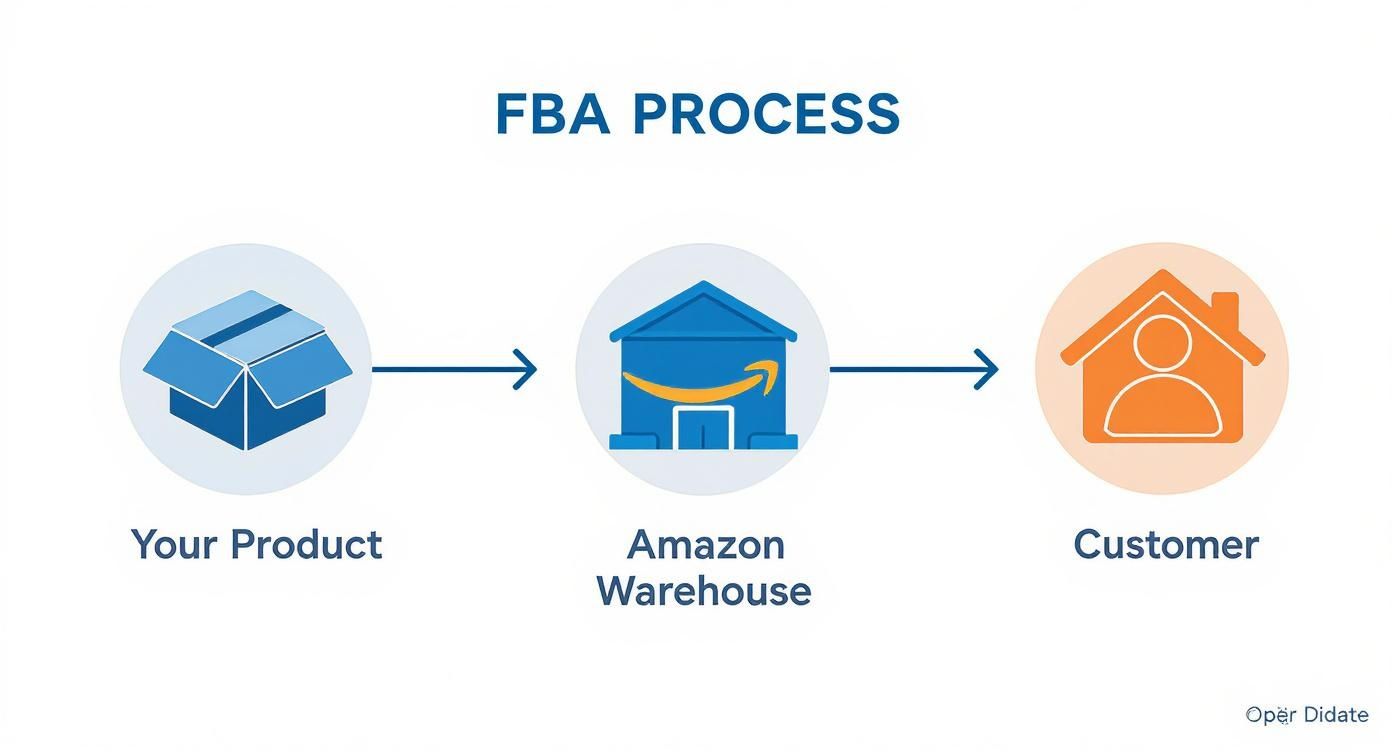
Just remember, every arrow in that diagram represents a fee that chips away at your bottom line.
The Two Core FBA Fee Categories
Amazon’s fee schedule can feel like a maze at first, but most costs fall into two main buckets. Understanding these is non-negotiable if you’re serious about FBA.
- FBA Fulfillment Fees: This is what you pay Amazon to pick, pack, and ship your product. It’s a per-unit fee calculated based on your product’s size and shipping weight. Lighter, smaller items are significantly cheaper to fulfill than large, heavy ones.
- Monthly Inventory Storage Fees: This is the rent you pay for your products to sit in an Amazon fulfillment center. It's calculated on the daily average volume (in cubic feet) your inventory occupies and is billed monthly. These fees spike during the busy holiday season from October to December.
These two make up the lion’s share of your FBA expenses. But they are far from the only ones. A common mistake is ignoring the "other" costs, which can quietly drain your profits.
Don't Overlook These Other FBA Costs
Beyond the big two, a handful of other charges can pop up on your statement. Staying on top of your inventory is the only way to keep them in check.
A data-driven guideline is the "Rule of Three." It suggests that roughly one-third of your sale price goes to Amazon fees, one-third to your cost of goods, and the final third is your gross profit. It’s an estimate, but it’s a solid gut check when you’re first evaluating a product.
Here are the additional fees that often catch new sellers off guard:
- Long-Term Storage Fees (Aged Inventory Surcharge): If your inventory sits unsold for more than 180 days, Amazon starts charging you extra on top of the regular monthly fees. They want their warehouse space for products that sell, not for ones collecting dust.
- Removal and Disposal Order Fees: Need to get your inventory out of FBA? Whether you have it shipped back to your own warehouse (removal) or ask Amazon to toss it (disposal), there’s a per-item fee for that.
- Returns Processing Fees: In certain categories like apparel and shoes, Amazon charges a small fee when a customer returns an item. This helps cover the cost of inspecting it and putting it back on the shelf.
- Unplanned Prep Service Fees: If you ship products to Amazon that aren’t prepped to their strict standards—think missing barcodes or improper poly bagging—they’ll fix it for you. And they'll charge you a premium for their trouble.
Trying to calculate all these variables with a spreadsheet is a recipe for headaches and errors. To get a real picture of your potential FBA profits, use a free ecommerce profit margin calculator that can model all these different costs for you. This lets you build a pricing strategy based on hard numbers, not just wishful thinking.
At the end of the day, a profitable FBA business is one that obsessively manages every single line item.
Choosing Your Fulfillment Model: FBA vs. FBM vs. 3PL
Figuring out if Amazon FBA is worth it isn't a simple yes or no. It's a strategic choice that puts FBA up against two other heavy hitters: Fulfillment by Merchant (FBM) and partnering with a Third-Party Logistics (3PL) provider. Each path offers a different mix of cost, control, and convenience that will directly shape your brand's growth across online and offline channels.
Think of it like choosing the right engine for your business. FBA is a high-performance engine built for speed and scale, but it only runs on one racetrack—Amazon. FBM is the manual transmission, giving you total control but forcing you to handle every gear shift yourself. A 3PL is a versatile hybrid, offering professional power you can use across multiple channels.
The right choice comes down to your operational setup and growth goals. A brand aiming for rapid dominance on Amazon has different needs than one building a multi-channel presence across retail, DTC, and other marketplaces.
Fulfillment by Amazon (FBA): The Scalability Engine
FBA is designed for one thing: explosive growth inside the Amazon ecosystem. When you hand your logistics over to Amazon, you instantly get Prime eligibility, which is a massive driver for conversions. Customers trust that Prime badge, and Amazon’s algorithm rewards it with better visibility.
But that convenience comes at a cost—both in fees and in control. You're playing in Amazon's sandbox, by their rules. That means dealing with strict prep requirements, having no branding control over your packaging, and very limited direct interaction with your customers. It’s the perfect model for brands with high-velocity, standard-sized products that can absorb the fees without killing their margins.
Fulfillment by Merchant (FBM): The Control Hub
FBM puts you squarely in the driver's seat. You manage your own inventory, pack every order, and handle all shipping and customer service. This hands-on approach gives you total control over the customer experience, from slipping custom inserts into your packages to communicating directly on service issues.
The biggest upside here is margin control. By sidestepping FBA's storage and fulfillment fees, you can often achieve higher profits per unit, especially on bulky, heavy, or slow-moving items. The trade-off is huge: you are responsible for meeting Amazon's high shipping standards. Fail to ship on time, and your account health will suffer, potentially tanking your listings.
Practical Takeaway: The choice between FBA and FBM isn't just about who ships the box. It’s a strategic decision about where you want to invest your resources—paying for Amazon’s scale (FBA) or building your own operational muscle (FBM).
Third-Party Logistics (3PL): The Omnichannel Integrator
A 3PL offers a powerful middle ground, blending professional logistics with multi-channel flexibility. You ship your inventory to their warehouse, and they handle fulfillment for all your sales channels—Amazon, your Shopify store, Walmart, and even your brick-and-mortar retail partners.
This model is the backbone of any true omnichannel strategy. It centralizes your inventory, solving the common headache of siloing stock for different platforms. A great 3PL can often negotiate better shipping rates than a single merchant ever could and can even help you meet the tough requirements for Seller Fulfilled Prime. If you need a hand finding the right partner, check out our expert comparison of the top Amazon FBA service providers.
To help you visualize how these models stack up, here’s a quick side-by-side breakdown. Each has its place, and seeing the differences laid out can make the right choice for your brand much clearer.
Fulfillment Model Comparison: FBA vs. FBM vs. 3PL
| Feature | Amazon FBA | Fulfillment by Merchant (FBM) | Third-Party Logistics (3PL) |
|---|---|---|---|
| Prime Eligibility | Automatic, granting access to millions of Prime customers. | Possible through Seller Fulfilled Prime (SFP), but with very strict requirements. | Often supports SFP, helping you meet the performance metrics. |
| Control Over Branding | Very low. Standard Amazon packaging with limited customization options. | High. Complete control over packaging, inserts, and the unboxing experience. | High. Most 3PLs offer customized packaging and kitting services. |
| Cost Structure | High fees for storage, fulfillment, and returns. Can be complex to forecast. | Lower overhead, but requires investment in warehouse space, staff, and materials. | Predictable pricing, often based on storage, pick-and-pack, and shipping volume. |
| Operational Effort | Low. Amazon handles everything from storage to customer service for fulfillment. | High. You are responsible for every step of the fulfillment process. | Low to Medium. You manage inventory levels, but the 3PL handles the heavy lifting. |
| Best For | High-volume, standard-sized products focused on rapid Amazon growth. | Oversized, slow-moving, or custom items where margin control is critical. | Brands selling across multiple channels (DTC, retail, other marketplaces). |
| Multi-Channel Support | Limited and often expensive (Multi-Channel Fulfillment). Not ideal for omnichannel. | Excellent. You can fulfill orders from any sales channel with the same inventory. | Excellent. Designed specifically to integrate with and support multiple channels. |
Ultimately, this table shows there's no single "best" option—only the best fit for your specific business goals, product catalog, and operational capacity.
Making the Right Choice for Your Brand
So, how do you decide? The market overwhelmingly leans toward FBA for its raw power. The data shows that 78% of Amazon sellers use FBA, with a whopping 64% using it exclusively. Why? Because FBA shipping can be up to 70% cheaper per unit than other premium options. Plus, sellers using FBA are 5.2 times more likely to hit $100,000 in their first year, proving its role as a massive growth engine. You can find more details on these Amazon seller statistics on AMZ Prep.
Here’s a simple framework to guide your decision:
- Choose FBA if: Your main goal is scaling fast on Amazon, your products are standard-sized with healthy margins, and you want to offload logistics to focus on marketing and brand building.
- Choose FBM if: You already have logistics capabilities, sell oversized or slow-moving products, or want maximum control over your branding and customer service.
- Choose a 3PL if: You're running an omnichannel strategy, selling across multiple platforms, and need a central inventory system to support your growth everywhere.
The smartest strategy is often a hybrid one. Many top brands use FBA for their fastest-selling products to lock in the Prime badge, while fulfilling niche or larger items via FBM or a 3PL to protect their margins. This flexible approach allows you to build a resilient, profitable, and truly scalable fulfillment machine.
Navigating the Hidden Risks of Amazon FBA
While the perks of FBA are hard to ignore, a smart strategy means looking at the full picture—including the downsides. To really answer "is FBA worth it?" you have to get familiar with the challenges that can quietly eat away at your profits if you're not paying attention.
These aren't necessarily deal-breakers, but they demand respect. The biggest shift for any brand moving to FBA is handing over direct control of your inventory. Once your products hit an Amazon fulfillment center, you’re putting your most valuable assets into a massive, complex system. This can be a significant leap of faith for brands used to running their own warehouses.
This loss of control gets real when you run into issues like commingled inventory or Amazon's rigid receiving rules. Small oversights here can quickly snowball into big problems.
The Pitfalls of Commingled Inventory
Amazon offers the option to "commingle" your inventory, meaning your products are stored alongside identical items from other sellers. Instead of labeling with your unique FNSKU barcode, you use the manufacturer’s UPC. It sounds simpler, but it’s a massive gamble.
If another seller sends in a batch of counterfeit or damaged goods with the same UPC, Amazon might grab their shoddy product and ship it to your customer. This can tank your brand reputation with negative reviews, trigger returns, and even get your account suspended—all for a mistake you didn't make.
Practical Takeaway: To protect your brand, sticking to FNSKU labeling is almost always the smarter choice. It ensures the products your customers receive are the ones you sent.
Navigating Strict Prep and Shipping Rules
Amazon’s machine runs on standardization. Every product sent to FBA must meet exact prep and shipping requirements, from barcode placement to the thickness of a poly bag. If you miss a detail, you’ll face delays, unplanned prep fees, or even have your entire shipment rejected.
These aren't suggestions; they're hard rules. We've seen brands send a perfect pallet of product, only to have it sit untouched for weeks because the labels were an inch off. That directly stalls your cash flow and can cause you to stock out on your bestsellers.
FBA's greatest strength—its massive, standardized system—is also its greatest source of risk. The system is built for efficiency, not flexibility. Your brand must adapt to its rules, not the other way around.
The Financial Drain of Slow-Moving Stock
The most common trap brands fall into is the penalty for slow-moving inventory. Amazon isn't a long-term storage unit; it's a high-speed fulfillment engine. Products that sit there become a serious liability.
- Aged Inventory Surcharges: Once your inventory hits the 180-day mark, Amazon starts tacking on hefty long-term storage fees. These surcharges escalate over time and can quickly turn a once-profitable product into a money pit.
- Inventory Performance Index (IPI) Score: Amazon grades your efficiency with an IPI score. If it drops too low—usually because of excess or aging inventory—Amazon will impose strict limits on how much stock you can send in. This can choke your growth just as you're trying to scale.
This is why sharp demand forecasting is non-negotiable. You need a solid handle on your sales velocity before you commit a single unit to FBA. For a deeper dive, check out our complete guide to Amazon FBA inventory management to build a more resilient strategy.
By getting ahead of these risks, you can build the right operational habits to make FBA a true growth engine for your brand.
So, Should You Go All-In On FBA?
After breaking down the costs, fulfillment models, and hidden risks, the big question remains: is Amazon FBA actually worth it? The answer comes down to your brand’s specific goals. FBA isn't just a shipping service; it’s a powerful growth lever—but only if it clicks into place with a clear, measurable plan.
Making the right call means looking at FBA through a structured lens. At RedDog, we guide brands through our core growth framework—Foundation → Optimization → Amplification—to determine if, when, and how FBA fits into their bigger picture. This approach gets you past a simple "yes or no" and gives you a practical path forward.
The Foundation: Is Your Brand Ready?
Before you even think about sending a pallet to Amazon, you need a rock-solid Foundation. This means you have a proven product with consistent demand and healthy enough margins to absorb FBA fees without crumbling. Think of FBA as an accelerant; it makes whatever is already happening move faster.
Practical Takeaway: If you don't have strong product-market fit or a crystal-clear grasp of your unit economics, FBA will only magnify your losses. You have to validate your product’s viability first before pouring gasoline on the fire.
A strong foundation also means you're operationally ready. You need solid systems for quality control and inventory forecasting. Shipping products to Amazon without these fundamentals is a recipe for expensive mistakes, stockouts, and those dreaded long-term storage fees.
Optimization: Dialing In for Profitability and Scale
Once your foundation is secure, it's time for Optimization. This is where you fine-tune your operations to make money within the FBA ecosystem. It involves digging into your fee structures, picking the right fulfillment mix (FBA, FBM, or a 3PL), and mastering Amazon’s strict prep requirements.
Optimization is a never-ending cycle of data analysis. You have to constantly watch your Inventory Performance Index (IPI), track your sales velocity, and tweak your pricing and ad strategies. This is what separates brands that are just selling products from those building a profitable, scalable sales channel that supports total brand growth.
Amplification: Reaching More Customers
With a solid foundation and optimized operations, you can finally use FBA for what it does best: Amplification. By tapping into Prime eligibility and Amazon’s world-class logistics, FBA puts your products in front of millions of buyers who are ready to spend. This is how you dramatically boost your visibility and sales potential.
This is the stage where FBA proves its worth, shifting from a cost center to a true growth engine. It lets you compete on a level playing field with bigger brands, all while meeting customer expectations for fast, reliable shipping. When used correctly as part of a holistic omnichannel plan, FBA becomes a critical piece of the puzzle for building a resilient, far-reaching brand.
FBA FAQs: Your Questions Answered
When you're digging into FBA, a lot of the same questions tend to pop up. Here are some straight answers to the most common things brands ask when they're trying to figure out if FBA is the right move.
Can You Still Make Money with Amazon FBA?
Absolutely, but the days of simply listing a product and watching the sales roll in are long gone. The market is crowded and competitive.
Profitability now comes down to a smart strategy. You need to pick products with margins that can handle FBA fees, keep your sales moving to avoid storage penalties, and run ads that generate a measurable return. Brands that treat Amazon like a real business channel—with solid product research and tight operations—are the ones winning.
How Much Money Do You Need to Start?
There's no magic number, but a realistic starting budget is usually somewhere between $1,000 and $3,000.
What does that cover?
- Initial Inventory: This will be your biggest expense.
- Amazon Professional Seller Account: The standard $39.99 a month.
- Shipping to Amazon: The cost to get your products into a fulfillment center.
- Essential Tools: You'll want software for product research and keyword tracking.
You can start with less, but a healthier budget provides a buffer for unexpected costs and lets you buy enough inventory to build momentum right away.
What Is the Difference Between an Amazon Seller and an FBA Seller?
Think of it this way: every FBA seller is an Amazon seller, but not all Amazon sellers use FBA. The only difference is who handles fulfillment.
An Amazon seller is anyone listing products on the marketplace. An FBA seller, on the other hand, pays Amazon to handle all the storage, packing, shipping, and customer service. If a seller is doing all that themselves, they're using Fulfillment by Merchant (FBM).
When Is FBA Not Worth It?
FBA is a powerful tool, but it's not a one-size-fits-all solution. There are a few scenarios where it just doesn’t make sense.
If you’re selling large, heavy, or oversized items, the fulfillment fees can get so high they completely wipe out your profit. Likewise, if your products sell slowly or are highly seasonal, you’ll get hit with expensive long-term storage fees for inventory that just sits there.
And finally, if your brand already has a dialed-in fulfillment system—either in-house or with a 3PL—the extra cost of FBA might not provide enough return, especially if you're building a business that integrates online and offline channels beyond just Amazon.
At RedDog Group, we help brands answer these questions with data, not guesses. If you're ready to build a profitable, scalable marketplace strategy that supports your total brand growth, let's connect.
Leave a comment: