
Published: March 2020 | Last Updated:April 2026
© Copyright 2026, Reddog Consulting Group.

TL;DR:
- Scaling retail requires assessing operational foundations like inventory, fulfillment, and demand planning first.
- Operational technology upgrades and disciplined measurement are critical for profitable multichannel growth.
- Focus on a few strong channels; avoiding margin leaks and data silos ensures sustainable scaling success.
Many CPG brands hit their first $1M or $2M in revenue and then stall. The product works, the early customers love it, but growth starts to feel like pushing a boulder uphill. The problem is rarely the product itself. It is almost always the infrastructure behind it: how inventory gets managed, how channels get prioritized, and how profitability gets tracked as complexity multiplies. This guide breaks down a structured, practical roadmap for scaling retail operations across multiple channels without letting margins quietly erode along the way.
| Point | Details |
|---|---|
| Start with scalability assessment | Evaluate operational processes to find gaps and set a foundation for growth. |
| Structure multichannel strategy | Choose and integrate channels that fit your brand and improve profitability. |
| Upgrade operations and technology | Invest in systems and automation to efficiently support scaling across retail channels. |
| Measure and optimize profitability | Track key metrics and refine strategies to ensure sustainable growth as complexity increases. |
Before you add a new channel, hire a new distributor, or launch on a new marketplace, you need an honest picture of where your current operations stand. Scalability in retail is not about how fast you can grow. It is about whether your core processes can handle that growth without breaking. Business scalability in the retail context means your systems, people, and processes can absorb volume increases without proportional cost increases.
Most founders skip this step. They see an open door and they walk through it. But gaps in process and resource allocation are among the most common obstacles in retail scaling, and they tend to compound quickly once volume picks up.
Start by evaluating three core operational areas:
Here is a simple baseline assessment to run before any expansion decision:
| Operational area | Healthy baseline | Warning sign |
|---|---|---|
| Inventory turnover | 6 to 12x per year | Under 4x or over 20x |
| Order fill rate | 95% or higher | Below 90% |
| Gross margin by channel | 40% or higher | Below 30% |
| Cash conversion cycle | Under 45 days | Over 60 days |
| SKU rationalization | Active pruning in place | No review process |
If more than two of these metrics are in warning territory, scaling will amplify the problems, not solve them. Fix the foundation first.
Pro Tip: Run a contribution margin analysis by channel before adding any new one. Gross margin tells you part of the story. Contribution margin, which accounts for channel-specific fees, shipping costs, and promotional spend, tells you whether a channel is actually profitable.
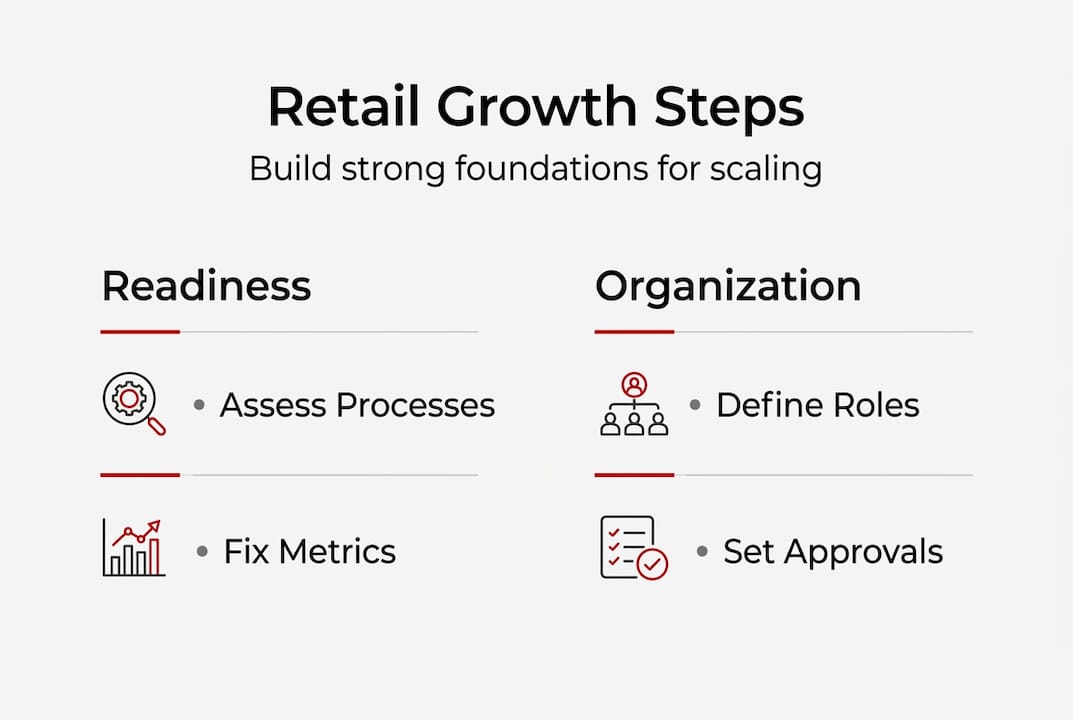
Building the foundation also means getting organizational clarity. Who owns inventory decisions? Who approves new retail partnerships? Who monitors margin performance? Without clear ownership at the operational level, scaling creates chaos instead of growth.
Once your foundation is solid, the next question is which channels deserve your attention and in what order. The answer is almost never “all of them at once.” The multichannel scaling process requires discipline because every channel you add introduces new complexity: different pricing expectations, different logistics requirements, and different customer relationships.
The two primary models for multichannel operations are centralized and decentralized. Here is how they compare:
| Factor | Centralized operations | Decentralized operations |
|---|---|---|
| Inventory control | Single pool, easier to manage | Channel-specific pools, harder to balance |
| Pricing consistency | Easier to enforce MAP policies | Higher risk of channel conflict |
| Fulfillment speed | Depends on single DC location | Can be faster if distributed well |
| Operational cost | Lower overhead at smaller scale | Higher overhead, but more flexible |
| Scaling risk | Single point of failure | More resilient but harder to coordinate |
For most CPG brands in the $500K to $5M range, a centralized model with clear channel rules is the safer starting point. As you push past $5M, a hybrid approach often makes more sense.
Here is a practical, step-by-step approach for expanding into new channels:
The omnichannel retail success framework also matters here. Omnichannel is not about being everywhere. It is about creating a consistent customer experience and a coherent data picture across every touchpoint. If your Amazon inventory, your DTC orders, and your wholesale replenishment are all living in separate systems with no shared visibility, you will make bad decisions on replenishment, pricing, and promotions.

Pro Tip: Treat your pricing architecture as a multichannel strategy tool, not just a margin exercise. If your DTC price is lower than your Amazon price after fees, you are training customers to channel-shop you, which creates long-term brand instability.
Channel strategy only works if your operations can support it. This is where many CPG brands hit their second wall. They have a great multichannel plan on paper, but their tech stack is held together with spreadsheets, manual data entry, and a Shopify account that was never built for wholesale.
Scaling retail operations requires three foundational technology layers:
The retail expansion tips that consultants use most often center on automating the repetitive, high-volume processes first. Reorder triggers, order routing rules, and low-stock alerts are low-hanging fruit that save significant time and reduce costly errors as volume grows.
Automation does not replace judgment. It protects your team’s time and attention so they can apply judgment where it actually matters: pricing decisions, vendor negotiations, and channel strategy.
Common operational bottlenecks to address before scaling include:
The retail strategy best practices that separate brands that scale well from those that stall almost always come back to operational discipline. The brands that invest in their systems before they need them grow faster and more profitably than those that scramble to catch up.
Pro Tip: Before investing in new technology, document your current process flows on paper first. If you cannot describe the process clearly without software, the software will not fix it. Clarity comes before tools.
Growth without measurement is just spending money and hoping. As your retail operations scale, the metrics you track need to evolve alongside the complexity of your business. The KPIs that mattered at $500K in revenue are not the same ones you need to manage at $5M or $15M.
Here is a structured framework for measurement as you scale:
The three most damaging pitfalls in scaled retail measurement are data silos, margin compression, and brand dilution. Ecommerce scaling for retail demands that your data infrastructure keeps pace with your channel footprint.
Data silos happen when each channel reports separately and no one has a consolidated view. The fix is a shared reporting layer, whether that is a BI tool, a shared dashboard, or even a well-structured master data spreadsheet that gets updated consistently.
Margin compression is sneaky. It rarely shows up as a dramatic drop. It shows up as a slow erosion across Amazon FBA fee increases, rising freight costs, retailer chargebacks, and promotional spend that never gets evaluated against its actual return. Track your contribution margin monthly, not quarterly.
Brand dilution happens when you distribute too widely without the operational or marketing support to maintain brand standards. A regional chain that is not executing your planogram correctly, or a third-party Amazon seller undercutting your price, can do long-term damage to your brand equity.
Key metrics to track at scale:
Most scaling guides focus on opportunity. Add a channel, enter a new market, launch a new SKU. What they underplay is the execution complexity that comes with every addition you make. Every new channel is not just a new revenue stream. It is a new set of relationships, compliance requirements, fulfillment demands, and data points that need to be managed.
The expansion tips from consultants that we find most useful are rarely about adding more. They are about building organizational resilience: the ability to absorb disruption, adapt to channel changes, and maintain margin discipline even when growth is messy.
Here is the contrarian view that most guides will not say directly: sometimes the smartest scaling move is to exit a channel, not enter one. If Amazon is generating top-line revenue but contributing negative margin after fees, storage costs, and advertising spend, keeping it active is not a growth strategy. It is a margin leak that is funding a vanity metric.
Disciplined focus, not channel proliferation, is what drives sustainable profitability. The brands we work with that scale most effectively are the ones that know exactly which two or three channels deserve their energy and resources, and they protect that focus aggressively.
Scaling retail profitably across Amazon, Walmart, DTC, and wholesale is not a linear process. It requires structured planning, margin-first thinking, and operational discipline that most brands have to build from scratch.
At RedDog Group, we help CPG brands in the $500K to $20M range build exactly that. From Amazon marketplace management to structured wholesale expansion and contribution-margin analysis, our work is built around measurable outcomes rather than generic advice. If you are ready to build a scalable retail operation that grows without hemorrhaging margin, explore our CPG retail growth offer and see how we can help you build a plan that actually works across every channel you operate.
Start by evaluating your current processes, inventory management, and readiness for multichannel expansion. Gaps in process and resource allocation are the most common barriers to retail growth, so fix those before adding any new channels.
Analyze your target customers, channel-specific margin floors, and operational strengths before committing to any expansion. Industry standards for multichannel growth consistently point to fit, not just opportunity, as the deciding factor.
Implement real-time inventory management, order automation, and channel-level analytics before volume increases. Retail expansion experts consistently identify operational infrastructure as the make-or-break factor in scaling successfully.
Track contribution margin by channel monthly, not just top-line revenue, and watch for margin compression from fees and chargebacks. Omnichannel scaling frameworks help brands build the measurement discipline needed to stay profitable as complexity grows.
Not always, but retail expansion consultants help brands identify margin leaks, implement proven frameworks, and avoid costly mistakes that slow growth. Many brands scale significantly faster with structured external guidance than without it.
Leave a comment: