
Published: March 2020 | Last Updated:April 2026
© Copyright 2026, Reddog Consulting Group.

TL;DR:
- Walmart Marketplace offers a growing, less saturated platform for CPG brands seeking online expansion.
- Success depends on meeting strict operational requirements like documented sales history and high delivery standards.
- Proper preparation and operational discipline enable brands to capitalize on Walmart’s omnichannel growth opportunities.
Most CPG founders treat Amazon as the only game worth playing online. That assumption is costing them real revenue. Walmart Marketplace has been quietly building a digital retail operation that is outpacing expectations, attracting millions of buyers who never shop Amazon, and rewarding early-entry brands with category visibility that would cost far more to buy on competing platforms. If you are a CPG brand operator sitting in the $500K to $20M revenue range and wondering where your next profitable growth channel lives, this guide is built specifically for you.
| Point | Details |
|---|---|
| Rapid marketplace growth | Walmart Marketplace is expanding up to 40% YoY in CPG and related categories. |
| Strict seller readiness | Success requires meeting Walmart’s rigorous seller performance and onboarding standards. |
| Strategic opportunity | Brands prepared to align with Walmart benefit from broader reach and profitable growth. |
| Operational preparation pays off | Brands who plan their entry and operations upfront see better acceptance and long-term results. |
Let’s start by retiring a myth: Walmart Marketplace is not a lower-tier fallback for brands that did not make it on Amazon. That framing is outdated by at least three years. Walmart’s digital marketplace has been growing 20 to 40% year over year, and the platform’s integration with 4,700 physical store locations gives it a structural advantage no pure-play digital marketplace can replicate.
The numbers tell a compelling story. Walmart’s online grocery, health, and household goods categories are attracting a customer demographic that overlaps strongly with CPG buyers. These are value-conscious, household-focused shoppers who buy in volume and return with high frequency. That behavioral profile is exactly who you need discovering your brand.
Here is what sets Walmart Marketplace apart when you look at it through a CPG lens:
A real-world example makes this concrete. The Farallon Brands case study documents a 50% increase in gross merchandise value (GMV) in under six months on Walmart Marketplace. That kind of lift in that timeframe is not typical of a saturated, low-opportunity platform.
| Platform | Annual seller growth | CPG category competition | Omnichannel integration |
|---|---|---|---|
| Walmart Marketplace | 20 to 40% YoY | Lower than Amazon | Yes, 4,700+ stores |
| Amazon | Single-digit growth | Very high | Limited |
| Target Plus | Invite only | Moderate | Yes, but restricted |
For a deeper breakdown of how these platforms stack up on margin and traffic dynamics, the Walmart vs Amazon comparison at RedDog Group walks through the specifics CPG operators care most about. If your goal is profitable growth on Walmart, the platform’s momentum is genuinely working in your favor right now.
“Walmart Marketplace is no longer just a secondary channel. For CPG brands with the right operational foundation, it can become a primary growth engine.”
With these advantages in mind, let’s examine what it actually takes to join and succeed on the Walmart Marketplace.
Walmart does not let everyone in. That selectivity is part of what makes it valuable. The platform’s onboarding process requires a verifiable U.S. business entity, documented sales history, and active product liability insurance. Brands that have been operating exclusively in early-stage DTC or farmers market environments often stumble here because they lack the paper trail Walmart’s team reviews during the application process.
Once you are in, the platform holds you to tight performance standards. Seller metrics Walmart enforces include:
How do these compare to Amazon and other platforms?
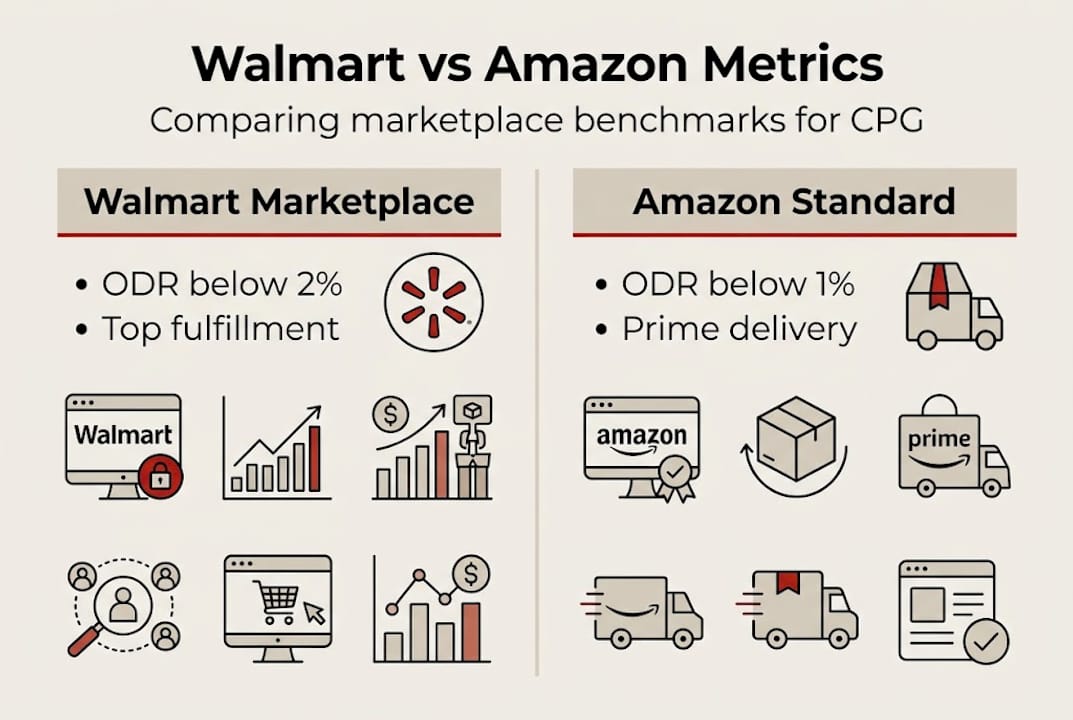
| Metric | Walmart Marketplace | Amazon (standard) |
|---|---|---|
| ODR threshold | Below 2% | Below 1% |
| On-time delivery | 95 to 99% | 97%+ |
| Cancellation rate | Below 2% | Below 2.5% |
| VTR requirement | Above 99% | Above 95% |
Amazon is actually slightly stricter on ODR, but Walmart’s VTR requirement is more demanding. The key difference is enforcement style: Walmart moves quickly on suspensions, and there is less appeals infrastructure than what Amazon sellers have grown accustomed to using.
Here is a numbered preparation sequence that CPG brands should work through before applying:
Pro Tip: Apply to Walmart Marketplace before your peak season, not during it. Brands that apply during their highest-volume months often cannot maintain the metrics Walmart requires while also managing fulfillment spikes. Build your operational baseline first, then time your application for a lower-velocity period.
For a more detailed walkthrough of the application steps, the guide on selling on Walmart Marketplace covers the full process from business registration to first live listing.
Clearing the operational bar opens the door to Walmart’s strategic growth levers for CPG brands.
The most obvious benefit is reach. Walmart’s customer base is enormous, geographically distributed, and actively purchasing in CPG categories every single week. When your brand appears in Walmart Marketplace search results, you are showing up to buyers who already have purchase intent and a Walmart account linked to a saved payment method. That is a meaningfully warmer audience than cold digital advertising delivers.

The omnichannel dimension matters even more. Curated shopping experiences tied to in-store and online behavior are driving mid-market growth across retail, and Walmart is positioned at the center of that trend. A buyer who discovers your product online and adds it to their Walmart cart may pick it up in-store next week. That dual-channel brand touchpoint is something you simply cannot manufacture on a pure digital platform.
Here is where CPG brands are seeing the most strategic lift from Walmart Marketplace:
Pro Tip: Do not launch every SKU at once. Identify your two or three highest-velocity products with the strongest margins and lead with those. Establish your seller health scores on a smaller catalog, then expand once your operational metrics are consistently strong.
Effective marketplace management strategies are what separate brands that scale sustainably from those that spike and then burn out. And if you want to understand how Walmart fits into a broader expansion model, the framework in CPG marketplace expansion strategies is worth building into your planning process.
Now, let’s turn insights into action. Here is how to set your brand up for Walmart success.
Preparation is not just about passing Walmart’s application. It is about building the operational infrastructure that keeps you from getting suspended six months after you launch. The brands that treat Walmart entry as a sprint often find themselves dealing with account health issues within the first quarter. The ones that treat it as a foundation build lasting channel equity.
Start with this readiness checklist before you submit a single application:
The onboarding requirements Walmart enforces at the application stage are not arbitrary. They exist because Walmart knows operationally weak sellers damage buyer trust at scale. Meeting those requirements upfront signals that your brand is ready to be a real retail partner, not a test case.
Pro Tip: Before applying to Walmart, spend 60 days tightening your fulfillment metrics on your existing channels. If your Amazon on-time delivery is at 91%, fix it before you add another platform. Walmart will not fix your operational problems. It will just surface them faster.
For a broader operational framework, the marketplace management guide covers the systems and processes growth-stage brands need across channels. And when you are ready to think about demand generation alongside your expansion, ecommerce marketing solutions can help you build the traffic strategy to match your new Walmart presence.
Here is what too few CPG founders truly appreciate about Walmart Marketplace expansion.
Most of the brands we work with come in believing that Walmart is easier than Amazon. Less competitive, more forgiving, lower stakes. That framing is exactly what gets them into trouble. Walmart is not harder than Amazon in every dimension, but it is unforgiving in specific ways that catch underprepared brands completely off guard. The VTR requirement alone eliminates a large percentage of brands that are relying on outdated fulfillment processes.
The bigger misconception is about what Walmart actually rewards. It is not the loudest brand or the one with the biggest ad budget. Walmart rewards operational discipline. Consistent on-time shipments, accurate inventory, clean listings, and strong customer experience scores. Those inputs compound over time into better organic placement, higher review counts, and ultimately better margin efficiency because you are not spending as much on ads to compensate for weak organic visibility.
We also see brands rush the entry process because they heard about a competitor launching on Walmart. That urgency is understandable, but acting before you have the operational foundation in place is how you get suspended and spend weeks trying to recover an account rather than building sales. Speed into a new channel without preparation is not a competitive advantage. It is a liability.
The brands that win on Walmart long term are the ones treating it as a retail partnership, not a listing exercise. They invest in effective marketplace strategies that align with how Walmart thinks about its marketplace ecosystem. That alignment, built deliberately and maintained consistently, is what generates durable CPG growth.
Having learned what it takes to succeed, here is how to act on it.
Getting into Walmart Marketplace is achievable for prepared CPG brands. But the gap between knowing what to do and executing it profitably is where most brands lose time and margin. At RedDog Group, we work with CPG founders in the $500K to $20M range who are ready to expand into Walmart with a real strategy behind them.
We help you assess operational readiness, build your catalog for Walmart’s content standards, map your fulfillment economics, and position your brand for the kind of category growth the platform’s momentum is already generating. If you want expert support before, during, or after your Walmart launch, visit RedDog Group to learn how we approach CPG marketplace expansion with a margin-first lens.
CPG brands need a U.S. business entity, at least 6 to 12 months of documented sales history and insurance, and must maintain strict performance metrics including an ODR below 2% and a VTR above 99%.
Walmart Marketplace is achieving 20 to 40% year-over-year growth, outpacing most direct competitors in core CPG categories, with documented examples like Farallon Brands hitting 50% GMV growth in under six months.
Most rejections come from missing sales history or insurance documentation, while suspensions typically result from failing to meet ODR or VTR thresholds after launch.
Brands that meet Walmart’s onboarding and performance standards can capture real category growth, but brands without established sales history or operational infrastructure often face rejection and should build those foundations first.
Leave a comment: