
Published: March 2020 | Last Updated:April 2026
© Copyright 2026, Reddog Consulting Group.

TL;DR:
- Building integrated workflows across channels improves profitability and prevents operational cracks.
- A phased channel rollout starting with DTC, then Amazon, then retail reduces risk.
- Cross-channel promotion and data integration drive significant growth and brand loyalty.
Growing a CPG brand past $500K often feels manageable on one channel. The moment you expand to a second or third, cracks appear fast. Ad budgets bleed without attribution. Teams duplicate work across Amazon, DTC, and soon, a new phased channel rollout becomes a scramble instead of a strategy. These aren’t execution failures. They’re workflow failures. The brands that scale profitably to $5M, $10M, and beyond don’t just work harder. They build systems that make each channel reinforce the next. This guide gives you a structured, evidence-backed approach to designing and optimizing your digital marketing workflow across Amazon, DTC, and the broader retail ecosystem.
| Point | Details |
|---|---|
| Phased rollout reduces risk | Launching channels sequentially lets you validate offers and optimize before large investments. |
| Channel-specific workflows win | Customizing ads, listings, and budgets for each channel leads to higher returns and lower cost per order. |
| Unified data unlocks efficiency | Integrating order management and promo calendars prevents cannibalization and drives sustainable growth. |
| Email automation multiplies orders | A coordinated email workflow can increase your multichannel orders by nearly 5X. |
| Focus on process, not hacks | Continuous workflow improvement beats chasing short-lived tactics for long-term brand success. |
Before you add a channel, you need to know where your current workflow actually breaks. Most CPG brands in the $500K to $20M range have the same blind spots: fragmented data, no single owner per channel P&L, and a promotional calendar that lives inside someone’s head.
A proper workflow audit covers four core components:
Here’s a quick benchmark for where brands in your revenue range typically stand:
| Component | $500K to $2M status | $2M to $20M status | Growth-ready standard |
|---|---|---|---|
| Data aggregation | Manual/spreadsheet | Semi-automated | Real-time OMS + reporting |
| Attribution | Last-click only | Multi-touch partial | Full cross-channel attribution |
| Channel P&L ownership | CEO owns all | Split by product | Owner per channel |
| MAP pricing enforcement | None | Ad hoc | System-enforced daily |
The role structure matters as much as the tools. Think of DTC as your data engine: it gives you first-party customer insight you can’t get from marketplace orders. Amazon is your discovery channel, where new customers find you through search intent. And multichannel workflow success across all three only happens when each channel has a dedicated owner who understands its margin profile.
Channel integration means unified data and order management systems are essential for brands that want to stop flying blind. Without a shared OMS and MAP pricing system, your teams will always be reacting instead of optimizing. See how a workflow for retail growth is structured for brands building these foundations.
Pro tip: Run a workflow audit every quarter, not just before you launch a new channel. What worked at $1M often creates bottlenecks at $3M.
Once you know your gaps, the next question is sequence. The biggest mistake CPG brands make is launching everywhere at once and then wondering why margins collapse.
A phased rollout reduces risk and is the recommended approach for CPG brands that want to learn fast without burning cash. The sequence that works most consistently is: DTC first, then Amazon, then retail or marketplace expansion like scaling omnichannel success.
Why this order?
| Factor | phased rollout | simultaneous omnichannel |
|---|---|---|
| Risk level | Low, controlled | High, unpredictable |
| Data quality | Clean, channel-specific | Mixed, hard to attribute |
| Cash flow impact | manageable | Heavy upfront pressure |
| Time to profitability | 6 to 9 months per phase | 12 to 18+ months |
| Team requirements | Small, focused | Large, specialized |
The technology you need evolves with each phase. At DTC launch: a reliable email platform and basic analytics. At Amazon: a listing optimization tool and bid management software. At retail/marketplace expansion: an OMS and a scalable growth strategy that connects inventory, pricing, and promotions across all points of sale.

Pro tip: Cap any single marketplace at 40 to 50% of total revenue. Channel concentration risk is real. If Amazon’s algorithm shifts or a new fee structure hits, you don’t want your business to be collateral damage.
Knowing the sequence is step one. Building the actual operational workflow inside each channel is where execution determines whether your margins hold.
Budget allocation and bidding
When running Amazon and marketplace simultaneously, a 80/20 budget split favoring Amazon initially is a practical starting point. Set your initial bids on Amazon based on category benchmarks, then share keyword data quarterly to inform your approach on other platforms.
Why separate optimization matters
Amazon and its search algorithms reward conversion rate, velocity, and keyword match. Different marketplace algorithms factor in different signals entirely, including price competitiveness and fulfillment speed. Their buyer demographics also differ. AI listing optimization specifically for each platform’s algorithm can drive dramatically better results than generic copy.
Your weekly channel workflow should include:
The multichannel listing optimization process should treat each channel as a distinct asset, not a copy-paste job.
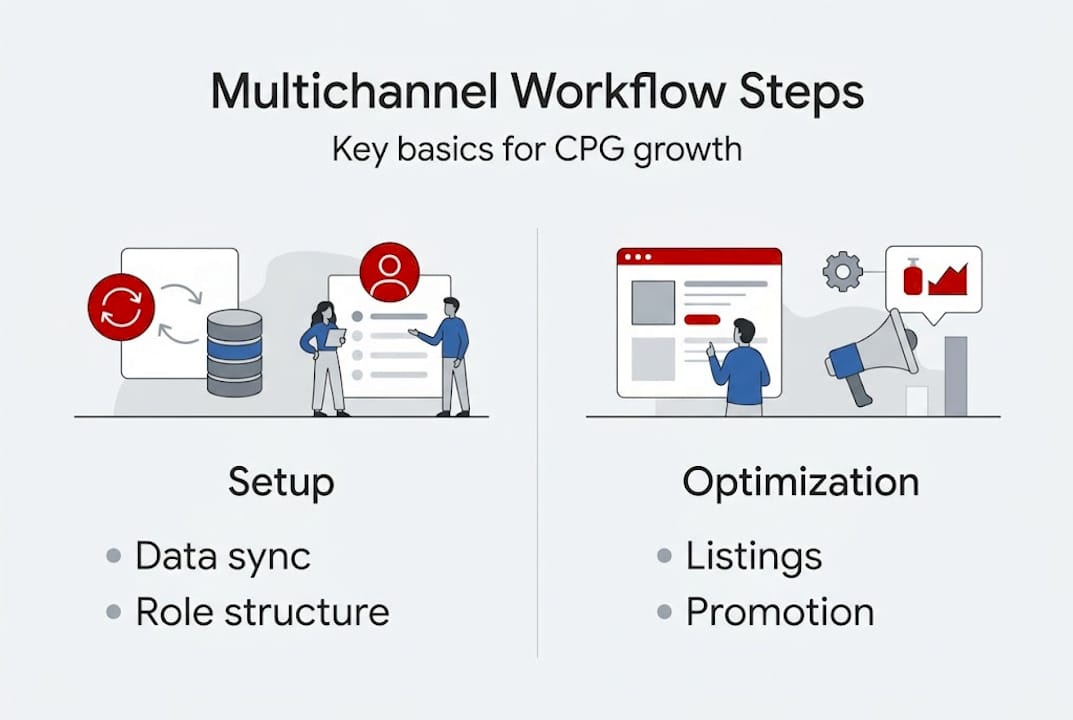
Never copy Amazon listings directly to another marketplace. Re-optimize every title, bullet, and backend attribute for the destination platform’s algorithm and shopper intent. This extra work pays off. Your guide to selling on that platform and your understanding of channel differences will shape how aggressively you can bid and how fast you build velocity.
Pro tip: When expanding to a second marketplace, re-write product listings from scratch using the destination platform’s AI tools. The effort compounds over time as the algorithm rewards platform-native content.
Getting each channel to perform individually is table stakes. The brands that pull ahead are the ones that tie their channels together at the data and promotion layer.
Start with your promotional calendar. Every planned sale event, coupon window, or ad push should be mapped across all active channels simultaneously. When Amazon runs a deal and your DTC site runs an uncoordinated promotion at a deeper discount, you’re training customers to shop for the lowest price instead of building loyalty.
Critical integration points to build:
Email automation is the highest-leverage tool most CPG brands underuse. Cross-channel email workflows can increase multichannel orders by 494%. That’s not a rounding error. That’s the difference between a channel that breaks even and one that actually compounds.
Performance benchmarks to build toward: DTC email open rates of 45 to 55%, click-through rates of 4 to 10%, and cart abandonment recovery at 70% of triggered emails. These are achievable when your segmentation and automation are dialed in. If you’re nowhere near these numbers, the gap is almost always a workflow problem, not a creative problem.
Cross-channel coordination through omnichannel merchandising practices ensures your promotions build brand equity instead of eroding it. When every channel tells the same story at the right price, the whole system grows faster.
Here’s the uncomfortable truth we see repeatedly with brands that plateau around $3M to $5M: they got there on tactics. A hot Amazon keyword. A viral social moment. A flash sale that spiked DTC for a quarter. Then growth stalls and they go looking for the next hack.
The problem isn’t that tactics don’t work. They do, briefly. The problem is that tactics without workflow infrastructure don’t compound. Each win is isolated. There’s no system to capture the learning, replicate the result, or translate it across channels.
Workflow is what turns a one-time win into a repeatable process. When you run a strong Amazon Prime Day campaign, a workflow captures keyword data, feeds it back into your listing strategy, syncs your DTC email promotion, and adjusts your OMS for inventory. A tactic just runs the campaign and moves on.
DTC is demand creation at the highest margin. marketplaces are demand capture at compressed margins. The brands that understand this distinction and build workflows that serve both functions systematically are the ones that make it to $10M and beyond.
Check out growth workflow case studies from brands that made this shift. The pattern is consistent: workflow investment before channel expansion, not after the fire starts.
Pro tip: Schedule a quarterly workflow review as a fixed calendar event, not a reaction to a bad month. The brands building compounding advantage are doing this proactively.
Building a profitable multichannel workflow from scratch takes time and costs margin mistakes along the way. If you want to avoid the trial and error that slows most brands down, structured support accelerates both the learning and the results.
At RedDog Group, we work with CPG brands in the $500K to $20M range to build the exact workflow infrastructure covered in this guide. From channel P&L audits to cross-channel promo calendars and OMS integration, our approach is margin-focused and built around your specific economics. Whether you’re launching your first secondary channel or untangling an overcomplicated omnichannel setup, we build the systems that make profitable growth repeatable. Visit reddog.group to connect with our team and start with a focused workflow assessment.
A phased rollout, starting with DTC, then Amazon, then broader retail, minimizes risk and maximizes the learning you carry into each new channel.
Start with an 80/20 budget split favoring Amazon and set bids on secondary platforms 30 to 40% lower to account for differences in cost-per-click and traffic volume.
Each platform’s algorithm scores listings differently, and AI re-optimization for the destination platform’s signals and buyer demographics can meaningfully increase your visibility and conversion rate.
Coordinate your promo calendar and enforce MAP pricing daily through a real-time monitoring system so no channel undercuts another and confuses buyers on price.
A coordinated cross-channel email workflow aligned with your promotional calendar can increase total multichannel orders by as much as 494%.
Leave a comment: