
Published: March 2020 | Last Updated:April 2026
© Copyright 2026, Reddog Consulting Group.

TL;DR:
- Marketplaces are high-cost, demand capture channels that should complement but not replace owned channels.
- Fee structures and advertising costs often erode margins, making strategic management essential.
- Successful brands leverage marketplace data as a competitive asset and build diversified, margin-focused omnichannel strategies.
Treating a marketplace like a digital shelf is one of the most expensive mistakes a CPG brand can make. Amazon, Walmart, and Kroger’s marketplace platforms are not passive distribution points. They are complex, fee-heavy ecosystems where margin can evaporate faster than revenue grows. Many emerging brands chase top-line sales on these platforms without understanding what they actually keep after fees, ads, and fulfillment costs. This guide breaks down the real economics, the strategic role these platforms should play in your channel mix, and the practical frameworks that separate brands that scale profitably from those that spin their wheels.
| Point | Details |
|---|---|
| Marketplaces are complements | Third-party platforms like Amazon should support, not replace, your DTC and wholesale efforts. |
| Margin risk is real | Fees and advertising can consume over 35% of revenue, demanding vigilant margin management. |
| Omnichannel integration matters | Marketplace success requires coordinated strategies combining demand capture and brand-driven demand creation. |
| Protect your data | Safeguard customer relationships and first-party data by diversifying and balancing platforms with owned channels. |
| Growth needs purposeful orchestration | Mixing marketplaces into your omnichannel plan purposely unlocks long-term CPG growth, not just quick sales. |
A third-party marketplace is any platform where brands sell products to consumers through a host platform’s infrastructure rather than their own storefront. Amazon Seller Central, Walmart Marketplace, and Kroger Ship are the most relevant for CPG brands in the U.S. These platforms give you access to massive built-in audiences, fulfillment networks, and search-driven purchase intent. That is genuinely powerful. But the mechanics are very different from running your own direct-to-consumer (DTC) site or selling wholesale to a retailer.
In wholesale, you sell a case of product to a buyer at a negotiated price. The retailer handles everything after that. In DTC, you own the customer relationship, the data, and the experience. Marketplaces sit in a different lane entirely. You are essentially renting shelf space in a high-traffic mall, paying a cut of every sale, and competing for visibility through paid placement. The platform controls the search algorithm, the buy box, and the customer relationship. You control the listing and the product.
Here is what marketplaces do well for CPG brands:
But the risks are real and often underestimated. You rarely capture first-party customer data on these platforms. You cannot retarget a customer who bought your hot sauce on Amazon. You also face margin compression from fees, increasing ad costs, and the constant threat of algorithm changes or account suspensions.
“Marketplaces are an omnichannel complement, not a replacement for DTC or wholesale.”
This framing matters. Brands that treat marketplaces as their primary or only channel are building on rented land. The smarter play is to use them as one node in a broader strategy. If you want to see examples of marketplace strategies that balance reach with margin discipline, the contrast between high-volume and high-margin approaches is instructive. Solid marketplace retail management starts with knowing exactly what role each platform plays in your overall growth plan.
This is where most brands get surprised. The revenue number looks great. The margin number tells a different story.

Let’s start with Amazon. Amazon fees include referral fees typically around 15% and FBA fulfillment fees that can add another 20 to 30% depending on product size and weight. That is before you spend a single dollar on advertising. Add in storage fees, return processing, and co-op costs, and you can easily be looking at 50% or more of your revenue going back to the platform before you account for your cost of goods.
Walmart Marketplace has a similar structure, though its fulfillment fees through WFS are often slightly lower. The trade-off is lower organic traffic volume compared to Amazon, which means ad spend often needs to be higher to drive visibility.
| Fee type | Amazon estimate | Walmart estimate |
|---|---|---|
| Referral fee | ~15% | 6 to 15% |
| Fulfillment fee | 20 to 30% | 8 to 20% |
| Advertising (CPC) | Variable | Variable |
| Storage fees | Seasonal spikes | Moderate |
CPC stands for cost-per-click, the amount you pay each time a shopper clicks your sponsored ad. ACOS (advertising cost of sale) is the percentage of ad-driven revenue spent on ads. A 30% ACOS means you spent $30 in ads for every $100 in ad-attributed sales. For many CPG categories, a 30% ACOS is considered acceptable. But when layered on top of referral and fulfillment fees, it can push your true contribution margin into negative territory.
Here is how to approach marketplace economics more strategically:
Pro Tip: If your landed cost of goods is above 35% of your retail price, marketplace economics become very difficult to make work without premium pricing or high velocity. Run the math before you commit to a platform.
For a deeper look at how to structure your approach, CPG marketplace growth strategies that start with margin first tend to outperform those chasing revenue rank.
Marketplaces are exceptional at one thing: capturing demand that already exists. A shopper searching “organic protein powder” on Amazon is ready to buy. Your listing either wins that moment or it does not. This is demand capture, and marketplaces are built for it.
What they are not built for is demand creation. Building brand awareness, educating a new consumer, or developing loyalty requires channels you control. Your DTC site, email list, social presence, and retail shelf presence all play roles that marketplaces simply cannot replicate. Upper-funnel demand creation is needed alongside marketplace demand capture, and brands that ignore this split end up with fragile, platform-dependent revenue.
Here is a practical comparison of how these channel types function:
| Channel | Primary function | Customer data ownership | Margin profile |
|---|---|---|---|
| Amazon/Walmart marketplace | Demand capture | Platform owns it | Lower, fee-heavy |
| DTC website | Demand creation and capture | Brand owns it | Higher, variable |
| Wholesale/retail | Demand capture at shelf | Retailer owns it | Moderate, predictable |
The optimistic case for marketplaces is real. Brands that invest in platform optimization, including content quality, review velocity, and fulfillment performance, can drive meaningful profitable growth. Walmart’s Sales Rewards program, for example, incentivizes brands that hit GMV (gross merchandise value) thresholds with promotional support, which can compound growth when managed well.
Best practices for building a channel mix that holds up:
Pro Tip: Your marketplace presence can actually support retail buyer conversations. Strong Amazon sales velocity signals consumer demand. Use that data proactively when pitching regional or national retailers.
For a structured approach to channel integration, omnichannel retail growth frameworks help you map each platform’s role against your margin and growth objectives. If you are evaluating which platforms belong in your stack, a review of best omnichannel platforms can sharpen that decision.
The risks of marketplace dependence are not hypothetical. They are well-documented and, for many brands, financially damaging.
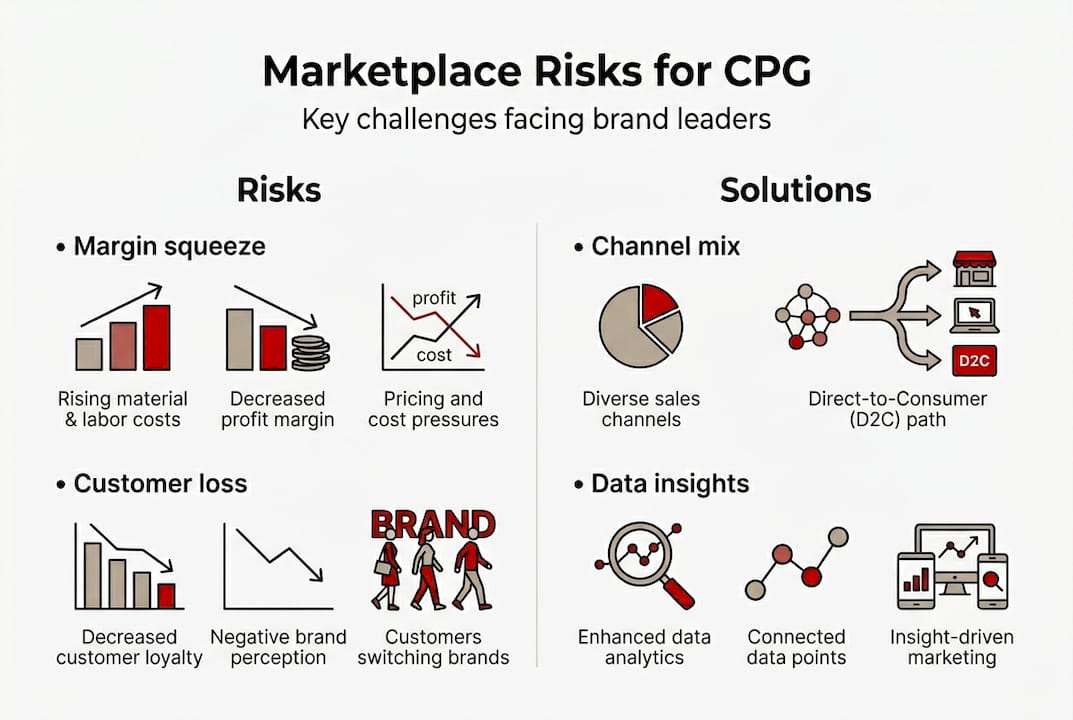
Start with the math. Platform extraction through fees and ads can consume more than 50% of revenue for brands that are not actively managing their cost structure. That is not a worst-case scenario. For brands in competitive categories with high ad dependency, it is closer to the norm.
Here are the most common pitfalls and how to address them:
Risks outweigh rewards without strategy: margin squeeze, loss of first-party data, and platform dependency all compound when brands lack an owned-channel counterbalance.
The solution is not to avoid marketplaces. It is to treat them with the same financial discipline you would apply to any high-cost, high-volume sales channel. Strong marketplace management strategies build in margin floors, diversification timelines, and data capture plans from day one. If you are thinking about scaling omnichannel retail beyond a single platform, the operational complexity increases, but so does your resilience.
Here is the uncomfortable truth we see repeatedly working with brands in the $500K to $20M range: the brands that struggle most on marketplaces are not the ones with bad products. They are the ones treating platforms as order pipelines instead of strategic assets.
Marketplaces generate enormous amounts of data. Search term reports, conversion rates by listing, return reasons, and review sentiment all tell you something about your customer, your product, and your positioning. Most brands extract the order and ignore the signal.
The brands that win treat marketplace data as capital. They use it to sharpen their DTC messaging, inform product development, and build the case for retail expansion. A strong Amazon marketplace consulting relationship is not just about ad optimization. It is about turning platform intelligence into a competitive advantage across every channel you operate.
Strategic orchestration beats scattershot channel expansion every time. Being on every platform is not a strategy. Knowing exactly what each platform is supposed to do for your brand, and holding it accountable to that role, is.
Understanding marketplace economics is one thing. Executing against them while managing inventory, cash flow, and channel mix is another challenge entirely.
At RedDog Group, we work with CPG brands that are serious about margin-first marketplace growth. Whether you need a full omnichannel growth consulting strategy or focused support on Amazon growth consulting, we bring the analytical rigor and operational experience to help you scale without bleeding margin. If your marketplace revenue is growing but your profitability is not, that is exactly the problem we are built to solve. Let’s talk.
Amazon fees including referral and FBA can reduce gross margin by 35% or more before advertising, making channel-level P&L tracking essential for any brand selling at scale.
Platform extraction through fees and ads can consume more than half of revenue, and deep dependency means brands lose both customer data and pricing control over time.
Marketplaces complement owned channels by capturing existing demand, but brands need DTC and wholesale to build customer relationships and generate first-party data that platforms do not share.
Rising CPC and ACOS costs make margin protection an active discipline, requiring brands to audit ad efficiency, diversify channels, and build owned-channel data capture to reduce platform dependency over time.
Leave a comment: