
Published: March 2020 | Last Updated:April 2026
© Copyright 2026, Reddog Consulting Group.

TL;DR:
- Optimizing site speed and listing quality across all channels drives significant revenue and margin growth.
- Continuous, small improvements and cross-channel insights build lasting competitive advantage in CPG retail.
- Regular monitoring and strategic channel-specific tactics are essential for sustained omnichannel success.
Growing a consumer packaged goods (CPG) brand across direct-to-consumer (DTC), Amazon, and Walmart simultaneously is one of the most operationally demanding challenges in retail today. Each channel has its own ranking signals, fee structures, and customer expectations. A 1% improvement in conversion rate on your DTC site, combined with a stronger Walmart Listing Quality Score, can produce compounding margin gains that dwarf any single marketing spend. This guide breaks down exactly what to optimize, where to focus first, and how to build a measurement rhythm that keeps your multi-channel operation improving month after month.
| Point | Details |
|---|---|
| Speed drives sales | Even small improvements in site speed reduce abandonment and boost revenue across channels. |
| Differentiate pricing by channel | Set Amazon and Walmart prices or bundles strategically to protect your DTC margins. |
| Listing quality matters | Optimized content and inventory on Walmart and Amazon maximize visibility and sales. |
| Continuous improvement yields results | Ongoing testing and adjustment ensure your optimization gains don’t stall over time. |
Before you start tweaking pages or relisting products, you need clarity on what actually moves the needle. For CPG brands operating across multiple channels, the wrong metrics will send you in circles. The right ones will surface margin leaks and conversion gaps fast.
Here are the core metrics every CPG operator should track:
The data is clear on why speed matters: 40% of buyers abandon a site that takes longer than 3 seconds to load, and Walmart has measured a 2% sales increase for every second of load time improvement. That is not a rounding error. That is real revenue.
Competitive pressure on Amazon and Walmart makes these metrics even more important. Both platforms algorithmically reward listings and seller accounts that convert well, stay in stock, and maintain strong reviews. A poorly optimized DTC site that confuses customers also damages your brand perception when those same customers find you on a marketplace.
Pro Tip: Do not measure your DTC site and your marketplace listings in separate silos. Customers move between channels. A slow DTC site can drive customers to find you on Amazon, where you pay referral fees and lose control of the relationship. Monitor both together.
For a deeper look at what optimizing ecommerce sites actually requires at the operational level, it starts with these foundational metrics.
Your DTC site is the one channel you fully control. That makes it both your highest-margin opportunity and your most neglected asset. Most emerging CPG brands underinvest here, assuming that Amazon and Walmart will carry the volume. That thinking costs margin.
Here is a practical, step-by-step checklist for speed and conversion improvements:
The 40% abandon rate for sites exceeding 3 seconds of load time applies whether you are running a $200K DTC operation or a $10M one. The standard benchmarks are LCP under 2.5 seconds and TTFB under 200 milliseconds.

| Metric | Common baseline | Target benchmark | Impact of improvement |
|---|---|---|---|
| LCP | 4.2 seconds | Under 2.5 seconds | Reduce bounce rate by up to 40% |
| TTFB | 600ms | Under 200ms | Faster server response, better SEO |
| Image file size | 800KB per image | Under 200KB | Faster load on mobile networks |
| Conversion rate | 1.2% | 2.5% or higher | Direct revenue multiplier |
Pro Tip: Google PageSpeed Insights is free and gives you a prioritized list of exactly what to fix. Start with the items labeled “Opportunities” before touching anything else. You can realistically move your score 20 to 30 points in a weekend.
Strong site speed also feeds your ecommerce SEO best practices since Google uses Core Web Vitals as a ranking signal. Better rankings mean lower customer acquisition cost. And when you focus on improving ecommerce conversion rates, you are compounding the value of every marketing dollar already being spent.
With your DTC store tightened up, the next leverage point is your marketplace presence. Both Amazon and Walmart use algorithmic ranking systems that reward sellers who meet specific quality thresholds. Ignoring these systems is leaving discoverability on the table.
On Walmart specifically, the Listing Quality Score evaluates five core factors:
High scores on these dimensions unlock the Pro Seller badge, which increases click-through rates meaningfully. This is not a vanity metric. It directly affects your sales volume and your ability to compete against larger, established brands.
“Brands that treat listing optimization as a quarterly task rather than a continuous process consistently underperform against competitors who treat it as a weekly discipline.”
On pricing, the margin protection strategy matters as much as the listing itself. Price differentiation across channels is not just allowed, it is essential for protecting your contribution margin.
| Channel | Pricing strategy | Pros | Cons |
|---|---|---|---|
| DTC | Lowest price, highest margin | Full margin capture, customer data ownership | Higher acquisition cost |
| Amazon | Price above DTC by 10 to 15% | Offsets FBA fees, protects DTC channel | Algorithmic price suppression risk |
| Walmart | Competitive with Amazon, use bundles | Volume opportunity, strong discovery | WFS (Walmart Fulfillment Services) fee pressure |
The tactical moves that protect margin are bundles, multi-packs, and channel-exclusive sizes. A 3-pack on Amazon at a premium price point is harder for Walmart to price-match against and harder for competitors to undercut directly. Dynamic pricing tools like Feedvisor or Wiser can automate these adjustments at scale.
For more on how to structure your channel assortment, the ecommerce merchandising best practices framework is a strong starting point.
Optimization is not a project with an end date. It is a rhythm. Brands that build a regular measurement cadence consistently outperform those that treat it as a one-time effort.
Here is a practical monthly and quarterly task list:
The tools worth tracking across channels include:
Protecting margins requires ongoing monitoring of pricing, fees, and inventory dynamics across channels. It is not a set-and-forget system.
Pro Tip: Build a one-page optimization checklist your team can run without you. Document the tools, the benchmarks, and the escalation criteria. That checklist becomes a business asset, not just a task list.
For teams ready to connect their measurement to a broader growth system, the resources on scaling ecommerce profits and omnichannel strategy process provide the connective tissue between data and decision-making.
Here is what we see repeatedly with emerging CPG brands: they optimize in bursts. A founder gets excited about conversion rates after a slow quarter, runs a sprint of changes, sees a small lift, then moves on to the next fire. Three months later, the gains have eroded and nothing was learned.
The brands that build lasting multi-channel advantage treat optimization differently. They do not ask “did this change work?” They ask “what did this channel teach us about our customer, and how does that apply everywhere else?”
A DTC page that converts better because of a simplified headline is telling you something about your customer’s decision criteria. That insight belongs on your Amazon bullets and your Walmart product description too. Most brand operators never make that connection.
The other trap is single-channel thinking. A brand obsesses over their Amazon conversion rate while their DTC site is leaking margin through slow load times and a confusing checkout. Or they nail their DTC site but ignore Walmart Listing Quality Scores, and their marketplace visibility quietly collapses.
The brands that win in CPG treat every website tweak as a multiplier, not a cost. The competitive edge in 2026 is not a single breakthrough. It is a hundred small improvements executed consistently, across every channel. When choosing where to invest, selecting the best omnichannel platforms is part of that strategic foundation.
Implementing these optimization strategies across DTC, Amazon, and Walmart simultaneously requires both analytical rigor and hands-on marketplace experience. Most emerging CPG brands have the ambition but not the bandwidth to execute across all three channels at once.
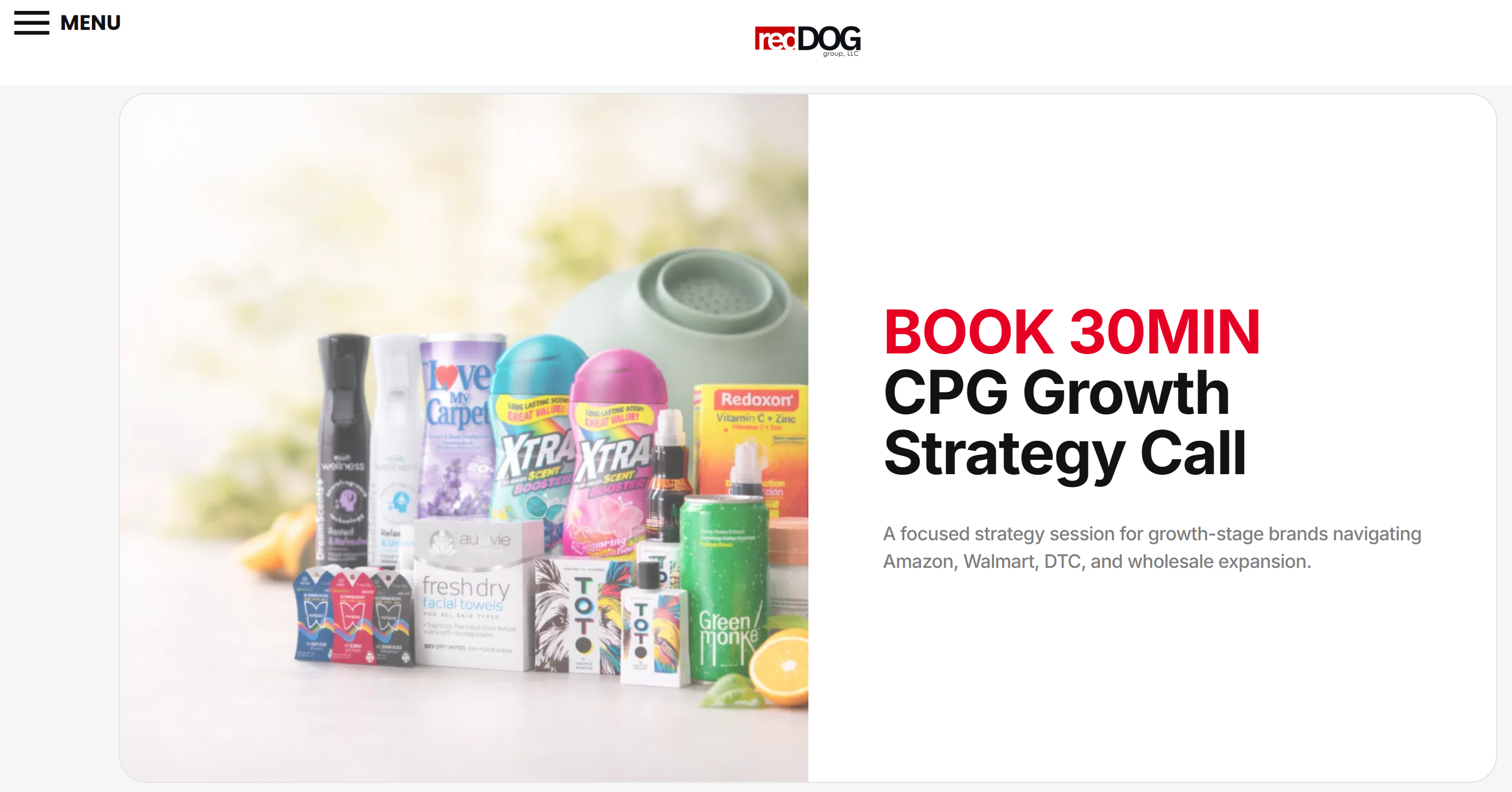
At RedDog Group, we work with CPG brands in the $500K to $20M revenue range to build margin-first, multi-channel growth systems. From Amazon growth consulting to full omnichannel growth services, our approach is built around contribution margin, not just top-line numbers. If you are ready to move from reactive optimization to a structured growth engine, we would like to show you exactly where your margin opportunities are hiding.
The highest-impact change is improving site speed, which reduces bounce rate and lifts sales across every channel. 40% of buyers abandon sites that take more than 3 seconds to load, and Walmart reports a 2% sales boost per second of improvement.
Use price differentiation by channel, offer unique bundles or pack sizes, and regularly audit fees and storage costs. Price Amazon and Walmart above your DTC price to offset fulfillment fees and protect your direct channel.
Your Listing Quality Score depends on content completeness, price competitiveness, shipping performance, customer ratings, and in-stock availability. High scores unlock the Pro Seller badge and improve your search visibility.
Review your website and channel optimization at least quarterly, with monthly checks on site speed, listing scores, and contribution margin for fast-moving CPG categories.
Leave a comment: