
Published: March 2020 | Last Updated:April 2026
© Copyright 2026, Reddog Consulting Group.

TL;DR:
- Demand generation builds new awareness and desire among consumers not actively shopping yet.
- Most CPG brands over-invest in demand capture, risking stagnant growth and margin erosion.
- Effective demand generation involves multichannel strategies, rigorous testing, and long-term brand focus.
Most CPG brand founders and marketing executives treat demand generation and demand capture as the same thing. They are not. Mixing them up is one of the most expensive strategic mistakes a growing brand can make. When you pour budget into capturing demand that does not yet exist, or when you measure brand-building the same way you measure a coupon drop, you end up with stunted growth and margin leaks you can not explain. This guide breaks down what demand generation actually means for CPG brands, how it differs from demand capture, and how to build a strategy that drives profitable, multichannel growth across every channel you operate.
| Point | Details |
|---|---|
| Demand generation defined | It’s about creating new demand and brand awareness, not just closing sales. |
| Demand generation vs capture | Mixing both strategies helps CPG brands grow profit and reach new shoppers. |
| Multichannel is key | Effective demand generation spans CTV, streaming audio, and digital brand building. |
| Measure and optimize | Success comes from incrementality testing and continuously refining your approach. |
Demand generation is not a campaign type. It is a business function. At its core, demand generation is about creating net-new awareness and desire for your brand among people who are not actively looking to buy yet. You are pulling new shoppers into your brand’s universe, not just catching people who are already in the aisle.
For CPG brands specifically, demand generation builds brand awareness and emotional connections through channels like connected TV (CTV), streaming audio, digital video, and sponsored content. The goal is to plant the seed before the shopper reaches the shelf or opens Amazon.
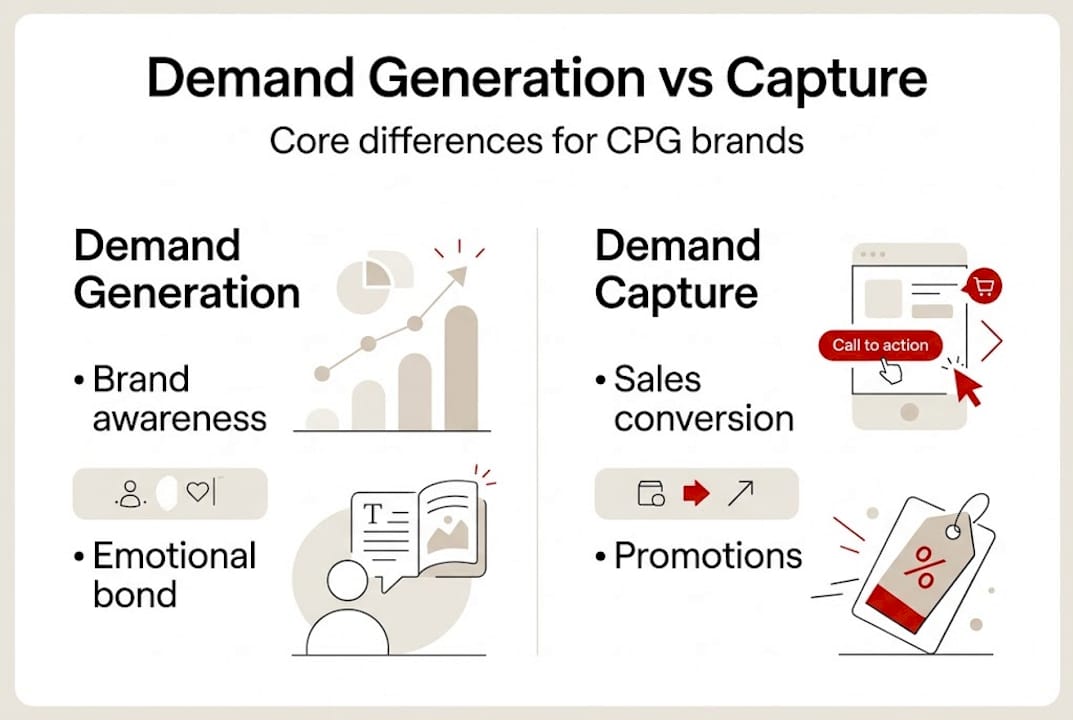
This is fundamentally different from demand capture, which we will cover in the next section. Demand generation asks: How do we make people want our brand before they know they need it? Demand capture asks: How do we convert people who already want to buy right now?
Here is a quick look at what actually counts as demand generation for a CPG brand:
“Demand generation in CPG is about reaching consumers before they are ready to buy, building the kind of brand recognition that pays dividends across every channel later.”
A strong lead generation workflow sits downstream from demand generation. First you create awareness, then you convert it. Getting the sequence right changes everything about how your marketing dollars perform.
Here is where most emerging CPG brands go wrong. They invest almost entirely in demand capture because it feels safer. You can see the ROAS. You can track the sponsored product click. But CPG brands historically allocate 50% of ad spend to shopper marketing, which is pure demand capture, and the data now points to a 50/50 split as the recommended approach for sustainable growth.
Demand capture includes your retail media buys, your search ads, your trade promotions, and your digital coupons. These tactics work on shoppers who are already looking. Demand generation works on shoppers who are not looking yet but could become loyal, high-value customers.
Here is a side-by-side comparison to make the distinction concrete:
| Dimension | Demand generation | Demand capture |
|---|---|---|
| Goal | Create new awareness and desire | Convert existing intent |
| Audience | Non-aware or early-stage shoppers | In-market, ready-to-buy shoppers |
| Channels | CTV, streaming audio, influencer, brand content | Retail media, search ads, coupons, trade promo |
| Measurement | Brand lift, new-to-brand sales, awareness | ROAS, conversion rate, cost per acquisition |
| Time horizon | Long-term brand equity | Short-term sales activation |
When you over-index on capture and neglect generation, you eventually run out of warm demand to harvest. Your retail media costs climb, your new-to-brand numbers flatline, and growth stalls. Learning how to optimize ad spend across both functions is where the real leverage lives.

Pro Tip: Before shifting budget into demand generation, run incrementality tests on your current capture spend. You may discover that a chunk of your retail media is converting shoppers who would have bought anyway, which means you are paying for sales you were already going to get. That reclaimed budget can fund your first brand-building push without increasing total spend. Strong marketing strategy examples show how brands have done exactly this.
Building a demand generation program from scratch sounds daunting. It does not have to be. The brands that do it well follow a clear, repeatable process and then test their way to confidence.
Here is a practical framework for CPG brands ready to invest in demand generation:
For multichannel growth, CPG brands should prioritize demand generation through CTV and brand channels as a long-term investment, using incrementality testing to ensure spend is producing genuine lift.
Here is how demand generation KPIs differ from capture KPIs in practice:
| KPI | Demand generation | Demand capture |
|---|---|---|
| Primary metric | Brand awareness lift | Return on ad spend (ROAS) |
| New customer signal | New-to-brand sales % | First-time buyer rate |
| Market signal | Category share growth | Conversion rate |
| Channel signal | Reach and frequency | Click-through rate |
Pro Tip: To avoid cannibalization, never run demand generation and capture campaigns against the same audience segment at the same time without a clean test design. You need clean control groups to know what is actually moving the needle. A disciplined ecommerce growth strategy maps both functions clearly so they complement rather than compete.
Knowing the framework is one thing. Watching it work in practice is what builds conviction. The CPG brands seeing real demand generation results share a few common traits.
Here are the best practices that separate high-performing brands from the ones still spinning their wheels:
“Leading CPGs leverage demand generation to create emotional connections via CTV and brand channels, turning awareness into lasting preference that drives long-term growth across retail and digital.”
Consider a mid-size better-for-you snack brand that shifted 20% of its shopper marketing budget into a 12-week CTV campaign focused on brand story. By week eight, new-to-brand sales on Amazon rose 18% without any increase in sponsored product spend. That is the compound effect of demand generation working.
Here is the uncomfortable truth: most CPG brands over-invest in demand capture because it is easy to measure and hard to argue with in a board meeting. ROAS is a clean number. Brand awareness lift is fuzzier. So brands default to what they can defend rather than what actually drives long-term profit.
This bias toward measurability is quietly shrinking margins for a lot of brands in the $1M to $10M range. They are paying more and more for retail media that is largely converting shoppers who were already going to buy. The incrementality testing prevents cannibalization of organic demand and exposes just how much paid capture spend is redundant.
The real profit drivers in 2026 are channel mix clarity and rigorous incrementality testing. Start by shifting 10 to 15% of your total marketing budget toward brand-building. Run a clean holdout test. Measure new-to-brand sales specifically, not total revenue. That is your signal. A solid lead generation profit workflow helps you track how demand generation activity converts into actual revenue downstream, giving finance and marketing a shared language.
The brands winning right now are not spending more. They are spending smarter by knowing what each marketing dollar is actually doing.
Demand generation strategy requires more than reading a framework. It requires applying the right channel mix, measurement structure, and budget discipline to your specific brand, margin profile, and retail footprint. That is where expert guidance makes the difference.
At RedDog Group, we work with CPG founders and marketing leaders to build demand generation programs that are grounded in contribution-margin-first thinking, not just top-line growth. Whether you are scaling on Amazon, expanding into wholesale, or building a DTC channel, we help you understand what your marketing spend is actually generating. Explore how omnichannel retail growth translates into sustainable profitability, or take a closer look at our CPG retail growth offer and see what a structured approach looks like for your brand.
A CPG brand running a national CTV ad campaign to drive new shoppers to seek their brand in stores and online is a classic example of demand generation. This type of brand awareness building creates desire before the shopper is actively in-market.
Demand generation focuses on creating awareness and desire for a CPG brand before a shopper is ready to buy, while lead generation collects contact information from prospects already showing buying intent. One plants the seed; the other harvests it.
Retail media costs are rising and competition for in-market shoppers is intensifying, making demand capture alone increasingly expensive. Investing in demand generation builds long-term brand equity and can unlock higher profits across channels as new audiences enter the funnel.
CPG brands measure demand generation through KPIs like brand awareness lift, new-to-brand sales, and category share growth rather than immediate conversions. Awareness, new-to-brand, and share lift are the primary signals that tell you whether your brand-building investment is compounding.
Leave a comment: