
Published: March 2020 | Last Updated:September 2026
© Copyright 2026, Reddog Consulting Group.

TL;DR:
- Most successful CPG brands treat marketplace expansion as a structured workflow with clear checkpoints and role ownership. They prioritize pre-launch preparation, role clarity, and gate reviews to ensure profitability and operational discipline. Rushing to launch without these controls leads to margin erosion and costly delays, while disciplined processes enable profitable growth.
Most CPG brands treat digital marketplace expansion like a race. They rush account setup, push live with incomplete listings, and discover margin problems three months after launch when the damage is already done. That approach burns cash, wastes team bandwidth, and creates operational headaches that take far longer to fix than they would have taken to prevent. The brands that scale profitably do something different: they treat marketplace expansion as a structured, cross-functional workflow with defined checkpoints, clear role ownership, and a contribution-margin lens applied at every single step. This guide walks you through exactly that process.
| Point | Details |
|---|---|
| Preparation is critical | Laying strong groundwork and aligning team roles reduces delays and costly errors in expansion. |
| Follow a clear workflow | A step-by-step marketplace onboarding process ensures every requirement is handled on time. |
| Use expansion gates | Applying a formal expansion gate checklist protects margin and prevents operational chaos. |
| Track and optimize metrics | Post-launch monitoring of key metrics reveals gaps and enables continuous improvement for profitability. |
Before diving into the tactical steps, you need the right foundation. Skipping these essentials causes most expansion headaches, and fixing them mid-launch costs significantly more than getting them right upfront.
The most common reason marketplace expansions stall or underperform is not a technology problem. It is a people and process problem. Cross-functional role alignment across sales, operations, and marketing is where most emerging brands have a gap. When digital shelf execution and ad efficiency ownership are siloed in different departments with no shared accountability, marketplace profitability metrics arrive too late to fix listing errors, pricing drift, or fulfillment failures. You end up reacting instead of steering.
The groundwork phase has three concrete outputs: a verified business profile ready for the platform, a SKU-level financial model that includes channel-specific costs, and a team structure with named owners for each workflow stage. Your digital shelf analytics guide covers what data you need to track once you’re live, but you need that tracking plan designed before launch, not after.
Here is what a solid pre-expansion checklist looks like for any major marketplace:
| Prerequisite | Owner | Status check |
|---|---|---|
| Business verification documents | Finance/Legal | Must be complete before registration |
| Channel-specific P&L template | Finance/Ops | Built with actual landed cost and marketplace fees |
| SKU-level readiness review | Product/Sales | Margin, compliance, and content status per SKU |
| Fulfillment method decision | Operations | FBA, WFS, or 3PL routing confirmed |
| Analytics and reporting setup | Marketing/Digital | Dashboard connected before first listing goes live |
| Team role assignments | Founder/GM | Named owners for each workflow stage |
The Walmart Seller Center onboarding portal is the entry point for Walmart Marketplace, and it requires business verification, payment setup, and store configuration including fulfillment methods and return requirements before you can activate listings. These are not optional steps you can circle back to. They gate every other action.
The critical items to prepare before you touch a single listing:
Pro Tip: Pre-assign accountability for every workflow stage before you start. Create a simple RACI table (Responsible, Accountable, Consulted, Informed) for your expansion. When a problem shows up at 11 PM before a launch deadline, you want zero ambiguity about who makes the call.
For brands managing growth across multiple channels at once, multichannel optimization tips are worth reviewing before committing to an expansion sequence, because the order in which you add channels affects your inventory positioning, pricing strategy, and cash flow timing simultaneously. Strong workflow strategies for growth emphasize sequencing and resource capacity before speed.
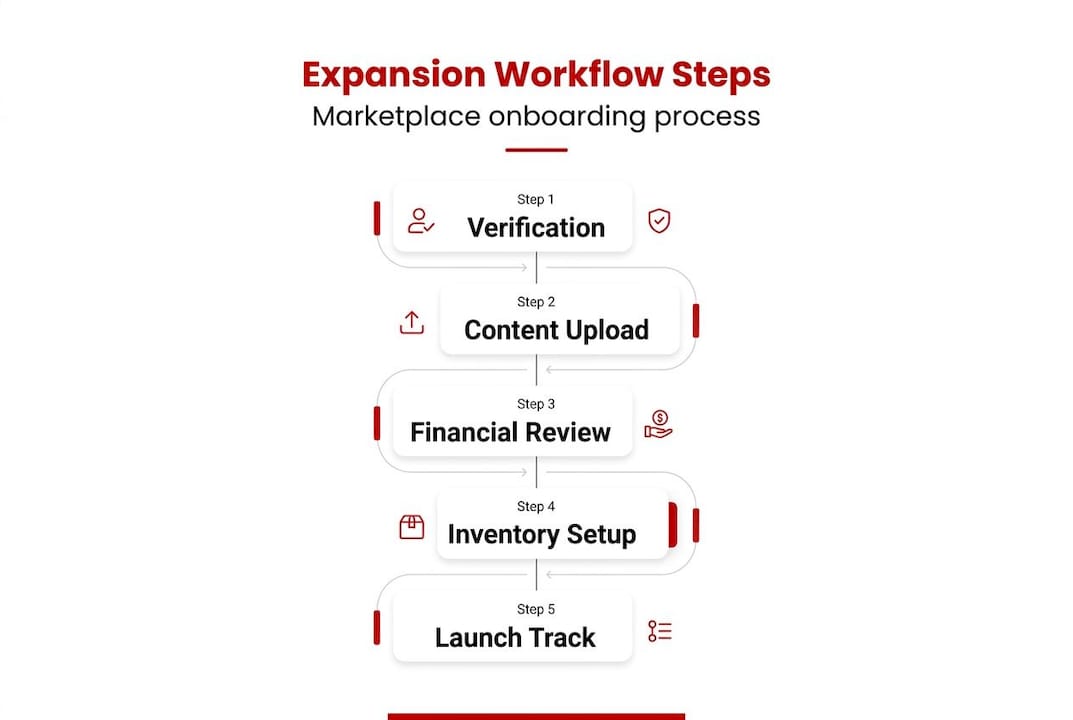
With your foundation prepared, you’re ready to walk through the exact expansion workflow. Here is how to execute with minimal friction and maximum margin protection.
Complete platform registration and business verification. Submit all required documents through the marketplace’s seller portal. For Walmart, this happens inside Seller Center and must be fully approved before any other steps unlock.
Configure payment setup within the required window. This is a time-sensitive step. Payment setup delays in Walmart’s onboarding carry a 30-day completion window. Miss it, and your listing readiness gets pushed back significantly. Set a calendar reminder the day you submit your application.
Set fulfillment method and configure returns. Decide upfront whether you’re using Walmart Fulfillment Services (WFS), your own warehouse, or a 3PL partner. Configure your return policy within the platform requirements. This step affects your listing eligibility, buy box competitiveness, and customer-facing experience all at once.
Build and upload product content before your go-live target. Title, bullet points, description, backend attributes, and high-resolution images should be completed before you start the listing activation process, not during it. Parallelize content production with compliance documentation so neither blocks the other.
Review compliance requirements specific to your product category. CPG products often carry labeling, ingredient disclosure, or regulatory documentation requirements that vary by category. Flag any incomplete compliance items before activation.
Run a pre-launch margin verification. Before you flip any SKU live, confirm that your contribution margin holds at the expected traffic and advertising cost of sale (ACOS) levels. If the numbers don’t work at realistic volume, you need to adjust pricing, reduce costs, or delay that SKU.
Activate listings and launch initial advertising. Start with your highest-confidence SKUs. Limit initial ad spend until you have real conversion data. Scale from a position of proof, not assumption.
Warning: Missing the payment setup deadline or submitting incomplete fulfillment configuration is one of the most common and most avoidable causes of delayed listing activation for emerging CPG brands. These deadlines do not flex. Build your entire pre-launch timeline backward from these hard stops, not forward from your preferred launch date.
Here is how a Walmart Marketplace expansion workflow compares to a typical general marketplace launch:
| Workflow stage | Walmart Marketplace | Typical marketplace |
|---|---|---|
| Business verification | Formal Seller Center approval required | Often automated or expedited |
| Payment setup deadline | 30-day hard window | Usually no hard deadline |
| Fulfillment configuration | WFS or seller-fulfilled, affects eligibility | Multiple options, fewer restrictions |
| Listing content requirements | Strict attribute and image standards | Variable by category |
| Compliance documentation | Category-specific, enforced | Varies widely |
| Time to first live listing | 2 to 6 weeks when done correctly | Often 1 to 2 weeks |
Pro Tip: Pre-upload content assets and flag every incomplete data field during the onboarding phase. Do not wait until submission day to discover a missing image dimension or an attribute gap. A staged content review two weeks before go-live prevents the last-minute scramble that causes quality shortcuts.
Your Walmart onboarding guide covers the platform-specific details in depth. And if regulatory or content standards are a concern for your category, marketplace compliance strategies provide a useful framework to reduce penalty risk before it appears.
Now that you’ve seen the full process, it is crucial to avoid missteps that stall or reverse momentum. Expansion gates are your safety net.
An expansion gate is a formal, team-approved checkpoint that must be cleared before you move to the next stage of growth, whether that means activating new SKUs, increasing ad spend, or adding a new marketplace channel. Think of it as a financial and operational green light, not just a technical one. Too many brands treat expansion gates as optional reviews. They are not.
Using an expansion gate checklist before adding SKUs or expanding assortment on a new marketplace means clearing four specific areas: channel-specific P&L with a confirmed contribution margin target, SKU-level ACOS plus return and cost sensitivity analysis, listing content quality and conversion readiness, and inventory and fulfillment performance including chargeback and penalty risk controls. Each of these gates catches a different category of costly mistake.
The four gates every CPG founder must clear before expansion:
The real-world mistakes that skip these gates:
Brands routinely add SKUs before running margin models, assuming that more product means more revenue. It often means more losses, especially when fulfillment costs, return rates, and advertising overhead aren’t accounted for by SKU. Another frequent mistake is neglecting compliance documentation for regulated CPG categories, which triggers listing suppressions and account warnings that can take weeks to resolve. Digital shelf analysis helps you spot content gaps and competitive positioning issues before they cost you conversions, while marketplace strategy examples illustrate what disciplined SKU selection looks like in practice.
Pro Tip: Treat each gate as a formal approval step with a sign-off from at least two team members: one from finance and one from operations. Document the decision. This small process change prevents the most expensive mistakes emerging brands make.
After launch, your job isn’t done. You must aggressively track, verify, and optimize to ensure expansion delivers profitable, sustainable growth.

The metrics that matter most post-launch are not vanity metrics. They are operational and financial signals that tell you whether your expansion is working or quietly bleeding margin. Cross-functional tracking across sales, operations, and marketing is what makes these signals actionable. When accountability is siloed, no one catches a fulfillment error until it becomes a chargeback pattern.
| Metric | Baseline target | Month 1 review check |
|---|---|---|
| SKU-level ACOS | Set by channel P&L model | Actual vs. modeled: flag if over by 15% |
| Return rate | Category benchmark | Flag if above 5% for consumables |
| Fulfillment compliance rate | 98% or above | Any dip triggers ops review |
| Listing quality score | Platform-defined threshold | Audit weekly for first 60 days |
| Contribution margin per SKU | Positive at launch volume | Recalculate at 30 days with actuals |
Understanding why digital shelf performance matters is central to this review process. Listing quality degrades over time if content isn’t maintained, and competitor pricing shifts can erode your conversion rate without any visible alert from the platform.
Quick-win optimization actions for the first 30 days post-launch:
The retail display trends shaping customer expectations in 2026 also apply to your digital shelf. Buyers respond to visual hierarchy, clear benefit statements, and trust signals whether they’re in a store aisle or scrolling a product page. Your content review should account for this.
With the step-by-step and metrics clear, let’s pull back and get honest about what really drives consistent success in digital marketplace expansion, and where most brands get it wrong.
Here is the uncomfortable truth: most emerging CPG brands focus on completing the workflow, not on the quality of decisions made inside it. They treat the checklist as a compliance exercise rather than a decision-making framework. They celebrate going live, not staying profitable.
The obsession with launch speed is the single biggest source of expansion regret we see. A brand rushes through onboarding to hit an arbitrary Q4 deadline, skips the SKU-level margin model, and discovers in January that two of their five live SKUs are losing money after returns and ad spend. The cost of fixing that is almost always higher than the cost of a two-week delay would have been.
What actually separates brands that scale profitably from brands that scale and then contract? Decision quality at each gate and genuine role clarity between team members. When no one owns the ACOS review, it doesn’t get done. When finance and operations don’t share a common P&L framework, margin problems hide in plain sight for months. Marketplace strategies for growth that deliver consistent results all share one underlying feature: there is a named decision-maker at every stage, and that person has both the data and the authority to pause expansion if the numbers aren’t right.
Build formal pause points into every expansion workflow. Not just technical go-lives, but financial reviews and compliance sign-offs that require a deliberate decision to proceed. This is not bureaucracy. It is the operational discipline that makes profitable scaling possible.
“In digital marketplace expansion, the speed of fixing mistakes matters more than the speed of launch.”
That principle should be posted in every growth team’s planning meeting. The brands that internalize it stop chasing launch dates and start protecting margin from day one.
Getting a marketplace expansion workflow right from the start is significantly easier when you have experienced guidance that understands both the platform mechanics and the underlying margin economics.
At RedDog Group, we work with CPG brands in the $500K to $20M revenue range to build structured, contribution-margin-first expansion plans across Amazon, Walmart, DTC, and wholesale. We help you identify where margin leaks are hiding before they show up in your P&L, and we build the workflows, role frameworks, and gate checklists your team needs to scale without costly backtracking. If you’re ready to expand profitably rather than just quickly, visit RedDog Group to learn how we can help you build a marketplace operation that actually performs.
Start with business verification, payment setup, and configuring fulfillment and return settings within the platform’s onboarding center, as these steps are required before any listings can be activated per Walmart’s official onboarding guide.
Maintain role clarity across sales, ops, and marketing so digital shelf and ad efficiency stay cross-functional; use expansion gates for margin targets and compliance sign-offs at each growth stage, as cross-functional ownership is what makes profitability metrics actionable rather than historical.
It is a four-part review covering margin targets, SKU cost control, content readiness, and inventory and fulfillment risk; using it before adding assortment to any marketplace prevents costly errors that compound over time and are expensive to unwind.
Most delays come from incomplete payment setups or missing fulfillment and returns configuration, both of which carry hard deadlines in most seller portals; Walmart’s onboarding, for example, enforces a 30-day payment setup window that can push your entire launch timeline back if missed.
Leave a comment: