
Published: March 2020 | Last Updated:August 2026
© Copyright 2026, Reddog Consulting Group.

PPC advertising is the fastest, most controllable way to put your business in front of customers who are ready to buy, and it produces measurable sales data from day one. No other channel lets you turn on demand this quickly or turn it off just as fast when the numbers don’t work.
That control is the whole point. You decide who sees your ad, how much you spend, and when the campaign runs. Here’s what that buys you:
PPC earns its keep during product launches, seasonal promotions, market testing, and any time competitors are bidding on your own brand name. If you need proof a product will sell before you invest in inventory or a six-month SEO campaign, PPC gives you that answer in weeks.
PPC works because it converts high-intent traffic into measurable revenue faster than any other channel, provided budget, tracking, and landing pages are built to match.
| Point | Details |
|---|---|
| Speed over patience | PPC generates traffic within hours, while SEO typically needs 6 to 12 months to build momentum. |
| Tracking is non-negotiable | Set up conversion tracking before launch, or you’re optimizing toward clicks instead of sales. |
| Match format to intent | Use search ads for high-intent keywords and shopping or social ads for product discovery. |
| Run a small test first | Start with $500 to $2,000 and a focused landing page before scaling any campaign. |
| Measure margin, not just ROAS | Reddog helps CPG brands track PPC performance at the SKU level against real contribution margin. |
The advantages of PPC aren’t abstract. They show up in specific business situations where waiting for organic traffic simply costs too much.
Precise audience targeting puts your ad in front of the exact person searching for what you sell, not a broad demographic hoping to notice you. A local plumber can target “emergency drain repair” within a 10-mile radius and skip paying for clicks from people three states away.
Immediate traffic matters most when you can’t afford to wait. A boutique launching a holiday sale doesn’t have three months for search rankings to climb. PPC gets the offer in front of shoppers the same day the campaign goes live.

Full budget control means you’re never exposed beyond what you set. Daily and monthly caps make PPC one of the few marketing channels where the ceiling is entirely yours to decide, which matters enormously for a business testing a new product line without ad experience.
Measurable ROI separates PPC from most traditional advertising. Every dollar ties back to a click, a conversion, or a sale, so you can prove what’s working instead of guessing.
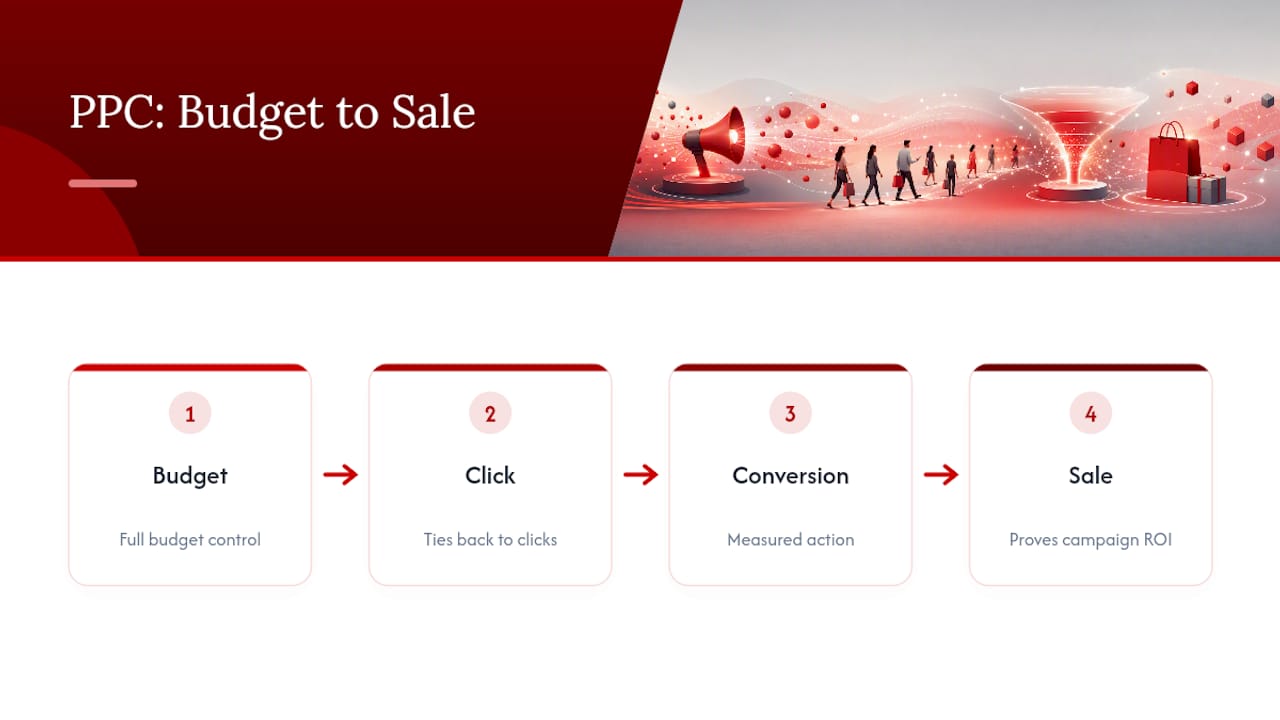
Rapid A/B testing lets you run two headlines or offers against each other and know within days which one converts better, feedback that would take a season to gather through organic content alone.
Small businesses that lean into local targeting, long-tail keywords, and ad extensions tend to see stronger returns than those running broad, generic campaigns.
Pro Tip: If your budget is under $1,000 a month, skip broad keywords entirely. Long-tail, local search terms cost less per click and convert at a much higher rate because the searcher already knows what they want.
PPC runs on an auction. You bid on keywords or audience segments, and when someone searches or browses, the platform runs a real-time auction to decide whose ad shows and in what position. You only pay when someone clicks, which is why it’s called pay-per-click in the first place.
A few terms you’ll run into constantly:
Here’s the part most beginners miss: a higher bid doesn’t guarantee a better position. Paid search rewards relevance as much as budget, so a well-written, tightly targeted ad can outrank a bigger spender with a sloppy one.
Neither channel replaces the other, but they solve different problems on different timelines.
The rule of thumb: run PPC when you need revenue now or want to test whether a product resonates before committing budget elsewhere. Invest in SEO when you’re playing a longer game and want to shrink acquisition costs over time.
The two channels feed each other well. PPC keyword data shows you exactly which search terms convert, which you can then target with organic content. A balanced approach often starts paid-heavy, then shifts budget toward SEO once organic rankings mature. See our own take on paid search vs organic search for CPG brands for how we help brands make that call.
Not every platform serves every business the same way. Picking the right one depends on whether you’re chasing intent or discovery.
Targeting options that matter most for SMBs include search keywords, geographic radius, age and household income, interest categories, remarketing lists, and shopping feeds for product-based businesses.
A service business chasing local demand usually starts with Google Ads and geographic targeting. A product brand launching on Amazon needs a different playbook entirely. Our guide to optimizing Amazon PPC campaigns walks through that setup in more depth.
Clicks feel good. They don’t pay the bills. The metrics that matter tie back to revenue and cost.
None of this works without conversion tracking set up before launch. That means pixels, goal tracking in your analytics platform, and a clear attribution model. Skipping tracking is the single most common reason PPC budgets get wasted, because you end up optimizing toward clicks instead of outcomes.
Pro Tip: Track contribution margin per acquisition, not just CPA. A $40 CPA looks great until you realize the product only nets $25 in margin after fulfillment costs.
Launching your first campaign doesn’t require a big budget. It requires discipline.
Your landing page needs to meet a few non-negotiable standards:
Most first-time SMB tests run comfortably between $500 and $2,000 total, enough to gather real click and conversion data without betting the business on an unproven channel.
Most wasted ad spend traces back to a handful of repeat offenders.
Running campaigns with no conversion tracking means you’re optimizing blind. Fix it by installing tracking before spending a single dollar. Weak landing pages kill conversion rates even when the ad itself is strong; send traffic to a dedicated page, never your homepage. Overly broad keywords burn budget on irrelevant clicks; tighten match types and add negative keywords early. Set-and-forget campaigns drift as costs rise and competitors adjust; check performance weekly at minimum. Watch daily spend closely during the first two weeks of any new campaign, since that’s when runaway costs from broad targeting or bidding errors tend to surface.
For CPG brands, a campaign that drives volume without protecting margin isn’t a win, it’s a slow leak. Amazon PPC in particular, when tracked at the SKU level against real P&L data, can fund sustainable growth instead of short-term spikes that evaporate once ad spend stops.
A margin-focused PPC checklist looks different from a typical marketing checklist:
We break this process down in detail in our guide on building a pay-per-click report that drives contribution margin. If your PPC reporting stops at ROAS without touching margin, you’re only seeing half the picture.
PPC effectiveness shifts significantly depending on what you’re selling and who’s buying.
Local service businesses (plumbers, dentists, salons) tend to see strong PPC performance because search intent is immediate and geographically bound. Someone searching “emergency AC repair near me” is close to a purchase decision, so conversion rates run higher than average.
Ecommerce and CPG brands face steeper competition and thinner margins per click, especially on Amazon where multiple sellers bid on the same product category. Success depends less on winning every auction and more on protecting margin per SKU, which is why disciplined P&L visibility matters more here than in almost any other category.
B2B and high-ticket service businesses often see lower click volume but higher value per conversion, making platforms like LinkedIn or narrowly targeted Google campaigns worthwhile despite higher CPCs.
Seasonal and promotional businesses (retail, events, holiday products) get outsized value from PPC’s speed. Waiting on SEO for a campaign with a six-week shelf life isn’t realistic, so paid search becomes the primary channel rather than a supplement.
The common thread: industries with high purchase intent and immediate need convert best on PPC, while industries with longer consideration cycles need to pair PPC with nurture sequences or remarketing to close the gap between click and purchase.
Ad format shapes performance as much as targeting does, and the strongest campaigns match format to intent.
Search ads are text-based and appear directly in search results. They work best for high-intent keywords where someone already knows what they want and just needs to find it.
Shopping ads display product images, prices, and ratings directly in search results, making them essential for any ecommerce or CPG brand with a product feed. They convert well because the buyer sees price and product before clicking.
Display ads are visual banners shown across a network of websites. They’re built for awareness and remarketing rather than immediate conversion, useful for staying visible to people who’ve already shown interest.
Social ads on Meta platforms combine strong visuals with detailed audience targeting, making them effective for product discovery even among people who weren’t actively searching.
Video ads on platforms like YouTube work well for demonstrating a product in use, particularly for items that benefit from visual explanation.
What separates a converting ad from a wasted one usually comes down to relevance: the image, headline, and offer need to match exactly what the searcher expects to find. A mismatch between ad promise and landing page reality is one of the fastest ways to burn budget without generating sales.
A local HVAC company running search ads targeting “furnace repair” plus a tight geographic radius can see conversion rates well above generic national campaigns, simply because the ad matches urgent, local intent.
A seasonal retailer launching a holiday product line can use PPC to generate sales volume in the exact window that matters, rather than waiting for organic rankings that wouldn’t mature until the season had already passed. This is the scenario where PPC data doubles as a demand-validation tool: if the ad converts well, you’ve confirmed the product before scaling inventory.
A growth-stage CPG brand entering Amazon can use Sponsored Products campaigns to establish visibility against entrenched competitors, then layer in Amazon Ads Manager workflows to keep spend aligned with actual profitability rather than raw sales volume.
Across all three examples, the pattern repeats: PPC works best when it’s paired with a specific, measurable goal and a landing experience built to match the ad’s promise, not a generic page hoping to convert everyone who lands on it.
We view PPC as a tactical lever for revenue, market validation, and defending brand demand, always measured against contribution margin, not vanity metrics. The brands that get the most from paid search treat it as a diagnostic tool first and a growth engine second, using SKU-level reporting to confirm a channel is actually profitable before scaling spend.
Reddog exists for the moment your PPC spend starts outpacing your understanding of what it’s actually returning at the SKU level. We built our practice around contribution margin, not blended ROAS, which means we catch the margin leaks that generic ad management misses entirely.
A free 30-minute strategy call with our team covers a review of your current CPC and ROAS baseline against real product margins, a quick audit of your conversion funnel from ad click to checkout, an honest look at where inventory velocity or 3PL costs might be quietly eating into ad-driven sales, and a set of next-step recommendations you can act on immediately. If you’re a CPG founder or operator scaling PPC spend on Amazon, Walmart, or DTC and want a clear-eyed read on whether that spend is actually building the business, book time with our Amazon growth consulting team and bring your current numbers.
Leave a comment: