
Published: March 2020 | Last Updated:May 2026
© Copyright 2026, Reddog Consulting Group.

TL;DR:
- Scaling a CPG brand through marketplace platforms requires shifting from ownership to orchestration, emphasizing efficiency and operational design. Network effects and liquidity drive sustainable growth, while early decisions in payments and workflows are critical to success. Starting narrow, testing economics, and automating processes enable effective expansion without overextending resources.
Scaling a CPG brand past a certain revenue point feels like running harder on a treadmill that keeps speeding up. You invest more in inventory, spend more on ads, hire more people, and the margin either holds flat or shrinks. That is the ceiling most brands hit when they treat growth as a linear problem. Understanding why scale with marketplace platforms matters is about recognizing that growth past $1M or $2M in revenue requires a fundamentally different operating model, not just more of what already works.
| Point | Details |
|---|---|
| Marketplaces don’t hold inventory | Platforms connect buyers and sellers, shifting inventory risk to suppliers and freeing your working capital. |
| Network effects compound growth | Each new participant increases platform value, reducing acquisition costs over time. |
| Payments architecture matters early | Your charge and payout structure decisions at setup directly affect compliance and dispute resolution later. |
| Automation enables non-linear scaling | AI-driven listing management lets you scale volume without scaling headcount proportionally. |
| Start narrow before expanding | Prove marketplace economics in one category before extending to broader selection or additional platforms. |
The word “marketplace” gets thrown around loosely in eCommerce. Some people mean Amazon. Others mean any platform with multiple sellers. What actually distinguishes a marketplace from a traditional eCommerce store is the operating model underneath it.
Marketplaces operate as intermediaries, connecting independent sellers and buyers without holding the inventory themselves. The platform’s job is to facilitate the transaction, not to own the product. That distinction changes everything about how the business scales.
In classic eCommerce, every unit of growth requires a corresponding unit of capital. You want to add 200 SKUs? You need to buy 200 SKUs. You want to enter a new category? You absorb the working capital risk until you learn whether that category converts. The growth model is direct but also brittle, because one bad inventory decision can compress cash flow for months.
Marketplace models decouple growth from ownership. Revenue comes primarily from commissions on completed transactions, aligning the platform’s incentive with transaction volume rather than inventory position. The operational focus shifts from “what do I stock?” to “how do I make transactions easier, faster, and more reliable?”
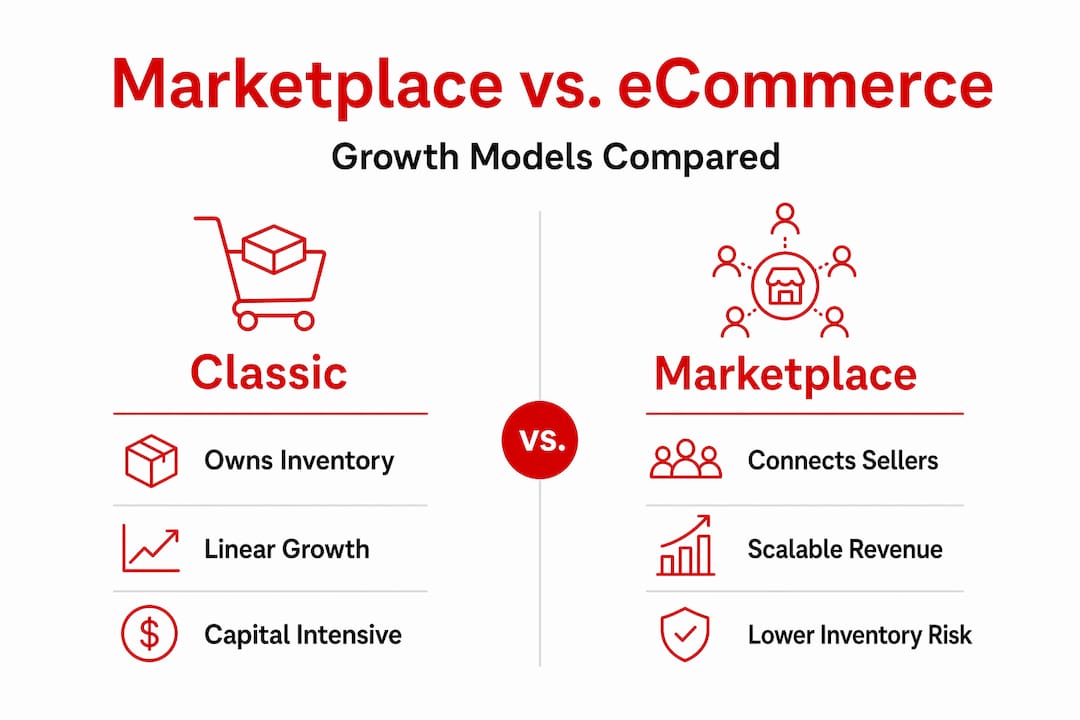
| Dimension | Classic eCommerce | Marketplace model |
|---|---|---|
| Inventory ownership | Brand owns all inventory | Sellers hold inventory |
| Revenue model | Margin on product sales | Commission on transactions |
| Scaling cost | Increases with each new SKU | Increases with platform investment |
| Working capital risk | High, brand absorbs all | Distributed to sellers |
| Category expansion | Requires capital per category | Sellers absorb test risk |
For CPG brands already selling on Amazon or Walmart, this model is familiar. What is less obvious is how to use this structure as a growth engine for your own brand’s distribution strategy.
Here is the concept that separates marketplace thinking from linear eCommerce thinking. In a standard online store, adding a new customer does not make the store more valuable for existing customers. In a marketplace, it does.
Network effects mean every new participant, whether buyer or seller, adds value for everyone already on the platform. More buyers attract better sellers. Better sellers attract more buyers. The compounding loop is what turns a marketplace from a distribution channel into a growth engine.
But here is where most people misread the model. User count alone does not create marketplace value. The real metric is liquidity.
“Liquidity is the true success metric because marketplaces win when participants consistently find relevant matches and complete transactions quickly.” (Marketplace network effects)
A marketplace with 10,000 sellers but poor match rates and low transaction completion is weaker than one with 2,000 sellers and high conversion. Match rates, transaction completion speed, and repeat purchase behavior matter more than raw participant numbers. When you think about marketplace growth strategies, optimizing liquidity signals is the strategic priority, not just growing the seller or buyer base.
The practical implications matter for CPG brands considering marketplace distribution. A marketplace with strong liquidity generates organic traffic through its own network flywheel, which means your cost of customer acquisition decreases as the platform matures. That is the structural advantage you cannot replicate by spending more on paid search.
The operational case for marketplace scaling is where CPG founders often have the clearest “aha” moment. Inventory risk falls to suppliers, not the platform or brand orchestrating the marketplace layer. You can expand selection, test new product categories, and respond to demand signals without proportional increases in working capital exposure.

This is not theoretical. A CPG brand in the $2M to $5M revenue range testing a new supplement category on Amazon absorbs full inventory risk for that test. Building a marketplace layer around your own DTC brand or wholesale channel means external sellers carry that exposure while you earn on the transaction.
Practically, here is how the operational shift works when you approach scaling online marketplaces as a brand operator:
Pro Tip: Before you invite your first external seller onto a marketplace layer, map the full transaction lifecycle end to end: listing creation, order receipt, payment capture, payout timing, and dispute handling. Gaps in that chain are far cheaper to close before launch than after.
The marketplace model also fits cleanly alongside existing eCommerce rather than replacing it. You do not need to abandon your DTC store or your Amazon presence to benefit from marketplace economics. Omnichannel scaling treats marketplace as an additive channel, not a replacement, which lowers the implementation risk considerably.
The advantages of marketplace platforms only materialize if you make the right structural decisions early. The mechanics underneath the marketplace, particularly around payments, fee architecture, and operational workflows, are harder to change once sellers are onboarded and transacting.
Your payment architecture decisions around charge type and payout model affect compliance responsibilities and dispute resolution for the life of the platform. Choose the wrong charge model and you may find yourself handling dispute liability that was meant to sit with the seller. This is a product decision masquerading as a technical one.
The fee structure compounds the challenge. Marketplace payment fees are multi-layered, combining base card processing fees, monthly active seller charges, and payout fees. Before you model your marketplace economics, you need to map the full fee stack or your margin projections will be wrong from day one.
Beyond payments, consider these structural realities:
The brands that succeed with marketplace scaling share one common trait. They start narrow and prove the economics before they expand. The temptation to launch with a wide seller base and broad categories typically leads to operational chaos before the model is proven.
Here is a practical sequence that Reddog recommends to CPG founders ready to add marketplace distribution:
Pro Tip: If you are already selling on Amazon or Walmart, use your existing sales data to identify which product categories have the strongest velocity and margin. Those are the categories to anchor your marketplace layer around first, because you already know demand exists.
For a deeper look at real-world marketplace strategies for growth, studying how brands have executed these steps across different categories provides better orientation than any generic framework.
In my experience working with CPG brands across the $500K to $20M revenue range, the biggest barrier to marketplace scaling is not technical. It is a mindset shift that founders resist longer than they should.
Most operators have built their business around ownership. They own the inventory, they own the customer relationship, they own the fulfillment process. The idea of orchestrating a system where external parties handle significant portions of that feels like losing control. What I have seen, though, is that the brands that hold on to everything end up constrained by their own capacity, capital, and organizational complexity.
The marketplace growth flywheel only starts turning when you genuinely shift from “I need to own this” to “I need to orchestrate this well.” That means accepting that operational leverage comes from system design, not from personally managing every transaction.
I have also watched brands get this wrong in a specific way. They add a marketplace layer on top of a DTC store without investing in the underlying operational and payments infrastructure. Sellers get paid late. Disputes go unresolved. Listings are inaccurate. The marketplace collapses not because the model was wrong but because operational orchestration was treated as an afterthought.
The brands that do this well treat marketplace scaling as an architectural decision. They think about payments, automation, and workflow design before they think about seller acquisition. That sequence matters more than almost anything else.
— Reddog
If you are a CPG founder or brand operator weighing marketplace platforms as a growth channel, the most expensive decision you can make is building your strategy around assumptions rather than actual channel economics. At Reddog, we work with brands in the $500K to $20M range to model contribution margin at the channel level, identify where margin is leaking, and build growth plans grounded in what each distribution model actually returns.
Our omnichannel growth consulting covers Amazon, Walmart, DTC, wholesale, and marketplace expansion. We also offer Amazon-specific marketplace consulting for brands ready to optimize their largest digital channel. If you want a practical 30-minute strategy session focused on your marketplace economics, channel mix, or inventory velocity, we would be glad to work through the numbers with you.
Marketplace platforms distribute inventory risk to sellers and generate network effects that compound growth over time, while DTC scales linearly with capital and traffic spend. For CPG brands past the $1M revenue mark, marketplace distribution often delivers better contribution margin at scale.
Liquidity measures how consistently buyers and sellers find relevant matches and complete transactions. A marketplace with high liquidity retains participants and generates organic growth; one with low liquidity loses sellers and buyers regardless of how many users are registered.
Early choices about charge types and payout models shape dispute resolution and compliance responsibilities long term and are difficult to change after sellers are onboarded. Getting these decisions right before launch protects both margin and operational integrity.
Start with one product category and one seller segment, model the full transaction economics including payment processing fees and payout costs, and prove retention and conversion before expanding. Most brands underestimate how much operational groundwork is needed before volume can scale.
AI-driven automation handles listing ingestion, categorization, and content quality at scale, enabling platforms to grow to millions of listings without proportional headcount growth. This is the primary operational lever that separates scalable marketplace models from those that hit a ceiling.
Leave a comment: