
Published: March 2020 | Last Updated:June 2026
© Copyright 2026, Reddog Consulting Group.

TL;DR:
- Marketplace compliance encompasses legal, regulatory, security, and operational requirements that online sellers must satisfy to operate legitimately.
- Proactively building compliance from the start safeguards revenue, builds consumer trust, and provides a competitive growth advantage, preventing costly penalties and suspensions.
Marketplace compliance is defined as the full set of legal, regulatory, security, and operational requirements that eCommerce sellers and platforms must satisfy to operate legitimately across online channels. Why marketplace compliance matters goes well beyond avoiding fines. It determines whether your brand can stay on Amazon or Walmart, whether customers trust you with their data, and whether your business can expand into new markets without hitting a regulatory wall. Sellers who treat compliance as a checkbox miss the real point. It is a structural advantage that separates brands built to scale from those that stall or get suspended.
Non-compliance is not a theoretical risk. It produces concrete, measurable damage to your business across three categories: financial penalties, operational disruption, and reputational harm.
Financial penalties are the most visible consequence. GDPR fines for data mishandling have reached billions of euros across enforcement actions in the EU, and GDPR non-compliance applies directly to marketplace data processing. In the UK, HMRC requires online marketplaces to submit annual seller reports by 11:59pm on January 31st, with strict accuracy requirements. Missing that deadline or filing inaccurate data is not a minor administrative error. It triggers penalties and puts your seller account at risk.
Operational disruption hits harder than most sellers expect. Platform suspensions on Amazon or Walmart can freeze your revenue overnight. Compliance gaps that are visible on launch day are also visible to bad actors, meaning security vulnerabilities and fraud exposure compound quickly once a gap exists.
Retrofitting compliance after the fact is the most expensive mistake a seller or platform operator can make. Building compliance in from the start costs significantly less than fixing it later. Most platforms that skip compliance architecture face critical issues within six months of launch, and the cost to remediate is three to five times higher than designing it correctly from day one.
“Compliance gaps that are visible on launch day are also visible to attackers.” This is not a metaphor. It is a documented operational reality for marketplace operators who defer security and regulatory controls.
Pro Tip: Map your compliance obligations before you list on a new channel, not after your first violation notice. A 30-minute pre-launch review of GDPR, CCPA, and platform-specific seller policies costs almost nothing compared to a suspension or fine.
The risks of non-compliance are not distributed evenly. Brands selling across multiple channels, including Amazon, Walmart, and international markets, carry compounded exposure because each jurisdiction and platform adds its own layer of enforceable obligations.
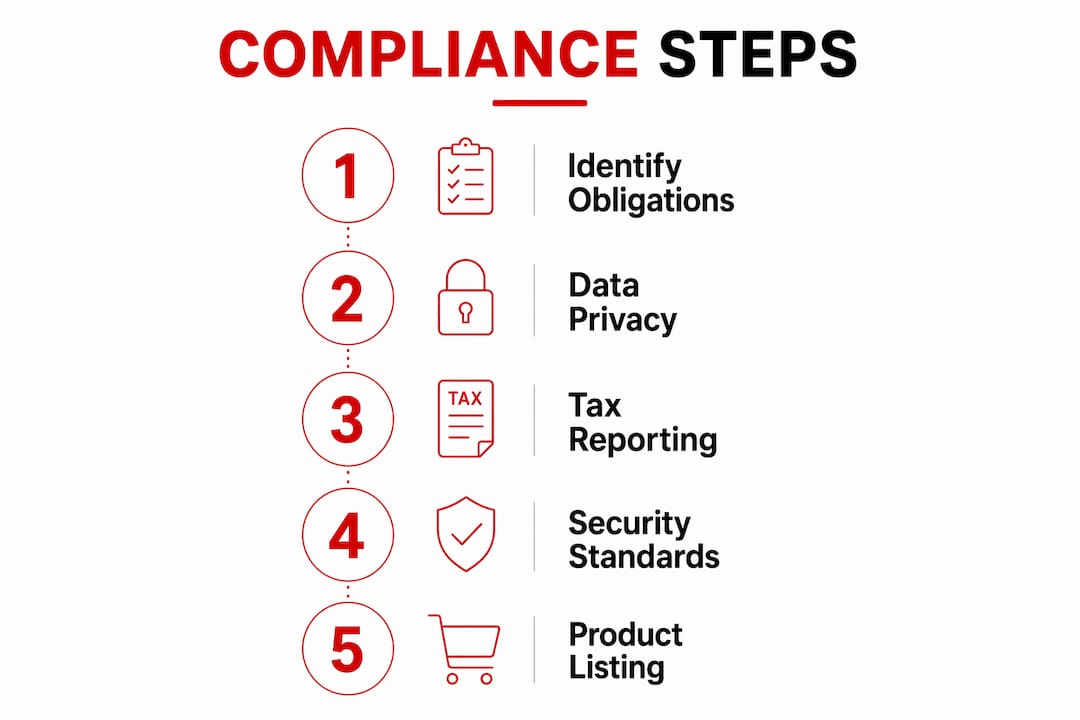
Compliance is not just a cost center. It is one of the most underused growth levers available to eCommerce brands, and the sellers who recognize this early gain a measurable competitive edge.
Consumers actively gravitate toward platforms and sellers that proactively announce privacy adherence, including CCPA and GDPR compliance. This is not a soft preference. It translates into higher retention, lower churn, and stronger repeat purchase rates. When a buyer knows their data is handled responsibly, the trust barrier to a second and third purchase drops significantly.
Here is how compliance creates growth advantages in practice:
Transparency tools, including clear privacy policies, data deletion options, and consent management, are becoming regulatory requirements under legislation like the EU Digital Services Act and California’s CPRA. Brands that implement these tools ahead of mandates gain the trust benefit before competitors are forced to catch up.
The scope of compliance in online marketplaces covers four distinct domains. Each one carries its own obligations and its own consequences for failure.

| Compliance domain | Core obligation | Key frameworks |
|---|---|---|
| Data privacy | Collect, store, and process user data lawfully | GDPR, CCPA, CPRA |
| Tax and financial reporting | Report seller income accurately to tax authorities | OECD MRDP, DAC7, HMRC |
| Product listing and content | Meet labeling, safety, and advertising standards | FTC, platform-specific policies |
| Security and fraud prevention | Protect payments and user identity data | PCI-DSS, platform KYC requirements |
Data privacy and protection is the most complex domain for most sellers. GDPR’s seven principles, covering lawfulness, purpose limitation, data minimization, accuracy, storage limitation, integrity, and accountability, apply to every marketplace that processes EU user data. CCPA applies to California residents. These are not optional frameworks. They are enforceable law with documented financial penalties.
Tax and financial reporting has grown significantly more demanding. The OECD Model Rules for Digital Platform Reporting provide a global baseline, but local laws like DAC7 in the EU and HMRC rules in the UK define the actual enforceable obligations. HMRC places verification responsibility directly on marketplace operators, even when third parties handle data collection. Error-free filing is not aspirational. It is required.
Security requirements go beyond standard eCommerce protections. Marketplace security demands five distinct layers: authentication and authorization, encryption, input validation, infrastructure security, and audit logging. Multi-party payments and user identity data create synthetic identity fraud risks that standard application security does not address.
Pro Tip: Do not rely on third-party regulatory glossaries to define your compliance obligations. Always reference official government sources, including HMRC.gov.uk, the EU’s official GDPR portal, and the California Attorney General’s CCPA guidance, to build accurate, testable compliance frameworks.
Product listing compliance is the area sellers most frequently underestimate. Amazon and Walmart both enforce content standards, restricted product categories, and advertising claim rules. A single non-compliant listing can trigger account-level reviews that affect your entire catalog.
Effective compliance is not a one-time project. It is an ongoing operational discipline. The sellers who manage it best treat it the same way they treat inventory management: with systems, ownership, and regular review cycles.
Pro Tip: When expanding to a new marketplace or geography, treat compliance readiness as a launch gate, not an afterthought. A pre-launch compliance checklist covering data privacy, tax reporting, and security controls takes less than a day to complete and can prevent months of remediation work.
For CPG brands scaling across Amazon, Walmart, and DTC simultaneously, compliance in eCommerce growth is directly tied to channel economics. A suspension on Amazon does not just cost you sales on that channel. It disrupts your inventory velocity, your cash flow timing, and your ability to fulfill wholesale and DTC orders from the same stock.
Marketplace compliance is a structural business requirement that directly protects revenue, enables growth, and reduces the cost of operating across multiple channels.
| Point | Details |
|---|---|
| Compliance prevents costly penalties | GDPR and HMRC violations carry financial penalties and platform suspensions that can freeze revenue immediately. |
| Retrofitting is far more expensive | Building compliance in from the start costs three to five times less than fixing gaps after launch. |
| Compliance drives consumer trust | Proactively announcing GDPR and CCPA adherence increases customer retention and repeat purchase rates. |
| Tax reporting is non-negotiable | HMRC, DAC7, and OECD MRDP create enforceable obligations that require accurate, timely seller data reporting. |
| Security requires layered architecture | Marketplace security demands five distinct layers beyond standard eCommerce protections to address multi-party fraud risks. |
At Reddog, we work with CPG brands across Amazon, Walmart, and DTC channels every week, and the pattern we see most often is this: founders treat compliance as something to deal with after they hit a problem. By then, the cost is already three to five times higher than it needed to be, and the operational disruption has already hit their margin.
The brands that scale cleanly are the ones that build compliance into their channel economics from the start. They know their GDPR obligations before they run their first EU ad campaign. They have their HMRC reporting workflows in place before their UK sales hit the threshold. They treat compliance as part of the cost of operating a real business, not as a tax on growth.
What I find most interesting is how compliance functions as a competitive filter. Annual registration fees and compliance requirements filter out less serious operators, which raises the overall legitimacy of the market. Brands that invest in compliance are not just protecting themselves. They are operating in a cleaner competitive environment where bad actors get removed.
The regulatory landscape will keep tightening. The EU Digital Services Act, CPRA updates, and evolving HMRC digital platform rules are all moving in one direction. Brands that build compliance infrastructure now will adapt to those changes at a fraction of the cost that brands face when they are forced to retrofit. Compliance is not a burden you manage. It is a foundation you build on.
— Reddog

Reddog works with CPG brands in the $500K to $20M revenue range that are scaling across Amazon, Walmart, DTC, and wholesale channels. Compliance is one of the most common sources of margin leakage and operational risk we see in brands at this stage, and it is almost always fixable with the right structure in place. If you want a clear picture of where your compliance gaps are and how they are affecting your channel economics, start with our CPG retail growth offer. It is a practical review session focused on contribution margin, channel economics, and operational readiness, not a generic audit. Book a free 30-minute strategy call and walk away with a clear view of where your business stands and what to fix first.
Marketplace compliance is the set of legal, regulatory, security, and operational requirements that eCommerce sellers and platforms must meet to operate lawfully across online channels, including data privacy laws like GDPR and CCPA, tax reporting obligations, and platform-specific seller policies.
Non-compliance exposes sellers to financial penalties under GDPR and HMRC rules, platform suspensions on Amazon or Walmart, and security breaches from unaddressed vulnerabilities. Retrofitting compliance after a violation costs three to five times more than building it in from the start.
Compliance directly supports sales by building consumer trust, improving platform trust scores, and enabling cross-border expansion. Sellers with clean compliance records receive better placement and faster approvals on major marketplaces.
UK HMRC requires annual seller income reports by January 31st, and the OECD Model Rules for Digital Platform Reporting set a global baseline. Local laws like DAC7 in the EU define the specific enforceable obligations that override the OECD model in scope and filing requirements.
A quarterly review is the minimum standard for most sellers. Regulations like GDPR, CCPA, and platform policies update frequently, and catching gaps through a scheduled audit is far less costly than responding to a violation or suspension after the fact.
Leave a comment: