
Published: March 2020 | Last Updated:May 2026
© Copyright 2026, Reddog Consulting Group.

TL;DR:
- Effective marketplace ads target high-intent shoppers and require proper sequencing, measurement, and optimization.
- Many brands fail by launching ads prematurely or treating campaigns passively without ongoing review, eroding profitability.
Marketplace ads are one of the most powerful tools available to CPG brands operating on Amazon and Walmart, yet most founders treat them like a faucet: turn them on, watch revenue rise. That belief costs real money. The truth is that marketplace ads give you direct access to high-intent shopping moments that no other digital channel can match, but without the right sequencing, measurement, and optimization cadence, you can spend aggressively and still erode margin. This article breaks down how marketplace ads actually work, where brands go wrong, and how to use them as a profitable growth engine rather than a cash drain.
| Point | Details |
|---|---|
| Target high-intent buyers | Marketplace ads place your CPG brand directly in front of shoppers ready to buy, boosting visibility and conversions. |
| Measure incremental impact | Avoid relying on platform ROAS; use sales lift and incremental metrics for true ad effectiveness. |
| Sequence ads after readiness | Ads are most profitable once product-market fit, creative, and retention are dialed in. |
| Optimize continuously | Marketplace ads require ongoing bid, targeting, and creative optimization—not a set-and-forget approach. |
| Expert help accelerates success | Consulting support turns marketplace ad complexity into scalable, measurable growth. |
Marketplace ads are paid placements inside retail search and browse environments, Amazon Sponsored Products being the most recognized format. Unlike social or display advertising, which interrupts users who may or may not want your product, marketplace ads surface at the exact moment a shopper is searching for something to buy. That distinction matters enormously for CPG brands competing in crowded categories.
The mechanics differ from traditional pay-per-click channels in a few important ways. First, relevance signals are tied directly to product listings, not landing pages or creative assets. Your listing quality, review count, conversion rate, and keyword match all feed into how often your ad shows and what you pay. Second, the auction system rewards both bid level and expected performance, meaning a well-optimized listing at a moderate bid can outperform a high bid on a weak listing. Third, the targeting modes available give you layered control that general PPC platforms cannot replicate.
Here is a quick breakdown of the core targeting modes:
“Marketplace ads let CPG brands directly buy visibility inside high-intent retail and search journeys, so you can optimize bids and targets around product-level demand rather than broad audiences.” — Sponsored Products best practices
For brands navigating the complexity of multiple channels, good marketplace management tips can clarify how ads fit into a broader retail strategy. Understanding the difference between marketplace ads and general pay-per-click is also essential. A useful comparison comes from studying SEO vs PPC for growth, which illustrates how search intent channels consistently deliver stronger purchase conversion than broader reach channels.
| Feature | Marketplace ads | General PPC (Google/Meta) |
|---|---|---|
| Shopper intent | High (actively shopping) | Mixed (awareness to purchase) |
| Targeting basis | Product keywords, ASINs | Audiences, interests, behaviors |
| Conversion environment | On-platform checkout | Off-platform landing page |
| Data feedback | Sales velocity, ACOS | CTR, CPL, conversion rate |
| Creative dependency | Moderate (listing matters) | High (ad creative critical) |
That context makes marketplace ads one of the highest-leverage placements available to CPG operators, but only when used correctly. Brands that understand marketplace growth strategies use ads as a precision tool, not a volume dial.
Understanding the mechanics is just the start. Knowing how to measure marketplace ad results separates effective operators from those wasting spend. The most common mistake is treating platform-reported return on ad spend (ROAS) as the definitive measure of success. It feels logical: if your ads generate $5 in revenue for every $1 spent, you’re profitable. Except that calculation often ignores whether those sales would have happened anyway.

Last-click attribution is the core problem. Marketplace platforms assign 100% of the sale credit to the last ad clicked, even if the shopper had already decided to buy your product based on organic search, repeat purchase habit, or prior brand awareness. When you run ads against your own branded search terms, you can end up paying for sales you were going to capture regardless.
Incremental measurement approaches like sales lift testing reveal the true impact of your spend by comparing sales in exposed vs. unexposed groups. The difference between platform-reported ROAS and incremental ROAS can be staggering. Brands have discovered gaps of 30 to 60 percent between what the dashboard claims and what actually drove new demand. Understanding measuring marketing ROI beyond basic cost-per-lead metrics gives CPG operators a sharper view of where ad dollars actually move the needle.
| Metric | What it tells you | Limitation |
|---|---|---|
| Platform ROAS | Revenue per ad dollar (reported) | Includes non-incremental sales |
| ACOS (Advertising cost of sale) | Ad spend as % of ad-attributed revenue | Same attribution bias as ROAS |
| Incremental ROAS | Revenue only from ad-driven demand | Requires lift testing or holdout groups |
| Sales lift | Actual uplift from ad exposure | Harder to execute but most accurate |
| New-to-brand rate | % of buyers who are new customers | Signals true category expansion |
Pro Tip: Before scaling any marketplace ad campaign, run a two-week holdout test on your lowest-converting ad group. Pause it for a defined period and compare total category sales. If you see little or no decline, that campaign was consuming budget without adding real demand.
The marketplace SEO tips that drive organic ranking are often more incremental than ads targeting branded terms, because they generate demand that compounds over time without per-click cost. Pairing organic visibility work with disciplined ad measurement makes your overall CPG marketing strategies far more efficient.
Effective measurement matters, but so does timing. Let’s look at how to strategically sequence marketplace ads for maximum profitability.
Many founders launch ads the moment they go live on Amazon or Walmart. That instinct is understandable but frequently expensive. Paid ads should not be your first growth lever if your positioning, product-market fit, creative assets, and retention economics are not yet ready. Ads amplify whatever is already working. If your listing converts at 4%, ads can profitably drive traffic. If it converts at 1%, you’re paying to expose weak creative to high-intent shoppers who then buy a competitor.
Here is the readiness checklist we recommend before activating marketplace ads:
The growth levers that typically need to come before ads include:
Brands that skip this sequencing often face what we call the ad death spiral: they spend on ads to drive velocity, margin erodes because conversion is poor, they cut budget, rank drops, and organic sales fall. The CPG marketplace expansion playbook works only when foundational elements are in place. Understanding how to scale marketplace businesses means recognizing that ads are a multiplier, not a foundation.
“Some CPG operators argue paid ads should not be the very first growth lever. If positioning, product-market fit, creative, and retention economics are not ready, ads can burn cash. Marketplace ads are still powerful, but they are most effective once the brand can convert and repeat profitably.” — Running paid ads should not be your first activity
Having explored timing, the final piece is execution. Here is how to turn marketplace ad investment into real, repeatable growth.
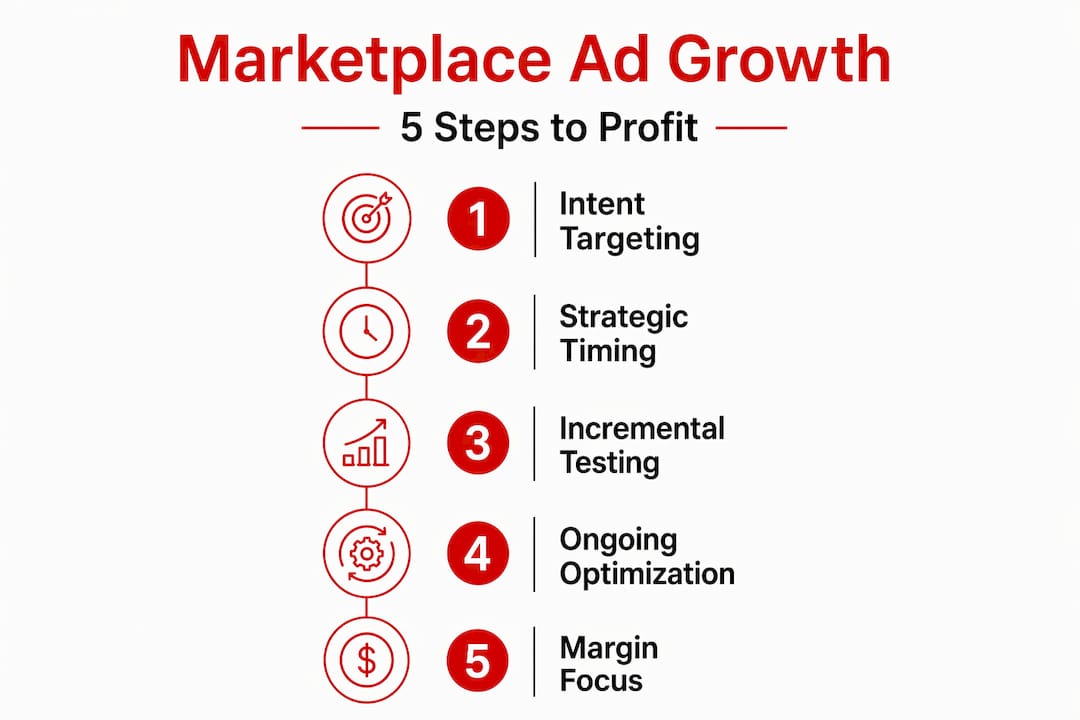
The biggest mistake after launching ads is treating them as passive infrastructure. Marketplace auctions are dynamic. Competitor bids shift. Category search volume fluctuates seasonally. New products enter the space and steal placement. If you set campaigns in January and review them in Q3, you have likely left significant money on the table or overspent on terms that no longer convert.
Amazon’s guidance on Sponsored Products makes this explicit: after an initial launch period, ongoing analysis and bid optimization are required for sustained performance. Marketplace auction delivery responds to both bid level and relevance signals, meaning a brand that consistently reviews and adjusts stays competitive while a passive spender slowly loses ground.
The core optimization loop looks like this:
Pro Tip: Every month, pull your search term report and identify the top 20 terms by spend. For each one, calculate incremental ROAS by checking whether those terms drove new-to-brand sales or primarily repeat purchasers. Reallocate budget from low-incremental terms toward high-incremental ones even if the ACOS looks similar on the surface.
Practical conversion optimization advice reinforces that ad performance and listing quality are inseparable. An optimized bid on a weak listing still underperforms. That is why ad optimization must run in parallel with continuous listing improvement.
| Optimization action | Frequency | Expected impact |
|---|---|---|
| Search term mining and negatives | Weekly | Reduces wasted spend by 10 to 20% |
| Bid adjustment by keyword | Monthly | Improves ACOS by 5 to 15% |
| New-to-brand analysis | Monthly | Identifies true growth campaigns |
| Campaign structure review | Quarterly | Prevents budget cannibalization |
| Competitive ASIN targeting | Quarterly | Expands reach in adjacent segments |
Our marketplace selling tips for Amazon and Walmart go deeper on platform-specific nuances. Walmart’s ad platform has meaningful structural differences from Amazon, and brands expanding there benefit from reviewing Walmart marketplace growth tactics specific to that environment. For operators managing both platforms in 2026, our marketplace management in 2026 resource outlines how the landscape has shifted and where the highest-margin opportunities currently sit.
Here is the candid take after working with brands across the $500K to $20M range: the brands that win with marketplace ads are almost never the ones with the biggest budgets. They are the ones with the most disciplined review process.
Most operators fall into one of two traps. The first is launching ads too early, before their listing can convert efficiently, and burning through budget that would have been better spent on product photography or review generation. The second is launching at the right time but then treating campaigns as passive assets, checking the dashboard once a month and assuming a green ROAS number means everything is working.
What the dashboard does not show you is how much of that revenue was already yours. It does not tell you whether the customer who clicked your ad had already added your product to their cart three times before. It does not distinguish between the ad that introduced a new household to your brand and the ad that simply captured a repeat buyer who searched your brand name directly.
The brands we see scale profitably on marketplaces share a specific mindset: they treat ad spend as investment, not expense, and they measure that investment against incremental outcomes, not platform-reported totals. They also recognize that third-party marketplace leadership requires a long-term approach to category positioning, not just short-term sales velocity.
Our honest advice: build a monthly rhythm around three questions. Did this spend bring in genuinely new customers? Did the margin on those customers justify the cost? And is the organic rank improving as a result of the velocity, reducing our dependence on paid traffic over time? If the answer to all three is yes, scale. If not, optimize before you spend more.
Marketplace ads are one of the highest-leverage tools available to CPG brands, but they require deliberate strategy, accurate measurement, and a consistent optimization cadence to actually move contribution margin.
At RedDog Group, we work directly with CPG founders and operators to build margin-first marketplace ad strategies across Amazon and Walmart. We help you identify where spend is incremental and where it is simply recapturing demand you already own. Whether you are launching campaigns for the first time or auditing an existing structure that is not producing the results you expected, our Amazon growth consulting work is built around measurable, profitable outcomes. Explore our broader CPG retail growth consulting offer to see how we approach marketplace performance within the full context of your retail strategy.
Marketplace ads allow CPG brands to target shoppers with high purchase intent directly within shopping platforms, leveraging product-level insights for greater visibility and conversion. As Sponsored Products guidance notes, this means you are buying into high-intent retail journeys rather than interrupting audiences who are not yet ready to purchase.
Brands should use incremental methods like sales lift instead of only platform-reported ROAS, which can overstate true ad impact. Incremental measurement approaches reveal whether ad spend is driving new demand or simply capturing sales that would have occurred organically.
Marketplace ads work best once your product-market fit, creative assets, and retention economics are strong enough to convert and retain customers profitably. Launching before those elements are ready means ads can burn cash without building durable growth.
Marketplace ads require a recurring cadence of optimization on bids and targeting to achieve sustained profitability, ideally weekly for search term mining and monthly for bid-level adjustments. Amazon’s own guidance explicitly recommends ongoing analysis after the initial launch period.
Marketplace ads are significantly less effective without strong product-market fit because poor conversion rates make every click expensive and unsustainable. Focus first on listing quality, review volume, and repeat purchase economics before investing in ads at scale.
Leave a comment: