
Published: March 2020 | Last Updated:May 2026
© Copyright 2026, Reddog Consulting Group.

TL;DR:
- Most eCommerce and CPG brands overlook the significant profit gains possible through improved customer retention. A 5% increase in retention can boost profits by over 25%, reducing reliance on costly acquisition efforts. Focusing on retention strategies and metrics enables brands to build scale and sustain long-term growth.
Most eCommerce and CPG brands spend the bulk of their budget chasing new customers. It feels like growth. It looks like progress on the dashboard. But a 5% increase in customer retention can lift profits by 25% or more, which means the most expensive line in your P&L might not be your ad spend. It might be the customers you keep losing. Understanding why invest in customer retention is not a philosophical question. It is a margin question, and for brands in the $500K to $20M range, getting the answer right separates brands that scale from brands that stall.
| Point | Details |
|---|---|
| Retention compounds profit fast | A 5% retention lift can produce 25%+ profit growth, making it one of the highest-return levers available. |
| Acquisition costs more than keeping | Replacing lost customers is expensive; shifting focus to retention frees capital for smarter growth. |
| First purchase is not the finish line | Repeat customers build compounding lifetime value; treating the first sale as a win caps your growth ceiling. |
| Churn is a signal, not just a number | Use churn data as feedback on product, pricing, and experience to fix root causes before they widen. |
| Metrics drive retention decisions | Tracking the right retention KPIs lets you intervene early, forecast accurately, and allocate budget with confidence. |
Customer retention, or more precisely customer lifecycle management, is about extending and deepening the commercial relationship after the first purchase. The economics are stark. Customer-obsessed businesses report 41% faster revenue growth and 49% faster profit growth than their peers. Those are not marginal gains. That is a structural advantage built on the back of repeat purchase behavior.
Here is what that looks like in practice for a CPG brand:
The compounding effect is where the real leverage lives. Retention strategies that improve repeat purchase frequency also improve CAC payback timelines and forecasting stability. When you know a certain percentage of last month’s buyers will purchase again this month, you can plan inventory, manage cash flow, and allocate ad spend with far more precision than a brand running pure acquisition.
| Scenario | 1,000 customers, 60% retention | 1,000 customers, 65% retention |
|---|---|---|
| Retained customers (Year 1) | 600 | 650 |
| Retained customers (Year 2) | 360 | 422 |
| Cumulative retention gap | Baseline | +62 customers |
| Profit impact (at avg. $200 LTV) | Baseline | +$12,400 net gain |
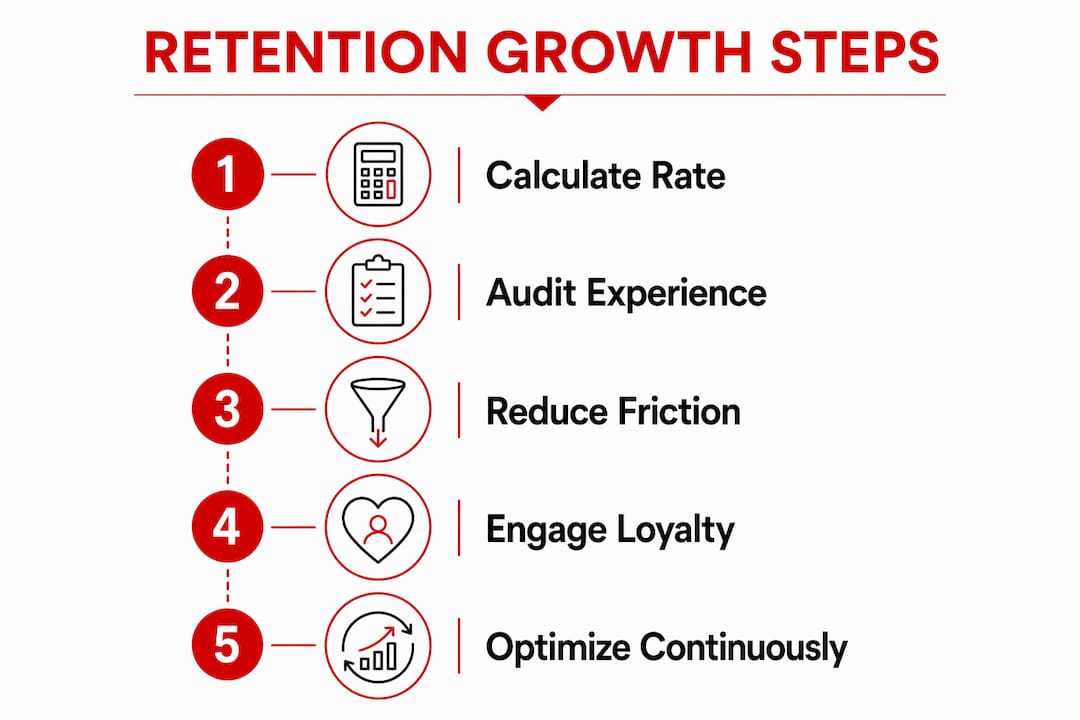
That five-point improvement in retention quietly generates thousands in margin without spending an extra dollar on paid media.
Pro Tip: Before running any new acquisition campaign, calculate your current retention rate. If it sits below 40% for a CPG repeat-purchase category, you are filling a leaky bucket. Fix the leak first.
The biggest misconception in eCommerce and CPG is that sales volume equals health. It does not. A brand can grow its top line while quietly hemorrhaging customers, and the unit economics will eventually catch up in an ugly way.
Many consumer brands mistakenly treat the first purchase as the finish line. The checkout confirmation email goes out, the order ships, and attention immediately shifts to the next acquisition campaign. That mindset creates a treadmill. You are constantly spending to replace customers you should have kept.
Here are the most common retention misconceptions Reddog sees in growth-stage CPG brands:
“Retention is not a lagging metric that tells you what already happened. It is a leading indicator that tells you what your growth will look like six months from now.”
When churn rises, it is telling you something. Maybe your onboarding process creates confusion. Maybe your price-to-value ratio shifted after a reformulation. Closed-loop churn analysis that maps attrition to specific journey touchpoints gives you something far more useful than a percentage. It gives you a to-do list.
Knowing why retention matters is only half the work. The other half is knowing where to put your energy. The importance of customer retention becomes concrete when you connect it to specific operational levers.
Investing in customer experience directly changes repurchase behavior. That sounds obvious until you audit your own post-purchase flow and realize the confirmation email is generic, the shipping notification is from a third-party tracker with no brand presence, and the first reorder reminder never goes out. Every one of those gaps is a retention opportunity you are leaving on the table.

Proactive service matters more than reactive support. A customer who receives a proactive heads-up about a delayed shipment is far less likely to cancel than one who has to chase down an answer.
Failed payments increase churn risk significantly, particularly for subscription-based CPG models. Involuntary churn from declined cards or clunky checkout flows is one of the most underreported revenue leaks in eCommerce. Modern payment platforms offer automatic card updaters, smart retry logic, and proactive dunning notifications that recover a meaningful percentage of would-be churned customers before they even realize there was a problem.
Community-building and personalized engagement move customers from transactional to relational. User-generated content campaigns, referral programs, and loyalty tiers that reward genuine behavior, not just spend, create the kind of brand affinity that survives a competitor’s promotional push.
Pro Tip: For CPG brands selling across Amazon, DTC, and wholesale simultaneously, building customer loyalty through owned channels is critical because you cannot run retention programs on Amazon’s marketplace. Your DTC channel is your retention engine. Treat it like one.
| Retention tactic | Best suited for | Key metric to track |
|---|---|---|
| Post-purchase email sequences | DTC, subscription CPG | Second-purchase conversion rate |
| Loyalty points program | High-frequency repeat categories | Redemption rate and program NPS |
| Referral program | Community-driven brands | Referred customer LTV vs. paid LTV |
| Proactive shipment communication | All eCommerce | WISMO contact rate reduction |
| Subscription model with pause option | Consumables, health and wellness | Pause-to-cancel conversion rate |
You cannot manage what you do not measure. Retention is one area where many brands track a headline number, say their monthly churn rate, and stop there. That is like checking your blood pressure once a year and calling it a health strategy.
The metrics that actually drive decisions:
Retention as an input to product and marketing decisions is the mindset shift that separates brands managing retention from brands merely reporting it. When churn spikes in a specific cohort, the first question should be “what did we do differently for this group?” not “how do we win them back?”
CRM segmentation lets you identify customers who are showing early churn signals, declining purchase frequency, dropping engagement with email, lower average order values, before they actually leave. Automated workflows triggered by those signals can intervene with a targeted offer, a personalized check-in, or a product recommendation that re-engages them at the right moment. The tactics for increasing CLV you implement today will show up in your forecasting accuracy six months from now.
In my experience working with CPG founders, the retention conversation almost always starts too late. By the time a brand is concerned about churn, they have usually already lost two or three cohorts of customers who could have been retained with relatively modest investment.
I think the core problem is that acquisition feels like growth and retention feels like maintenance. It is a framing issue, and it is expensive. What I have observed repeatedly is that brands that shift even 15% of their acquisition budget toward retention programs see disproportionate gains in contribution margin within two quarters. Not because retention is magic, but because the math of compounding customer value is relentless.
The other thing I would push back on is the idea that retention is primarily a marketing function. In CPG specifically, the brands with the highest retention rates typically have the best product-market fit, the cleanest post-purchase experience, and the most honest pricing strategy. Marketing can support retention, but it cannot substitute for those fundamentals.
If you are a founder reading this and your repeat purchase rate is under 30%, I would not spend another dollar on paid acquisition until you understand why. The answer is almost always sitting in your churn data, waiting to be read.
— Reddog
If this article surfaced questions about where your brand is actually leaking margin, that is worth a conversation. Reddog works with CPG brands in the $500K to $20M range to build retention-driven growth plans grounded in contribution margin, not vanity metrics. We review channel economics, identify where repeat purchase behavior is breaking down, and help you build the operational structure to fix it sustainably. Book a free 30-minute strategy call with the Reddog team to review your retention rate, CLV by channel, or inventory velocity across your key distribution points. No pitch. Just a focused look at the numbers that actually drive your profitability.
Retaining an existing customer costs significantly less than acquiring a new one, and retained customers generate compounding revenue through repeat purchases, referrals, and higher average order values over time.
It varies by category, but most replenishment-driven CPG brands should target a 12-month retention rate above 40%. Subscription models should aim for monthly churn below 5% to maintain healthy lifetime value economics.
Subtract new customers acquired in a period from total customers at the end of the period, divide by customers at the start, then multiply by 100. Reddog’s guide on calculating retention rate walks through the formula for omnichannel brands specifically.
The most common drivers include poor post-purchase communication, payment friction causing involuntary churn, mismatched product expectations set during acquisition, and lack of personalized engagement after the first order.
The impact is faster than most brands expect. Because retained customers require no re-acquisition spend, even a modest lift in retention rate flows directly to contribution margin, often within one to two quarters depending on your purchase cycle.
Leave a comment: