
Published: March 2020 | Last Updated:June 2026
© Copyright 2026, Reddog Consulting Group.

TL;DR:
- Influencer marketing drives measurable eCommerce growth by fostering authentic, interactive partnerships that build trust and conversions.
- Effective strategies include targeted creator selection, causally measured campaigns, and compliance with disclosure rules to sustain audience trust.
Influencer marketing is defined as a paid or partnership-based strategy where brands collaborate with social media creators to reach and convert target consumers through trusted, content-driven endorsements. US influencer ad spend is forecast to reach $13.7 billion by 2027, growing 15.7% in 2026 alone. That number reflects a shift in how brands earn consumer attention. For eCommerce marketing professionals, the question is no longer whether influencer marketing works. The question is whether your brand is using it with enough precision to see the return.
The core case for influencer marketing rests on purchase behavior, not impressions. 58% of consumers over age 18 have purchased a product because of an influencer endorsement, and 35% made multiple purchases. That is not a soft brand awareness metric. That is a direct conversion signal that no paid search campaign can replicate with the same degree of social proof.

Consumer engagement is the mechanism that makes this work. Research published in 2026 found that engagement mediates brand trust with a coefficient of β=0.636 (p<0.001), meaning influencer credibility and authenticity translate into trust only when consumers actively interact with content. Passive exposure to a sponsored post does not move the needle. Active participation, through comments, shares, and user-generated content, does.
The ROI comparison with paid advertising also favors influencer marketing when campaigns are structured correctly. Paid social ads on Meta or Google generate clicks, but they do not generate the peer-to-peer trust that drives repeat purchase behavior. Influencer partnerships, particularly long-term ones, build category authority for a brand in a way that a display ad cannot. For eCommerce brands managing tight contribution margins, that distinction matters at the unit economics level.
Pro Tip: Track influencer-driven revenue separately from paid media in your attribution model. Blending the two obscures which channel is actually earning the conversion.
Authenticity in influencer marketing is not a personality trait. It is a collective outcome from aligned brand-influencer relationships that prioritize transparency and genuine communication. A creator who uses your product organically and speaks about it in their own voice produces a fundamentally different audience response than one reading from a brand script. The difference shows up in engagement rates, comment sentiment, and ultimately, conversion.
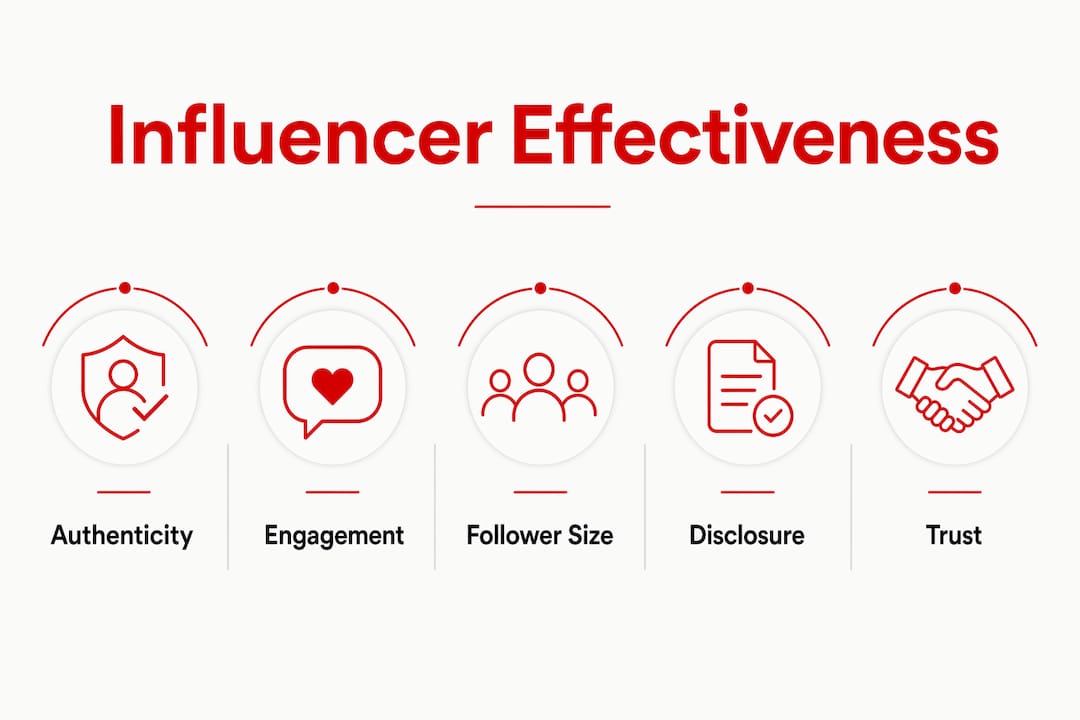
A 2026 meta-analysis from the University of Washington found that influencers outperform brand posts and virtual influencers on purchase intention, while matching or exceeding celebrity endorsers on engagement quality. This is a meaningful finding for brand managers deciding where to allocate budget. Celebrities carry reach but often lack the niche credibility that drives conversion in specific product categories. A micro-influencer in the natural food space will outperform a celebrity post for a CPG snack brand nearly every time.
The follower size question deserves its own analysis. Larger influencers increase reach but reduce perceived authenticity. Smaller influencers generate more conversation and participation per follower. Neither is universally better. The right choice depends on where the consumer sits in the purchase funnel.
| Influencer type | Typical follower range | Strength | Best use case |
|---|---|---|---|
| Nano | 1K to 10K | High authenticity, strong community trust | Product trials, UGC generation |
| Micro | 10K to 100K | Balanced reach and engagement | Category education, conversion |
| Macro | 100K to 1M | Broad reach, brand awareness | New product launches |
| Celebrity | 1M+ | Maximum reach | Mass awareness campaigns |
Disclosure compliance sits at the intersection of authenticity and legal obligation. 64% of consumers distrust undisclosed influencer relationships, and 70% react negatively to undisclosed payments. Brands that skip or bury disclosure language are not just risking FTC penalties. They are actively eroding the trust that makes influencer marketing worth the investment.
Pro Tip: Build disclosure language directly into your creative brief for every platform format. Instagram Stories, TikTok videos, and YouTube integrations each have different disclosure mechanics. Treat non-compliance as a brand risk event, not a minor oversight.
The same channel that drives purchase behavior also carries a higher distrust baseline than most marketers expect. 26% of consumers distrust influencer marketing specifically, compared to only 11% who distrust advertising overall. That gap exists because audiences have become sophisticated enough to recognize when a creator partnership feels transactional rather than genuine.
The most common failure modes in influencer marketing break down into three categories:
The measurement problem is particularly damaging for eCommerce brands. When a consumer sees an influencer post on Tuesday, browses the product on Thursday, and purchases through a Google Shopping ad on Saturday, last-click attribution gives Google the credit. The influencer’s role in initiating that purchase journey disappears from the data. This is why incremental lift measurement via randomized holdout experiments is the only method that provides a causal estimate of influencer marketing’s true sales impact.
Pro Tip: When auditing influencer candidates, check the ratio of comments to likes. A high like count with minimal comments often signals low genuine engagement or an audience that is not actively invested in the creator’s content.
Effective influencer marketing strategy starts with selection criteria that go beyond follower count. Audience relevance, content tone, engagement quality, and category fit are the variables that predict campaign performance. A creator whose audience overlaps with your buyer persona at 80% is worth more than one with twice the followers and 40% overlap. Reddog consistently sees this play out with CPG brands trying to find influencers on Amazon who can drive both discovery and conversion within the same platform.
Campaign design must prioritize interaction over broadcast. The MDPI research confirms that two-way interaction and UGC amplify brand trust more than passive content consumption. Campaigns built around Q&A sessions, comment challenges, product reviews with response threads, and creator-led polls generate the behavioral engagement that moves trust metrics.
A structured approach to influencer selection and campaign design looks like this:
The measurement framework deserves particular attention. Holdout incremental lift tests using multi-cell experimentation isolate the influencer’s actual contribution from baseline demand and other marketing activity. Always-on programs benefit from rolling holdout designs that withhold 10 to 15% of audience segments continuously, enabling causal measurement without sacrificing scale. This is the standard that CFOs and growth-stage operators should demand from their marketing teams. For a deeper look at how this connects to overall marketing ROI, Reddog’s guide on measuring marketing ROI for CPG brands covers the full framework.
A mixed influencer size strategy also produces better funnel coverage than concentrating spend at one tier. Macro influencers build awareness at the top of the funnel. Micro and nano influencers drive engagement and conversion in the middle and bottom. Allocating budget across tiers based on funnel objectives, rather than defaulting to the largest available creator, is the approach that produces consistent results.
Pro Tip: Run your first holdout test on a single influencer or campaign before scaling the methodology. The learning from one clean experiment is worth more than six months of last-click attribution data.
Influencer marketing drives measurable revenue growth when brands prioritize authentic partnerships, interactive campaign design, and causal measurement over vanity metrics and one-off posts.
| Point | Details |
|---|---|
| Purchase behavior is proven | 58% of consumers have bought products due to influencer endorsements, confirming direct conversion impact. |
| Engagement mediates trust | Consumer interaction with influencer content, not passive exposure, is what builds brand trust and loyalty. |
| Disclosure is non-negotiable | 64% of consumers distrust undisclosed relationships; disclosure failures are brand risk events, not minor issues. |
| Measurement requires holdout testing | Last-click attribution systematically undercounts influencer impact; incremental lift tests provide causal evidence. |
| Influencer size must match campaign goals | Larger creators build reach; smaller creators build conversion. Match tier selection to funnel objectives. |
After working with CPG brands across Amazon, DTC, and wholesale channels, the pattern Reddog sees most often is this: brands treat influencer marketing like a paid media buy. They negotiate a post, approve the content, pay the invoice, and wait for results. When the results are underwhelming, they conclude that influencer marketing does not work for their category. The real problem is the model, not the channel.
The brands that get consistent returns from influencer marketing treat creators the way they treat their best retail partners. They invest in the relationship, provide product context and brand story, give creators room to communicate authentically, and measure performance over quarters rather than weeks. That shift in mindset changes everything about how campaigns are designed and how results are evaluated.
The 2026 research landscape makes one thing clear: consumer expectations for authenticity have increased faster than most brand marketing practices have adapted. Audiences can identify transactional content within seconds. The brands winning with influencer marketing are the ones that have built genuine creator relationships, designed for interaction, and built measurement systems that can actually prove what is working. That is not a creative challenge. It is an operational one.
— Reddog
Influencer marketing works when it is built on the right measurement foundation and the right creator relationships. At Reddog, we help CPG and eCommerce brands structure influencer marketing for CPG growth in a way that connects creator spend to contribution margin, not just top-line revenue. We work with brands in the $500K to $20M range that need structured growth planning and channel economics that hold up under scrutiny. If you want a practical review of how your influencer strategy connects to your actual margin picture, book a free 30-minute strategy call with the Reddog team. We will focus on what each channel is actually contributing to your growth.
Influencer marketing generates peer-to-peer trust that paid advertising cannot replicate. Research shows 58% of consumers have purchased products due to influencer endorsements, a conversion signal that paid display ads rarely produce at the same trust level.
Consumer engagement mediates the relationship between influencer credibility and brand trust, with a statistically significant effect (β=0.636, p<0.001). Trust builds through active interaction with influencer content, not passive exposure to sponsored posts.
Last-click attribution is the most common measurement error. It assigns conversion credit to the final touchpoint before purchase, which systematically undercounts the influencer’s role in initiating the purchase journey. Holdout incremental lift tests provide causal estimates instead.
Match influencer tier to funnel objective. Macro influencers (100K to 1M followers) build awareness. Micro and nano influencers (1K to 100K) drive engagement and conversion. Larger follower counts increase reach but reduce perceived authenticity.
The FTC requires clear disclosure of paid partnerships across all platforms. 70% of consumers react negatively to undisclosed payments, making compliance a brand protection issue as much as a legal one. Disclosure language must be tailored to each platform format.
Leave a comment: