
Published: March 2020 | Last Updated:June 2026
© Copyright 2026, Reddog Consulting Group.

TL;DR:
- Customer experience influences loyalty, retention, and revenue by shaping customer perceptions across all interactions.
- AI is transforming CX from reactive to proactive, requiring integrated technology, trust principles, and perception-based metrics.
- Effective CX management demands unified data, cross-functional collaboration, journey mapping, and continuous improvement to build lasting loyalty.
Customer experience (CX) is the cumulative perception a customer forms across every interaction with a brand, from the first ad impression through post-purchase support, and it is the single most direct driver of loyalty, retention, and revenue. 60% of consumers have purchased from a brand solely based on the service they expected to receive. That statistic alone reframes CX from a support function into a revenue engine. With agentic AI reshaping how brands interact with customers at scale, the urgency to treat CX as a strategic priority has never been greater.
The case for prioritizing CX is not philosophical. It is financial. 80% of customers would repurchase after an amazing experience, while 79% would switch to a competitor after a terrible one. That is a razor-thin margin between growth and churn, and it is entirely within your control.
The benefits of improving customer experience fall into four concrete categories:
Brand reputation is also a direct output of CX quality. Customers who feel well-served become advocates. Customers who feel ignored become detractors. The difference between those two outcomes is almost always the consistency and quality of the experience you deliver.
Pro Tip: Map your current CX against the full customer journey, not just support tickets. Most brands discover their biggest friction points sit in pre-purchase or onboarding, not in the service queue.

Artificial intelligence is not just automating customer service. It is restructuring where and how customers form opinions about your brand. KPMG’s Global Customer Experience Excellence research, based on 80,000 consumers, identifies a fundamental shift from reactive CX to proactive, AI-driven experience orchestration that unifies customer, employee, partner, and ecosystem interactions.
BCG calls this the “agentic CX layer,” a new operational reality where AI agents and influencers shape consumer evaluations before a human representative ever enters the conversation. Brands that do not architect for this layer risk losing control of the customer relationship entirely.
Here is what adapting to AI-driven CX actually requires:
Customer expectations are also rising faster than most brands realize. Service expectations increased from 19% in 2024 to 42% in 2026 among U.S. consumers. That is not incremental drift. It is a structural shift in what customers consider acceptable, and brands that calibrate their CX to 2023 standards are already behind.
Pro Tip: Before deploying any AI-powered CX tool, define what a failed interaction looks like and build a human escalation path for it. Most AI failures in CX are not technical. They are architectural.
Strong CX management is not a single department’s responsibility. It is a cross-functional discipline that connects marketing, sales, and service into a single, coherent customer narrative. Salesforce describes this alignment as a survival requirement for brands competing in markets where customers have unlimited alternatives.
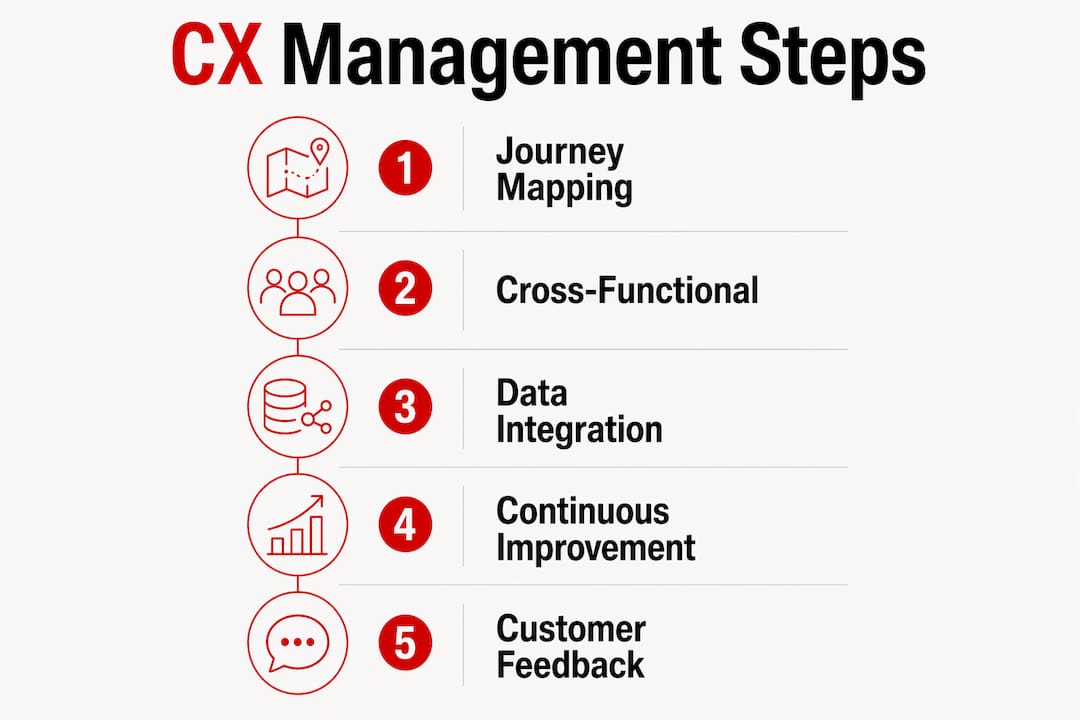
The practical difference between brands that manage CX well and those that do not often comes down to data. Siloed systems create fragmented experiences. A customer who contacts support after seeing a promotion should not have to re-explain their context. Unified customer data, accessible across teams, is the operational foundation of consistent CX.
| CX practice | What it looks like in execution |
|---|---|
| Journey mapping | Documenting every touchpoint from awareness through post-purchase and identifying friction points at each stage |
| Data unification | Connecting CRM, support, and marketing platforms so every team sees the same customer history |
| Personalization at scale | Using behavioral data to tailor messaging, offers, and support responses without requiring manual segmentation |
| Human-AI balance | Routing routine queries to automation while preserving human agents for high-stakes or complex interactions |
| Expectation tracking | Surveying customers regularly to detect shifts in what they consider acceptable service |
BCG’s research on customer journey orchestration shows that brands connecting post-purchase moments to ongoing engagement outperform those treating the sale as the finish line. Loyalty is built after the transaction, not during it.
Zendesk’s benchmark data reinforces that CX measurement failures almost always trace back to measuring isolated service outcomes rather than the full perception arc. A customer who had a smooth purchase but a frustrating return experience does not have a “good CX score.” They have a mixed perception that will influence their next decision. Managing CX means managing the whole picture.
For CPG brands scaling across Amazon, Walmart, and DTC channels, this is especially relevant. Each channel creates a distinct touchpoint set, and customers do not mentally separate them. Your omnichannel commerce strategy directly shapes how customers perceive your brand as a whole, not just how they feel about one transaction.
Most CX programs fail not because of bad intentions but because of structural blind spots. The four most common failure modes are predictable and avoidable.
The first is measuring the wrong things. Brands that track Net Promoter Score or CSAT at the service level often miss the broader perception problem. A customer can rate a support call positively and still churn because the overall journey felt disjointed. Effective CX measurement requires managing perception across the entire journey, not just isolated service metrics.
The second is ignoring expectation drift. Verint’s 2026 data shows that customer expectations rose sharply from 19% in 2024 to 42% in 2026. Brands that set their CX benchmarks once and revisit them annually are measuring against a moving target they have already missed. Expectations must be treated as dynamic inputs, not fixed baselines.
The third is deploying AI without governance. BCG’s analysis is direct: the rise of AI changes where and how customers form trust, and that requires revised governance models beyond simply deploying automation tools. Brands that add AI to broken processes get faster broken processes.
The fourth is organizational silos. Legacy systems and disconnected teams produce fragmented experiences regardless of how good the front-end service is. A customer who receives a promotional email from marketing while simultaneously being told by support that their order is delayed has experienced a CX failure that no individual team caused but every team owns.
Pro Tip: Audit your CX program by asking one question: “Does our measurement system capture how a customer feels about us after their worst interaction, not their average one?” If the answer is no, your data is optimistic and your churn risk is higher than your metrics suggest.
Customer experience is a direct revenue driver, and brands that treat it as a strategic priority outperform those that treat it as a service function.
| Point | Details |
|---|---|
| CX drives loyalty and revenue | 80% of customers repurchase after great experiences; 79% leave after poor ones. |
| AI raises the stakes | Customer expectations rose from 19% to 42% in two years, requiring proactive CX architecture. |
| Measurement must cover the full journey | Tracking isolated service metrics misses the cumulative perception that drives real loyalty decisions. |
| AI and efficiency can align | 43% of service leaders expect AI to cut contact center costs by 30% while improving agent output. |
| Silos are the hidden CX killer | Disconnected teams and legacy systems create fragmented experiences that no front-end fix can solve. |
At Reddog, we work with CPG brands that are scaling fast across multiple channels, and the CX conversation almost always surfaces the same pattern. Founders invest heavily in acquisition, optimize their Amazon listings, and build out their Walmart shelf presence, then wonder why retention is soft. The answer is almost always the same: the experience after the first purchase was not designed. It was inherited.
What I find most telling is the gap between how brands describe their CX and how their customers actually experience it. A brand can have excellent product quality, competitive pricing, and a well-run support team and still lose customers because the journey between those touchpoints feels disconnected. The customer who buys on Amazon, has a question, and gets routed to a generic email form is not having a bad support experience. They are having a bad brand experience.
The AI dimension makes this more urgent, not less. Brands that deploy AI tools without rethinking the underlying architecture are not improving CX. They are automating the symptoms of a structural problem. The brands I see winning in 2026 are the ones treating CX as a growth consulting discipline, not a reactive cost center. They map the journey, unify the data, and build AI into a system that was already working.
The uncomfortable truth is that CX is not a project with a finish line. Customer expectations will keep rising. AI will keep changing the interaction model. The brands that build CX as a continuous operational discipline, rather than a periodic initiative, are the ones that compound loyalty over time. That compounding is the actual competitive advantage.
— Reddog
At Reddog, we work with CPG brands in the $500K to $20M revenue range that are scaling across Amazon, Walmart, DTC, and wholesale. CX is not separate from channel economics. How your customers experience your brand on each platform directly affects your contribution margin, your return rate, and your repeat purchase velocity.
If you are looking to connect your CX strategy to real growth metrics, our Amazon growth consulting practice is a strong starting point. We review channel economics, customer engagement patterns, and operational workflows to identify where experience gaps are costing you margin and loyalty. Book a free 30-minute strategy call with the Reddog team to review your current CX posture, contribution margin by channel, and where the highest-impact improvements are hiding.
Product quality gets customers to buy once. Customer experience determines whether they buy again. 60% of consumers choose a brand based on expected service, meaning perception often precedes the product itself.
Effective CX measurement tracks perception across the full customer journey, from awareness through post-purchase, not just individual service interactions. Combining NPS, CSAT, churn rate, and repeat purchase data gives a more accurate picture than any single metric.
AI is reshaping CX by enabling proactive, personalized interactions at scale. According to Deloitte Digital, 43% of service leaders expect AI to cut contact center costs by 30% or more while increasing agent productivity over the next three years.
The most common mistake is measuring isolated service outcomes instead of managing the full perception arc. Brands also frequently underestimate expectation drift, treating customer standards as fixed when they are rising continuously.
When products and pricing are comparable, CX becomes the differentiator that drives retention and advocacy. Brands that integrate CX across marketing, sales, and service build loyalty that competitors cannot replicate through discounting alone.
Leave a comment: