
Published: March 2020 | Last Updated:April 2026
© Copyright 2026, Reddog Consulting Group.

TL;DR:
- Market penetration driven by brand awareness is the primary growth factor for CPG brands.
- A balanced 60/40 split between brand and performance marketing supports sustainable growth.
- Consistent emotional messaging and multi-channel presence strengthen long-term brand recall and market share.
Most CPG founders assume that loyal, repeat buyers are the engine of growth. They are not. Penetration drives CPG growth more than loyalty does, meaning the brands that win are the ones attracting new shoppers, not just retaining old ones. That single insight rewires how you should think about your marketing budget, your channel strategy, and your long-term plan. Whether you are selling at regional grocery chains, on Amazon, or through your own DTC site, brand awareness is the mechanism that puts you in front of new buyers at the exact moment they decide to spend. This article breaks down what brand awareness actually does, how to build it on a real budget, and how to track whether it is working.
| Point | Details |
|---|---|
| Market penetration matters | Gaining new customers drives most CPG growth, making brand awareness critical. |
| Balance brand and performance | Adopting a 60/40 split between brand and performance marketing supports sustainable growth. |
| Affordable strategies work | Local storytelling, targeted ads, and community-building drive awareness without big budgets. |
| Track what counts | Monitor brand recall and multi-channel impact to measure the real effect of your campaigns. |
Brand awareness is not just about recognition. It is about mental availability, which means your brand comes to mind automatically when a shopper stands in the beverage aisle, scans a search results page, or walks past a promotional display. That mental shortcut is built over time through consistent exposure, and it pays off fast in CPG where shelf decisions happen in seconds.
For brands in the $500K to $20M range, awareness is often the invisible gap between flat growth and a breakout year. You may have a great product and solid margins, but if buyers cannot recall your brand at the point of purchase, someone else gets the sale. That is why understanding brand positioning matters as much as pricing or distribution.
The key elements that build mental availability in CPG include:
“In CPG, awareness is not a soft metric. It is the structural advantage that determines which brand a shopper reaches for when speed and habit drive the decision.”
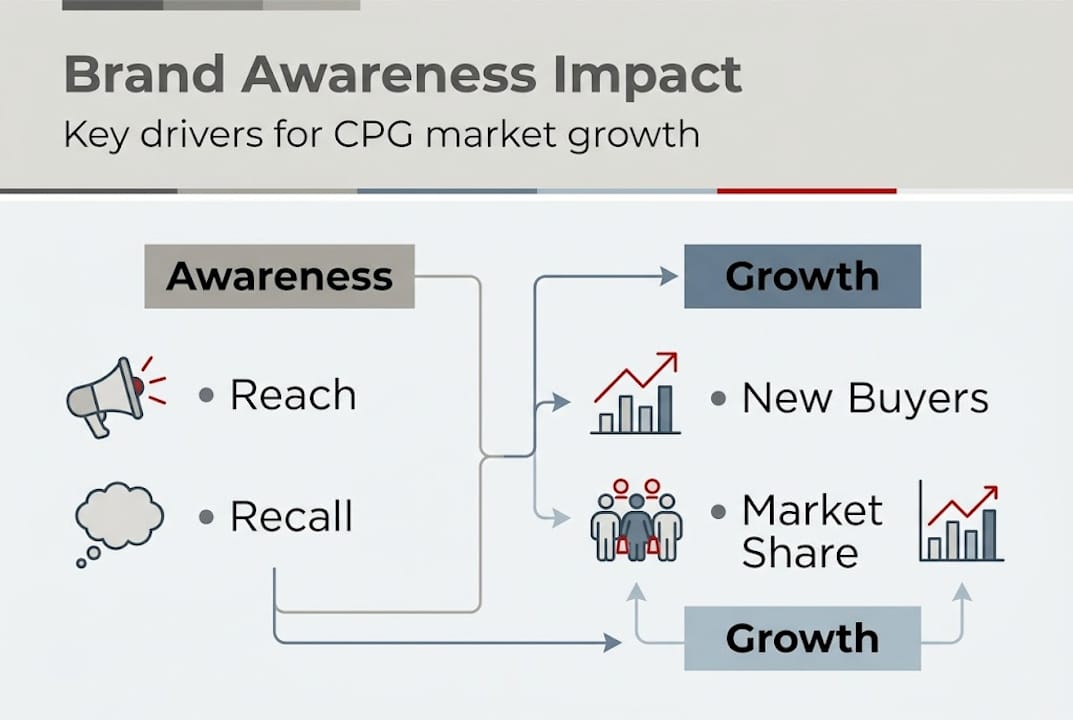
Most CPG growth comes from new buyers, not repeat buyers. That means your brand awareness strategy is, by definition, your growth strategy. It is not a supporting function. Emotional connection through storytelling reinforces that structure at every stage of the buyer journey.
Performance marketing captures purchase intent. Brand marketing creates it. Both are necessary, but most growing CPG brands tip too far toward performance because the ROI is immediate and measurable. That feels responsible. Over time, though, it erodes brand relevance and makes you dependent on paid channels to sustain revenue you used to earn organically.
Research consistently supports a 60/40 brand-to-performance split for CPG brands focused on sustainable market share growth. The 60% going to brand-building creates long-term demand. The 40% going to performance marketing converts it.
| Marketing type | Primary function | Time horizon | Risk if over-indexed |
|---|---|---|---|
| Brand marketing | Creates demand and emotional pull | Long-term | Slow to show ROI, often cut first |
| Performance marketing | Captures existing demand | Short-term | Audience fatigue, rising CPCs |
| Combined 60/40 approach | Builds and converts simultaneously | Both | Requires discipline to maintain |
Over-indexing on performance is one of the most common mistakes we see from brands in this revenue range. You get efficient short-term numbers, but your brand loses ground. New buyers never develop a connection, and when ad costs rise or a competitor increases spend, you have no brand equity to fall back on.
Pro Tip: Even during slow sales periods or cash flow crunches, protect your brand budget. Cutting brand spend is one of the fastest ways to lose market share that takes years to recover.
Performance marketing works best when brand awareness has already laid the groundwork. Without awareness, even a perfectly optimized campaign is fighting an uphill battle.
Market penetration means getting your product into the hands of buyers who have never purchased it before. It is the primary growth driver for CPG brands, and brand awareness is the mechanism that makes it happen. When more people recognize your brand across more contexts, more first-time purchases occur. That is not theory. New buyer penetration accounts for the majority of sales growth in CPG categories studied across product segments.
Declines also tend to follow the same pattern in reverse. When penetration drops, the brand shrinks. Churn from existing buyers is rarely the main culprit.
Here is a practical four-step approach to building awareness-driven penetration:
Multi-channel presence, both retail and digital, is what sustains this effort over time. A brand that only lives on Amazon will miss buyers who discover products in-store. A brand without a digital footprint loses buyers who research before they shop. Increasing online brand visibility is not optional. It is the connective tissue of a real penetration strategy.
You do not need a national TV budget to build meaningful brand awareness. Mid-sized CPG brands consistently outperform their spend by being smart about where and how they show up. The brands that win at this stage tend to do three things well: they tell a real story, they target precisely, and they activate communities.
For brands in the $500K to $20M range, storytelling without big budgets is not a compromise. It is a competitive advantage. Large brands struggle to feel personal. You do not have that problem. Use your founder story, your sourcing story, or your community roots to create emotional connection that a national brand cannot replicate.
High-impact tactics that work at this scale:
Pro Tip: Layer local event sponsorships with geo-targeted digital ads running in the same window. The physical and digital impressions compound each other, and you get far more recall per dollar than running either tactic alone.
Building a compelling brand story is not a one-time exercise. It is the foundation everything else builds on.
If you cannot measure it, you cannot optimize it. Brand awareness is often treated as a soft, qualitative concept, but the metrics are real, trackable, and actionable when you set them up correctly.
Start with these core awareness indicators:
Multi-channel awareness requires benchmarking by channel, not just overall. An impression on Amazon Sponsored Brands means something different from an organic social mention. Treat each channel’s data separately, then look at aggregate trends to identify where awareness investments are actually driving new buyer behavior.
Combine retailer point-of-sale data, social listening, and periodic buyer surveys for a complete picture. Then scale your Amazon marketplace presence as one of the channels where awareness data can most directly connect to purchase behavior.
Here is the uncomfortable truth we see repeatedly: most CPG operators intellectually accept that brand awareness matters, but emotionally they cannot resist cutting it when Q4 looks tight or when the board wants faster returns. Performance spend stays. Brand spend goes. The logic seems sound in the moment.
But cutting brand spend is one of the most expensive mistakes a CPG brand can make because the cost does not show up immediately. Market share erodes quietly. New buyer acquisition slows. Then, six to twelve months later, the numbers look confusing because performance spend never dropped, yet revenue is declining anyway.
The other pattern we watch play out is inconsistent emotional messaging. A brand runs a heartfelt campaign in spring, then a discount-heavy promotion in fall, then a different look entirely for a retail pitch. Buyers never form a durable impression. Each campaign starts from scratch.
Emotional consistency in branding is not about using the same slogan. It is about making sure every touchpoint reinforces the same feeling and the same promise. That consistency is what compounds. Small, consistent actions taken over 18 to 24 months create the kind of brand recall that converts cold buyers without needing to re-earn their attention every time.
Brand value is not built in campaigns. It is built in the space between campaigns.
The strategies in this article are proven, but executing them across retail, Amazon, DTC, and wholesale simultaneously requires more than a good plan. It requires operational alignment, margin-aware channel decisions, and the discipline to stay brand-focused even when short-term pressures push back.
At RedDog Group, we help CPG brands in the $500K to $20M range build awareness frameworks that are grounded in contribution-margin thinking, not just top-line growth. Our omnichannel growth solutions connect brand strategy to channel economics so that every awareness dollar you spend is traceable to profitable market penetration. If you are ready to move from reactive marketing to a structured growth engine, let’s build it together.
CPG growth is driven primarily by attracting new buyers, not retaining existing ones, which makes brand awareness the most important lever for scaling revenue in most categories.
Start by sharpening your brand story and then run geo-targeted social ads pinned to the zip codes around your top retail doors to build recognition where it converts to sales.
Research supports a 60/40 brand-to-performance split, with the larger portion going to brand-building to create sustainable demand and protect long-term market share.
Track aided and unaided brand recall through periodic surveys, monitor impression share in paid channels, and measure social mentions and share of voice to understand how awareness is building over time.
Yes. Cutting brand spend consistently leads to long-term market share loss that is slow to reverse, even when short-term sales figures appear stable.
Leave a comment: