
Published: March 2020 | Last Updated:March 2026
© Copyright 2026, Reddog Consulting Group.

Many brand owners believe white label products are generic and undifferentiated. That’s a costly misconception. White label branding can help rapidly expand product lines and improve profit margins when done strategically. This guide will explain white label branding, its benefits, comparisons with private label, and practical strategies for CPG startups to use it for profitable multichannel growth.
| Point | Details |
|---|---|
| White label speeds market entry | Rebrand pre-made products under your name to launch faster without development overhead. |
| Margins improve significantly | White label products deliver 10-20% higher margins than national brands on average. |
| Different from private label | White label offers less customization but faster deployment than private label exclusivity. |
| Legal diligence is essential | Trademark clearance and strong contracts prevent costly disputes and liability issues. |
| Partner selection drives success | Quality manufacturers with reliable supply chains protect brand reputation and profitability. |
White label branding is a business practice where one company produces products which another company brands and sells as its own, enabling fast market entry without development overhead. You sell pre-manufactured products under your brand name, bypassing months or years of product development.
White label products are typically generic formulations sold to multiple brands simultaneously. The manufacturer creates the core product, and you apply your branding, packaging, and positioning. Common CPG categories include supplements, beauty products, food items, beverages, and household goods.
This model allows brands to enter markets faster by eliminating product development cycles. You focus on branding, marketing, and building your brand story while the manufacturer handles production complexities. The speed advantage becomes critical when testing new categories or responding to market trends.
Key characteristics of white label branding include:
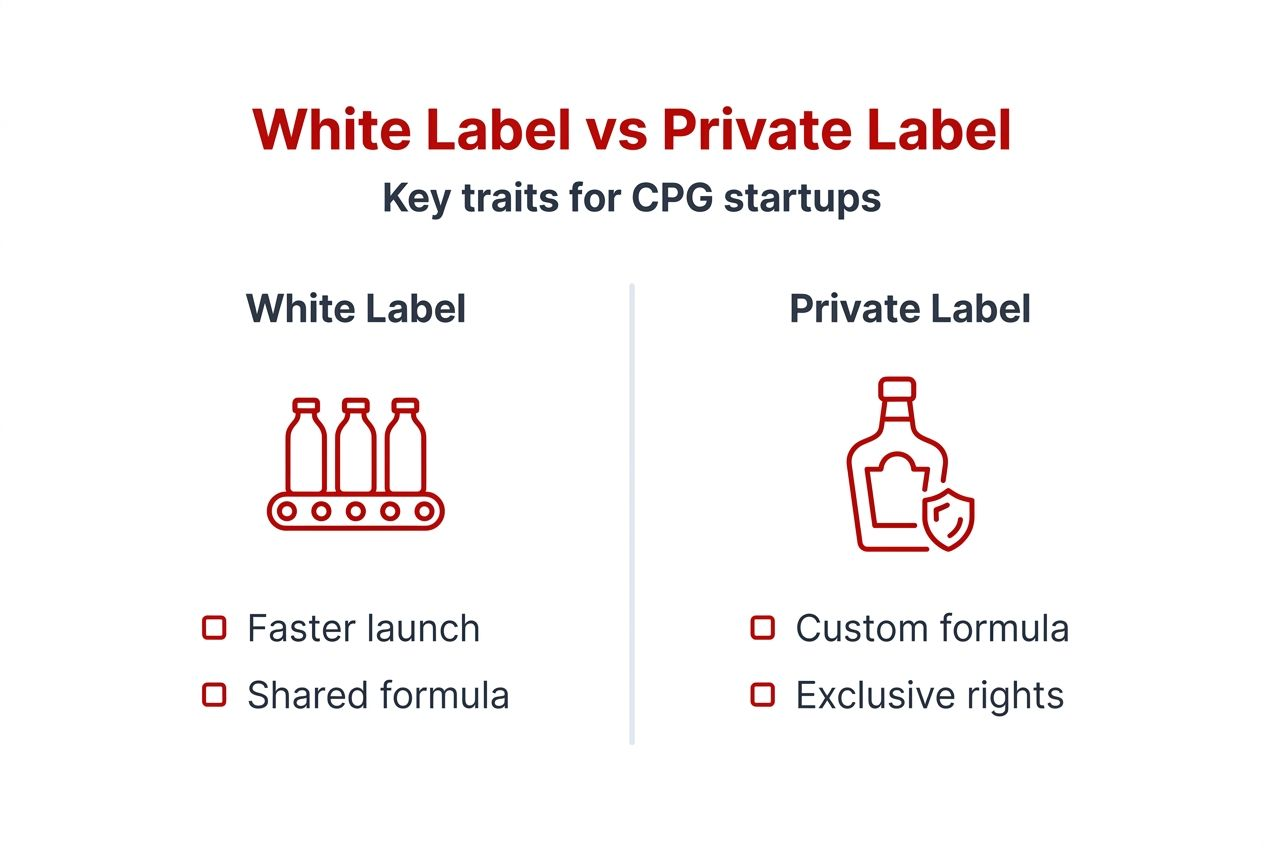
White label differs from private label primarily in exclusivity and customization levels. Private label products are exclusive to your brand with custom formulations. White label products use standard formulations available to multiple brands, trading exclusivity for speed and lower costs. For more guidance, review this white label branding guide.
Cost savings on production and R&D represent the most immediate advantage. You avoid product development expenses, formulation testing, regulatory approval costs, and manufacturing setup. These savings flow directly to your bottom line or fund marketing initiatives.

Speed to market crushes traditional timelines. While private label or own manufacturing might take 12-18 months from concept to shelf, white label products can launch in 60-90 days. You identify a manufacturer, customize packaging, and start selling. This speed lets you capitalize on trends before they fade.
White labeling enables CPG brands to diversify product lines rapidly and access new revenue streams without the complexities of manufacturing and inventory management. You can test a new supplement line, skincare products, or snack category without building new supply chains. Failed experiments cost less, successful ones scale quickly.
Margin control improves substantially. Margins on white-label products can be 10-20% higher than national brands on average. You control pricing strategy, avoid brand tax paid to established names, and optimize for channel diversification across Amazon, Walmart, DTC, and wholesale.
Benefits breakdown:
Pro Tip: Use white label to test new categories with minimal risk. Launch with small inventory commitments, measure customer response and unit economics, then scale winners while cutting losers quickly. This approach protects capital while exploring growth opportunities.
Understanding the strategic and operational differences helps you choose the right sourcing model for specific product lines and growth stages.
| Factor | White Label | Private Label |
|---|---|---|
| Exclusivity | Shared formulation sold to multiple brands | Exclusive product customized for your brand |
| Customization | Limited to packaging and branding elements | Full control over formulation and features |
| Speed to Market | 60-90 days typical launch timeline | 12-18 months for development and production |
| Upfront Investment | Lower minimums and setup costs | Higher investment in formulation and tooling |
| Branding Control | Strong control over positioning and packaging | Complete control including product attributes |
| IP Ownership | Manufacturer retains product IP | You may own formulation IP depending on contract |
White label products are sold to multiple brands with the same basic formulation while private label products are exclusive with customized features. This exclusivity impacts competitive positioning and pricing power.
Speed to market advantages make white label ideal for trend-driven categories or testing unproven concepts. Private label works better when you need product differentiation that competitors can’t easily replicate. Production lead times favor white label for quick launches.
Operational complexity stays lower with white label because manufacturers have established processes. Private label requires more involvement in quality control, formulation adjustments, and regulatory compliance. Upfront investment differences can be substantial, with private label requiring 3-5x more capital commitment.
Branding control and intellectual property ownership differ significantly. White label gives you packaging and marketing control but not formulation rights. Private label contracts can secure exclusive formulations and protect your product innovation. Building brand authority works with both models but requires different strategies.
Channel fees impact margins differently across retail platforms. Amazon FBA fees, Walmart WFS costs, and 3PL storage charges eat into margins if not planned carefully. Channel fee impacts like Amazon FBA and Walmart WFS can reduce margins significantly if not managed.
Inventory velocity becomes critical with white label products because low differentiation increases competition. Slow-moving inventory generates storage fees that compress margins. You need faster turns than private label or national brands to maintain profitability. Track days of inventory and storage costs weekly.
3PL storage costs compound when products don’t move quickly. Calculate all-in landed costs including storage, and set minimum velocity thresholds for each SKU. Products that don’t hit velocity targets should be discontinued or repriced aggressively.
Margin compression risks in white label come from price competition since multiple brands sell similar products. Mitigate this through:
Benefits of white label on operational simplicity include established supply chains and proven manufacturing processes. You avoid production troubleshooting, quality control buildout, and supplier relationship complexity. Faster scaling becomes possible with proper fulfillment strategy and channel management.
Pro Tip: Build a margin leak monitoring system that tracks all-in costs by channel monthly. Include COGS, shipping, storage, channel fees, returns, and promotional spend. Identify which SKUs and channels actually contribute to profit, then reallocate resources accordingly. Most brands discover 20-30% of SKUs lose money once all costs are factored.
Trademark infringement risks emerge when brand names or logos conflict with existing marks. Legal risks in white label branding include trademark infringement and product liability; strong contracts and IP diligence are essential to avoid costly disputes. Conduct comprehensive clearance searches before launching any white label product.
Contract terms define critical rights and obligations with white label partners. Your agreement should specify:
Product safety and regulatory compliance obligations rest with you as the brand owner, not the manufacturer. FDA regulations for food and supplements, Consumer Product Safety Commission rules, and state-level requirements all apply. You’re liable for recalls, injuries, and regulatory violations even if the manufacturer caused the problem.
Risk management through legal counsel pays dividends. Have attorneys review supplier contracts, conduct trademark searches, and verify regulatory compliance before launch. Due diligence costs less than product recalls or trademark lawsuits. Document everything: quality audits, ingredient certifications, safety testing, and regulatory submissions.
Evaluating manufacturers requires looking beyond price to assess total value and risk. Choosing white label partners requires evaluating product quality, reputation, pricing, and customization options to ensure alignment with brand standards and channel demands.
Criteria for manufacturer selection:
Negotiating branding and customization options maintains differentiation even with shared formulations. Push for exclusive packaging designs, unique scent profiles, or slight formula modifications. These small changes help your product stand out while keeping costs near standard white label pricing.
Assessing pricing and margin potential requires modeling all-in costs by channel. Factor in COGS, shipping, storage, channel fees, and promotional spend. Ensure sufficient margin remains after all costs to justify the effort. Target minimum 35-40% gross margin before marketing spend for marketplace channels.
Supply chain reliability and compliance prevent disruptions. Verify manufacturers have:
Pro Tip: Order samples from multiple manufacturers and run blind testing with target customers. Measure quality perception, purchase intent, and willingness to pay. The cheapest manufacturer rarely delivers the best total value. Building customer loyalty depends on consistent quality.
Align white label product selection with channel profitability metrics. Different platforms reward different product attributes. Amazon favors products with strong reviews and competitive pricing. Walmart emphasizes value positioning. DTC channels reward unique brand stories. Match white label products to channels where they can win.
Continuously monitor margin leaks across channels and optimize assortments. Track contribution margin by SKU and platform monthly. Cut products that don’t meet profitability thresholds. Redirect inventory and marketing spend to winners. This discipline separates profitable brands from revenue-focused ones that burn cash.
Use white label branding to maintain differentiation and limit commoditization:
Plan fulfillment and inventory strategies tailored to each channel’s requirements. Amazon FBA needs different inventory planning than Walmart WFS or DTC fulfillment. White label flexibility lets you optimize inventory placement by channel without managing multiple SKUs. Review Amazon brand guidelines for platform-specific strategies.
Emphasize ongoing margin optimization as a core discipline for profitable scaling. White label products offer margin advantages, but only if you actively manage pricing, costs, and channel mix. Build financial dashboards showing contribution margin trends. Review them weekly. Adjust quickly when margins compress.
Scaling CPG brands profitably requires more than just sourcing white label products. You need channel-specific strategies that protect margins while driving growth. RedDog Group specializes in helping CPG startups leverage white label branding for faster scaling across Amazon, Walmart, DTC, wholesale, and distribution.
Our margin-first approach identifies exactly where your white label products contribute to profit and where margin leaks hide. We help you navigate Amazon FBA fees, Walmart WFS compression, pricing strategy, and inventory velocity challenges that derail growth. Whether you’re testing new categories or scaling proven winners, our omnichannel growth services provide the analytical frameworks and operational clarity you need. Explore our CPG retail growth offer to see how tailored consulting accelerates profitable multichannel expansion.
White label branding involves selling pre-manufactured products under your own brand name to speed market entry and cut development costs. The manufacturer creates the core product while you control branding, packaging, and marketing. It differs from private label by offering less customization but faster deployment, typically launching in 60-90 days versus 12-18 months.
White label reduces R&D and production costs while speeding time to revenue, often delivering 10-20% higher margins than national brands. It simplifies inventory and operational overhead by using established manufacturing processes and proven products. Combined with strategic pricing and channel fee awareness across Amazon, Walmart, and DTC, it significantly improves overall margin performance and cash flow.
Trademark infringement poses risk if you don’t clear brand names and logos through comprehensive searches before launch. Contract terms defining branding rights, product liability, and quality standards require careful negotiation and legal review. Product safety compliance remains mandatory regardless of manufacturer assurances, and you’re liable for recalls or regulatory violations. Engaging legal counsel and performing due diligence reduces these risks significantly.
Assess product quality through samples, testing, and third-party certifications rather than just reviewing spec sheets. Evaluate manufacturer reputation via customer references, compliance history, and industry standing. Negotiate customization options for packaging and minor formulation tweaks that maintain brand differentiation. Confirm pricing and margin structures align with your channel strategy and profitability goals. Check supply chain stability, backup capacity, and geographic advantages that support reliable fulfillment.
Leave a comment: