
Published: March 2020 | Last Updated:May 2026
© Copyright 2026, Reddog Consulting Group.

TL;DR:
- Walmart Marketplace is a vetted, application-based platform where approved sellers list products alongside Walmart’s own inventory. Success depends on catalogue readiness, fulfillment setup like WFS, and maintaining high performance metrics for better visibility and margins. Proper preparation and operational excellence unlock growth opportunities in this rapidly expanding, high-traffic channel.
Walmart Marketplace is not what most sellers assume it to be. It is not an open listing platform where anyone can sign up and post products the same afternoon. It is a vetted, application-based third-party seller program that places your inventory directly alongside Walmart’s own products on Walmart.com, one of the highest-traffic retail destinations in the United States. If you are an eCommerce seller or CPG brand operator evaluating your next channel, understanding exactly how this platform works, what it demands from sellers, and where the real margin opportunity lives will save you months of guesswork. This guide covers all of it.
| Point | Details |
|---|---|
| Vetted seller program | Walmart Marketplace requires application approval, business documentation, and catalog compliance before you can sell. |
| WFS changes operations | Walmart Fulfillment Services handles picking, packing, and returns, fundamentally shifting how sellers manage inventory and staffing. |
| Performance drives visibility | Pro Seller metrics like on-time delivery and content quality directly affect Buy Box wins and platform visibility. |
| Marketplace growth is accelerating | Marketplace sales are growing nearly 50% year-over-year, making 2026 a critical window for sellers to establish a position. |
| Catalog readiness matters most | Product ID compliance and GTIN readiness are the most underestimated factors affecting onboarding speed and long-term success. |
At its core, Walmart Marketplace is a third-party platform where approved businesses sell products directly to consumers on Walmart.com, sitting alongside Walmart’s own first-party inventory. Walmart is not your customer here. The end consumer is. That distinction matters because it shapes every operational and financial decision you will make as a seller.
Sellers manage their own catalog, set their own pricing, and choose their own fulfillment method. Walmart does not take ownership of your inventory. The platform provides the storefront, the traffic, and the infrastructure, while you supply the products and maintain your listings through a tool called Seller Center.
Seller Center is your command center for everything: uploading product listings, monitoring performance metrics, managing orders, and accessing fulfillment integrations. It is functional and detailed, though it has a learning curve if you are coming from other platforms. The good news is that the Walmart online selling ecosystem is purpose-built for sellers who are operationally prepared.
Pro Tip: Before applying, map out your catalog carefully. Sellers who arrive at the application process with clean product data, proper GTINs, and a clear fulfillment plan move through onboarding significantly faster than those who improvise along the way.
Here is a quick breakdown of how the Walmart Marketplace model works in practice:
This structure makes the Walmart seller program genuinely different from retail vendor arrangements, where Walmart buys your product wholesale. As a Marketplace seller, you set the price, absorb the margin, and control the relationship with your inventory.
Getting onto Walmart Marketplace is not difficult, but it is not casual either. Walmart screens applicants to protect the customer experience, which means the entry bar is higher than you might expect from a marketplace.
Here is what you need to qualify:
Because Walmart Marketplace is an application-based channel, sellers generally need stronger catalog and fulfillment infrastructure compared to more open platforms. Think of it as a quality filter working in your favor once you are inside. The sellers competing alongside you have cleared the same bar.
Pro Tip: Upfront catalog readiness is the most underestimated gating factor in Walmart onboarding. Brands that clean up their product data and secure GTINs before applying consistently report smoother, faster approvals.
One nuance worth understanding: there is a meaningful difference between a Walmart Marketplace seller and a Walmart vendor. Vendors sell to Walmart wholesale. Marketplace sellers sell through Walmart to consumers. Each model has different economics, different requirements, and different risk profiles. If you are reading this guide, you are almost certainly evaluating the Marketplace model.
Walmart Fulfillment Services, commonly called WFS, is the logistics program that lets you ship inventory into Walmart’s fulfillment network and have Walmart handle the rest. This is not just a convenience feature. For many sellers, it is a fundamental shift in how their business operates.
When you use WFS, Walmart handles picking, packing, and shipping from its own fulfillment centers. You send your inventory in, and Walmart delivers it to customers with a two-day or better shipping promise. That speed badge shows up on your listings and directly improves conversion. Returns are handled by Walmart, online or at any of its 4,600-plus physical store locations.

Here is a summary of how WFS pricing is structured:
| Fee type | Details |
|---|---|
| Shipping label fee | Starts at $3.45 for items weighing 1 lb or less |
| Storage fees | Vary by season; higher rates apply October through December |
| Long-term storage | Additional charges apply for items stored over 12 months |
| Hazmat items | Subject to separate pricing |
| Returns handling | Included in WFS; no additional per-return charge |
WFS rates are estimated 15% lower than comparable fulfillment providers, which matters when you are doing unit-level contribution margin math. That said, the real value is not just the rate. It is the customer experience you get access to without building it yourself.
Using WFS also shifts your operational model in ways that are worth thinking through carefully:
You can explore third-party fulfillment cost comparisons if you want to benchmark WFS rates against other options before committing your inventory strategy.
The Walmart Marketplace Pro Seller program is where the platform rewards sellers who run a clean, reliable operation. If you qualify, the financial benefits are real.
Pro Seller status is earned by meeting performance thresholds across several key metrics:
Hit the benchmarks consistently, and you unlock faster payouts (up to 10% more per cycle), discounts up to 25% on shipping labels, and improved visibility in search results. That last benefit compounds over time. Better placement means more impressions, more conversions, and more data to reinforce your ranking.
The deeper lesson from the Pro Seller framework is that operational excellence drives Buy Box wins, not just price. Sellers who try to compete on price alone without maintaining delivery rates or content quality consistently underperform compared to sellers who treat operations as a strategic asset.
Pro Tip: Track your cancellation rate and on-time delivery weekly, not monthly. By the time a monthly review surfaces a problem, the platform algorithm has already penalized your ranking. Early visibility into your metrics gives you time to course-correct before it costs you placement.
Understanding how the Walmart seller program rewards performance changes how you think about investment priorities. The return on a better fulfillment setup or a cleaner product catalog is not just operational. It shows up in your visibility, your conversion rate, and your long-term margin per unit.
Walmart Marketplace does not exist in isolation. It is tightly woven into Walmart’s broader digital commerce and logistics infrastructure, and that integration is accelerating. Marketplace sales are growing at nearly 50% year-over-year, driven by Walmart’s fast delivery investments and its massive physical store footprint working as a fulfillment asset.
For sellers evaluating how to sell on Walmart in 2026, here is where to focus your energy:
| Strategy | What it affects |
|---|---|
| WFS adoption | Delivery speed, conversion rate, and customer service load |
| Catalog optimization | Search visibility, content score, and conversion rate |
| Pro Seller compliance | Buy Box eligibility, payout timing, and label costs |
| Pricing strategy | Marketplace visibility and margin per unit |
The role of Walmart Marketplace in a multi-channel strategy is increasingly that of a high-intent, high-traffic channel with relatively less competition than mature platforms. For CPG brands looking to read more on how Walmart Marketplace drives CPG growth, the channel economics in 2026 are worth studying carefully before you act.
I have worked with enough CPG brands on Walmart Marketplace to say this plainly: the sellers who struggle are not struggling because the platform is hard. They are struggling because they treated Walmart like a lower-stakes version of Amazon and skipped the preparation work.
What I have seen consistently is that catalog readiness and fulfillment setup determine 80% of your early trajectory. Brands that arrive with clean GTINs, a working WFS plan, and realistic margin models get traction fast. Brands that improvise spend the first three months chasing errors that should have been resolved before launch.
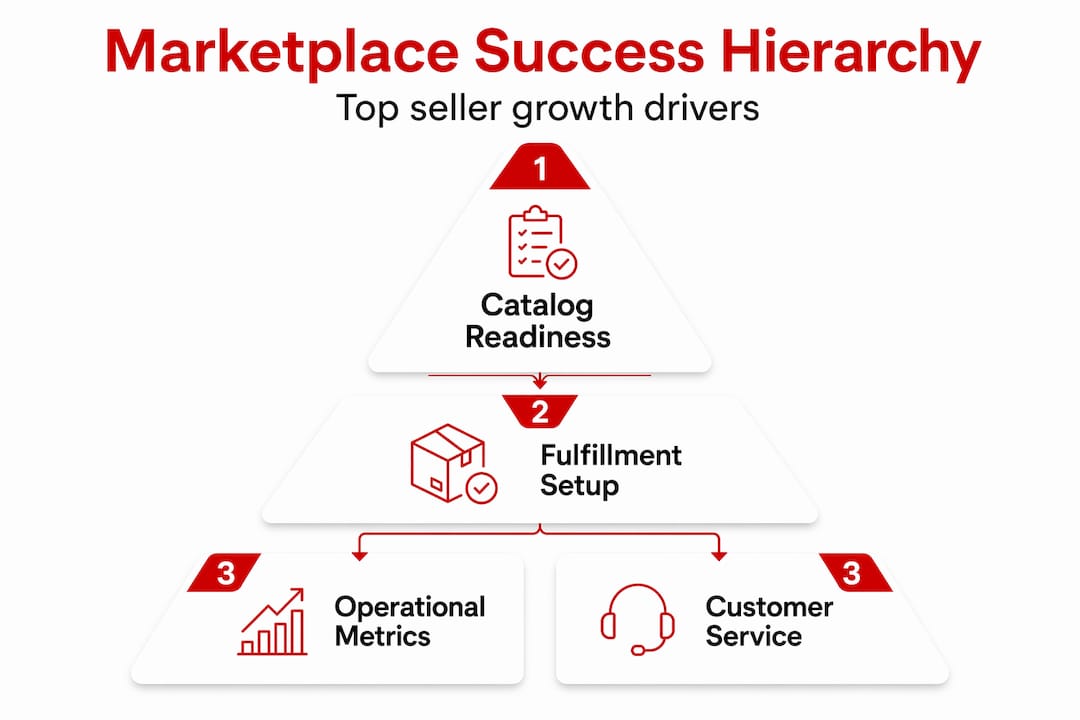
WFS is genuinely a differentiator. Once you hand fulfillment and returns to Walmart’s infrastructure, you free up internal capacity to focus on growth activities: catalog expansion, advertising, and pricing strategy. That shift is more valuable than most sellers anticipate before they experience it.
The price competitiveness requirement makes some sellers nervous, but in practice it rarely forces margin destruction if you go in with a clear pricing strategy. The Walmart Marketplace vs Amazon comparison is one I walk brands through carefully, because the right answer depends entirely on your category, your catalog structure, and your current cost stack. Answering “is Walmart marketplace profitable” requires that kind of unit-level analysis, not a general opinion.
My take: Walmart Marketplace rewards sellers who respect the operational standards the platform was built around. If you do, the growth trajectory in 2026 is real.
— Reddog
If you are evaluating Walmart Marketplace as a growth channel, the questions that matter most are not “how do I list products” but rather “what will this channel actually contribute to my margin, and am I operationally ready to scale it.”
At Reddog, we work with CPG brands in the $500K to $20M range that are ready to get serious about marketplace economics. Our marketplace growth consulting covers Walmart and Amazon channel strategy, WFS economics, catalog optimization, and contribution margin planning. We focus on what each channel actually returns at the unit level, not just top-line revenue numbers that look good on a dashboard.
If you want a practical review of your Walmart readiness, your current channel economics, or your inventory velocity across platforms, book a free 30-minute strategy call with the Reddog team. No pitch, no pressure. Just a focused conversation about what your numbers are actually telling you.
Walmart Marketplace is Walmart’s vetted third-party seller program where approved businesses sell products directly to consumers on Walmart.com alongside Walmart’s own inventory. Sellers control their own pricing, catalog, and fulfillment.
You need a business tax ID, verified business identity, product GTINs or UPCs, and a qualifying fulfillment setup. Personal accounts and informal business structures are not accepted.
Profitability depends on your category referral fees, WFS costs, and pricing strategy. Sellers who use WFS and qualify for Pro Seller status generally see better margins because of lower shipping costs and higher conversion rates from the two-day delivery badge.
WFS is Walmart’s fulfillment network where you ship inventory in and Walmart handles the rest, including delivery and returns. WFS rates run approximately 15% lower than comparable providers, and the two-day shipping badge it provides improves listing conversion rates.
The Pro Seller program rewards high-performing sellers with faster payouts, shipping label discounts up to 25%, and better search visibility. Qualification is based on on-time delivery, cancellation rate, content quality, and price competitiveness.
Leave a comment: