
Published: March 2020 | Last Updated:July 2026
© Copyright 2026, Reddog Consulting Group.

TL;DR:
- Third-party logistics involves outsourcing warehousing, order fulfillment, and shipping to specialized providers. It supports brands by managing multi-channel logistics, real-time inventory, and peak season surges efficiently. Selecting the right 3PL depends on stage fit, system integration, and operational capacity to ensure sustainable growth.
Third-party logistics (3PL) is defined as the practice of outsourcing warehousing, order fulfillment, and shipping operations to a specialized external provider that manages these supply chain functions on your behalf. For ecommerce and CPG brands, this means a dedicated logistics partner receives your inventory, picks and packs orders, and ships directly to customers or retail partners. The global 3PL market is projected to reach $1.57 trillion by 2031, driven by ecommerce expansion and the growing complexity of omnichannel CPG distribution. That scale reflects how central outsourced logistics has become to modern retail operations. Understanding what third party logistics offers, and when it makes sense for your brand, is one of the most consequential decisions you will make as you scale.
A 3PL provider delivers a broad set of services that replace or supplement your internal logistics operation. The core offering covers warehousing and inventory management, order picking and packing, carrier selection and shipping, and returns processing. Beyond those fundamentals, most providers today offer a range of value-added capabilities.
Common third party logistics services include:
3PL providers typically operate advanced inventory systems that give brands real-time visibility without requiring you to build or maintain that infrastructure internally. That visibility reduces overselling risk across channels and gives your team accurate data for purchasing decisions.
Pro Tip: Ask any prospective 3PL provider for a live demo of their warehouse management system (WMS) before signing. A provider that cannot show you real-time inventory and order status data in a demo will not perform better once you are live.

In-house logistics means your team manages warehousing, staffing, packing, and shipping directly. For early-stage brands, this model offers maximum control over the customer experience and lower fixed costs at low order volumes. The tradeoff becomes apparent as volume grows.
Most brands underestimate in-house fulfillment costs by 20–40%, overlooking hidden labor, overhead, and the opportunity cost of founder or operator time spent on logistics rather than growth. That gap between perceived and actual cost is what makes 3PL economics look more attractive once you run a true comparison.
| Factor | In-house fulfillment | Third-party logistics |
|---|---|---|
| Fixed cost structure | High (lease, staff, equipment) | Variable (pay per order or unit) |
| Scalability | Limited by space and headcount | Scales with order volume |
| Peak season flexibility | Requires overstaffing or outsourcing | Built into provider capacity |
| Technology investment | Brand-funded | Included in 3PL infrastructure |
| Operational control | Full control | Dependent on provider SLAs |
| Geographic reach | Single location typically | Multi-location networks available |
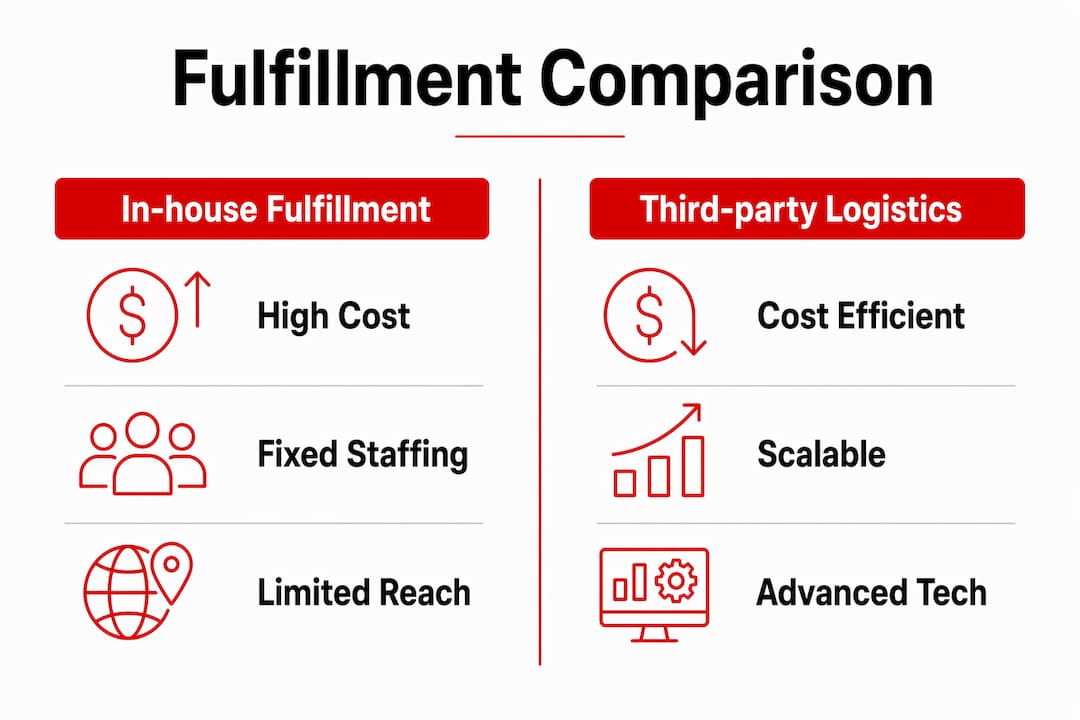
A hybrid logistics model combining in-house fulfillment for core markets with 3PL for geographic expansion is a proven approach for mid-market CPG brands scaling omnichannel distribution. This model lets you retain control over your highest-volume or most complex SKUs while using a 3PL network to reach new regions without opening additional facilities.
Pro Tip: Before comparing 3PL pricing to your current costs, build a true cost-per-order model that includes your warehouse rent, labor hours, packing materials, carrier rates, and the hours you personally spend managing logistics. Most brands are surprised by the result.
The decision to move from in-house to outsourced fulfillment is not purely financial. Brands that rely on highly customized packaging or white-glove unboxing experiences sometimes find that 3PL providers cannot replicate that experience at scale without significant setup and oversight. That is a legitimate reason to delay the transition, not avoid it entirely.
Choosing the wrong 3PL partner is expensive and disruptive. The right framework focuses on operational fit, not just price or brand recognition.
Stage fit. Selecting a 3PL based on matching your order volume and product complexity to the provider’s client profile is the most overlooked criterion. A provider built for enterprise accounts will deprioritize your brand when capacity is tight.
System integration. Integration readiness and vertical experience matter more than warehouse location or pricing alone. Confirm native connections to your sales platforms before committing.
Service level agreements. Strong providers commit to order accuracy rates of 99.8% or better and inventory accuracy near 99.9%. Brands without solid integration can spend over 20 hours weekly on manual reconciliation. Demand SLA commitments in writing.
Pricing transparency. Request a complete fee schedule covering receiving, storage, pick-and-pack, special handling, returns, and account management. Hidden fees in 3PL contracts are common and erode margin quickly.
Peak season capacity. Ask specifically how the provider handles volume surges during Q4, Prime Day, or promotional events. Get references from brands that have shipped through at least one peak season with the provider.
Facility visits and pilot programs. Operational due diligence requires site visits and pilot programs to verify workflows and provider responsiveness beyond marketing materials. A facility tour reveals staffing levels, cleanliness, and actual operational pace.
Discovery questions. Ask what percentage of their current clients are in your revenue range, what their average error rate is, and how they handle chargebacks from retail partners.
Pro Tip: Evaluate 3PL partners well before volume spikes. The biggest mistake brands make is signing contracts during peak stress periods when there is no time for proper vetting. Start your search three to six months before you need to transition.
The clearest signal that a brand needs a 3PL is order volume growth. Most ecommerce brands begin transitioning to a 3PL partner when they reach 500 to 1,500 orders per month with year-over-year growth of 20% or more. At that threshold, in-house fulfillment starts generating service failures and chargebacks that cost more than outsourcing would.
Specialized 3PL networks often operate 25 or more locations across the U.S., providing two-day ground shipping coverage to most of the country without air freight costs. For a CPG brand selling on Amazon, Walmart, and DTC simultaneously, that network reach directly affects your competitive position on delivery speed.
Practical examples of where 3PL adds measurable value:
For omnichannel brands, the benefits of third party logistics extend beyond cost. Real-time inventory visibility across all channels reduces the risk of stockouts on Amazon while simultaneously fulfilling a Walmart purchase order. That coordination is difficult to manage manually and nearly impossible to scale without a technology-enabled fulfillment partner. Brands pursuing omnichannel growth consistently find that logistics infrastructure is the constraint that limits channel expansion, not marketing or demand.
Third-party logistics is the operational foundation that allows ecommerce and CPG brands to scale across channels without building the infrastructure to match.
| Point | Details |
|---|---|
| 3PL definition | A 3PL outsources warehousing, fulfillment, and shipping to a specialized external provider. |
| Volume trigger | Most brands transition to a 3PL at 500–1,500 orders per month with 20% or more year-over-year growth. |
| Hidden cost gap | Brands underestimate in-house fulfillment costs by 20–40%, making 3PL economics more favorable than they appear. |
| Stage fit matters | Match your order volume and product complexity to the provider’s client profile, not just their brand reputation. |
| Due diligence standard | Visit facilities and run pilot programs before signing. SLAs should commit to 99.8% order accuracy or better. |
The most common mistake I see CPG brands make with 3PL selection is choosing a provider based on name recognition or a polished sales deck. Stage fit is the variable that determines whether the relationship works. A provider that serves enterprise clients with millions of units per month will not give your $2M brand the attention it needs when their warehouse is at capacity in November.
The second mistake is timing. Brands almost always start evaluating 3PL partners when they are already overwhelmed. Orders are backing up, chargebacks are coming in from retail partners, and the team is exhausted. That is the worst possible moment to make a long-term operational decision. The brands that get this right start the evaluation process months before they need to transition, when they have the bandwidth to visit facilities, run pilots, and negotiate terms from a position of stability.
A hybrid model is often the right answer for brands in the $1M–$10M revenue range. Keep your highest-margin, most customized fulfillment in-house where you can control the experience. Use a 3PL for geographic expansion, retail compliance, and peak season overflow. That structure gives you control where it matters and flexibility where you need it. Reddog works with brands at exactly this stage, helping them map their supply chain options against their actual contribution margin before committing to any provider.
The brands that scale logistics well treat 3PL selection as a strategic decision, not a vendor procurement exercise. The difference shows up in your margin, your chargeback rate, and your ability to say yes to new retail opportunities without operational panic.
— Reddog
Logistics decisions directly affect your contribution margin, and most brands do not model that impact before signing a 3PL contract.
Reddog works with ecommerce and CPG brands in the $500K–$20M revenue range to evaluate 3PL fit, model true fulfillment costs, and build channel economics that support profitable growth across Amazon, Walmart, DTC, and wholesale. The work is analytical and specific to your numbers, not generic advice. If you are approaching the volume threshold where in-house fulfillment is becoming a constraint, or if you are already with a 3PL and suspect your retail growth strategy is leaking margin, a focused 30-minute strategy call is the right starting point. Book a free session to review your contribution margin, inventory velocity, or channel economics with a consultant who works in this space every day.
Third-party logistics (3PL) means hiring an outside company to handle your warehousing, order fulfillment, and shipping instead of managing those operations yourself. The 3PL stores your inventory, packs orders, and ships to your customers or retail partners on your behalf.
Most ecommerce brands transition to a 3PL when they reach 500 to 1,500 orders per month with consistent year-over-year growth above 20%. At that volume, in-house fulfillment typically generates service failures and chargebacks that cost more than outsourcing.
A 3PL provides multi-location distribution networks, negotiated carrier rates, retail compliance expertise, and technology-enabled real-time inventory visibility without requiring you to build or fund that infrastructure. That combination is difficult and expensive to replicate internally.
Prioritize stage fit, system integration capability, and SLA commitments over price or warehouse location. Visit the facility in person, run a pilot program before committing, and confirm the provider’s order accuracy SLA is 99.8% or better.
Omnichannel CPG brands need to fulfill DTC orders, Amazon FBA prep, Walmart purchase orders, and wholesale shipments simultaneously. A 3PL with CPG experience handles retail compliance, EDI, and multi-channel inventory coordination in ways that in-house operations at growth-stage volumes cannot sustain.
Leave a comment: