
Published: March 2020 | Last Updated:May 2026
© Copyright 2026, Reddog Consulting Group.

TL;DR:
- Shopper marketing focuses on designing buying environments to influence active shoppers at every decision point. It encompasses physical and digital touchpoints, aiming to convert interest into immediate purchases and build long-term loyalty. Effective strategies require continuous measurement and coordination across channels to optimize profitability and growth.
Most CPG founders think shopper marketing means slapping a coupon on a shelf or funding a retailer’s circular ad. That misunderstanding costs real revenue. What is shopper marketing, actually? It’s the discipline of designing the buying environment so that shoppers at every stage of their decision process, from a Google search to a Walmart aisle, encounter the right message at the right moment and choose your product. It targets active shoppers rather than passive media audiences, mapping touchpoints from pre-shop intent all the way through checkout. That’s a fundamentally different strategic tool than brand awareness or trade spending.
| Point | Details |
|---|---|
| Shopper marketing defined | Shopper marketing focuses on influencing active shoppers at purchase moments across physical and digital channels. |
| Tactics matter | Effective tactics include in-store displays, sampling, ecommerce optimization, and retail media ads tailored to shopper journey stages. |
| Shopper journey focus | Mapping and targeting decision touchpoints from pre-shop to checkout increases chances of conversion. |
| Data-driven optimization | Measurement and alignment with retailers enable continuous optimization and better shopper marketing ROI. |
| Distinct yet complementary | Shopper marketing complements brand and trade marketing by converting preference into actual purchase. |
Shopper marketing is a purpose-built discipline focused on changing buying behavior at the moment it’s most shapeable. It’s not about making someone like your brand over time. It’s about converting interest, existing or newly created, into a transaction. Right now. In this aisle. On this product page.
The formal shopper marketing definition centers on influencing shoppers at the point of purchase to increase sales, market share, and brand loyalty across physical and digital touchpoints. Notice what’s in that definition: physical and digital. If you’re only activating in-store, you’re running half the playbook.
For CPG brands in the $500K to $20M range, that dual-channel scope matters enormously. You’re not yet big enough to blanket the market with national advertising, but you are positioned to create a buying environment that systematically tilts purchase decisions in your favor wherever shoppers encounter your brand.
Shopper marketing functions across several areas:
Linking local marketing strategies for CPG into your shopper marketing plan is often where regional brands find a genuine edge, particularly when national brands can’t activate with the same cultural specificity or retailer relationship depth.
Once you understand the scope, the tactics become clearer. Shopper marketing tactics span physical executions like in-store displays, sampling programs, and packaging callouts, as well as digital executions like product pages, retail media ads, and search placements. The distinction matters less than the sequencing.
In-store tactics that actually move product:
Online and digital tactics:
A critical principle here: channels behave differently, and your tactics need to reflect that. A shopper on a Walmart grocery app is in a different mental mode than a shopper walking the snack aisle at a regional grocer. If you apply the same creative and message to both, you’re leaving money behind.
Pro Tip: Before funding any new tactic, map it back to a specific shopper behavior you want to change. “We want first-time triers” requires completely different tactics than “we want lapsed buyers to return.” Tactics without behavioral targets are just spending.

Review digital advertising best practices before committing budgets to retail media, especially if you’re new to platform-specific ad formats. And if you’re building your digital retail presence for the first time, an ecommerce growth checklist for CPG will help you avoid costly activation gaps.
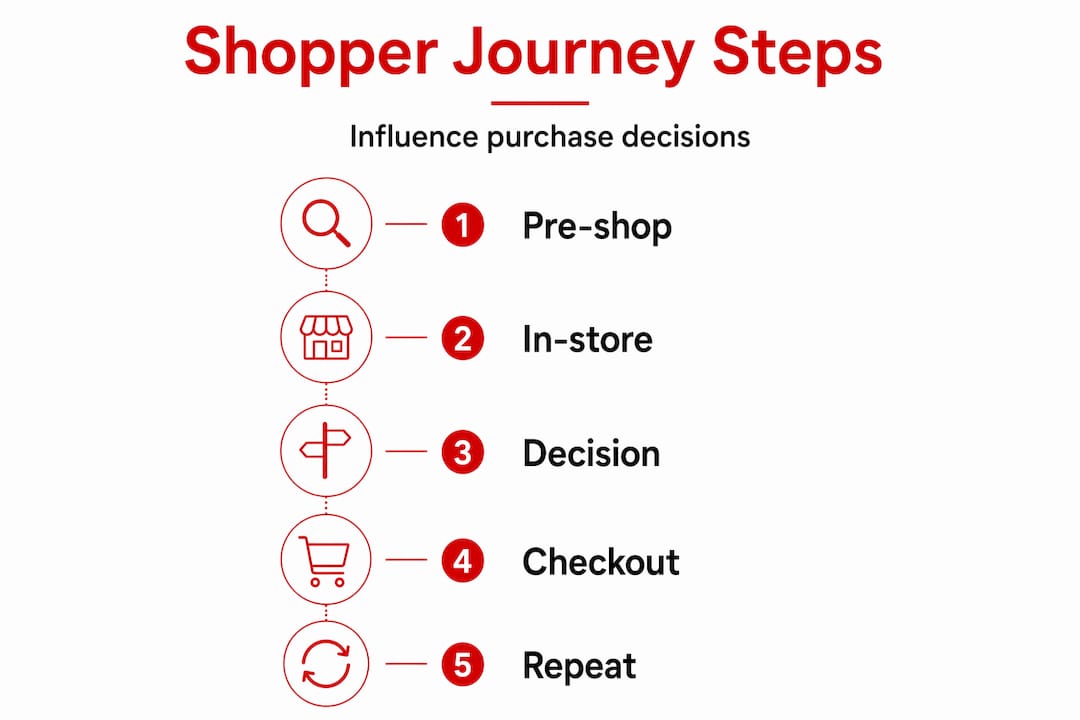
Shopper marketing maps every stage from pre-shop intent through checkout, targeting active shoppers at each decision point. That’s the model. Here’s what it looks like in practice.
The five stages of the shopper journey and what belongs at each:
| Shopper journey stage | Primary tactic | Goal |
|---|---|---|
| Pre-shop intent | Retail search ads, content, app banners | Earn a place on the shopping list |
| Store entry | End caps, homepage placements | Interrupt the default path |
| Aisle navigation | Shelf placement, secondary display | Get into the consideration set |
| Point of decision | Packaging cues, price callout | Win the final choice |
| Checkout | Cross-sell, loyalty prompt | Trigger repeat behavior |
Pro Tip: If you sell through three or more retail channels, map this journey separately for each. A Kroger shopper and a Target shopper have different digital pre-shop behaviors and different in-store decision environments. A single journey map applied to all channels will misfire on most of them.
Building omnichannel marketing campaigns that connect these journey stages across both physical and digital retail is how mid-market CPG brands punch well above their media budget. For a deeper look at omnichannel customer experience, the underlying principles of continuity and context apply directly to shopper marketing design.
You can run a great shopper marketing activation and have no idea whether it worked. That’s a common problem for brands in the $1M to $10M range. Retailer syndicated data like SPINS or IRI arrives with a lag. Promo lift is tangled up with seasonal effects. And digital retail media reporting often inflates attributed sales.
Shopper marketing measurement is an omnichannel, data-driven capability critical for aligning with retailers to optimize activation and growth. That’s not just a nice principle; it’s a practical operating requirement. Without measurement infrastructure, you cannot make the case to a retailer for better shelf placement or increased marketing investment.
Key measurement approaches worth prioritizing:
| Metric | What it tells you | Common pitfall |
|---|---|---|
| Promo lift | Incremental volume during activation | Conflates timing with tactic impact |
| Retail media ROAS | Revenue per ad dollar spent | Platform attribution is often inflated |
| Rate of sale | Velocity per store per week | Masks distribution gaps as performance |
| Repeat purchase rate | Long-term buyer conversion | Rarely reported by retailers by default |
For brands scaling across multiple channels simultaneously, omnichannel marketing integration frameworks help connect these measurement threads into a coherent picture rather than siloed channel reports that contradict each other.
These three disciplines are often confused, underfunded, or accidentally cannibalized. Here’s the practical distinction:
Brand marketing builds long-term equity and preference. A television campaign or national social push that makes shoppers predisposed to choose your product when they eventually encounter it. The ROI is real but slow and indirect.
Trade marketing is B2B. It’s the spending you do to earn and maintain shelf space, promotional support, and distribution commitment from retailers and distributors. Slotting fees, trade spend, and co-op advertising all live here.
Shopper marketing converts demand into purchase at the point of decision. It complements brand marketing by catching the shopper that brand equity pre-warmed, and it works alongside trade marketing by activating the shelf real estate your trade investment secured.
The failure mode for most brands in the $500K to $5M range is spending heavily on brand marketing, investing in trade to get on shelf, and then doing nothing at the moment of purchase. You’ve paid for the awareness and the distribution. Shopper marketing is how you actually close it.
Distinguishing these roles clearly:
For brands operating across Amazon, Walmart, and independent retail simultaneously, effective marketplace management best practices at the channel level need to connect directly to your shopper marketing approach at the product and promotion level.
Most shopper marketing content reads like it was written for someone managing a $50M brand with a dedicated agency, full syndicated data access, and a retailer joint business planning process. That describes almost none of our clients.
Here’s the view from the ground: for a CPG brand doing $2M to $8M in revenue, shopper marketing is less about running sophisticated campaigns and more about removing friction at every moment a shopper might choose you. That means your product page on Walmart.com has better photography than your competitor. It means your shelf set doesn’t look like an afterthought. It means you know which product benefit resonates with the Kroger shopper specifically, not just “the target consumer” in the abstract.
The brands we see growing consistently aren’t outspending anyone. They’re out-designing the purchase environment. They treat the store aisle and the digital shelf as a designed experience, not just real estate to occupy.
The other thing most guides skip: shopper marketing has a margin dimension. Every activation costs money. A sampling event, a retail media flight, a secondary display program. The question isn’t whether it drove sales. The question is whether it drove profitable sales. We’ve seen brands run shopper marketing programs that increased velocity but cratered contribution margin because the promo depth wasn’t accounted for. Build your measurement framework around margin, not just volume.
If you’ve read this far, you already understand that shopper marketing isn’t a single tactic or a seasonal event. It’s a continuous discipline that connects brand intent to purchase behavior across every channel where shoppers encounter your product.
At RedDog Group, we work with CPG brands in the $500K to $20M range to build shopper marketing strategies grounded in real channel economics, not just activation theory. We help you identify where purchase friction lives, what tactics fit your margin structure, and how to align retail investments with measurable sales velocity. Whether you’re expanding into new retail accounts, rebuilding your digital shelf, or trying to turn promo buyers into loyal customers, we translate shopper marketing principles into executions that actually protect your margins while growing your top line. Talk to our team to start the conversation.
Brand marketing builds long-term preference; shopper marketing converts that preference into a purchase at the active buying moment. They work together but operate on different timelines and require different tactics.
Ecommerce shopper marketing uses product page optimization, ratings and reviews, retail search ads, and digital circular placements to influence decisions at digital touchpoints, the same behavioral logic as in-store but executed through platform-specific tools.
Successful shopper marketing requires integration with retailer commercial plans because without that partnership, your brand lacks access to the merchandising commitments, media placements, and shelf support that make activations visible and measurable.
The shopper journey maps every touchpoint from pre-shop research through checkout, providing a framework for placing the right tactic at each stage when the shopper is most open to influence.
Retail media and shopper marketing are merging, with shopper data enabling real-time personalization of messaging and promotions that connect traditional in-store tactics to digital media in a single, transaction-oriented experience.
Leave a comment: