
Published: March 2020 | Last Updated:July 2026
© Copyright 2026, Reddog Consulting Group.

TL;DR:
- Shoppable content embeds purchasing options directly within digital media, simplifying the sales process. Its strongest formats include shoppable videos, live shopping, and tagged social posts, which significantly boost conversion rates. Successful scaling depends on authentic content, precise product tagging, and automated infrastructure for managing creators and performance.
Shoppable content is defined as digital media that embeds purchasing capability directly within the content itself, letting consumers buy products without leaving the page, video, or post they are already viewing. This format collapses the traditional sales funnel by combining discovery and transaction in a single moment, cutting the drop-off points that plague standard branded content. For marketing professionals and brand strategists, the business case is concrete: websites embedded with shoppable video report 4.8% conversion rates versus 2.9% for sites without it. That gap represents real revenue, not a rounding error. Understanding what shoppable content is, and how to build it well, is now a core competency for any team running a serious ecommerce or omnichannel program.
Shoppable content covers a wider range of formats than most marketers initially expect. Each format works differently, and the right choice depends on your audience, platform, and product category.
Shoppable images use clickable hotspots or product tags overlaid on a photo. A consumer sees a styled kitchen photo, taps the cutting board, and lands directly on the product page or checkout. Instagram Shopping and Pinterest Product Pins are the most widely used implementations of this format. The experience works because it meets the consumer at the moment of visual inspiration, not after they have already moved on.

Shoppable video is the highest-converting format in the category. Recorded shoppable videos embed clickable product links directly in the video frame, so viewers add items to their cart without pausing playback. Live shopping takes this further with real-time hosts, Q&A, and time-limited offers. Live shopping success requires a conversation-first approach with interactive hosts, scheduled sessions, and a limited number of products per session to maximize engagement per impression. Measuring engagement per impression, not total viewership, is the correct metric for live formats.
Shoppable blog posts embed product links or buy buttons within editorial content. A recipe article links directly to the featured ingredients. A gear review links to each product mentioned. This format works well for brands with strong content programs because it monetizes existing editorial without disrupting the reading experience.
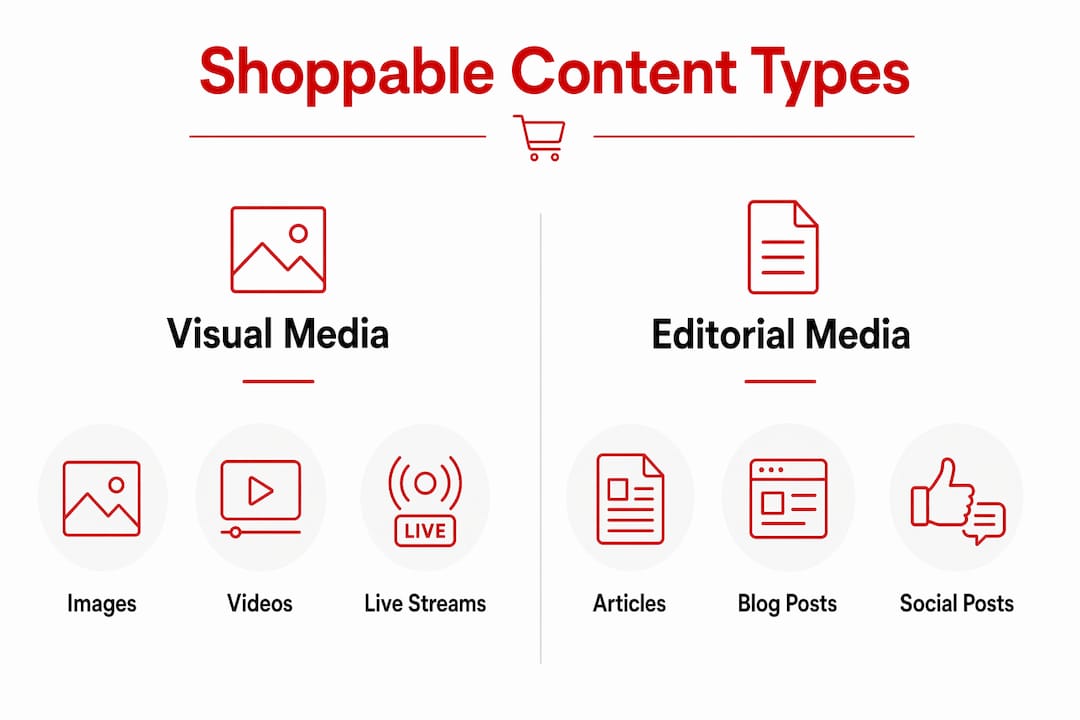
US digital buyers aged 18–34 increasingly purchase directly on Facebook, Instagram, and TikTok without leaving the app. About a third of these shoppers complete a transaction entirely within the social platform. That behavior makes social shoppable posts a critical channel for any brand targeting younger demographics.
Pro Tip: When choosing between embedded purchase (checkout inside the content) and linked purchase (click to product page), test both. Embedded checkout reduces friction but requires platform support. Linked purchase is easier to set up and works across more placements.
The conversion data for shoppable content is among the strongest in digital marketing. Shoppable video lifts site-wide conversion rates by 17–33%, with engaged viewers seeing increases of 50% to 500%. The median conversion lift across controlled tests is +125% for users who actively interact with the video. Top-performing brands outperform median brands by 2.5–3x on conversion lift.
“Add-to-cart rates are 225% higher for visitors interacting with shoppable videos compared to static product pages. Shoppable video ads generate 3.2x more conversions than standard video ads.”
Shoppable Video Conversion Rate: 2026 Benchmarks and ROI Stats
Those numbers reflect a structural advantage, not just a novelty effect. Shoppable content reduces clicks from discovery to checkout, eliminating the need for consumers to navigate through multiple product pages. Fewer clicks means fewer opportunities to abandon the purchase.
The engagement improvement extends beyond conversion rate. Click-through rates, time on page, and return visit frequency all increase when shoppable elements are present. This matters because engagement metrics feed algorithmic distribution on social platforms, meaning shoppable content often earns more organic reach than passive content of the same quality.
Format and placement also drive ROI speed in ways that most teams underestimate. Brands using floating player formats for shoppable video see 60% faster ROI than those using static inline carousels, recovering their investment in under 30 days for top deployments. Format choice outweighs traffic volume as a driver of ROI speed. A smaller audience engaging with a well-placed floating player will outperform a large audience scrolling past an inline carousel.
| Metric | Shoppable content | Standard content |
|---|---|---|
| Website conversion rate | 4.8% | 2.9% |
| Add-to-cart rate lift | +225% vs. static pages | Baseline |
| Conversion lift (engaged users) | +125% median | Baseline |
| Video ad conversions | 3.2x standard video | Baseline |
Creating shoppable content that converts requires more than adding a buy button to a video. The following practices separate programs that scale from ones that stall.
Lead with authenticity, not promotion. Personalizing shoppable content through data-driven insights improves conversion rates by 10–15% and customer satisfaction by 20%, according to BCG research. Relevance outperforms aggressive selling every time. Content that feels like an ad first and a recommendation second loses the trust that makes shoppable formats work.
Tag products with precision. Vague or mismatched product tags break the experience. Each tag should link to the exact product variant shown, with accurate inventory status. A consumer who clicks a tag and lands on an out-of-stock page is more likely to leave the site entirely than to browse alternatives.
Choose the right deployment format. Floating video players deliver faster ROI than inline carousels. For brands new to shoppable video, starting with a floating player on high-traffic product category pages gives the fastest feedback loop on what works.
Build creator networks, not one-off campaigns. Experts recommend moving beyond isolated shoppable campaigns toward sustainable creator networks that incentivize authentic content at scale. A single viral shoppable video is a spike. A network of creators producing consistent content is a channel.
Automate the affiliate infrastructure. Brands that scale creator programs successfully use affiliate-first infrastructures with automated brief generation, commission tracking, and bulk payments. Manual management fails at any meaningful volume. The automation is not optional once you move past a handful of creators.
Limit products per session in live shopping. Featuring too many products in a live session dilutes attention and reduces purchase intent per viewer. Three to five products per session is a practical ceiling for most formats.
Pro Tip: Test your shoppable content on mobile before launch. The majority of social commerce traffic arrives on mobile devices, and a tag or button that works on desktop may be too small or misaligned on a phone screen.
For a deeper look at how ecommerce conversion rate improvements connect to shoppable content placement, Reddog has published practical guidance on this exact topic.
Measurement is where most shoppable content programs lose discipline. Without the right KPIs, teams optimize for vanity metrics like views and shares while missing the signals that actually predict revenue.
The core metrics for shoppable content performance are:
Scaling requires connecting these metrics to your content production workflow. A structured digital marketing workflow that incorporates shoppable content tagging, creator briefing, and performance review cycles prevents the program from becoming a collection of disconnected experiments.
Aligning shoppable content with your broader omnichannel content strategy is the step most teams skip. Shoppable content performs best when it reinforces the same product story appearing in email, paid media, and in-store displays. Consistency across channels builds the recognition that makes a consumer click “add to cart” instead of scrolling past.
Automation tools for content tagging, creator management, and performance reporting are now available across a range of price points. Entry-level platforms handle basic product tagging and link tracking. Enterprise platforms add AI-driven personalization, real-time inventory sync, and multi-creator affiliate management. Choosing the right tier depends on your content volume and the size of your creator network. A data-driven content platform can help teams plan and execute at scale without adding headcount.
Shoppable content drives measurable conversion lifts because it removes the steps between discovery and purchase, and brands that combine authentic creator networks with the right deployment formats see the fastest and most durable results.
| Point | Details |
|---|---|
| Conversion impact is significant | Shoppable video lifts conversion rates by 17–33%, with engaged users seeing a median +125% lift. |
| Format determines ROI speed | Floating video players recover investment 60% faster than inline carousels. |
| Authenticity protects conversion | Data-driven personalization improves conversion by 10–15% and customer satisfaction by 20%. |
| Creator networks beat campaigns | Sustainable affiliate-first infrastructure scales shoppable content without manual overhead. |
| Measurement must be format-specific | Track add-to-cart rate, engagement per impression, and revenue by creator separately for accurate optimization. |
The conventional marketing funnel assumes a consumer moves through awareness, consideration, and purchase as separate events spread across days or weeks. Shoppable content makes that model obsolete for a growing share of transactions. A viewer watches a 60-second recipe video, taps the featured pan, and checks out. The entire funnel compressed into one content experience.
What I find most interesting is that the brands winning with shoppable content are not the ones spending the most on production. They are the ones who figured out that authenticity is the conversion mechanism. A polished brand video with a buy button is still a polished brand video. A creator showing how they actually use a product, with a tag that goes directly to checkout, converts at a fundamentally different rate because the trust is already there.
The live shopping format is the clearest example of this shift. The brands seeing the strongest engagement per impression are running sessions that feel like conversations, not broadcasts. The host answers questions, acknowledges hesitation, and limits the product selection so each item gets real attention. That is not a production technique. That is a sales philosophy applied to content.
For CPG brands in particular, the creator network model changes the economics of content entirely. Instead of funding a content calendar from a marketing budget, you build a system where creators produce content in exchange for commissions. The content cost scales with revenue, not with headcount. That is a structural advantage worth building toward, even if you start with three creators and a simple affiliate link.
— Reddog
Shoppable content is one of the most direct paths from content investment to measurable revenue, but only when it is built into a channel strategy that accounts for margin, not just top-line sales.
At Reddog, we work with CPG founders and operators in the $500K–$20M revenue range who are building out their digital and retail channels simultaneously. If you are evaluating shoppable content as part of a broader DTC or marketplace strategy, the conversation worth having is about contribution margin by channel, not just conversion rate. A free 30-minute strategy call through our CPG retail growth offer covers exactly that: channel economics, inventory velocity, and where your growth plan is leaving margin on the table.
Shoppable content is digital media, such as a video, image, or social post, that lets consumers purchase a product directly within the content without navigating to a separate website.
Shoppable video, particularly with floating player placement, delivers the highest conversion lifts. Live shopping and tagged social posts are also high-performing formats for brands targeting younger buyers.
Shoppable video ads generate 3.2x more conversions than standard video ads, and add-to-cart rates are 225% higher for viewers who interact with shoppable video versus static product pages.
The primary metrics are add-to-cart rate from shoppable interactions, conversion rate by content format, engagement per impression for live sessions, and revenue attributed to creator content through affiliate tracking.
Scaling requires affiliate-first infrastructure with automated commission tracking, brief generation, and bulk payments. Manual creator management fails at volume, making automation a prerequisite for sustainable growth.
Leave a comment: