
Published: March 2020 | Last Updated:June 2026
© Copyright 2026, Reddog Consulting Group.

TL;DR:
- Shopify Marketplace Connect is a native app that links your Shopify store to external marketplaces like Amazon and eBay, enabling centralized management of listings, inventory, and orders. It streamlines multichannel selling but requires careful attribute mapping and margin modeling to prevent listing errors and profit erosion. Differentiating Shopify as a platform from marketplaces and understanding tools like Shopify Markets are key to successful, cost-effective multichannel strategies.
Shopify Marketplace is defined as Shopify’s ecosystem for connecting your online store to major external marketplaces, powered by the native Shopify Marketplace Connect app. Shopify itself is an ecommerce platform, not a traditional marketplace like Amazon or Walmart. What it does is give you the infrastructure to sell on those marketplaces without leaving your Shopify admin. Through Marketplace Connect, merchants can list products, sync inventory, and manage orders across Amazon, Walmart, eBay, Etsy, and Target Plus from one centralized dashboard. The Shop app adds a consumer-facing discovery layer on top, but the real power for sellers sits inside Marketplace Connect.
Shopify Marketplace Connect is the native app that links your Shopify store to external selling channels. It was originally built by Codisto and is now deeply integrated into Shopify’s platform. That history matters because it means the app carries enterprise-grade multichannel logic inside a familiar Shopify interface.
The setup process follows a clear sequence. Most merchants complete the initial configuration in 30–60 minutes, though catalog complexity can extend that timeline.
Attribute mapping is the step most merchants underestimate. Skipping it or doing it carelessly causes listing errors and deactivated products on Amazon and eBay. Every field must conform to the marketplace’s own category structure, not just your internal naming conventions.
Pro Tip: Before you map attributes, export your full Shopify product catalog to a spreadsheet and audit field consistency. Inconsistent size labels or missing GTINs will block listings on Amazon before you even get started.

The app’s value comes from a specific set of capabilities that reduce the operational cost of selling across multiple channels. Here is what matters most for small business owners and CPG founders.
| Feature | Marketplace Connect | Sellbrite / ChannelAdvisor |
|---|---|---|
| Native Shopify integration | Yes | Requires API connection |
| Setup complexity | Low to moderate | Moderate to high |
| Best for | Small to mid-size catalogs | Large or complex catalogs |
| Cost model | Free tier + 1% fee above threshold | Monthly subscription fees |
| Marketplace coverage | Amazon, Walmart, eBay, Etsy, Target Plus | Broader, including niche channels |
Power users with large catalogs often outgrow Marketplace Connect and move to tools like Sellbrite or ChannelAdvisor. For most entrepreneurs launching multichannel operations, the native app is the right starting point.
Pro Tip: Use channel-specific pricing rules to build marketplace commissions directly into your listed price. If your base margin is 40% and Amazon takes 15%, your marketplace price should reflect that math before you go live, not after you see your first payout.
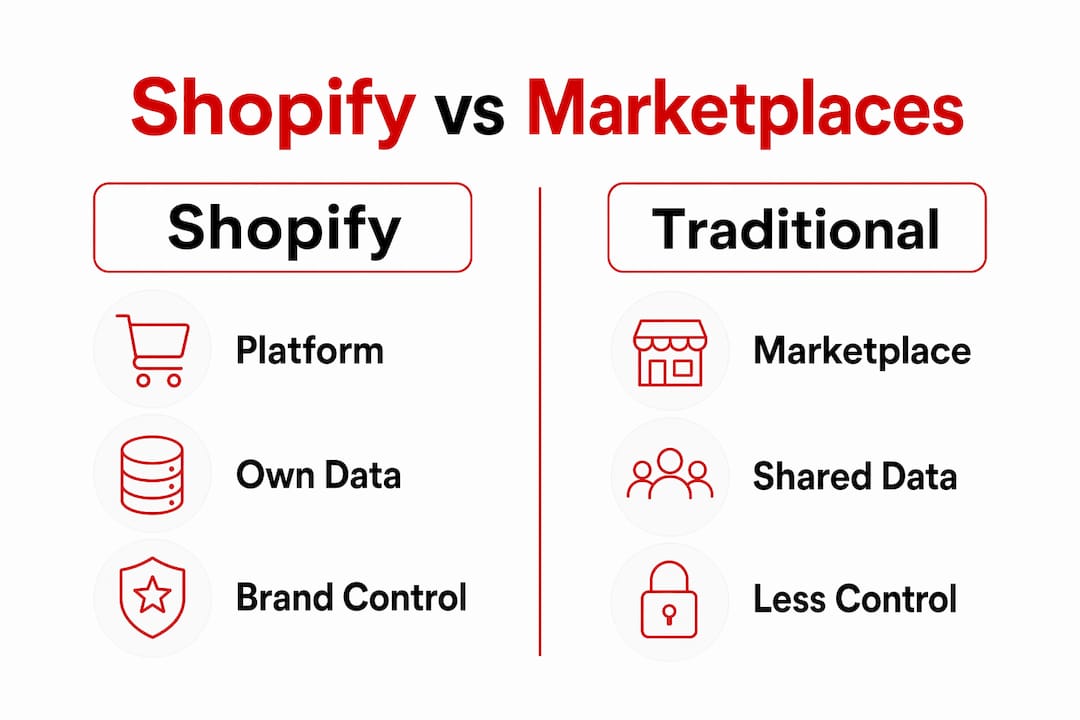
This is where a lot of entrepreneurs get confused, and the confusion is expensive. Shopify and Amazon are not the same type of business. Understanding the difference shapes every channel decision you make.
Shopify is an ecommerce platform. You own your store, your customer data, and your brand experience. Amazon is a marketplace. You rent shelf space, compete on a shared product page, and hand over customer relationships to the platform. The distinction between platform and marketplace determines who controls pricing, who owns the customer, and who captures long-term brand equity.
Confusing these two tools is one of the most common setup mistakes. Mixing up Shopify Markets with Marketplace Connect leads to misconfigured pricing and broken inventory rules. Here is the clear distinction.
They solve different problems. Use Shopify Markets when you want to sell to customers in Germany or Canada through your own store. Use Marketplace Connect when you want your products listed on eBay or Target Plus.
The Shop app functions as a discovery layer for independent Shopify stores. Consumers browse and track orders from Shopify merchants in one place. It is not a centralized marketplace in the Amazon sense. Merchants do not compete on a shared product detail page, and the Shop app does not aggregate pricing the way Amazon does. Think of it as a branded consumer experience that surfaces your store, not a marketplace that commoditizes your product.
For entrepreneurs building a multi-vendor marketplace on Shopify, the path runs through Shopify Plus. That tier unlocks the API-driven checkout extensibility and payment splitting needed to run a true marketplace where multiple vendors sell through one storefront.
Marketplace Connect has a free tier, but the cost structure changes as your order volume grows. Understanding this before you scale prevents margin surprises.
Beyond pricing, the operational challenges are real. Attribute mapping is the most common source of listing failures. Manual category and attribute mapping must align your Shopify catalog fields with each marketplace’s specific taxonomy. A product listed as “Blue” in your Shopify store may need to be mapped to a specific color code in Amazon’s backend. Getting this wrong deactivates listings silently.
For merchants building a multi-vendor model, payment splitting is the other major complexity. Automated payment splitting through tools like Stripe Connect enables automatic commission payouts to vendors at checkout. This capability requires Shopify Plus and custom development work. It is not a plug-and-play feature.
Pro Tip: Run a full channel economics model before you go live on any new marketplace. Map your product cost, Shopify transaction fee, marketplace commission, shipping, and return rate into a single contribution margin calculation. If the number is negative, adjust your price or skip the channel.
For a deeper look at how Shopify and Amazon stack up as selling channels, the Shopify vs. Amazon comparison from Reddog breaks down the economics for omnichannel brands.
Shopify Marketplace Connect is the most direct path for small business owners to manage multichannel selling across Amazon, Walmart, eBay, Etsy, and Target Plus from a single admin.
| Point | Details |
|---|---|
| Shopify is a platform, not a marketplace | Marketplace Connect is the tool that connects your store to external marketplaces. |
| Attribute mapping is non-negotiable | Skipping or rushing this step causes listing errors and deactivated products on Amazon and eBay. |
| Channel-specific pricing protects margin | Build marketplace commissions into your listed price before launch, not after your first payout. |
| Shopify Markets and Marketplace Connect are different tools | Confusing them leads to misconfigured pricing and broken inventory rules. |
| Shopify Plus unlocks multi-vendor capabilities | Payment splitting and advanced checkout extensibility require the Plus tier and custom development. |
I work with CPG founders every week who treat Shopify Marketplace Connect as a growth lever without first doing the margin math. That is the wrong order of operations. The app is genuinely well-built. Centralized order management across Amazon, Walmart, and eBay from one dashboard saves real time and reduces fulfillment errors. But the efficiency gain means nothing if you launch on a channel where your contribution margin is negative after fees.
The brands I see succeed with Marketplace Connect share one habit. They model channel economics before they publish a single listing. They know their cost of goods, their Shopify transaction fee, the marketplace commission rate, and their average shipping cost. They set channel-specific pricing rules to protect margin from day one. They also invest time in attribute mapping upfront, which prevents the silent listing failures that kill momentum in the first 30 days.
For merchants with catalogs above a few hundred SKUs or complex variant structures, I often recommend evaluating Sellbrite or ChannelAdvisor alongside Marketplace Connect. The native app is excellent for simplicity. Specialized middleware earns its cost when your catalog complexity or reporting needs outgrow what Shopify’s native tool handles well.
The multi-vendor marketplace path through Shopify Plus is real, but it is a product build, not a configuration. Founders who want to run a marketplace where other vendors sell through their storefront need a development partner, a payment infrastructure plan, and a vendor onboarding process. That is a different project than connecting your own store to Amazon.
Start with the economics. Build the infrastructure to support them. Then scale.
— Reddog
Selling on Amazon, Walmart, or eBay through Shopify Marketplace Connect is straightforward to set up. Building a channel strategy that actually protects your margin is a different challenge.

Reddog works with CPG founders and operators in the $500K–$20M revenue range who need structured clarity on channel economics, inventory velocity, and contribution margin across every selling channel. If you want a practical review of what each marketplace actually contributes to your bottom line, and where margin is leaking, book a free 30-minute strategy call with the Reddog team. No pitch. Just a focused session on your numbers and your next move.
For more on managing inventory across Shopify and external channels, the multichannel inventory guide from Reddog covers the operational mechanics in detail.
Shopify Marketplace Connect is a native Shopify app that links your store to external marketplaces including Amazon, Walmart, eBay, Etsy, and Target Plus. It centralizes listing management, inventory sync, and order fulfillment inside your Shopify admin.
Shopify is an ecommerce platform, not a marketplace. You own your store and customer data on Shopify, while Amazon is a marketplace where you rent shelf space and compete on shared product pages.
Setup typically takes 30–60 minutes for basic account linking and attribute mapping, though larger or more complex catalogs require additional time to map attributes correctly across each marketplace.
Shopify Markets manages international selling through your own Shopify storefront with localized pricing and currency. Marketplace Connect manages listings and orders on third-party platforms like Amazon and Walmart. They are separate tools that solve different problems.
The app includes a free monthly order tier. Orders above that threshold incur a 1% transaction fee, which stacks on top of each marketplace’s own commission rate. Model your full channel cost before scaling volume.
Leave a comment: