
Published: March 2020 | Last Updated:June 2026
© Copyright 2026, Reddog Consulting Group.

TL;DR:
- Diversifying sales channels reduces revenue risk by reaching more customers through multiple platforms. Relying on a single channel creates fragility; an algorithm change or policy update can drastically cut income. Building a balanced mix of owned and rented channels enhances long-term resilience and growth potential.
Sales channel diversification is the practice of selling products through multiple distinct channels simultaneously to reduce revenue risk and reach more customers. The industry term for this approach is multichannel distribution strategy, and it applies whether you sell through Amazon, Walmart, a direct-to-consumer website, wholesale accounts, or regional distributors. Channel sales through third-party partners account for roughly 75% of global consumer sales, which means most revenue in retail already flows through diversified networks. For CPG founders and sales leaders, understanding how to build and manage a channel portfolio is not optional. It is the foundation of a business that can survive marketplace disruptions, algorithm changes, and shifting consumer behavior.
Sales channel diversification means distributing your products across multiple sales channels rather than depending on a single platform or retailer. A sales channel is any path through which a product reaches a paying customer. That includes Amazon FBA, Walmart Marketplace, a branded DTC website, regional grocery chains, specialty retailers, social commerce platforms like TikTok Shop, and wholesale distributors.
The risk of single-channel dependency is concrete and measurable. A single algorithm change can eliminate up to 60% of organic traffic overnight. That statistic applies directly to brands that rely on Amazon search ranking or Google Shopping as their primary acquisition engine. One policy update, one suppressed listing, or one fee structure change can cut revenue in half before you have time to react.
Modern consumers interact with brands across 6 to 8 unique touchpoints before making a purchase. That buying behavior alone justifies a multichannel presence. Customers who discover your product on Instagram, research it on Amazon, and buy it at Walmart are not unusual. They are the norm.
Overreliance on one channel creates revenue fragility. When that channel underperforms, there is no fallback. The business does not bend. It breaks.
“Diversification is not just a growth lever. It is structural insurance designed to make businesses bend under pressure instead of breaking.” — BM Magazine
The most common single-channel traps for CPG brands are:
Expanding across multiple sales channels allows brands to access new audiences, reduce platform dependence, and build more resilient businesses. The goal is not to be everywhere. The goal is to ensure no single channel controls more than 40% of your acquisition mix.
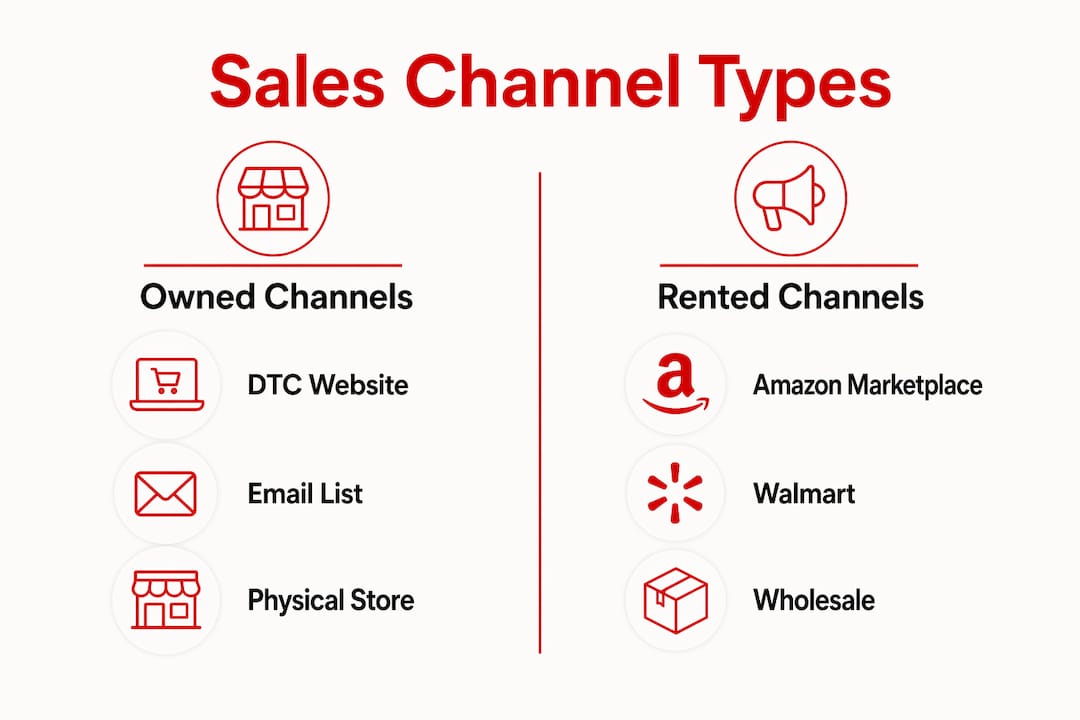
Sales channels fall into two broad categories: owned channels and rented channels. Owned channels include your DTC website, email list, and branded app. You control the customer relationship, the data, and the pricing. Rented channels include Amazon, Walmart Marketplace, and retail shelf space. You access their audience, but they set the rules.

Each channel type serves a different strategic role. Direct channels give you margin and data. Indirect channels give you reach and volume. The right mix depends on your product category, price point, and operational capacity.
| Channel Type | Control | Reach | Cost to Enter | Customer Data Access |
|---|---|---|---|---|
| DTC website | High | Low to medium | Medium | Full |
| Amazon FBA | Low | Very high | Medium to high | Limited |
| Walmart Marketplace | Low | High | Low to medium | Limited |
| Wholesale / retail | Medium | High | High | None |
| Social commerce (TikTok Shop) | Medium | High | Low | Partial |
| Regional distribution | Medium | Medium | Medium | None |
Channel conflict occurs when a brand’s direct channels compete with retail or marketplace partners on price or availability. Successful brands segment markets or products before a full multichannel rollout. A practical approach is to offer exclusive SKUs or bundle configurations to specific channels, so a Walmart buyer does not see the exact same listing at a lower price on your DTC site.
Pro Tip: Before adding a new channel, define its role in writing. Is it a hedge against your primary channel, a growth upside play, or a test? Channels without a defined role consume resources without accountability.
Channel sequencing is the practice of mastering one channel before adding the next. Businesses spending under $100,000 per month on acquisition should master one channel before adding others. Spreading resources too thin produces shallow performance across every channel rather than strong performance in any.
The 60/40 resource allocation rule provides a practical framework. Allocate 60% of resources to high-growth, higher-risk channels and 40% to stable, lower-risk channels. This maintains baseline revenue while still pursuing growth opportunities.
Classify every channel in your portfolio by role before committing budget:
| Channel Role | Definition | Example |
|---|---|---|
| Hedge | Stable, low-risk, protects baseline revenue | Established wholesale account |
| Upside | High-growth potential, higher risk | TikTok Shop, new marketplace |
| Ignore | Low fit with brand, poor unit economics | Channels outside your category |
Operational maturity is the most underestimated requirement in multichannel growth. Each channel requires expertise in creative production, platform-specific attribution, and inventory management. Adding a channel without the human capital to run it well produces worse results than staying focused on fewer channels.
Pro Tip: Attribution measurement and creative production are the two hidden bottlenecks that slow most multichannel expansions. Solve both before you add a third channel, not after.
Effective implementation follows a clear sequence. Skipping steps is how brands end up with five underperforming channels instead of two strong ones.
When building your channel mix, prioritize a combination of owned and rented channels. Your DTC site and email list are assets you control. Amazon and Walmart are distribution networks you rent. A healthy multichannel retailing strategy builds both simultaneously rather than treating them as alternatives.
For CPG brands scaling across Amazon, Walmart, and wholesale, assortment optimization across channels is a direct driver of margin improvement. The right SKU in the right channel at the right price point is where contribution margin is won or lost.
Sales channel diversification is the most direct way CPG brands protect revenue, reach new customers, and build a business that survives marketplace disruptions.
| Point | Details |
|---|---|
| Define channel roles upfront | Classify every channel as a hedge, upside, or ignore before committing resources. |
| No channel should exceed 40% of acquisition | Single-channel concentration creates fragility that one policy change can break. |
| Master one channel before adding another | Brands under $100,000/month in acquisition spend should go deep before going wide. |
| Use the 60/40 allocation rule | Put 60% of resources into growth channels and 40% into stable baseline channels. |
| Owned channels are assets, rented channels are distribution | Build your DTC and email base alongside marketplace presence for long-term resilience. |
Most CPG founders I work with at Reddog come in thinking they need more channels. After auditing their numbers, the real problem is almost always the opposite. They have too many channels running at half capacity, each one bleeding margin and management attention.
Shallow diversification is worse than focused single-channel execution. A brand with a mediocre Amazon presence, an underperforming Shopify store, and a wholesale account that barely covers freight costs is not diversified. It is fragmented. Each channel needs real investment, real expertise, and real accountability to produce results.
The brands that build durable multichannel businesses do it in sequence. They get Amazon right first. Then they layer in DTC with a clear customer acquisition strategy. Then they test wholesale with a regional distributor before committing to national retail. That sequence is not exciting. It does not make for a good pitch deck slide. But it is how you build a business that actually compounds.
Diversification is a long-term resilience strategy, not a short-term revenue hack. The brands that treat it as a quick fix end up with more complexity and less profit. The brands that treat it as infrastructure end up with a business that can absorb shocks and keep growing.
— Reddog
Reddog works with CPG brands in the $500,000 to $20,000,000 revenue range that need to get their channel economics right before they scale. That means understanding what each channel actually contributes to profit, where margin is leaking, and which channels deserve more investment versus which ones should be cut.
If you are a CPG founder or operator navigating Amazon FBA fees, Walmart WFS margin compression, wholesale expansion, or DTC profitability, a free 30-minute strategy call with Reddog is a practical starting point. The session focuses on your contribution margin by channel, inventory velocity, and where your biggest growth or margin opportunity sits right now. You can book a strategy call to get a clear-eyed review of your current channel portfolio and what to do next.
Sales channel diversification means selling your products through multiple channels, such as Amazon, Walmart, DTC, and wholesale, rather than depending on one. The goal is to reduce risk and reach more customers.
The right number depends on operational capacity, but no single channel should represent more than 40% of your acquisition mix. Most growth-stage brands perform best with two to three well-managed channels before expanding further.
Single-channel dependency means one algorithm change, policy update, or buyer decision can eliminate a large share of revenue overnight. A single policy change can cut up to 60% of organic traffic with no warning.
Owned channels, like a DTC website or email list, give you full control over customer data, pricing, and the relationship. Rented channels, like Amazon or Walmart Marketplace, give you access to large audiences but on the platform’s terms.
Segment your products or markets by channel before launching across multiple platforms. Offering exclusive SKUs or bundle configurations to specific channels prevents direct price competition between your own sales outlets.
Leave a comment: