
Published: March 2020 | Last Updated:June 2026
© Copyright 2026, Reddog Consulting Group.

TL;DR:
- Sales attribution assigns credit to marketing and sales interactions that lead to closed revenue, linking the full customer journey to actual sales. Proper implementation relies on high-quality CRM data, stable identity resolution, and comparing multiple models over time to inform better budget and strategy decisions. Most brands struggle with data quality issues and treat attribution as a one-time project, but ongoing review and clean pipelines are essential for reliable insights.
Sales attribution is defined as the process of assigning credit for closed revenue to the specific marketing and sales touchpoints that influenced a customer’s decision to buy. Unlike basic lead tracking, which only tells you where a prospect came from, sales attribution connects the full customer journey to actual dollars won. Tools like Salesforce, HubSpot, and Google Analytics are commonly used to capture and map these touchpoints across channels. For marketing professionals and business owners managing spend across Amazon, Walmart, DTC, and wholesale, understanding sales attribution is the difference between guessing and knowing what drives revenue.
Sales attribution assigns credit to the marketing and sales touchpoints that contributed to a conversion, pipeline opportunity, or closed deal. In B2B and multi-channel CPG contexts, this includes both marketing activities like paid ads and email campaigns, and sales activities like rep outreach and demos.
The mechanics work like this: every customer interaction gets logged as a touchpoint. Those touchpoints are then connected to a CRM record, such as a contact, opportunity, or closed deal in Salesforce or HubSpot. An attribution model then distributes credit across those touchpoints based on a set of rules. The result is a map showing which activities contributed to revenue, and by how much.
Identity resolution is the foundation for trustworthy attribution. Without stable join keys linking a touchpoint record to a closed-deal record, the math looks precise but produces misleading results. A customer who clicked a Facebook ad, received a sales email, and then converted through a Walmart retail shelf visit represents three separate data streams that must be stitched together correctly.
Pro Tip: Before selecting an attribution model, audit your CRM data quality first. Gaps in contact records or missing campaign tags will corrupt any model you apply on top of them.
Common sales attribution models include first-touch, last-touch, linear, position-based, and time-decay approaches. Each encodes a different assumption about which part of the buyer journey matters most.
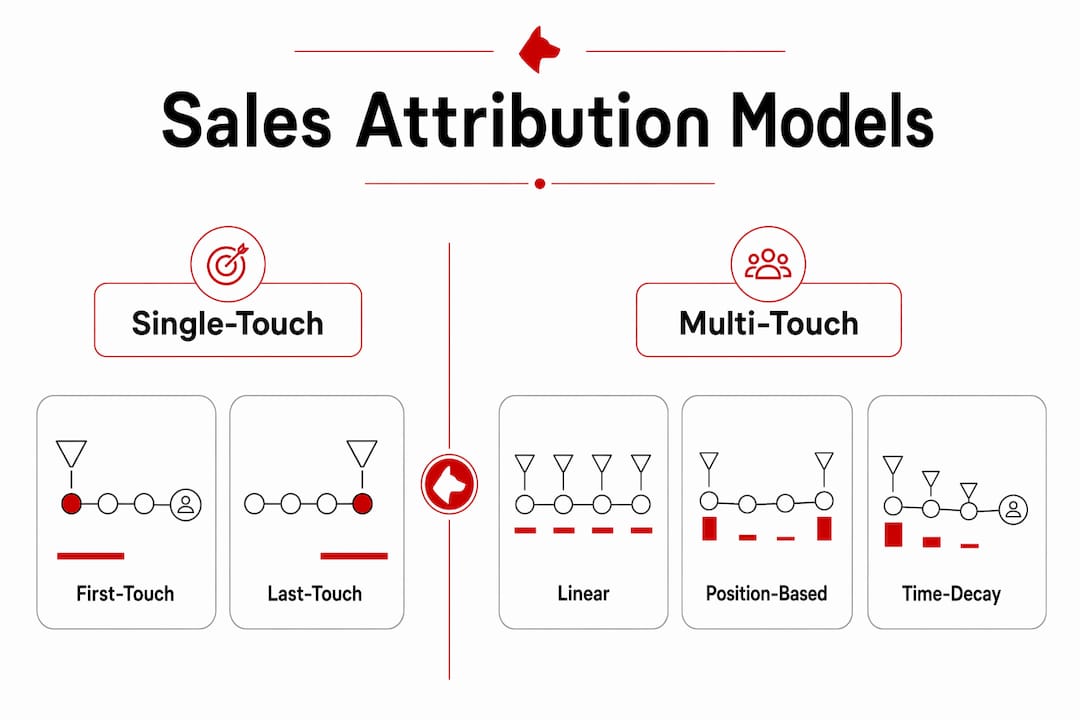
First-touch attribution gives 100% of the credit to the first interaction a customer had with your brand. It is simple to implement and useful for measuring top-of-funnel channel performance. The downside is that it ignores everything that happened after the initial contact, including the sales conversations that often close deals.
Last-touch attribution gives 100% of the credit to the final interaction before conversion. This model is equally simple and widely used as a default in Google Analytics. It tends to over-credit bottom-of-funnel activities like branded search or retargeting ads while ignoring the awareness channels that started the journey.
Multi-touch models distribute credit across multiple touchpoints. Single-touch and multi-touch models provide very different credit distributions, which is why the model you choose directly shapes the budget decisions you make.
| Model | Credit Distribution | Best For |
|---|---|---|
| Linear | Equal credit to all touchpoints | Long, complex sales cycles |
| Position-based (U-shaped) | 40% first, 40% last, 20% middle | Balancing awareness and conversion |
| Time-decay | More credit to recent touchpoints | Short sales cycles with fast decisions |
| Data-driven | Algorithmic, based on actual conversion patterns | High-volume data environments |
Multi-touch attribution better reflects real-world buyer journeys and is preferred by most high-growth companies despite its complexity. The trade-off is that multi-touch models require more data, cleaner CRM records, and more analytical capacity to interpret correctly.

Pro Tip: Comparing multiple attribution models and reporting ranges is more reliable than committing to a single model. Different models will tell different stories, and the truth usually sits somewhere in between.
Sales attribution, lead attribution, and marketing attribution are related but solve different problems. Confusing them leads to budget decisions based on the wrong signal.
Lead attribution identifies where a lead originated, such as a Google search, a trade show, or a referral. It tells you which channels generate contacts. Optimizing on lead attribution alone can be costly because leads and customers do not always correlate. A channel that generates high lead volume may produce low-quality deals that never close, or close at thin margins.
Marketing attribution typically covers only marketing touchpoints, such as ads, emails, and content. It stops at the handoff to sales. Sales attribution extends the picture to include what happened after that handoff: the sales calls, demos, proposals, and negotiations that ultimately determined whether a deal closed.
The practical gap between these concepts shows up clearly in CPG retail. A brand running Amazon Sponsored Products, a Walmart display campaign, and a regional distributor program might see strong lead or click data from all three. But linking touchpoints to CRM outcomes like pipeline stage and deal value reveals that only one channel is actually closing revenue at a profitable margin.
Lead ownership in CRM and attribution credit do not always align because they serve different business functions. A sales rep may own a lead record, but the marketing campaign that generated the initial awareness deserves attribution credit. Sorting this out requires deliberate process design, not just software.
Sales attribution replaces vanity funnel metrics with evidence tied to actual money. That shift matters because most marketing teams are evaluated on metrics like impressions, clicks, and leads, which can look healthy even when revenue is declining.
The practical benefits of accurate attribution are direct:
Budget allocation by revenue contribution. You stop funding channels based on click volume and start funding them based on closed revenue. A paid social campaign generating 500 leads but zero closed deals gets cut. A trade publication sponsorship generating 20 leads and 8 closed deals gets scaled.
Quota setting and territory design. When you know which channels and activities produce revenue in specific regions or segments, quota targets become grounded in real data rather than historical averages.
Forecasting accuracy. Attribution data shows which pipeline stages and touchpoint combinations historically convert to closed deals. That pattern becomes a forecasting input, not just a reporting output.
Eliminating margin-destroying spend. For CPG brands managing Amazon FBA fees, Walmart WFS costs, and 3PL storage simultaneously, knowing which channel actually contributes to net margin is not optional. It is the core of data-driven marketing strategy.
The challenges are real too. Data quality problems, disconnected systems between marketing platforms and CRM, and disagreements between sales and marketing teams over credit all create friction. Attribution models provide directional guidance, not absolute truth. Treating them as gospel rather than a decision-support tool is a common and expensive mistake.
Effective implementation follows a clear sequence. Skipping steps early creates data problems that compound over time.
Audit your CRM data first. Check that every contact record has consistent campaign source tags, that closed deals are linked to contacts, and that timestamps are accurate. Without this foundation, any attribution model you apply will produce unreliable results.
Establish stable identity resolution. Accurate attribution requires linking touchpoint data to closed-deal records via consistent identifiers across your marketing platforms and CRM. A customer who interacts with your brand across Amazon, a DTC site, and a retail shelf needs a single unified record, not three separate ones.
Map the full customer journey. Integrate your marketing automation platform (Klaviyo, Marketo, or HubSpot) with your CRM so that every touchpoint from first ad click to final purchase is captured in one place.
Test multiple models before committing. Run first-touch, last-touch, and at least one multi-touch model simultaneously for 60–90 days. Compare the budget recommendations each model would produce. The divergence between models tells you where your assumptions are most consequential.
Report ranges, not single outputs. Present attribution findings as a range of possible credit distributions rather than a single definitive number. This builds credibility with stakeholders and prevents over-reliance on any one model’s conclusions.
| Implementation Step | Common Pitfall | Fix |
|---|---|---|
| CRM data audit | Missing campaign source tags | Enforce UTM tagging standards across all channels |
| Identity resolution | Duplicate contact records | Merge duplicates before running attribution logic |
| Journey mapping | Offline touchpoints excluded | Integrate POS and distributor data where possible |
| Model testing | Selecting one model too early | Run 3 models in parallel for 60–90 days |
| Reporting | Presenting single-model output as fact | Report a range with model assumptions stated |
Understanding omnichannel attribution is the natural next step once your single-channel attribution is working. Multi-channel CPG brands need to connect online and offline touchpoints into a single revenue picture.
Sales attribution works because it connects specific marketing and sales activities to closed revenue, replacing assumption-based budget decisions with evidence grounded in actual deal outcomes.
| Point | Details |
|---|---|
| Definition is precise | Sales attribution assigns credit to touchpoints tied to closed deals, not just lead origins. |
| Model choice shapes decisions | First-touch, last-touch, and multi-touch models produce different budget recommendations from the same data. |
| Lead attribution is not enough | Optimizing on leads without linking to revenue can fund channels that generate volume but not profit. |
| Data quality comes first | Stable CRM identifiers and consistent campaign tagging are required before any model produces reliable results. |
| Attribution guides, not governs | Treat attribution outputs as directional evidence, not absolute truth, especially in complex multi-channel journeys. |
After working with CPG brands across Amazon, Walmart, DTC, and regional wholesale, Reddog sees the same pattern repeatedly. Brands invest in attribution software before they fix their data. They buy a tool like Rockerbox or Northbeam, connect it to their ad accounts, and expect clean answers. What they get instead is a precise-looking report built on incomplete CRM records and missing offline touchpoints.
The uncomfortable truth is that attribution is a data problem before it is a technology problem. The brands that get the most value from attribution are not the ones with the most sophisticated models. They are the ones with the cleanest data pipelines, the most consistent tagging discipline, and the clearest agreement between marketing and sales on what counts as a touchpoint.
Reddog also sees brands treat attribution as a one-time project rather than an ongoing practice. Buyer journeys change as channels evolve, new retail partners come online, and consumer behavior shifts. An attribution model calibrated in 2024 may be encoding assumptions that no longer reflect how your customers actually buy in 2026. The brands that use attribution well review their model assumptions quarterly, not annually.
The goal is not perfect attribution. The goal is attribution that is good enough to make better budget decisions than you would make without it. That bar is achievable for most brands, and the return on getting there is direct.
— Reddog
Understanding sales attribution is one thing. Applying it across Amazon, Walmart, DTC, and wholesale channels with real margin data behind it is another challenge entirely.

Reddog works with CPG brands in the $500K–$20M revenue range to build attribution frameworks grounded in contribution margin, not just top-line revenue. If you want to know which channels are actually driving profitable growth and where your marketing spend is leaking margin, a focused conversation is the fastest way to find out. Book a free 30-minute strategy call to review your channel economics, attribution setup, and growth planning priorities with the Reddog team.
Sales attribution is the process of identifying which marketing and sales touchpoints contributed to a closed deal and assigning each one a share of the credit for that revenue.
The main types are first-touch, last-touch, linear, position-based (U-shaped), time-decay, and data-driven models. Each distributes revenue credit differently based on assumptions about which part of the buyer journey matters most.
Lead attribution tracks where a prospect originated. Sales attribution connects touchpoints to closed revenue in a CRM, which is a more reliable signal for budget decisions because leads and customers do not always correlate.
Salesforce, HubSpot, and Google Analytics are widely used for capturing and mapping attribution data. Specialized tools like Rockerbox and Northbeam are built specifically for multi-channel revenue attribution.
Test multiple models simultaneously for 60–90 days and compare the budget recommendations each would produce. Report a range of outputs rather than committing to a single model as the definitive answer.
Leave a comment: