
Published: March 2020 | Last Updated:June 2026
© Copyright 2026, Reddog Consulting Group.

TL;DR:
- Programmatic advertising automates digital ad buying through real-time auctions, reaching audiences at scale. Most U.S. digital display spend is now managed programmatically, with supply chain quality significantly impacting campaign effectiveness. Success depends on strategic planning, creative quality, and optimizing the supply chain rather than the technology alone.
Programmatic advertising is the automated buying and selling of digital ad space using software, real-time auctions, and data-driven algorithms to deliver ads to specific audiences at scale. As of mid-2026, programmatic accounts for over 91% of all U.S. digital display ad spending, making it the default method for digital media buying. The technology replaces manual insertion orders with systems that evaluate, bid on, and place ads in milliseconds. Key components include demand-side platforms (DSPs), supply-side platforms (SSPs), ad exchanges, and real-time bidding (RTB). Understanding how these pieces fit together is the difference between running ads and running a real strategy.
Programmatic ad buying operates through a chain of automated systems that connect advertisers to publishers in real time. When a user loads a webpage, the publisher’s SSP sends a bid request to an ad exchange, which simultaneously notifies multiple DSPs. Each DSP evaluates the impression against its advertiser’s audience data and campaign parameters, then submits a bid. The winning bid wins the placement, and the entire RTB auction completes in approximately 100 milliseconds. That is faster than a human blink.
Here is the sequence in plain terms:
The DSP is the advertiser’s control center. Platforms like The Trade Desk, Google Display and Video 360, and Amazon DSP let buyers set audience targets, budgets, frequency caps, and creative rules. The SSP sits on the publisher side, managing inventory yield and connecting to multiple exchanges simultaneously.
Pro Tip: Set up conversion tracking before your first programmatic campaign goes live. Without it, the DSP’s algorithm has no performance signal to optimize against, and you will burn budget on impressions that never convert.

Not all programmatic inventory is the same. The four primary buying models differ significantly in price, control, and inventory quality.
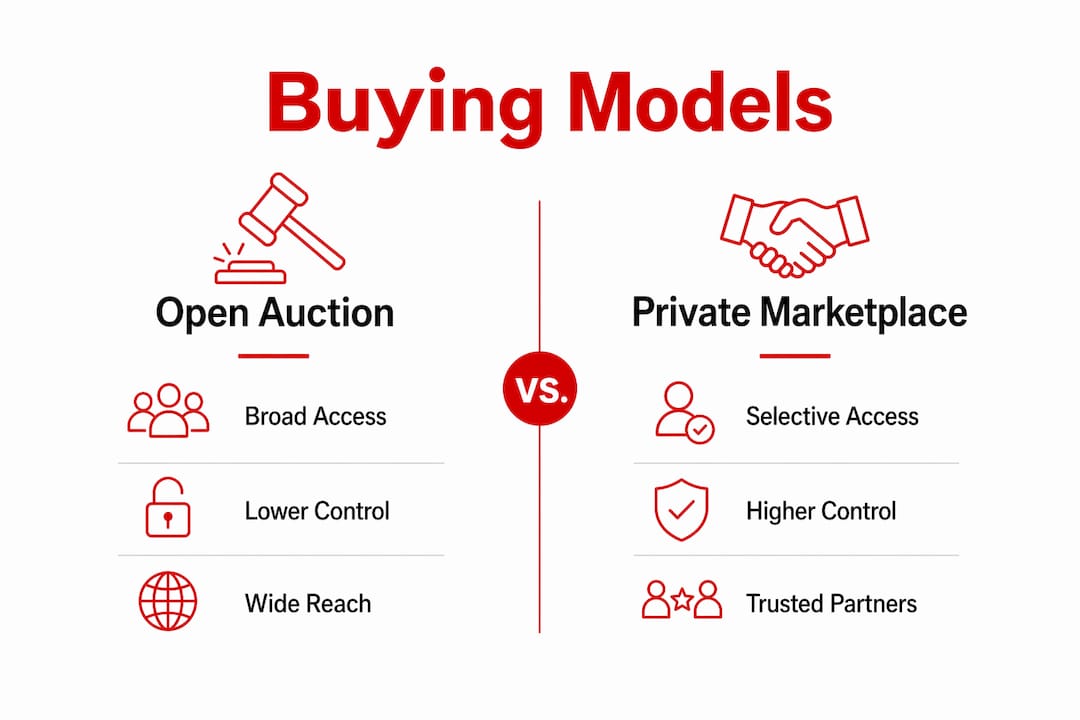
| Buying model | Inventory access | Price control | Best for |
|---|---|---|---|
| Open auction (RTB) | Broad, open market | Competitive bidding | Scale and reach |
| Private marketplace (PMP) | Curated, premium publishers | Negotiated floor price | Brand safety and quality |
| Preferred deal | Specific publisher, fixed price | Fixed CPM | Consistent premium placement |
| Programmatic direct | Reserved inventory, guaranteed | Fixed CPM, guaranteed | High-stakes campaigns |
Open auctions offer the widest reach but carry the highest risk of low-quality or fraudulent inventory. Programmatic Direct and PMPs give advertisers access to premium, brand-safe inventory that never appears in open auctions. That distinction matters more than most buyers realize.
Beyond buying models, programmatic platforms also split into two service structures:
By early 2026, most programmatic platforms offer both models, letting brands choose based on internal capability. Smaller teams often start with managed service and migrate to self-service as they build expertise.
Programmatic also extends well beyond display. Traditional media buying is site-focused and manual, while programmatic now covers connected TV (CTV), digital audio, digital out-of-home (DOOH), and mobile, all bought through the same automated infrastructure.
Pro Tip: If you are new to programmatic, start with a PMP deal through a publisher you already trust. You get the targeting benefits of programmatic without the inventory quality risks of the open auction.
The most significant advantage of programmatic over traditional media buying is the shift from site-based to audience-based targeting. Audience-based targeting reduces wasted impressions by focusing on consumer segments rather than specific web properties. You are buying the right person, not just a slot on a particular website.
The practical benefits stack up quickly:
The efficiency gains are real, but they depend on one thing most marketers underestimate: creative quality. Programmatic delivers your ad to the right person at the right moment. If the creative does not convert, the targeting precision is wasted. Mature programmatic buyers treat creative asset validation as equal in priority to audience strategy.
Programmatic campaigns can drain budget quickly when buyers do not understand where the money actually goes. Hidden fees from intermediaries in the supply chain can inflate your effective cost per thousand impressions (CPM) by 15–30% beyond the base DSP fee. That means a $10 CPM on paper can cost $12–$13 in practice once SSP fees, data fees, and exchange margins are factored in.
Supply path optimization (SPO) is the practice of reducing the number of intermediaries between your DSP and the publisher. Fewer hops mean lower fees and more of your budget reaching actual media. Ask your DSP partner which supply paths they have optimized and whether they offer direct publisher integrations.
A second common problem is creative fatigue. Dynamic creative optimization (DCO) is the practice of rotating ad creative automatically based on performance signals. Without it, the same creative can exhaust its audience within 7–14 days, causing click-through rates to collapse while spend continues. Build creative rotation into your campaign structure from day one, not as an afterthought.
A few more pitfalls worth knowing:
Pro Tip: Request a supply path audit from your DSP or agency before scaling spend. Identify which exchanges and SSPs are delivering your best-performing impressions, then concentrate budget there.
Programmatic advertising is the automated infrastructure that delivers ads to the right audience at scale, but its effectiveness depends entirely on the strategy, creative, and supply chain decisions surrounding it.
| Point | Details |
|---|---|
| Programmatic dominates digital display | Over 91% of U.S. digital display spend runs programmatically as of 2026. |
| RTB auctions are nearly instant | The full bid-to-ad-render process completes in approximately 100 milliseconds. |
| Buying model determines inventory quality | PMPs and Programmatic Direct deliver brand-safe premium inventory; open auctions carry fraud risk. |
| Hidden fees erode real CPMs | Intermediary fees can inflate effective costs by 15–30% beyond stated DSP rates. |
| Creative rotation is non-negotiable | Without dynamic creative optimization, ad fatigue sets in within 7–14 days and performance drops. |
At Reddog, we work with CPG brands that have often spent real money on programmatic campaigns and struggled to connect that spend to actual revenue or margin contribution. The technology is not the problem. The problem is treating programmatic as a strategy rather than a delivery mechanism.
The brands that get the most from programmatic are the ones that arrive with a clear audience definition, validated creative, and a specific business outcome they are measuring against. They use CPG marketing strategy to define the goal first, then use programmatic to execute it efficiently. The ones that struggle tend to start with the platform and work backward.
The other thing most guides skip is the supply chain cost. A 20% fee inflation on a $50,000 monthly programmatic budget is $10,000 in invisible waste. That is real margin, and it shows up nowhere in your standard campaign report. Asking your DSP or agency for a supply path breakdown is not a technical question. It is a financial one.
Programmatic is worth using. Just know what it is and what it is not before you scale it.
— Reddog
Reddog works with CPG founders and operators who want to understand what each marketing channel actually contributes to profit, not just top-line impressions or clicks.
If you are running programmatic campaigns and are not sure whether the spend is generating contribution margin or just activity, a focused review can clarify that quickly. Reddog offers a free 30-minute strategy call covering channel economics, advertising cost structure, and growth planning for brands in the $500K–$20M range. Book your session at Reddog’s CPG growth offer and bring your real numbers.
Programmatic advertising is the automated process of buying and selling digital ad space using software and real-time auctions, replacing manual media buying with data-driven, algorithm-based decisions.
Traditional media buying is manual, site-specific, and negotiated directly with publishers. Programmatic automates the process across thousands of publishers simultaneously, targeting audiences rather than specific websites.
Yes. Google Ads operates programmatically through automated bidding and real-time auctions, making it a form of programmatic advertising, though it operates within Google’s own inventory ecosystem.
A demand-side platform (DSP) is the software advertisers use to manage programmatic ad buying. It connects to ad exchanges, applies audience targeting rules, and submits bids automatically on the advertiser’s behalf.
Use private marketplaces (PMPs) or Programmatic Direct deals to access premium, verified inventory. Apply pre-bid filtering tools like DoubleVerify or Integral Ad Science to block fraud in open auctions, and conduct regular supply path audits to reduce intermediary fees.
Leave a comment: