
Published: March 2020 | Last Updated:August 2026
© Copyright 2026, Reddog Consulting Group.

Price parity means that identical goods or assets carry the same effective price across different markets, currencies, or channels once you account for exchange rates, costs, or conversions. The term splits into three practical families: Purchasing Power Parity (PPP), which compares what currencies can actually buy across countries; Interest Rate Parity (IRP), which links exchange rates to interest-rate differentials between economies; and channel/platform parity, which is the commercial rule that a product should sell at a consistent price across retail channels. Each family uses different measurements, involves different actors, and produces different outcomes — so knowing which version of parity you’re dealing with is the first step to using the concept correctly.
Purchasing Power Parity (PPP): A macroeconomic tool economists and institutions like the OECD use to compare living standards and GDP across countries by stripping out price-level differences.
Interest Rate Parity (IRP): A finance principle stating that the difference in interest rates between two countries should equal the expected change in their exchange rate, preventing risk-free arbitrage.
Channel/platform parity: A business rule requiring that a seller’s price on one channel (say, Amazon) matches its price on every other channel, enforced through contracts or internal policy.
Price parity is a governance discipline as much as an economic concept: brands that treat it as a rule to enforce rather than a number to match protect both their channel relationships and their contribution margin.
| Point | Details |
|---|---|
| Three distinct families | PPP compares purchasing power across countries; IRP links exchange rates to interest differentials; channel parity governs retail pricing consistency. |
| Retail parity drives behavior | Lidl’s plant-based price parity initiative coincided with more than 30% growth in plant-based sales, showing price gaps directly suppress purchase volume. |
| PPCs carry contractual risk | Platform price parity clauses can force DTC prices up to match marketplace levels, compressing your most profitable channel’s margin. |
| Governance over uniformity | Define a base price and pricing waterfall, document every channel adjustment, and monitor percent-of-parity weekly rather than assuming identical list prices mean identical economics. |
| Reddog’s role | Reddog helps CPG brands in the $500K–$20M range map contribution margin by channel, identify parity violations, and build pricing governance that protects margin across Amazon, Walmart, DTC, and wholesale. |
PPP, as the OECD explains, is a currency-conversion rate that equalizes purchasing power by eliminating price-level differences between countries. The core idea is simple: if a basket of goods costs $100 in the United States and £80 in the United Kingdom, the PPP exchange rate is 1.25 dollars per pound, regardless of what the market exchange rate actually is.
Economists express this as a price-relative ratio:
PPP Rate = Price of basket in Country A / Price of same basket in Country B
The World Bank uses PPP-adjusted GDP figures to compare economies on an apples-to-apples basis, because market exchange rates can distort how large or small an economy looks depending on currency movements. A country with a weak currency but low domestic prices can appear much poorer in nominal terms than it actually is in real purchasing terms.
IRP states that the forward exchange rate between two currencies should reflect the interest-rate differential between the two countries. If U.S. interest rates are higher than eurozone rates, the dollar should trade at a forward discount against the euro by exactly that differential, leaving no room for risk-free profit.
The conceptual relationship looks like this:
Forward Rate / Spot Rate ≈ (1 + domestic interest rate) / (1 + foreign interest rate)
Federal Reserve research on uncovered interest rate dynamics shows that in emerging markets, this relationship often overshoots or reverses in the short run, creating the “IRP puzzle” that currency traders and central bankers watch closely. In practice, covered IRP holds fairly well in liquid developed markets; uncovered IRP is far less reliable.
Finance uses “parity” in several narrower contexts beyond PPP and IRP. Each one describes a specific equilibrium relationship where two instruments or prices should be equal.
The law of one price. Identical goods traded freely across borders should sell at the same price once you convert currencies. This holds reasonably well for standardized commodities like crude oil or wheat, but breaks down for goods with high transport costs, tariffs, or local regulatory requirements. Reuters’ 2024 agricultural market analysis illustrates how trade-policy shifts and freight disruptions fractured price relationships in grain markets that had previously tracked each other closely.
Convertible bond parity. A convertible bond trades at parity when its market price equals the value of the shares you’d receive by converting it. If a bond converts into 20 shares and those shares trade at $50 each, parity value is $1,000. When the bond trades above parity, the premium reflects optionality and credit quality; below parity signals distress or a deeply out-of-the-money conversion.
Put-call parity in options. This is one of the most precise parity relationships in finance: for European options on the same underlying asset with the same strike and expiry, the price of a call minus the price of a put must equal the present value of the difference between the spot price and the strike. Violations create textbook arbitrage opportunities that market makers close within seconds on liquid exchanges.
Commodity parity pricing. Agricultural economists use “parity price” to describe what a commodity would need to sell for today to give farmers the same purchasing power they had during a historical base period (typically 1910–1914 in U.S. farm policy). When corn prices fall far below parity, it signals that input costs have outpaced farm-gate revenue, a dynamic that shapes subsidy debates and futures positioning.
In commerce, price parity shifts from a descriptive economic concept to a prescriptive rule. A brand selling on Amazon, Walmart.com, and its own DTC site faces a practical question: should those prices be identical, or can they vary by channel?
Channel parity means the brand commits to a consistent consumer-facing price across all distribution points. The goal is to prevent channel conflict, protect retailer relationships, and maintain brand equity. It differs from economic PPP in one critical way: economic parity is observed and measured after the fact, while commercial parity is enforced in advance through policy or contract.
The table below compares parity pricing and dynamic pricing across the dimensions that matter most to brand operators.
| Dimension | Parity pricing | Dynamic pricing |
|---|---|---|
| Price consistency | Uniform across channels | Varies by channel, time, or demand |
| Primary goal | Channel trust, brand equity | Revenue and margin optimization |
| Best fit | Established brands with retail partners | High-velocity, commodity-like SKUs |
| Risk | Leaves margin on the table in high-demand windows | Channel conflict, retailer friction |
| Monitoring need | Moderate (violation detection) | High (real-time repricing and alerts) |
For most growth-stage CPG brands, omnichannel pricing strategy sits somewhere between strict parity and full dynamic pricing. A brand might hold a consistent everyday price while allowing short promotional windows on a single channel, provided those promotions are disclosed to retail partners in advance. The practical outcome for consumers is price predictability; for retail partners, it’s confidence that they won’t be undercut by the brand’s own DTC site.
Platform price parity clauses (PPCs) are contractual terms that marketplaces insert into seller agreements to prevent sellers from listing lower prices on competing platforms or their own websites. Amazon’s historical “most-favored-nation” clause and similar provisions at other marketplaces are the most visible examples.
How enforcement typically works:
Academic analysis published in the Journal of Industrial Economics finds that PPCs protect a marketplace’s investment in product discovery and logistics infrastructure, but can also reduce downstream retail competition and, in some cases, raise consumer prices. The regulatory conversation in the United States has intensified as the FTC has scrutinized most-favored-nation clauses in several industries. In the EU, competition authorities have already required Amazon and hotel booking platforms to drop or narrow their parity clauses.
Platform price parity clauses are often framed as consumer protections, but their primary economic function is to protect the marketplace’s monetization model. Brands that accept them without negotiation are effectively subsidizing the platform’s price-discovery investment with their own margin flexibility.
Economists measure PPP using price surveys across a basket of comparable goods, constructing a price-relative ratio for each product and aggregating up to a national index. The OECD coordinates this work through the International Comparison Program. For retail and channel parity, brands use percent-of-parity: the ratio of a product’s actual price on a given channel to its reference or base price, expressed as a percentage.
Percent-of-parity = (Observed channel price / Reference price) × 100
NBER research cautions that much of the measured variation in spatial price indexes comes from heterogeneity biases and index-construction choices rather than true price differences. This matters for brands using third-party price-index data: a reported parity gap may reflect how the index was built as much as a real pricing discrepancy.
One of the clearest retail experiments in price parity comes from the plant-based food category. ProVeg’s analysis of scanner data and retailer case studies shows that plant-based products consistently sell at a premium to animal-based equivalents, and that when retailers actively close that gap, purchase behavior shifts materially.
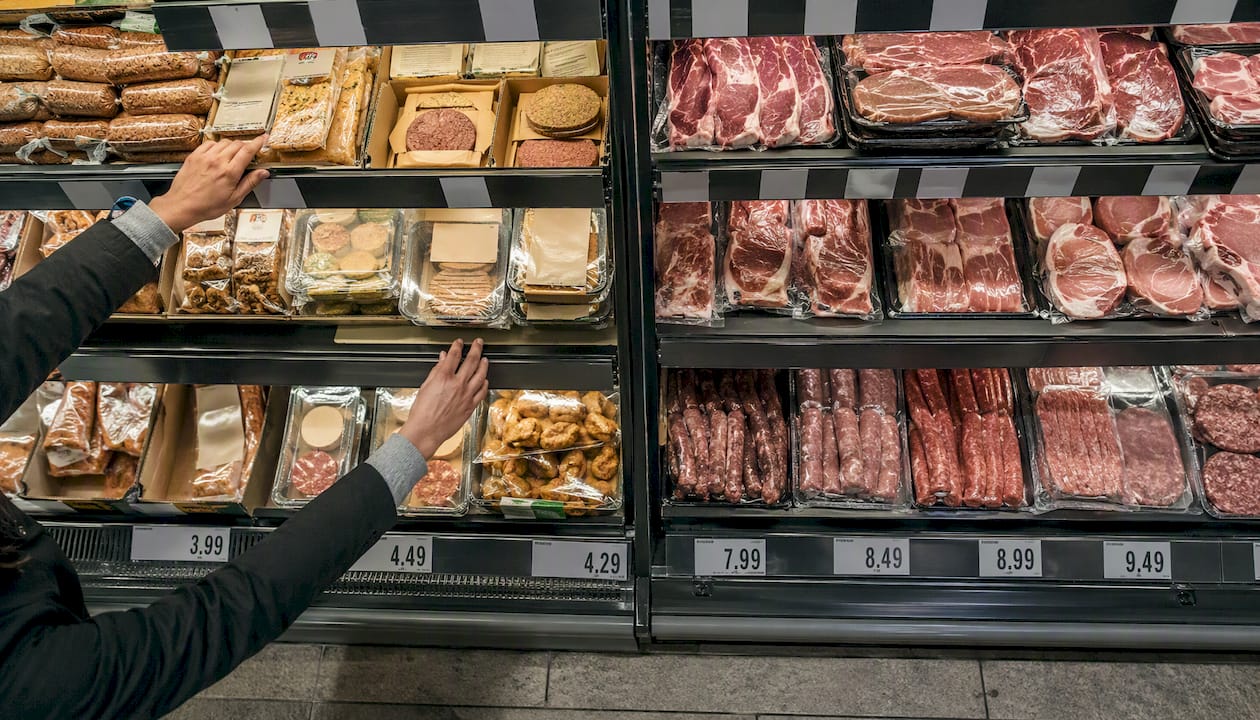
| Metric | Finding | Source |
|---|---|---|
| Plant-based price premium | Consistently above animal-based equivalents | ProVeg scanner data |
| Lidl plant-based sales growth after parity initiative | More than 30% | ProVeg |
| PPP measurement bias | Much of spatial price variation explained by index construction | NBER working paper |
Data sources for parity monitoring include retail scanner feeds (IRI, NielsenIQ), price-comparison platforms, CPI microdata from the Bureau of Labor Statistics, and OECD/World Bank PPP datasets for cross-country work.
Governance-first pricing means defining a base price logic and making every regional or channel adjustment explicit and auditable, rather than assuming “same price everywhere” is either feasible or desirable. Here is how to build that discipline.
Define your base price and pricing waterfall. Set a single reference price (typically your MSRP or MAP) and document every intentional deviation: distributor margin, retailer margin, marketplace fees, promotional allowances. This waterfall makes parity violations visible because any unexplained gap stands out against the documented structure.
Set acceptable channel and regional adjustment bands. A 2–3% regional price variation to cover freight differentials is defensible; a 15% gap between your DTC price and your Amazon price is a channel-conflict risk. Write these bands into your internal pricing policy before a marketplace contract forces the conversation.
Document and enforce MAP/MRP policies. Minimum Advertised Price (MAP) policies are your primary legal tool in the U.S. for maintaining channel parity without running afoul of price-fixing laws. They govern advertised prices, not transaction prices, so they need to be paired with retailer agreements that address promotional pricing windows.
Build a monitoring cadence. Winning marketplace pricing requires tracking percent-of-parity weekly across your top channels. Tools like Priceva, Wiser, or custom price-scraping feeds can automate this. Parity pricing monitoring tools flag violations in near-real-time so you can act before a retailer notices and escalates.
Track contribution margin alongside price. A price that looks at parity on the surface can still erode margin if channel fees, co-op requirements, or freight costs shift. Monitor contribution margin by channel, not just list price, to catch silent erosion early.
Negotiate marketplace clauses before signing. Most brands accept marketplace agreements without negotiating PPC terms. Request carve-outs for your own DTC site, for promotional periods disclosed in advance, and for channel-exclusive SKUs. Marketplaces negotiate more than sellers expect, especially for brands with strong velocity or exclusive products.
Build an escalation ladder. Define in advance what happens when a violation is detected: first a data pull to confirm it’s real, then a direct outreach to the violating channel, then a formal MAP warning, then supply restriction. Having this ladder documented means your team acts consistently rather than reactively.
Pro Tip: The most dangerous parity violations are the ones that never show up in a price report. A retailer running a “free gift with purchase” promotion or a bundled deal is effectively discounting your product without changing the listed price. Build a clause into your retail agreements that requires advance notice of any promotional mechanic that changes the effective consumer price, not just the sticker price.
PPP assumes goods are freely tradable, transport costs are negligible, and consumers can arbitrage price differences. None of those hold perfectly in the real world. Haircuts, restaurant meals, and locally produced services never reach parity because they can’t be shipped. Even for tradable goods, tariffs, non-tariff barriers, and local regulatory requirements create persistent price gaps that PPP theory predicts should disappear but don’t.
IRP faces its own limits. Covered IRP holds well in developed markets with liquid forward markets, but uncovered IRP regularly fails, particularly in emerging economies where capital controls, political risk, and liquidity constraints prevent the arbitrage that the theory assumes is always available.
Myth: Price parity means identical margin across channels. Fact: Parity refers to the consumer-facing price, not the net margin. A $25 product priced at parity across Amazon and DTC generates very different contribution margins because Amazon’s referral fee and FBA costs don’t exist on your own site.
Myth: Parity protects you from channel conflict. Fact: Parity prevents price-based conflict, but channel conflict also arises from assortment, availability, and promotional timing. A brand holding strict price parity while giving Amazon exclusive early access to new SKUs is still creating channel conflict with its brick-and-mortar partners.
Myth: PPP deviations signal a currency is mispriced. Fact: As NBER research documents, much of the measured deviation from PPP reflects index-construction choices and product heterogeneity rather than true arbitrage opportunities. Traders who act on raw PPP gaps without adjusting for these biases often find the gap is a measurement artifact.
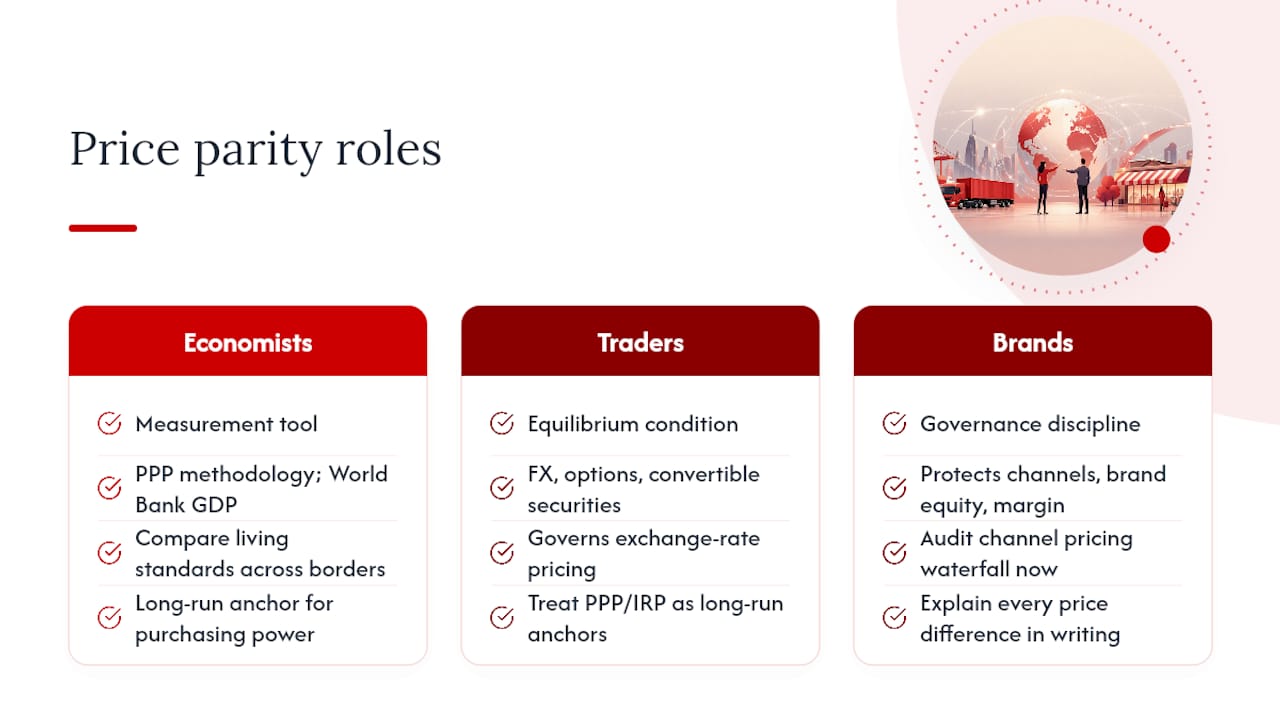
Price parity is one concept with three very different jobs. For economists and institutions, it’s a measurement tool for comparing purchasing power and living standards across borders, anchored in PPP methodology and World Bank GDP datasets. For traders and finance professionals, it’s an equilibrium condition that governs exchange rates, options pricing, and convertible securities. For brand operators and retailers, it’s a governance discipline that protects channel relationships, brand equity, and contribution margin.
For consumers: When a retailer commits to price parity, you benefit from consistent prices regardless of where you shop. When platform parity clauses prevent sellers from discounting elsewhere, you may pay more than you would in a more competitive market.
For brands: Audit your channel pricing waterfall now. If you can’t explain every price difference across your channels in writing, you have a parity governance gap that will eventually surface as a retailer complaint, a marketplace penalty, or a margin leak.
For traders and analysts: Treat PPP and IRP as long-run anchors, not short-run trading signals. The deviations are real, but so are the structural reasons they persist.
Most of the CPG brands we work with at Reddog come in with a pricing problem they’ve misdiagnosed. They see a revenue number that looks healthy and assume the business is working. What they haven’t mapped is the contribution margin by channel, and that’s where parity failures hide. A brand holding “parity” at $24.99 across Amazon, Walmart, and DTC is actually running three different margin profiles because the cost-to-serve each channel is completely different. The price looks the same; the economics are not.
Parity governance isn’t about enforcing one price everywhere. It’s about making every deviation from your base price intentional, documented, and margin-positive. When a marketplace clause forces your DTC price up to match your Amazon price, you’ve handed the platform control over your most profitable channel. That’s the conversation we have with founders before they sign, not after.
Pricing parity violations are one of the most common sources of silent margin erosion for growth-stage CPG brands, and they’re almost always fixable once you can see the full picture. At Reddog, we work with CPG founders and operators in the $500K–$20M revenue range who need structured clarity on what each channel actually contributes to profit.
If you’re navigating Amazon FBA fees, Walmart WFS margin compression, MAP enforcement, or channel pricing conflicts, a focused 30-minute strategy call can surface where the leaks are and what to do about them. We cover contribution margin by channel, pricing waterfall structure, inventory velocity, and growth planning — no generic advice, just the numbers that matter for your specific business. Book your free strategy session and come with your channel P&L. We’ll show you exactly where parity is costing you margin.
Leave a comment: