
Published: March 2020 | Last Updated:August 2026
© Copyright 2026, Reddog Consulting Group.

Omnichannel support is the operational and consulting infrastructure that lets a CPG brand sell, price, fulfill, and manage inventory consistently across Amazon, Walmart, DTC, wholesale, and brick-and-mortar without margin bleeding out at the seams. Done right, it protects contribution margin while you scale into new channels instead of forcing you to choose between growth and profitability.
For a $500K to $20M brand, that support usually comes down to three operational levers:
Omnichannel support works when inventory visibility, one customer record, and centralized pricing rules are unified before you add another sales channel.
| Point | Details |
|---|---|
| Definition | Omnichannel support means operational and consulting infrastructure to sell, price, and fulfill across Amazon, Walmart, DTC, wholesale, and retail without margin loss. |
| Build order matters | Establish inventory visibility and one customer record before adding orchestration software or new channels. |
| Watch the failure point | Manual routing and spreadsheets tend to break once a brand passes three to four channels. |
| Measure before you expand | Track contribution margin by channel, inventory days of cover, and exceptions per 1,000 orders. |
| Get expert guidance | Reddog Group builds channel economics diagnostics and connector roadmaps to help mid-market CPG brands scale 3–5 channels profitably. |
Every new channel you add without an operational plan behind it quietly taxes your margin. Duplicate promotions run on Amazon and DTC at the same time because nobody synced the calendar. Split shipments rack up extra freight because inventory sits in the wrong warehouse. Stockouts on your best SKU tank your Walmart scorecard while a different warehouse sits on excess units nobody can see.
Channel expansion is not a marketing decision. It is an operations project with a marketing outcome, and treating it otherwise is where most brands lose money without noticing.
The stakes are real: McKinsey’s research on omnichannel excellence found that most companies attempting omnichannel growth need to build entirely new supply-chain capabilities to pull it off. Bolting a new sales channel onto an old operational stack rarely works.
What manual, siloed growth tends to look like in practice:
Omnichannel support rests on a handful of architectural layers, and the brands that scale well tend to build them in a specific order.
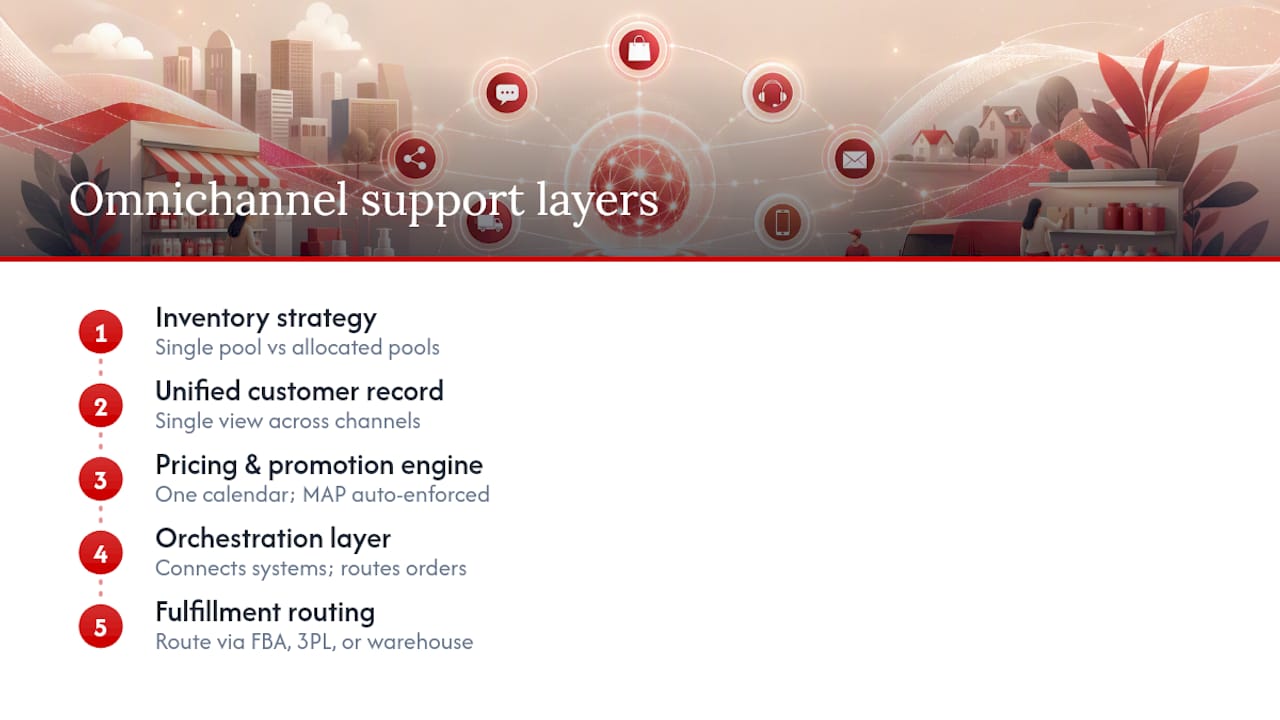
1. Inventory strategy. Decide early whether you’re running a single shared pool or allocated pools per channel. A single pool with near real-time visibility usually outperforms allocated pools for brands under $10M in revenue, because it avoids stranding inventory in the wrong bucket. Above that scale, allocated pools with a shared visibility layer often make more sense for service-level reasons.
2. One customer record. You need a single view of who’s buying, whether that data lives in a full customer data platform or a simpler unified record. Without it, you can’t tell if your Amazon buyer and your DTC repeat customer are the same person, which makes retention strategy guesswork. Unifying customer experience across channels is as much a data problem as a marketing one.
3. A centralized pricing and promotion engine. One calendar, one source of truth, with MAP (minimum advertised price) rules enforced automatically rather than checked manually after a competitor complains.
4. An orchestration layer, not a system replacement. Rather than ripping out your ERP or WMS, orchestration connects what you already have, translates data formats between platforms, and routes orders based on rules you set, according to Pipe17’s operational analysis.
5. Fulfillment routing. Know in advance when an order goes through Amazon FBA, a third-party logistics partner, or your own warehouse. The 3PL Cowboy’s advisory work is a useful reference point for brands deciding when in-house fulfillment stops making financial sense.
Pro Tip: Build your customer record and pricing engine before you touch orchestration software. Connecting broken data faster just means you make bad decisions faster.
At one to three channels, most brands get by on spreadsheets and manual routing. It’s not elegant, but a founder or ops lead can keep the whole picture in their head. That stops working somewhere around channel four or five.
Past that point, the same manual habits that felt manageable start breaking in ways that cost real money:
This is where an orchestration layer earns its cost. It gives you continuous inventory visibility instead of a daily or weekly snapshot, and it enables dynamic routing rules that shift orders to the cheapest or fastest fulfillment source automatically. Exception handling moves from “someone noticed a problem” to “the system flagged the problem before the customer did.”
Brands running five or more channels benefit more from connecting the systems they already have than from replacing them. Orchestration is about producing near real-time inventory visibility, dynamic routing, and proactive exception handling, not building a new tech stack from scratch.
That’s the core finding from Pipe17’s work on omnichannel operations, and it lines up with a broader pattern: connection speed usually beats feature depth at this stage. A brand that can onboard a new marketplace connector in days captures the sales window a slower, more “complete” system misses. McKinsey’s research on omnichannel makes a similar point about governance, favoring centralized visibility paired with decentralized execution over forcing every channel into one rigid system.
Before you hire a consultant, buy orchestration software, or add a fifth channel, run the numbers. A handful of metrics will tell you more than any sales pitch.
For mid-market brands, the stack that unifies inventory and orchestration typically runs somewhere between 0.15% and 0.40% of revenue, a cost that gets recovered through fewer stockouts and protected margin rather than added sales alone, per AiSolv’s analysis of mid-market omnichannel economics.
If your numbers show trouble in two or more of these areas, run a small pilot before committing broadly: put orchestration behind one or two SKUs and one new channel, and measure the payback before rolling it out further.
The conventional advice tells CPG founders to “be everywhere,” and it’s mostly wrong for brands in the $500K to $20M range. Every new marketplace adds operational surface area, and operational surface area is where margin quietly disappears.
The research backs a narrower, sharper approach. AiSolv’s mid-market data makes the case plainly: three or four channels executed well outperform seven or eight channels run at half attention.
What we’d prioritize first, if we were in your seat, is not a new marketplace listing. It’s inventory visibility and one customer record. Everything else, from pricing rules to orchestration to fulfillment routing, depends on getting those two layers right. Skip them and every new channel just adds another place for margin to leak unnoticed.
Scale the channels you can operate well. Add the next one only once you can measure what it actually contributes.

Most brands don’t need more channels. They need clearer visibility into what their existing channels actually contribute to profit, and a plan for adding the next one without breaking what already works.
That’s the core of how Reddog approaches every engagement. We start with a channel economics diagnostic that shows contribution margin by channel, not just top-line revenue, so you can see exactly where Amazon FBA fees, Walmart WFS margin compression, or 3PL storage costs are eating into what you actually keep. From there, we build a SKU protocol and prioritize connectors based on which integrations unlock the fastest, safest onboarding for your next channel, backed by clear SOPs for handling exceptions before they become customer complaints. Clients typically come out of this work with a sharper contribution-margin picture per channel, faster onboarding into new marketplaces, and noticeably fewer split shipments eating into fulfillment costs.
If you’re a founder or operator trying to figure out which channels deserve more investment and which ones are quietly costing you money, our Amazon growth and optimization consulting work is a natural starting point. Book a free 30-minute strategy call and bring your channel numbers. We’ll walk through contribution margin, inventory velocity, and where your growth plan needs operational backup before you add the next channel.
Leave a comment: