
Published: March 2020 | Last Updated:August 2026
© Copyright 2026, Reddog Consulting Group.

For CPG founders and operators, omnichannel customer experience means selling and optimizing the same SKUs across Amazon, Walmart Marketplace, Shopify DTC, wholesale, and brick-and-mortar with unified pricing, inventory allocation, and contribution-margin management. It is not a customer service philosophy. It is an operational and financial discipline. When you get it right, you build revenue resilience, protect shelf placement, and make reinvestment decisions based on what each channel actually earns, not what the dashboards report.
Omnichannel success for CPG brands comes down to one discipline: knowing what each channel contributes to margin and managing inventory, pricing, and data accordingly.
| Point | Details |
|---|---|
| Unify margin reporting first | Track contribution margin by SKU and channel weekly before adding new channels. |
| Treat retail as a primary channel | Pricing parity and retail velocity protect shelf placement and long-term distribution. |
| Own your first-party data | Integrate Shopify with Klaviyo or Attentive to build an audience Amazon and Walmart cannot take away. |
| Run channel decisions through unit economics | A referral fee plus fulfillment costs changes the margin math significantly; model it per SKU. |
| Use the 30/90/180 roadmap | Start with settlement reconciliation and channel P&Ls, then scale inventory systems and retail programs. |
The most damaging mistake CPG brands make is treating physical retail as a secondary channel. When online pricing undercuts shelf price, retailers notice. Chargebacks follow. Reorders slow. Shelf space disappears.
A balanced revenue flywheel looks like this: Amazon drives volume and product discovery. Walmart Connect builds omnichannel attribution and opens a Store-to-Shelf pathway. DTC captures first-party data and protects margin. Wholesale and retail build long-term brand equity and distribution density. Each channel reinforces the others when pricing and inventory are coordinated. When they are not, you get channel cannibalization, margin compression, and retailer distrust, all at once. The benefits of an omnichannel approach compound only when the financial infrastructure keeps pace with channel growth.
Six components make omnichannel work: pricing parity rules, unified demand planning, an inventory master, channel-level P&Ls, a fulfillment strategy, and a first-party data plan. Miss one and the others degrade.
Here is how a new SKU flows through a functional system. A sale on Amazon FBA triggers an inventory deduction in your master IMS. Settlement data flows into a channel P&L template. Net revenue minus FBA fees, ad spend, and COGS produces a contribution margin figure. That figure informs the next ad budget decision and whether to push the SKU into Walmart WFS or hold inventory for a retail program.
Practically, this requires:
Pro Tip: If your brand shows strong online velocity on Amazon or Walmart, document that sell-through data before approaching a retail buyer. Walmart’s Store-to-Shelf program uses marketplace performance as a qualifying signal for physical shelf placement, and retail buyers at other chains respond to the same evidence.
Winning operators treat Amazon as a volume engine and Walmart as a margin and omnichannel optionality play. DTC owns the customer relationship. Wholesale builds distribution density. Each channel has a distinct economic profile.

| Dimension | Amazon (FBA) | Walmart Marketplace (WFS) | Shopify DTC | Wholesale / Retail |
|---|---|---|---|---|
| Best for | Volume, discovery, fast velocity validation | Omnichannel attribution, Store-to-Shelf pathway | First-party data, margin control, brand storytelling | Long-term equity, distribution scale |
| Fees and margin impact | referral fee + FBA fulfillment fee (varies by size/weight) | referral fee + WFS fulfillment fee (generally competitive with FBA) | Payment processing plus Shopify plan fee; no referral fee | Wholesale margin off MSRP plus slotting, trade spend |
| Fulfillment options | FBA (Amazon-managed) or FBM (self-fulfilled) | WFS (Walmart-managed) or seller-fulfilled | 3PL or in-house; full seller control | Direct-to-retailer or via distributor/3PL |
| Customer data access | No buyer emails; limited first-party data | Limited buyer data; omnichannel attribution tools via Walmart Connect | Full first-party data ownership (email, SMS, purchase history) | Sell-through data from retailer POS; limited direct consumer data |
| Advertising platform | Amazon Ads: Sponsored Products, Sponsored Brands, DSP | Walmart Connect: Sponsored Products, lower CPCs in many categories | Meta, Google, TikTok; full attribution control | Trade promotions, co-op, in-store displays |
| Retail integration path | No direct pathway to physical retail | Store-to-Shelf program translates online velocity to shelf placement | Requires separate retail sell-in strategy | Already in retail; focus on velocity and reorder rates |
Example unit economics (illustrative math only): On a product with a $20 MSRP and $5.00 COGS, a FBA fulfillment fees plus referral fees leave a mid-sized contribution margin before ad spend. The same unit sold DTC at $20 with a $1.50 fulfillment cost and no referral fee yields a higher gross margin before CAC. The channel that wins on paper depends entirely on your CAC and ad efficiency.
The single gating requirement is a financial system that tracks contribution margin by SKU and by channel. Without it, brands scaling beyond modest revenue thresholds frequently hit working-capital crises because cost-allocation rules were never established.
Run through this checklist before adding a channel:
On staffing: a dedicated channel manager makes sense when you are running two or more active marketplaces. A finance lead or fractional CFO becomes necessary around $1M in revenue when settlement complexity and trade deductions start obscuring true margin. National grocery expansion, like the path Ancient Crunch took from a regional store test to national Whole Foods distribution, requires a head of operations and a supply-chain lead before the rollout, not after. For regional retail entry, CPG brokerages can manage sell-in and promotional mechanics while your internal team builds capacity.
Contribution margin by channel is the primary KPI. Blended top-line revenue hides which channels are funding growth and which are quietly destroying it.
Track these metrics at minimum:
Run this calculation per SKU, per channel, every month.
Platform-reported data can mask true profitability; reconciling settlements to actual contribution margin is what surfaces distributor deductions and excessive promotional allowances before they compound.
| Cadence | What to review |
|---|---|
| Daily | DTC sales, inventory levels, stockout alerts |
| Weekly | Channel P&L, ROAS by platform, sell-through by retailer |
| Monthly | Reconciled settlements, trade deductions, CM2 by SKU and channel |
Pricing mismatch is the most common and most damaging pitfall. A DTC promotion that undercuts Amazon or retail shelf price triggers retailer complaints and can cost you a planogram slot.
Other frequent mistakes and their mitigations:
For practical operator examples of how these mitigations play out, the pattern is consistent: brands that catch pricing mismatches early and maintain channel P&Ls recover margin faster and retain retail relationships longer.
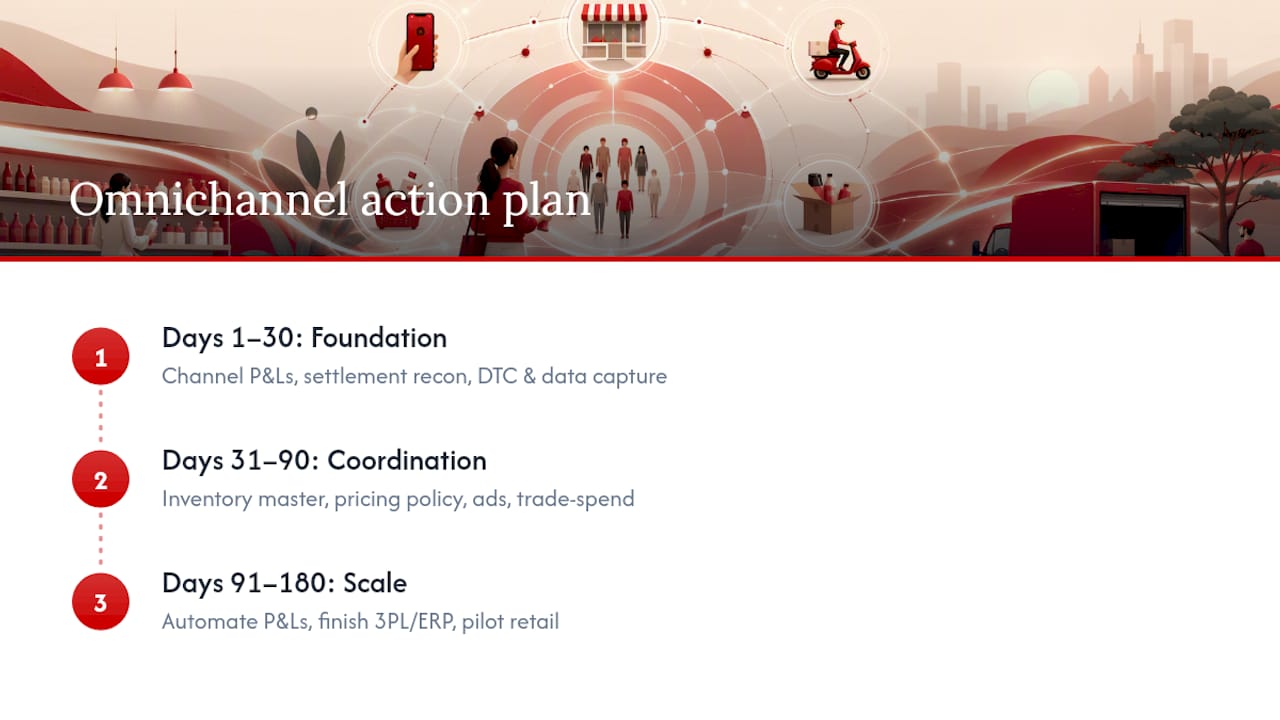
Prioritize financial clarity, inventory control, and first-party data capture in the first 30 days. Scale capabilities in the 90 and 180-day windows.
Days 1–30: Foundation Build a basic channel P&L template for each active channel. Reconcile the last 90 days of Amazon and Walmart settlements to true net revenue. Set up Shopify as your DTC property and connect Klaviyo or Attentive for email and SMS capture. Audit your current pricing across all channels and document any mismatches. Success signal: you can state contribution margin for your top three SKUs by channel.
Days 31–90: Coordination Implement a unified inventory master in your IMS or ERP. Align pricing rules across Amazon, Walmart, and retail price lists with a written policy. Launch or optimize Amazon Ads Sponsored Products and Walmart Connect campaigns with weekly ROAS reviews. Begin tracking trade-spend deductions by retailer. Success signal: weekly channel P&L reviews are happening and ad budgets are informed by CM2, not just ROAS.
Days 91–180: Scale Automate channel P&L reporting from reconciled settlement data. Complete 3PL and ERP integrations so inventory data flows without manual entry. Pilot a retail shelf program, whether a regional distributor trial or a Walmart Store-to-Shelf application, using your marketplace velocity data as the qualifying evidence. For coordinating marketing across channels during this phase, align paid, owned, and retail activations around the same promotional calendar. Success signal: you can produce a full channel P&L within 48 hours of month close.
At Reddog, our position is simple: top-line growth without margin clarity is a liability, not an asset. We have seen brands hit $2M in combined marketplace revenue and still not know which channel was funding the others. That is not a growth problem. It is a financial infrastructure problem.
The brands that scale well share one trait: they treat contribution margin by channel as a weekly operating metric, not a quarterly finance exercise. They know their FBA fee structure, their WFS margin compression, their DTC CAC, and their wholesale DSO. They make channel mix decisions from that data, not from gut feel or platform dashboards.
Reddog works with CPG brands in the $500K–$20M revenue range navigating exactly this complexity. Our work covers marketplace optimization, channel economics, inventory velocity, and retail expansion readiness. We are grounded in Texas retail and distribution networks, but we work with brands scaling nationally across Amazon, Walmart, DTC, and brick-and-mortar.
CPG founders scaling across Amazon, Walmart, DTC, and retail often reach a point where the channels are running but the margin picture is blurry. Reddog offers a free 30-minute strategy call for founders and operators in the $500K–$20M revenue range who want a clear-eyed review of their channel P&Ls, unit economics, inventory velocity, or next-step growth roadmap.
The call is practical and specific. We will look at where your contribution margin is leaking, whether your channel mix makes sense for your current stage, and what the most leveraged next move is. No generic advice, no sales pressure. If you are ready to get clarity on what each channel actually earns, book your free strategy session and we will get to work.
Leave a comment: