
Published: March 2020 | Last Updated:August 2026
© Copyright 2026, Reddog Consulting Group.

TL;DR:
- Omnichannel communication for CPG brands involves coordinating messaging, pricing, and promotions across multiple channels to protect contribution margins. Building a margin-floor pricing governance layer and documenting promotions are crucial control points to prevent profit erosion. Separate channel P&Ls and operational practices help identify profitable channels and improve overall contribution margin.
Omnichannel communication, in the CPG retail context, means coordinating your messaging, pricing, promotions, and channel operations across Amazon, Walmart, DTC, wholesale, and brick-and-mortar so every channel works together to protect contribution margin. The bottom line: before you scale channels, build a margin-floor pricing governance layer and document every promotion’s margin impact. Three control points to act on immediately:
The industry term is omnichannel retail and marketing strategy, and for CPG brands it covers five specific elements: consistent product messaging, synchronized pricing rules, promotion documentation, channel operations and fulfillment split, and KPI alignment across channels. What it does not cover is contact-center unification, phone-to-chat handoffs, or customer-service ticketing. That is a different discipline with a different audience.
Scope the program by SKU tier and channel priority, not by trying to coordinate every product across every channel at once. Pick your top 20% of SKUs by revenue and contribution margin, then build the governance model around those first.
Pro Tip: Start with two channels and three SKUs. Prove the pricing governance model works at small scale before rolling it to your full catalog.
Amazon FBA fees, referral charges, and advertising can push all-in channel costs toward a high proportion of revenue on many CPG SKUs. When you run a single blended P&L across channels, those costs hide inside an average that makes the business look healthier than it is. Channel-level contribution margin analysis reveals which channels fund growth and which destroy cash.
A 30% wholesale contribution margin can outperform a 20% DTC contribution margin once you account for fully loaded customer acquisition cost. Wholesale eliminates per-order CAC entirely. That math changes how you allocate inventory, trade spend, and working capital.
The measurable outcomes of a coordinated omnichannel approach:
Key KPIs to track: contribution margin per channel, blended TACOS, channel concentration percentage, and Buy Box win rate.
Treating Amazon and Walmart as separate businesses sharing a P&L is the single most important structural decision you can make. Separate content calendars, separate inventory plans, and separate PPC logic, tied together by a shared pricing governance layer.

| Practice | Channel Outcome |
|---|---|
| SKU-level channel P&Ls | Reveals which channel subsidizes others |
| Documented promo margin-impact analysis | Prevents promotional margin erosion |
| 24-hour price parity band | Avoids Walmart listing suppression |
| Separate listing content calendars | Improves organic rank per platform |
| Inventory allocation rules (FBA vs. WFS vs. 3PL) | Reduces stockouts and overstock fees |
| Unified blended TACOS measurement | Surfaces true advertising efficiency |
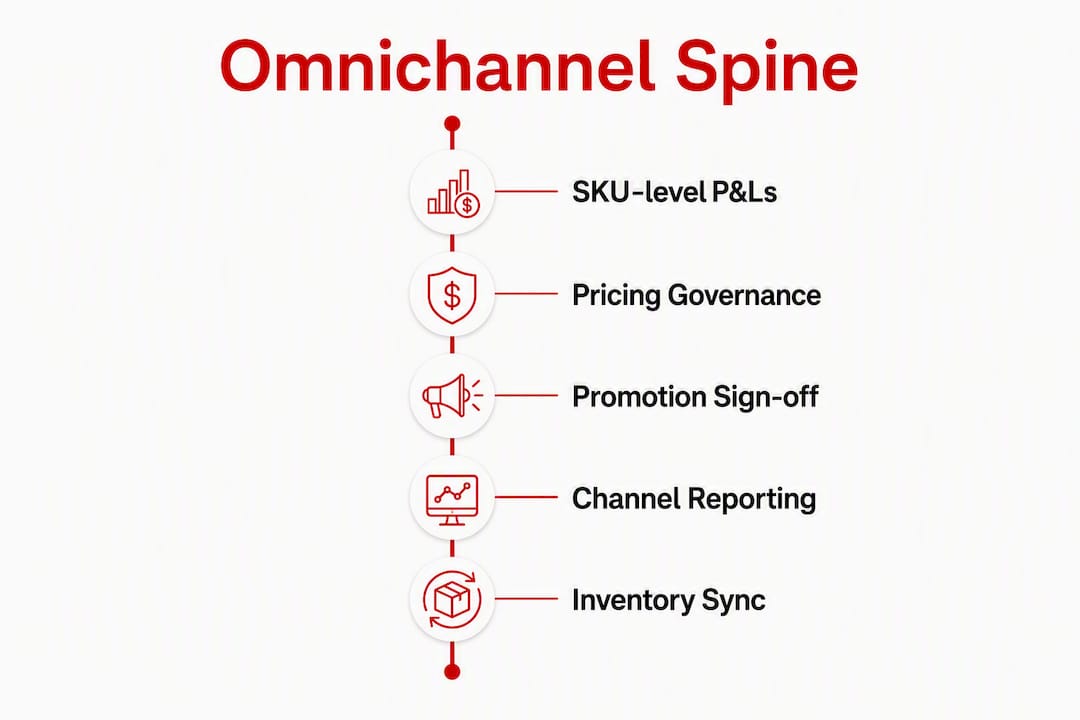
Pro Tip: Assign one owner for pricing governance and a separate owner for promotion sign-off. When one person controls both, undocumented promotions slip through.
A rule-based pricing engine starts with a SKU-level floor: the minimum price at which a unit generates positive contribution margin after all channel fees. Sync prices within a 24-hour window using a repricer or strict SKU-level SOPs to prevent Walmart’s parity algorithm from suppressing your listings.
| Channel | Fee Line Items to Model |
|---|---|
| Amazon | Referral fee (15%), FBA fulfillment, storage, returns |
| Walmart | Commission (6–15%), WFS fulfillment, returns |
| DTC | Payment processing (2–3%), shipping, returns, CAC |
| Wholesale/Retail | Trade spend, slotting, distributor margin, freight |
Sample margin-impact calculation: A $20 MSRP SKU with $6 COGS runs a 20% Amazon coupon. Revenue drops to $16. After a 15% referral fee ($2.40) and $3.50 FBA, contribution margin goes from roughly $7.50 to $1.10. That promotion nearly wipes the unit’s contribution. Documenting this before the promotion runs is what separates margin-aware operators from brands that wonder why profitable revenue feels unprofitable.
Margin floor rule: Never run a promotion that takes any SKU below its channel contribution margin floor. Calculate the floor in dollars, not percentages, because fees are dollar-denominated.
Pro Tip: Build a simple promo sign-off template: SKU, channel, discount depth, pre-promo contribution margin, post-promo contribution margin, and approval signature. One page, run it every time.
Profitable mid-market brands use Amazon as a demand signal and harvest margin-protective volume through Walmart and DTC with distinct playbooks per channel. Here is what that looks like in practice.
Amazon
Walmart
DTC
Wholesale and brick-and-mortar
Platforms that integrate Amazon and Walmart PPC into a single dashboard enable blended TACOS monitoring and cross-platform bid rules. That is the reporting layer. Below it, you need four more tool categories.
| Tool Category | Primary Function | Data In/Out |
|---|---|---|
| Repricer / price engine | Enforces margin floors and parity bands | SKU cost data in; channel prices out |
| PIM (Product Information Manager) | Single source of truth for listing content | Master content in; channel-formatted feeds out |
| OMS / inventory sync | Allocates units across FBA, WFS, 3PL | Sales velocity in; replenishment signals out |
| Multichannel analytics | Blended TACOS, channel P&L, contribution margin | All channel data in; unified dashboard out |
| Bid management (PPC) | Cross-platform ACoS and ROAS management | Ad spend and revenue in; bid adjustments out |
Critical data flows to build first: price and promotion sync (triggers within 24 hours of any price change), inventory webhook cadence (daily minimum), blended TACOS reporting (weekly), and channel P&L feed (monthly close). A multichannel SEO and discoverability strategy sits on top of this stack to improve organic visibility across platforms.
30-day milestones
60-day milestones
90-day milestones
Role matrix: pricing governance owner (ops lead), promotion sign-off (founder or CFO), inventory allocation (supply chain or ops), reporting (analyst or agency).
Pro Tip: Run a 30-minute monthly audit: pull Buy Box win rate, blended TACOS, and channel concentration from your dashboard. If any of the three moved more than 5 percentage points, trace it to a pricing, inventory, or promotion event before the next planning cycle.
When a brand comes to Reddog carrying 80%+ of revenue on Amazon and no documented channel P&Ls, the first intervention is always the same: build the margin floor, then build the channel playbooks. A typical engagement starts with a SKU-level contribution-margin triage, followed by pricing governance setup, WFS onboarding for the top velocity SKUs, and DTC promotion controls.
The measurable outcomes Reddog targets: a reduction in channel concentration risk, an improvement in blended TACOS, and a contribution-margin lift per channel as fee leakage gets documented and closed.
For the SKU triage, use your existing P&L export. Add columns for channel fees (referral, fulfillment, advertising as a percentage of revenue), then subtract from gross margin. Any SKU with contribution margin below 15% after fees needs a pricing or cost review before the next promotion cycle. Reddog’s CPG retail growth offer includes a contribution-margin review as part of the initial strategy call.
Omnichannel communication for CPG brands is a contribution-margin-first operating model, not a marketing tactic. Build the pricing governance layer before scaling channels.
| Point | Details |
|---|---|
| Pricing governance comes first | Set SKU-level margin floors and a 24-hour parity rule before running any cross-channel promotions. |
| Channel P&Ls reveal the truth | Amazon all-in costs can reach 30–50% of revenue; separate P&Ls show which channels fund growth. |
| Walmart needs its own playbook | Separate listing content, WFS for TwoDay badge, and strict parity sync prevent suppression and unlock lower CPCs. |
| Document every promotion | A pre-run margin-impact analysis is the single fastest way to stop contribution margin erosion. |
| Reddog’s approach | Reddog builds contribution-margin-first omnichannel programs for CPG brands in the $500K–$20M range, starting with SKU triage and pricing governance. |
Most CPG brands we see at Reddog are not losing money because their products are weak. They are losing margin because their channels are running independently, their promotions are undocumented, and their pricing is static. The omnichannel strategy conversation in the industry tends to focus on customer experience and messaging consistency, which matters. But for a CPG operator, the more urgent question is always: what does each channel actually contribute after fees, fulfillment, and acquisition cost?
The brands that scale profitably are the ones that answer that question with a number, not a feeling. They build the pricing governance layer first, assign clear ownership, and treat Amazon and Walmart as separate businesses that share a P&L. That discipline is what separates a brand growing toward $20M with healthy margins from one growing toward $10M and running out of cash.
Scaling across Amazon, Walmart, DTC, and wholesale without a contribution-margin framework is how brands grow revenue and shrink cash at the same time. Reddog works with CPG brands in the $500K–$20M range to build the pricing governance, channel P&Ls, and operational SOPs that make omnichannel growth profitable, not just bigger.
The free 30-minute strategy call covers your current channel contribution margins, a quick channel economics checklist, and a starter outline for a 30–90 day omnichannel plan. No hard sell, no generic advice. Just a practical review of where your margin is going and what to fix first. Book your strategy call here and come with your top five SKUs and a rough sense of your current channel mix.
The guidance in this article draws on the following resources. All fee structures, program rules, and platform mechanics apply to U.S.-based sellers and U.S. marketplace operations.
“Brands with channel-level P&Ls make significantly better capital allocation decisions than those flying blind on blended metrics. True contribution margin by channel reveals which sales channels fund growth and which destroy cash.” — Endless Commerce, Contribution Margin by Channel: A Unit Economics Framework for CPG Brands
Leave a comment: