
Published: March 2020 | Last Updated:June 2026
© Copyright 2026, Reddog Consulting Group.

TL;DR:
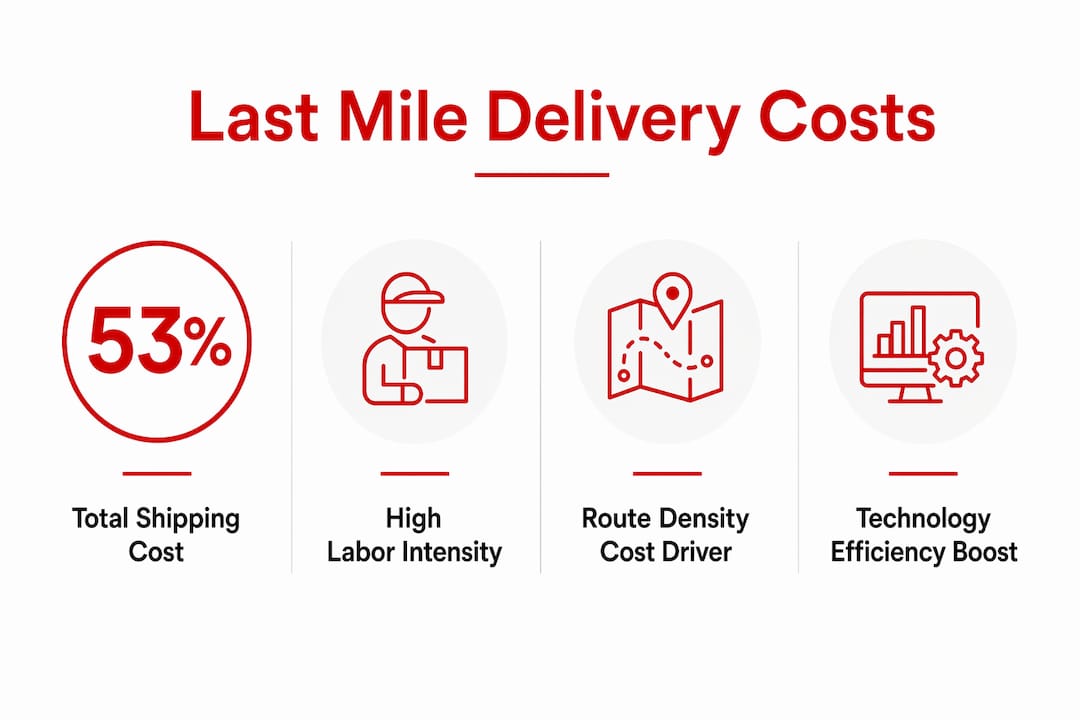
- Last mile delivery is the final stage of the supply chain, accounting for 53% of total shipping costs. Improving delivery density through strategic inventory placement and efficient routing can significantly lower costs and boost customer satisfaction.
Last mile delivery is defined as the final stage of the supply chain, moving goods from a local distribution hub or fulfillment center directly to the customer’s doorstep or designated pickup point. It is also called final mile delivery in formal logistics contexts. This stage accounts for 53% of total shipping costs) in B2C operations, making it the single largest cost driver in the entire delivery chain. For eCommerce managers and logistics professionals, understanding this stage is not optional. It directly shapes customer satisfaction, repeat purchase rates, and brand reputation.
Last mile delivery is the highest customer interaction point in the supply chain. Every other stage of logistics happens behind the scenes. This stage happens at the customer’s front door, which means every failure is visible and personal.
The cost problem is structural. Unlike long-haul freight, where a single truck moves thousands of units across hundreds of miles, final mile delivery requires individual stops, often just one package per address. That means labor, fuel, and time costs are spread across far fewer units per route. The math works against you from the start.
Several factors compound the expense:
Last mile distances vary widely) too. In dense urban areas, the final leg might cover just a few city blocks. In rural settings, it can exceed 50 miles. The physical distance matters less than route density. A driver covering 50 miles with 40 stops is more profitable than one covering 10 miles with 4 stops.
Pro Tip: Track deliveries per mile as your primary cost metric, not cost per package. Route density is the lever that actually moves your unit economics.
The right delivery model depends on what you are shipping, not just where. Delivery strategies should be segmented by product profile: white-glove service for high-value or fragile items, standard parcel carriers for commodity products, and gig-economy drivers for high-volume, time-sensitive retail orders. A one-size-fits-all approach consistently underperforms on both cost and service quality.

Parcel carriers handle the bulk of standard eCommerce volume. They offer established networks, tracking infrastructure, and predictable pricing. The tradeoff is limited flexibility on delivery windows and minimal customer interaction.
Gig-economy platforms provide on-demand capacity, which is useful for same-day delivery in metro areas. Cost per delivery can be competitive at high volumes, but quality control and reliability vary by market.
White-glove delivery teams specialize in large, high-value, or installation-required products. Think furniture, appliances, and medical equipment. The cost is higher, but so is the customer expectation. Matching the service tier to the product protects your brand.
Micro-fulfillment and ship-from-store models place inventory closer to the end customer. This shortens the final leg and improves delivery density without requiring a full distribution center buildout.
Technology is what separates average performers from top-tier operations. Route optimization software, GPS tracking, and real-time customer notifications enable on-time delivery rates that frequently exceed 99%. That level of reliability is not achievable through manual dispatch and phone calls alone.
| Delivery model | Best use case | Key advantage | Primary limitation |
|---|---|---|---|
| Parcel carrier | Standard retail and eCommerce | Network scale and tracking | Limited delivery window flexibility |
| Gig-economy driver | Same-day urban delivery | On-demand capacity | Variable quality and reliability |
| White-glove team | High-value or large items | Premium customer experience | Higher cost per delivery |
| Ship-from-store | Metro and suburban markets | Shorter final leg distance | Requires distributed inventory |
Pro Tip: Integrate your order management system directly with your delivery platform so customers receive automatic status updates. Proactive communication cuts “where is my order” support tickets significantly.
Cutting delivery costs rarely comes from negotiating cheaper carrier rates. Improving delivery density through strategic inventory placement, including micro-fulfillment centers and local hubs, is the more reliable path to lower unit costs. This is especially true outside major metro areas, where sparse delivery points make every route expensive.
The logic is straightforward. If your inventory sits in a single national distribution center, every order ships across the country. If you place inventory in regional hubs closer to your customer clusters, the final leg shrinks. Shorter legs mean fewer miles, lower fuel costs, and faster delivery windows.
Multi-channel inventory management adds another layer of complexity here. Brands selling across Amazon FBA, DTC, and wholesale channels often hold inventory in multiple locations simultaneously. Coordinating those positions to support last mile efficiency requires real-time visibility into stock levels, demand patterns, and fulfillment costs by channel.
Strategic tips for improving delivery density:
The role of logistics in eCommerce profitability is often underestimated by growth-stage brands. Founders focus on top-line revenue while last mile costs quietly compress contribution margin. Getting inventory placement right is one of the highest-leverage moves available.
Customer psychology and supply chain efficiency meet at the doorstep. Transparency and communication are as critical as cost control in final mile delivery. A package that arrives on time but with no tracking updates still generates anxiety and support tickets. A package that arrives one day late with clear communication often generates forgiveness.
The steps that most reliably improve customer experience in last mile delivery are:
The cost of a poor delivery experience extends well beyond the direct expense of a reattempt or a return. Customers who experience a failed delivery are significantly less likely to reorder. For subscription or repeat-purchase CPG brands, that churn compounds over time. Investing in communication infrastructure is not a customer service expense. It is a retention investment.
Last mile delivery is the most expensive and customer-facing stage of the supply chain, and controlling it requires better route density, smarter inventory placement, and proactive communication rather than simply cheaper carriers.
| Point | Details |
|---|---|
| Cost concentration | Final mile delivery accounts for 53% of total shipping costs in B2C supply chains. |
| Route density over distance | Deliveries per mile matters more than physical distance when controlling last mile cost. |
| Model segmentation | Match delivery model to product type: white-glove for high-value items, gig-economy for standard retail. |
| Inventory placement | Positioning stock closer to customer clusters reduces last mile distance and improves delivery density. |
| Communication as retention | Real-time tracking and delivery windows reduce support costs and protect repeat purchase rates. |
Working with CPG brands across Amazon, DTC, and wholesale channels, I see the same pattern repeatedly. Founders treat last mile delivery as a carrier selection problem. They spend weeks comparing rate cards and negotiating contracts, then wonder why their delivery costs stay stubbornly high.
The actual problem is almost never the carrier rate. It is inventory position and route density. A brand shipping from a single warehouse in the middle of the country will always pay more per delivery than one with inventory staged near its customer base, regardless of which carrier it uses.
The second blind spot is product segmentation. Brands selling both $12 snack packs and $180 specialty food kits often run both through the same standard parcel carrier. That works fine for the snack packs. For the premium kits, it creates delivery failures and damaged brand perception that no discount can fix.
The brands that get last mile right treat it as a margin problem, not a logistics problem. They track contribution margin by channel and by fulfillment location. They know which zip codes are profitable and which ones are not. They make deliberate decisions about where to hold inventory based on demand data, not convenience.
Final mile delivery is not going to get cheaper on its own. Fuel costs, labor costs, and customer expectations all move in one direction. The brands that build density, segment their delivery models, and invest in communication infrastructure will widen their margin advantage every year. The ones waiting for carriers to solve it for them will keep watching their delivery costs eat into growth.
— Reddog
Last mile delivery is where margin either holds or leaks. Reddog works with CPG brands in the $500K–$20M revenue range to identify exactly where delivery costs are compressing contribution margin and what to do about it.
Our work covers supply chain optimization for eCommerce, inventory placement strategy, channel economics, and fulfillment cost analysis across Amazon FBA, Walmart WFS, DTC, and wholesale. We help founders and operators understand what each channel actually costs to fulfill, not just what it costs to ship. If you want a clear picture of where your last mile logistics are eroding margin, book a free 30-minute strategy call with Reddog. We will review your current fulfillment structure, identify the highest-impact cost levers, and give you a practical path forward.
Last mile delivery is the final stage of the supply chain, moving goods from a local distribution hub or fulfillment center directly to the customer’s doorstep or pickup point. It is the most expensive and customer-facing segment of the entire logistics process.
Final mile delivery accounts for approximately 53% of total shipping costs because it requires individual stops, high labor input, and variable routing. Low delivery density, meaning few stops per mile, is the primary cost driver.
Common examples include a parcel carrier dropping a package at a residential address, a gig-economy driver completing same-day grocery delivery, and a white-glove team delivering and installing a large appliance. Each model suits a different product type and customer expectation.
Route optimization software calculates the most efficient sequence of stops, reducing miles driven and time per route. Top-performing providers using route optimization and GPS tracking achieve on-time delivery rates that exceed 99%.
Last mile delivery and final mile delivery refer to the same concept. Both describe the final leg of the supply chain from a local hub to the end customer. “Final mile” is the more formal industry term, while “last mile” is the more widely used phrase in eCommerce and logistics discussions.
Leave a comment: