
Published: March 2020 | Last Updated:May 2026
© Copyright 2026, Reddog Consulting Group.

TL;DR:
- Global marketplace expansion is a structured, multi-layered strategy that involves deliberate market selection, tailored go-to-market plans, and scalable infrastructure. Companies that succeed internationally grow revenue 1.5 times faster than domestic-only firms, but they must carefully plan and timing to reduce failure risk. Proper localization, entry mode choice, and early demand validation are essential for sustainable global growth.
Most executives who ask what is global marketplace expansion assume the answer is simple: start selling your products in other countries. That framing costs companies millions. Global marketplace expansion is a structured, multi-layered strategy for entering, operating in, and scaling across international markets. It requires deliberate market selection, adapted go-to-market execution, and infrastructure built to sustain growth. The upside is real. Companies that successfully expand internationally grow revenue 1.5 times faster than those that stay domestic. But the path is more demanding than most leaders expect before they commit.
| Point | Details |
|---|---|
| Expansion is a system, not a shortcut | Global growth requires deliberate market selection, entry strategy, and operational infrastructure. |
| Entry mode shapes risk and return | Exporting, licensing, and direct investment carry different capital requirements and control levels. |
| Localization is load-bearing infrastructure | Treating multilingual operations as an afterthought causes growth stalls and costly rebuilds. |
| Timing changes the outcome | Expanding during high business momentum significantly reduces failure risk. |
| Most failures trace back to strategy gaps | 75% of companies miss expansion targets due to poor market entry choices, not market conditions. |
Global marketplace expansion is the process of taking a business beyond its home market and building the capacity to generate sustainable revenue in one or more international markets. That definition sounds straightforward, but the word “capacity” carries all the weight. You are not just shipping product overseas. You are building demand, trust, supply chain resilience, and brand positioning in a market that does not already know you.
The motivations vary by company. Most executives are chasing at least one of these four drivers:
The global retail e-commerce market is projected to reach $6,190 billion by 2030, growing at 11.2% annually, with Asia-Pacific driving the largest share of that expansion. That is not just a trend worth noting. It is a signal that the demand infrastructure in new markets is maturing faster than ever, which lowers the barrier to entry for brands willing to plan carefully.
One misconception worth correcting early: global expansion is not a fallback strategy for when domestic results disappoint. Treating expansion as a fallback rather than a strategic investment is one of the most consistently documented causes of failure. The companies that win internationally are the ones that enter with a clear answer to “why this market, why now, and what does success require from our supply chain.”
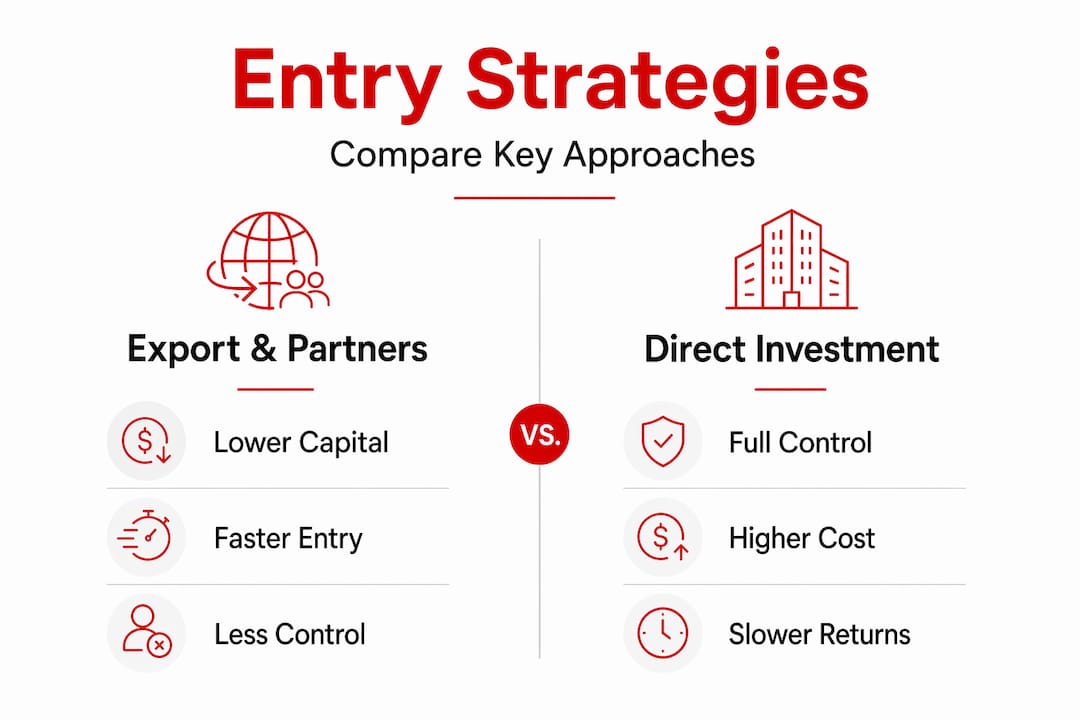
The entry strategy you choose sets the ceiling on your control, speed, and capital exposure. There is no universally correct answer. The right mode depends on your budget, risk tolerance, timeline, and how much operational involvement your team can realistically sustain abroad.
Here is a breakdown of the primary entry modes:
| Entry Mode | Capital Required | Control Level | Timeline to Returns | Best For |
|---|---|---|---|---|
| Exporting | Low | Low | 6-18 months | First-time expansion, demand validation |
| Licensing / Distributor | Moderate | Moderate | 12-24 months | Capital-light market penetration |
| Joint Venture | Moderate-High | Shared | 18-36 months | Markets requiring local partnerships |
| Foreign Direct Investment | High | High | 24-48 months | Committed, long-term market strategy |
Exporting is the initial strategy for over 98% of American exporters because of lower risk and capital requirements. It also gives you the fastest read on whether demand actually exists before committing significant resources. The limitation is control. Your brand experience, pricing, and distribution are filtered through a third party.
Foreign direct investment, including subsidiaries, acquisitions, and greenfield operations, flips that equation. You own the operation, so you control the brand. But direct market entry requires a 12 to 24 month build period before you can establish control and local operational stability. And businesses without at least a $2 million budget for years one and two should default to export, licensing, or distributor models to avoid overexposure.

The factors that most influence which mode fits your situation include your product’s regulatory complexity in the target market, whether local manufacturing or storage is required, how important brand consistency is to your premium positioning, and whether you have leaders who can operate in-country without constant headquarters involvement.
Pro Tip: Before committing to an entry mode, run a single-country pilot with a distributor or localized landing page. You can validate real demand for under $5,000 before scaling into a full market operation.
Once you have chosen an entry mode, you face a second strategic fork that many companies underestimate: how much do you adapt your product, messaging, and operations to each market versus maintaining a consistent global approach?
Three models dominate how companies answer that question:
The choice matters more than most executives realize because it shapes your entire supply chain design. Different expansion strategies from standardization to transnational localization require fundamentally different supply chain architectures. Getting that wrong means expensive retrofits later.
For CPG brands in particular, localization is rarely optional. Flavor profiles, packaging language, regulatory certifications, and retail channel norms all differ by region. You can explore how local retail marketing strategies work in practice to see how granular the adaptation requirements can get even within a single country.
One clarification that saves companies real money: functional translation and persuasive localization are not the same thing. Functional translation handles product details like ingredient lists and instructions. Persuasive localization rewrites marketing content to resonate emotionally with a local audience. Mixing up those two tasks, or applying the cheaper approach to the wrong content type, consistently underperforms.
Knowing the strategy options is one thing. Building the execution plan is where most companies stall. Here is a structured sequence that reduces avoidable failure:
Run a market readiness diagnostic. Before entering any market, analyze demand signals, competitor density, regulatory barriers, and logistics costs. Your product-market fit does not automatically transfer across borders.
Validate before investing. Most international expansions can start with a localized landing page, a local case study, and a translated sales deck for $2,000 to $5,000. That investment buys you real data before committing to infrastructure.
Build local leadership early. Remote management of an international market from headquarters rarely works past the early test phase. You need someone with local market knowledge and authority to make decisions on the ground.
Localize your digital presence with SEO in mind. For smaller companies early in international growth, subfolder URL structures (yoursite.com/uk/) consolidate domain authority better than country-specific domains, which require building site authority from scratch.
Design supply chain for the market, not from headquarters. Centralized fulfillment works at low volumes. As you scale, regional distribution and local inventory positioning become necessary for speed and cost control. Reddog’s breakdown of ecommerce supply chain management covers how to structure this across channels.
Set local KPIs, not just global ones. Revenue measured in home currency masks what is actually happening in market. Track contribution margin by geography, local return rates, regional inventory velocity, and channel-specific cost structures.
Time your entry during momentum, not desperation. The optimal time to expand is when your business already has strong momentum. US startups, for example, typically wait until a Series C funding event. Expanding from a position of strength gives you the financial runway to absorb the inevitable learning curve.
Pro Tip: 75% of companies miss international growth targets because of poor market entry strategy choices. The fix is almost never more budget. It is better pre-entry research and a realistic timeline.
I have watched brands with genuinely strong products stall out internationally because they treated localization as a marketing expense rather than an operational foundation. The assumption is that once you translate your website and packaging, you are localized. You are not. Real localization means your customer service workflows, your sales process, your retailer relationships, and your digital content are all built for that market from the ground up.
The other thing I see consistently is companies entering new markets at the wrong time. Expansion during a domestic slowdown feels logical as a revenue hedge, but waiting for strong local validation before expanding almost always outperforms the hedge move. When you expand from strength, your team has the bandwidth and resources to do it right.
Treating multilingual operations as core infrastructure rather than an add-on is not just a best practice. It is the difference between a company that builds compounding international equity and one that gets stuck in a perpetual pilot phase. Build the system once, build it right, and it pays for itself many times over.
— Reddog
If you are evaluating international expansion or trying to understand which channels and markets will actually generate profitable growth for your brand, Reddog works directly with CPG founders and operators to answer those questions with real numbers.
We focus on contribution margin, channel economics, and inventory velocity. Not general frameworks. Whether you are looking at your first international marketplace or trying to fix a stalled expansion, the starting point is the same: understanding what each channel actually costs and contributes. Explore CPG marketplace growth strategies to see how brands at your stage have approached this. When you are ready for a structured conversation, book a free 30-minute strategy call with the Reddog team to review your expansion economics.
Global marketplace expansion is the structured process of entering and scaling a business across international markets. It includes market selection, entry mode strategy, localization, supply chain adaptation, and performance measurement specific to each geography.
The four primary entry modes are exporting, licensing or distributor partnerships, joint ventures, and foreign direct investment. Exporting is the lowest-risk starting point and is used by over 98% of American exporters entering new markets.
The most common risks include poor market selection, underfunded entry plans, and underestimating localization requirements. Research shows that 75% of companies fail to meet international growth expectations, primarily because of weak entry strategy rather than poor market conditions.
Companies pursuing direct market entry should plan for at least $2 million in budget for the first two years. Brands with smaller budgets should start with export, licensing, or distributor models and validate demand with a localized landing page for as little as $2,000 to $5,000 before scaling.
Expand when your domestic business already has strong momentum, not when you need a revenue rescue. US startups typically expand at the Series C stage. The key signal is having the financial runway and operational bandwidth to absorb a 12 to 24 month build period before seeing full returns.
Leave a comment: