
Published: March 2020 | Last Updated:July 2026
© Copyright 2026, Reddog Consulting Group.

Customer segmentation is the practice of dividing your existing customer base into distinct groups based on shared, data-driven characteristics so you can tailor marketing, retention, and expansion strategies to each group. Rather than treating every buyer the same, segmentation lets you direct the right message, offer, or resource to the right people at the right time. The core inputs are first-party data such as purchase history, behavioral patterns, and direct interactions, not external market research.
Here is what effective customer segmentation relies on:
One quick note on terminology: customer segmentation and market segmentation are related but distinct disciplines. Market segmentation looks outward at potential buyers; customer segmentation looks inward at people who already buy from you.
The two concepts are often used interchangeably, but they answer different business questions. Market segmentation focuses on potential customers and broad target audiences, typically using third-party data, surveys, and external research to inform product positioning and new customer acquisition. Customer segmentation, by contrast, works with internal first-party data to understand and act on the behavior of people who already have a relationship with your brand.

The objectives diverge just as clearly. Market segmentation drives decisions about where to compete, how to price for a new audience, and which channels to enter. Customer segmentation drives decisions about who to retain, who to upsell, and where your highest-value buyers actually live. Both matter, but at different stages of growth.
For an early-stage brand still finding product-market fit, market segmentation is the starting point. Once you have a real customer base generating transaction data, customer segmentation becomes the sharper tool. The data sources, timing, and business decisions each approach informs are fundamentally different, and conflating them leads to strategies that are neither fish nor fowl.
Customer segmentation covers a wide range of methods, and the right type depends entirely on the business decision you are trying to make. Here are the most widely used approaches, each with its defining characteristics.
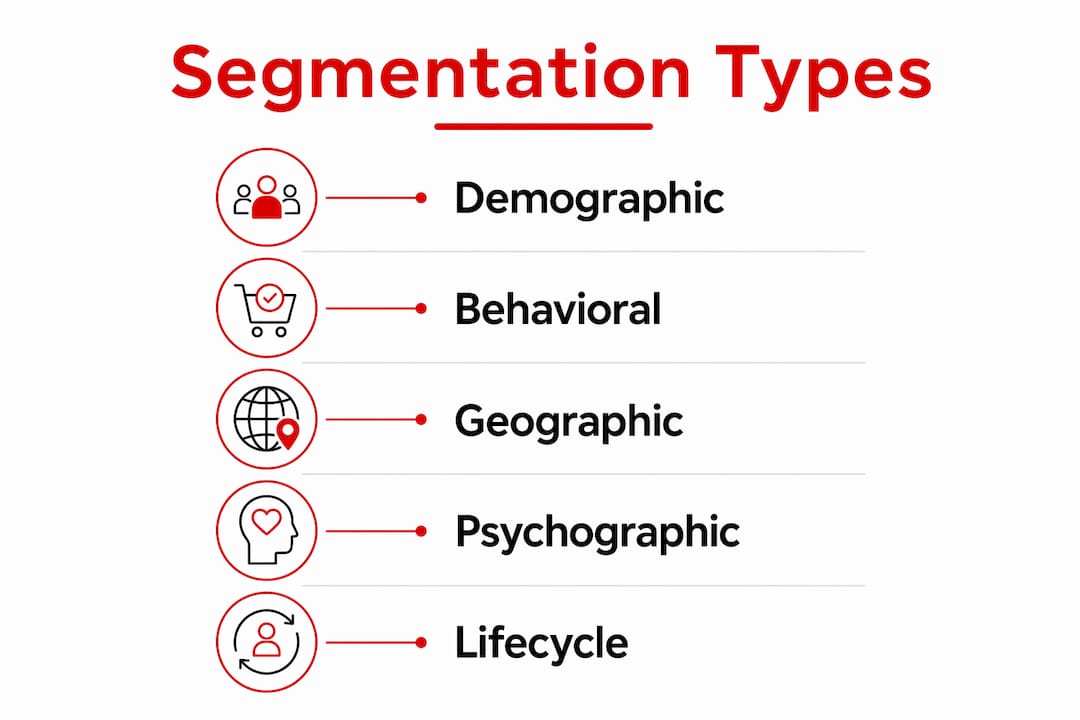
Groups customers by measurable personal attributes.
Divides customers by physical location.
Groups by values, lifestyle, and personality traits.
The most operationally useful type for most brands. Groups by how customers actually interact with your product.
Ranks customers by the revenue or profit they generate.
Groups customers by the specific problem they are trying to solve.
Relevant for brands selling through digital channels or to business buyers.
Groups customers by where they are in their relationship with your brand.
Pro Tip: Behavioral and lifecycle segmentation tend to produce the most immediately actionable results for CPG brands because they map directly to purchase decisions you can influence today.
Abstract frameworks only go so far. Here is how segmentation plays out in real business contexts.
Segmenting by purchase frequency. A CPG brand selling through both Amazon and direct-to-consumer channels identifies three behavioral clusters: one-time buyers, monthly repeat purchasers, and high-frequency loyalists who order every two to three weeks. The brand runs a standard welcome sequence for one-time buyers, a subscription nudge for monthly purchasers, and an exclusive early-access program for loyalists. Each group receives a different offer, and the marketing spend is weighted toward the loyalist tier because their lifetime value is highest.

Demographic clusters in retail. A food brand distributing through regional grocery chains in Texas finds that its top-selling SKU over-indexes with households in the 35–55 age range with children at home. Armed with that insight, the brand negotiates for end-cap placement in family-oriented store sections and adjusts its packaging copy to speak directly to that buyer profile. The omnichannel retail strategy shifts from broad awareness to targeted placement.
Behavioral triggers for churn prevention. A subscription brand flags any customer who skips two consecutive monthly orders as “at-risk.” That segment automatically receives a personalized email with a pause option and a loyalty discount, rather than a standard promotional blast. The result is a measurable reduction in full cancellations because the intervention matches the specific behavior that predicts churn.
Value-based segmentation to protect margin. A wholesale brand identifies that its top 20% of accounts by revenue generate a disproportionate share of gross profit, while a bottom tier of small accounts generates thin margins after accounting for fulfillment and support costs. The brand restructures its minimum order quantities and shifts account management resources toward the high-value tier, directly improving contribution margin.
Key lessons from these scenarios:
Treating all customers the same causes margin leaks and accelerates churn. When you send the same promotion to a loyal high-value buyer and a one-time discount shopper, you are either leaving money on the table with the loyalist or training the discount shopper to wait for a sale. Neither outcome serves the business.
Effective segmentation addresses this directly. The core benefits:
For CPG brands specifically, customer retention strategies built on segmentation data consistently outperform broad-based loyalty programs because they address the specific reasons each group stays or leaves. A loyalist needs recognition; an at-risk buyer needs a reason to re-engage; a new buyer needs confidence. One message cannot do all three jobs.
Segmentation also sharpens how you allocate field sales, trade promotion budgets, and retail support resources. When you know which geographic segments drive the most velocity in specific retail chains, you can justify shelf space negotiations with data rather than intuition.
Segmentation should be driven by the business decision it needs to support, not by the data you happen to have available. That is the single most common mistake brands make: they build segments because the data exists, not because a specific revenue or retention decision requires it. Start by naming the decision, then build the segment around it.
A few principles that separate effective segmentation from theoretical exercises:
Pro Tip: Start with behavioral and value-based dimensions first. They map most directly to margin outcomes and give you segments you can act on within a single quarter.
The digital marketing workflow that connects segmentation insights to channel execution is where most brands lose traction. The analysis gets done, the segments get named, and then nothing changes in the actual marketing calendar. Build the segment-to-campaign handoff into your process from day one.
Customer segmentation works when it is built around a specific business decision, limited to two to three actionable dimensions, and reviewed on a regular cadence to stay current with how your buyers actually behave.
| Point | Details |
|---|---|
| Definition and scope | Customer segmentation groups existing buyers using first-party data to guide retention, upsell, and engagement decisions. |
| Differs from market segmentation | Market segmentation targets potential buyers with external data; customer segmentation works with internal data on current customers. |
| Most actionable types | Behavioral, value-based, and lifecycle segmentation map most directly to purchase decisions and margin outcomes. |
| Avoid over-segmentation | Limit segments to two to three key dimensions; more complexity reduces operational usefulness without improving results. |
| Reddog’s approach | Reddog helps CPG brands connect segmentation insights to contribution margin, channel economics, and retail growth planning. |
Most brands we work with at Reddog have more customer data than they realize. The gap is rarely in the data itself. It is in the translation from segment to decision. A brand might correctly identify that its top 15% of customers generate the majority of its gross profit, then continue allocating trade promotion dollars evenly across all accounts because “that is how it has always been done.” The segmentation existed. The action did not follow.
The other pattern we see consistently is over-engineering. Brands build elaborate eight-dimension models with 20-plus segments, present them in a beautiful deck, and then watch the sales team ignore the whole thing because no one can explain what to do differently for Segment 12 versus Segment 13. Simplicity is not a compromise. It is what makes segmentation operational.
For growth-stage CPG brands navigating Amazon, Walmart, and physical retail simultaneously, the most valuable segmentation work connects channel behavior to margin contribution. Which customer segments buy primarily through Amazon and accept full price? Which ones wait for a Walmart rollback? Which ones are loyal DTC subscribers who also buy in-store? Those distinctions drive pricing strategy, promotional calendar decisions, and inventory allocation in ways that a single blended customer view never can. The retail sales growth that comes from acting on those distinctions is measurable and repeatable.
Reddog works with CPG founders and operators who are ready to move beyond broad-based marketing and start making decisions based on what their customer data actually shows. Our consulting work connects segmentation analysis directly to contribution margin, channel economics, and inventory velocity, so the insights translate into real operational changes, not just a slide deck.
If you are a CPG brand in the $500K–$20M revenue range and want a clear-eyed look at where your highest-value customer segments are and where margin is leaking, a focused conversation is a practical starting point. We offer a free 30-minute strategy call structured around your specific growth planning questions, whether that is channel mix, pricing by segment, or retail expansion readiness. Book your session at Reddog’s CPG growth offer and come with your real numbers. We will work through them together.
Leave a comment: