
Published: March 2020 | Last Updated:July 2026
© Copyright 2026, Reddog Consulting Group.

TL;DR:
- Customer retention is a business’s ability to keep existing customers purchasing over time, and it is the most valuable lever for profitable growth in CPG brands. Increasing retention by just 5% can boost revenue by 25 to 95%, as repeat purchases compound over time, reducing the need for costly acquisition efforts. Effective retention strategies include loyalty programs, personalized engagement, and fast issue resolution, which foster emotional loyalty and long-term customer relationships.
Customer retention is defined as a business’s ability to keep existing customers purchasing over time, measured as a percentage of customers who stay versus those who leave. For CPG brands and marketing professionals, retention is the single most direct lever for profitable growth. Acquisition costs 6–7 times more than keeping an existing customer. That gap alone makes retention the highest-return investment most brands are undervaluing. A 5% retention increase can lift company revenue by 25–95%, a range that reflects how compounding repeat purchases reshape a brand’s entire financial profile.
Customer retention is the practice of maintaining ongoing relationships with existing customers so they continue buying from your brand. The industry standard term is customer retention rate, calculated as the percentage of customers who remain active over a defined period. The formula is straightforward: subtract new customers acquired during a period from total customers at the end, divide by customers at the start, and multiply by 100.
Retention rate and churn rate are two sides of the same coin. If your retention rate is 80%, your churn rate is 20%. Tracking both gives you a complete picture of customer flow. Measuring retention separately from acquisition shifts how you allocate budget and define success, because the two activities require different tactics, timelines, and team structures.
Three metrics sit at the core of any retention program:
Pro Tip: Calculate retention rate by channel separately. A brand’s Amazon retention rate and its DTC retention rate often differ by 20 or more percentage points, and treating them as one number hides where the real problem sits.
For omnichannel CPG brands, calculating retention rate across each channel separately is the only way to see where customers are actually leaving and why.
Retention beats acquisition on cost, margin, and compounding revenue. Acquisition costs 6–7 times more than retention. That means every dollar you spend keeping a customer is worth six or seven dollars of acquisition spend in equivalent output. For brands operating on tight contribution margins, that math is not abstract. It determines whether growth is profitable or just expensive.
Loyal customers do three things that new customers rarely do in their first purchase cycle:
Customer lifetime value grows directly through retention because repeat buyers compound their spending over months and years. A customer who buys four times a year at $40 is worth $160 annually. Retain that customer for three years and you have a $480 relationship, built on zero additional acquisition spend.
The revenue math is equally clear. A 5% improvement in retention translates to a 25–95% revenue increase depending on your margin structure and average order value. That is not a rounding error. It is a structural shift in how much revenue your existing base generates without adding a single new customer.
Pro Tip: Before increasing your ad budget, calculate what a 5% retention improvement would add to your annual revenue. For most CPG brands in the $1M–$10M range, the number is larger than the projected return on any paid acquisition campaign.
For a deeper look at the cost dynamics between these two growth levers, Reddog’s guide on reducing acquisition cost breaks down the omnichannel math in detail.
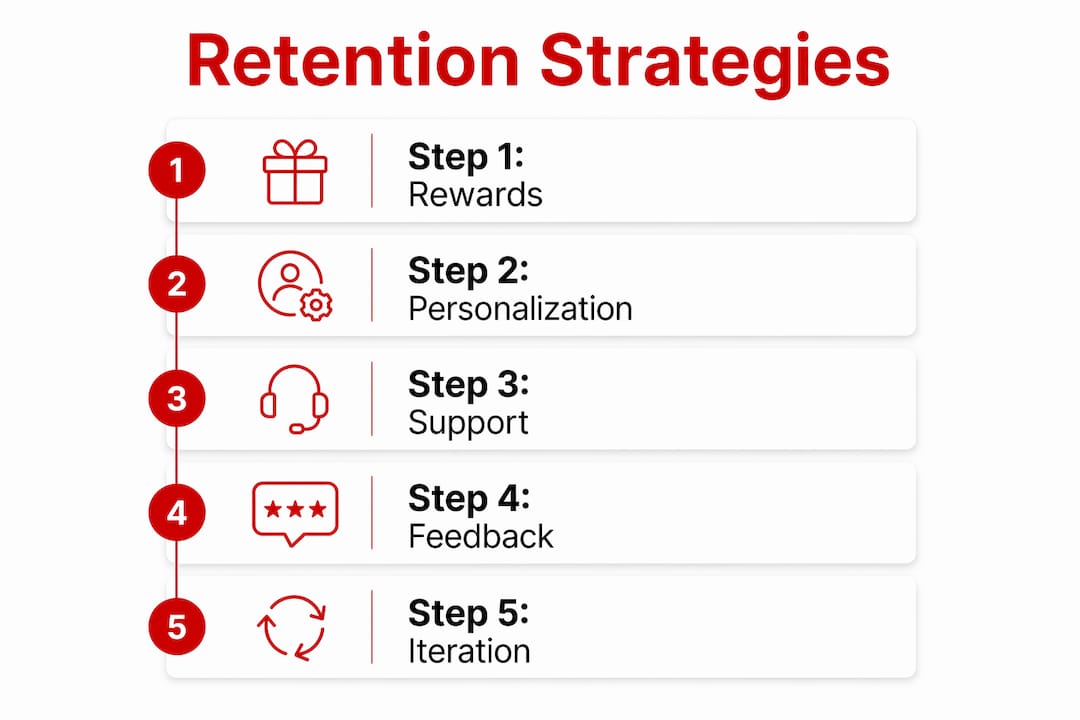
The most effective retention strategies build habits, not just transactions. Rewards programs, personalized engagement, and fast issue resolution each address a different layer of why customers stay or leave.

Rewards programs grow a brand’s customer base by 7.1% over 12 months, which is roughly equivalent to one full month of new customer acquisition at no incremental cost. Loyalty program usage in the CPG sector increased 28% in 2024, reflecting how seriously growth-stage brands are taking proactive retention. The programs that work are not generic punch cards. They use first-party data and segmentation to deliver offers that feel relevant to the individual customer’s purchase history and preferences.
Overusing discounts creates price-sensitive customers rather than loyal ones. It trains buyers to wait for a deal instead of buying at full price. That behavior erodes margins and lifetime value simultaneously. The goal of a loyalty program is emotional connection, not a cheaper transaction.
Pro Tip: Design rewards around behavior triggers, not just purchase frequency. A customer who buys your product after a 45-day gap responds to a different incentive than one who buys weekly. Timing the reward to the behavior builds habit, not just repeat sales.
Personalized, data-driven loyalty programs outperform uniform ones because they address what each customer actually values. Segmenting your customer base by purchase frequency, product category, and channel lets you send the right message at the right time. A subscription customer on your DTC site needs a different retention touch than a Walmart shopper buying seasonally.
Reddog’s guide on personalized marketing frameworks covers how to build segmentation that works across both digital and physical retail channels.
85% of customers defect after a single unresolved issue. That statistic reframes customer support from a cost center to a retention investment. Fast, consistent resolution of complaints keeps customers in the relationship. Slow or dismissive responses end it permanently. Customer success teams that actively manage the post-purchase experience, not just respond to complaints, are the operational backbone of any serious retention program.
For a practical look at how customer experience connects to growth, Reddog’s breakdown of customer experience and growth is worth reading alongside your support metrics.
Improving retention requires a continuous measurement cycle, not a one-time audit. The process has four distinct phases that repeat on a quarterly basis.
Set a baseline. Calculate your current retention rate by channel and by customer segment. Without a baseline, you cannot tell whether any change you make is working. Most brands discover their retention rate varies significantly between their best and worst performing channels.
Benchmark against your category. Retention benchmarks vary widely by industry and product type. Subscription CPG brands typically target retention rates above 70% at 90 days. Non-subscription brands measure repeat purchase rate instead, with top performers seeing 30–40% of customers buying again within six months.
Collect and act on customer feedback. Customer feedback and issue resolution speed are the two most overlooked inputs in retention management. Post-purchase surveys, review analysis, and direct customer interviews surface the specific friction points that cause churn. Acting on that feedback closes the loop and signals to customers that their input matters.
Iterate your loyalty program based on data. Effective retention programs focus on timing and behavioral triggers rather than blanket promotions. Test different reward structures, measure the impact on repeat purchase rate and CLV, and adjust quarterly. Programs that never change stop working within 12–18 months as customers habituate to the incentive.
Integration of customer success, marketing, and analytics teams is what separates brands that improve retention consistently from those that run one-off campaigns. Cross-functional ownership means no single team can ignore the retention number. For CPG brands building this capability, Reddog’s resource on CPG retention investment explains how to structure the internal case for prioritizing retention over acquisition.
A partner resource from Babylove Growth on proven retention strategies also covers complementary tactics worth reviewing alongside your own program design.
Customer retention is the highest-return growth lever available to CPG brands, and the gap between retention-focused and acquisition-focused brands compounds every quarter.
| Point | Details |
|---|---|
| Retention beats acquisition on cost | Acquiring a new customer costs 6–7 times more than keeping an existing one. |
| Small retention gains drive large revenue shifts | A 5% retention improvement can increase revenue by 25–95%. |
| Discounts build price sensitivity, not loyalty | Overusing discounts trains customers to wait for deals and erodes margins. |
| Measure retention by channel separately | Blended retention rates hide where customers are actually leaving. |
| Cross-functional teams sustain retention gains | Customer success, marketing, and analytics must share ownership of the retention metric. |
Most brands I work with at Reddog treat retention as a marketing tactic rather than a business system. They run a loyalty promotion, see a short-term sales spike, and call it a win. Six months later, the churn rate is exactly where it was before.
The real problem is that they are optimizing for the wrong signal. A sales spike after a promotion tells you the discount worked. It tells you nothing about whether the customer will come back at full price. That distinction is everything when you are trying to build a profitable brand rather than just move units.
What actually works is shifting focus from immediate revenue to habit formation. The brands that retain customers at high rates are not the ones with the most aggressive promotions. They are the ones whose products fit naturally into a customer’s routine, whose support teams resolve issues before they become complaints, and whose loyalty programs reward the behavior they want to see repeated, not just the last purchase.
Emotional loyalty is also harder to build than transactional loyalty, but it is far more durable. A customer who buys from you because they trust your brand and feel recognized as an individual will stay through a price increase. A customer who buys because you had the lowest price that week will leave the moment someone else does.
The brands that get this right integrate retention into their growth planning from the start. They track CLV alongside customer acquisition cost. They set retention rate targets by channel. They hold customer success accountable to the same metrics as marketing. That is not a complex system. It is just a deliberate one.
— Reddog
Retention strategy only works when it connects to the real economics of your business: contribution margin, channel mix, and inventory velocity.
At Reddog, we work with CPG founders and operators in the $500K–$20M revenue range who want to understand what their existing customer base is actually worth and where margin is leaking. Our CPG retail growth offer includes a free 30-minute strategy call focused on the metrics that matter most to your growth stage. Whether you need to build a retention baseline, evaluate your loyalty program’s margin impact, or align your channel economics with a retention-first plan, that call is a practical starting point. Book it when you are ready to move from general retention awareness to a plan built around your specific numbers.
Customer retention rate equals the number of customers at the end of a period, minus new customers acquired, divided by customers at the start of the period, multiplied by 100. Track this metric by channel for the most accurate view of where customers are leaving.
Acquiring a new customer costs 6–7 times more than retaining an existing one, so high churn forces brands to spend heavily on acquisition just to maintain flat revenue. A 5% improvement in retention can increase revenue by 25–95%, depending on margin structure and average order value.
Emotional loyalty, built through personalized engagement, consistent product quality, and fast issue resolution, outlasts any discount-driven program. Customers who feel recognized and valued by a brand spend more over time and refer others without being incentivized to do so.
Quarterly reviews are the standard for high-performing CPG brands. Programs that go unchanged for more than 12 months typically see diminishing returns as customers habituate to the incentive structure and the behavioral triggers lose their effect.
Retention rate measures the percentage of customers who stay over a period. Churn rate measures the percentage who leave. The two always add up to 100%, so a retention rate of 75% means a churn rate of 25%. Both metrics are needed to manage a retention program effectively.
Leave a comment: