
Published: March 2020 | Last Updated:July 2026
© Copyright 2026, Reddog Consulting Group.

Customer acquisition is the end-to-end process of turning strangers into paying customers, covering every touchpoint from the first moment someone discovers your brand through the moment they complete a purchase. It is not just a sales function. It spans marketing, content, product positioning, and cross-team execution, all working together to move prospects through a structured funnel. For any business aiming to grow revenue and build market presence, mastering this process is the foundation everything else rests on.
What makes customer acquisition distinct from simply “doing marketing” is its scope and intentionality. According to Salesforce, the process involves three core funnel stages: awareness, consideration, and conversion. Each stage requires a different approach, different content, and different success metrics. Treating acquisition as a single event, like closing a sale, misses the upstream work that makes closing possible.
Here is what a complete customer acquisition effort actually involves:
Customer acquisition is how a business grows its revenue base. Every new customer adds income, expands market reach, and signals that the brand’s value proposition is landing. Without a consistent inflow of new buyers, even a well-run business eventually plateaus or declines as natural churn erodes the existing base.
The importance of customer acquisition goes beyond the immediate transaction. A new customer represents future lifetime value, potential referrals, and proof that your acquisition channels are working. Businesses that treat acquisition as a repeatable, measurable system rather than a series of one-off campaigns build compounding advantages over time.
One distinction worth making early: customer acquisition is not the same as sales. Confusing the two leads to misaligned priorities and masks underlying growth problems. Sales closes the deal. Acquisition is the entire upstream process of building trust, generating interest, and nurturing a prospect to the point where closing becomes natural. A business that only measures sales performance will miss the signals that its acquisition funnel is leaking.
Acquisition also differs from demand generation, though the two work together. Demand generation builds upstream awareness and category interest. Customer acquisition picks up from there, converting that interest into signed orders and paying customers. A strong demand generation program makes acquisition faster and less expensive, but they remain separate disciplines with separate metrics.
The funnel is the structural model that explains how prospects move from strangers to customers. Salesforce describes a five-stage version: awareness, interest, consideration, conversion, and onboarding. Each stage has a specific job, and collapsing them together is one of the most common reasons acquisition programs underperform.
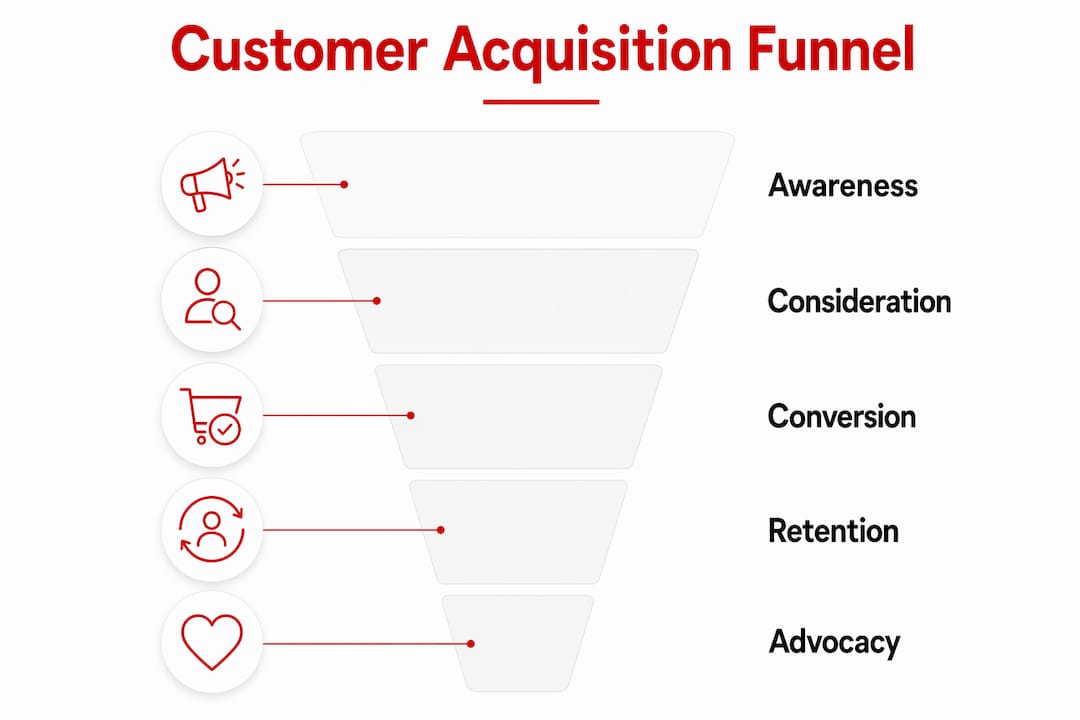
Awareness is where prospects first encounter your brand, whether through a Google search, a social media post, a marketplace listing, or word of mouth. The goal here is visibility and relevance, not selling. Interest follows when a prospect engages more deliberately, reading content, watching a demo, or exploring your product pages. At this point, they are self-qualifying.

Consideration is where intent sharpens. Prospects compare options, read reviews, and evaluate whether your offer fits their need. This is where proof points, case studies, and clear differentiation do the most work. Conversion is the moment of purchase or contract signature. By this stage, the prospect has already made most of the decision; the conversion step just needs to remove friction. Onboarding closes the loop, setting new customers up for success and reducing early churn.
Pro Tip: Map your current marketing content to each funnel stage. Most brands over-invest in bottom-of-funnel conversion content and under-invest in awareness and consideration, which starves the top of the funnel and raises acquisition costs over time.
The funnel is not a straight line for every buyer. Some prospects skip stages or cycle back. The value of the model is that it forces you to think about what each type of prospect needs at each moment, rather than sending the same message to everyone.
Here is a quick reference for what each stage requires:
Channels are the vehicles that carry your acquisition strategy into the market. The right mix depends on your audience, your price point, and where your buyers actually spend time. No single channel works for every business, but several consistently deliver results across industries.

Amazon Ads is one of the highest-intent acquisition channels available to product brands. Shoppers on Amazon are already in buying mode, which compresses the funnel and raises conversion rates compared to cold traffic channels. Sponsored Product and Sponsored Brand campaigns let you capture demand at the moment it exists, making Amazon Ads especially powerful for CPG brands competing in crowded categories.
Social media serves the awareness and interest stages most effectively. Platforms like Meta, TikTok, and Instagram let brands reach highly targeted audiences with visual content that builds recognition and drives traffic. Paid social is particularly useful for new brands that lack organic search authority, because it generates visibility immediately. Organic social builds community and trust over time, which lowers acquisition costs as the audience grows.
Content marketing works across the entire funnel but earns its biggest returns at the awareness and consideration stages. Well-optimized blog content, YouTube videos, and educational resources attract prospects through search and establish credibility before a sales conversation ever begins. The compounding nature of content, where a single article can drive traffic for years, makes it one of the most cost-efficient customer acquisition strategies available to growth-stage brands.
Email marketing remains one of the highest-return channels for converting warm prospects. Once someone has opted in, email lets you deliver personalized, sequenced content that moves them through the consideration and conversion stages at their own pace. Paired with a CRM platform, email becomes a systematic nurture engine rather than a broadcast tool.
SEO builds the organic foundation that reduces long-term dependence on paid acquisition. Ranking for the search terms your buyers use at each funnel stage means your brand appears when intent is highest, without paying per click. The tradeoff is time: SEO typically takes months to build momentum, which is why most brands run paid and organic channels in parallel.
AI applications are increasingly embedded in acquisition workflows, from predictive lead scoring to personalized content generation and chatbot-driven qualification. These tools accelerate the speed at which teams can test, personalize, and respond to prospect behavior across channels.
CRM platforms tie everything together. Without a system to track where each prospect is in the funnel, which channels brought them in, and what actions they have taken, acquisition efforts become disconnected and hard to measure. A well-configured CRM turns acquisition from a series of campaigns into a managed, auditable process.
The most effective acquisition programs integrate these channels deliberately, mapping each one to the funnel stages where it performs best, rather than running them in isolation.
Measurement is where acquisition strategy either proves its value or exposes its waste. The central metric is Customer Acquisition Cost, or CAC. CAC measures the total expense required to convert a prospect into a paying customer, calculated by dividing all acquisition expenses by the number of new customers gained during a specific period.
The formula is straightforward:
CAC = Total Acquisition Spend / Number of New Customers Acquired
For example, if your business spends $50,000 on marketing and sales in a quarter and acquires 200 new customers, your CAC is $250. That number only means something in context, specifically in relation to how much revenue and profit each customer generates over their lifetime.
The challenge is that most businesses undercount their true CAC. Accurate CAC requires including not just media spend but also sales team salaries, marketing software subscriptions, agency fees, content production costs, and allocated overhead. Leaving these out produces a CAC figure that looks better than reality, which leads to budget decisions built on false assumptions.
Beyond CAC itself, three related metrics give a fuller picture of acquisition health:
| Metric | What it measures | Why it matters |
|---|---|---|
| CAC Payback Period | Months to recover the cost of acquiring one customer | Shorter payback periods improve cash flow and reduce risk |
| CLV to CAC Ratio | Customer lifetime value divided by CAC | A ratio of at least 3:1 is a widely cited benchmark for healthy unit economics |
| Channel-Level CAC | CAC broken out by acquisition channel | Reveals which channels deliver customers most efficiently |
The CLV to CAC ratio is particularly telling. Businesses that maintain a customer lifetime value at least three times higher than their acquisition costs have room to invest in growth without eroding margins. When that ratio compresses, it usually signals either rising acquisition costs, declining retention, or both.
Pro Tip: Calculate CAC separately for each channel rather than blending everything into a single number. A blended CAC hides the fact that one channel may be subsidizing another that is actually unprofitable.
One more measurement challenge worth naming: acquisition cost and retention cost interact. Brands that ignore customer churn while focusing solely on acquisition end up spending more just to replace lost customers, which inflates effective CAC without growing the actual customer base. Measurement systems that track both acquisition and retention together give a far more accurate picture of growth efficiency.
The most common mistake in customer acquisition is optimizing for volume instead of profit. Acquiring more customers is not the goal. Acquiring customers whose lifetime value exceeds the cost of winning them, by a margin wide enough to fund operations and growth, is the goal. In CPG and other margin-compressed sectors, this distinction determines whether a brand scales or stalls.
Contribution-margin-first strategy means evaluating every acquisition channel and campaign against what it actually contributes to profit after variable costs, not just what it contributes to revenue. A channel that drives high order volume but attracts customers who buy once, return frequently, or require heavy support can destroy margin even while growing the top line.
Balancing acquisition with retention is equally critical. Acquiring new customers without retaining them inflates costs and undermines growth. The economics are straightforward: if churn is high, you spend acquisition budget just to stay in place. Brands that build retention into their acquisition strategy from the start, by targeting buyers who fit the product well and onboarding them effectively, reduce the effective cost of growth over time. Reddog’s guide on customer retention strategies covers this balance in depth for CPG operators.
Data-driven channel economics are the practical tool for making these decisions. When you know the CAC, payback period, and average order frequency for each channel, you can allocate budget toward the channels that compound value rather than just generate transactions. Inventory velocity matters here too: a channel that drives fast-moving SKUs at healthy margins is worth more than one that moves slow inventory at thin contribution.
Customer acquisition is a continuous discipline, not a campaign. Brands that build consistent acquisition rigor, testing channels, refining targeting, and adjusting spend based on margin data, outperform peers who treat acquisition as a periodic initiative. The compounding effect of consistent, margin-aware acquisition is one of the clearest differentiators between brands that scale and those that plateau.
Pro Tip: Before increasing acquisition spend, audit your current channel mix against contribution margin by SKU. You may find that your highest-volume acquisition channel is driving your lowest-margin products, and a reallocation could improve profitability without adding a dollar of new spend.
Customer acquisition is a strategic, multi-stage process that drives revenue growth only when managed with equal attention to cost, channel performance, and long-term customer value.
| Point | Details |
|---|---|
| Acquisition spans the full funnel | The process runs from awareness through onboarding, not just the moment of sale. |
| CAC must include all costs | Salaries, software, agency fees, and overhead belong in the calculation, not just media spend. |
| CLV to CAC ratio signals health | A ratio of at least 3:1 between customer lifetime value and CAC is a widely cited benchmark. |
| Channel mix determines profitability | Measuring CAC and contribution margin by channel reveals which sources actually drive profit. |
| Reddog’s approach | Reddog applies contribution-margin-first strategy to help CPG brands identify which acquisition channels deliver real profit, not just volume. |
Most acquisition advice focuses on tactics: which channels to use, how to write ad copy, how to structure a funnel. That is useful, but it sidesteps the question that actually determines whether acquisition creates value or destroys it. The margin question.
We have seen CPG brands running aggressive acquisition programs, growing their customer counts quarter over quarter, and still losing ground on profitability. The mechanism is almost always the same. They are measuring success by customer volume and top-line revenue, while the actual contribution margin per acquired customer is thin or negative. The acquisition machine is running, but it is running at a loss.
The fix is not to spend less on acquisition. It is to measure acquisition differently. When you evaluate each channel against what it contributes to margin after variable costs, including the cost of goods, fulfillment, returns, and the acquisition spend itself, you get a completely different picture of which channels are worth scaling and which ones are quietly draining the business.
Omnichannel brands face an additional layer of complexity here. A customer acquired through Amazon Ads may have a very different margin profile than one acquired through a DTC email campaign or a wholesale relationship. The channel economics are different, the fulfillment costs are different, and the repeat purchase behavior often differs too. Treating all acquired customers as equivalent, regardless of channel, is one of the most expensive analytical mistakes a growth-stage brand can make.
The brands that get this right build acquisition programs that are analytical at their core. They test channels with margin as the primary success metric, not just conversion rate or cost per click. They track customer cohorts by acquisition source to understand lifetime value by channel. And they adjust spend based on what the data shows, not what the top-line numbers suggest.
Most CPG brands know they need to grow their customer base. Fewer have a clear picture of which acquisition channels are actually profitable after accounting for contribution margin, fulfillment costs, and channel economics. That gap is exactly where Reddog works.
Reddog is a Houston-based CPG retail growth consultancy built for emerging and growth-stage brands in the $500K–$20M revenue range. We help founders and operators understand what each acquisition channel truly costs, what it returns in margin, and where the leaks are hiding. Whether you are scaling on Amazon, expanding into Walmart, building a DTC channel, or navigating wholesale distribution, we bring the analytical framework to make acquisition decisions with confidence. Our work is grounded in contribution margin strategy and channel economics, not generic marketing advice.
If you are a CPG founder or operator ready to take a hard look at your acquisition costs, channel mix, or growth plan, we invite you to book a free 30-minute strategy call with the Reddog team. We will review your current acquisition approach, identify where margin is leaking, and outline a practical path forward. No pressure, no pitch deck. Just a focused conversation about what the numbers actually show. Book your strategy call and let’s look at the real picture together.
Leave a comment: