
Published: March 2020 | Last Updated:July 2026
© Copyright 2026, Reddog Consulting Group.

TL;DR:
- Channel conflict causes friction when multiple sales channels compete within the same network, harming relationships and profits. Resolving conflicts varies from three to twelve months depending on the type, with proactive policies being essential for prevention. Structural solutions like pricing policies and clear territory assignments are more effective than relationship management alone.
Channel conflict is defined as the friction that occurs when two or more sales channels within the same distribution network compete for the same customers, undermining partner relationships and profitability. It is one of the most persistent challenges in multichannel sales, and it intensifies as brands expand across Amazon, Walmart, DTC, wholesale, and retail simultaneously. The three recognized types are vertical, horizontal, and multichannel conflict, each with distinct causes and resolution timelines. Left unmanaged, channel conflict disrupts market coverage and erodes the brand equity you have spent years building. Understanding the channel conflict definition is the first step toward protecting your margins and your partner relationships.
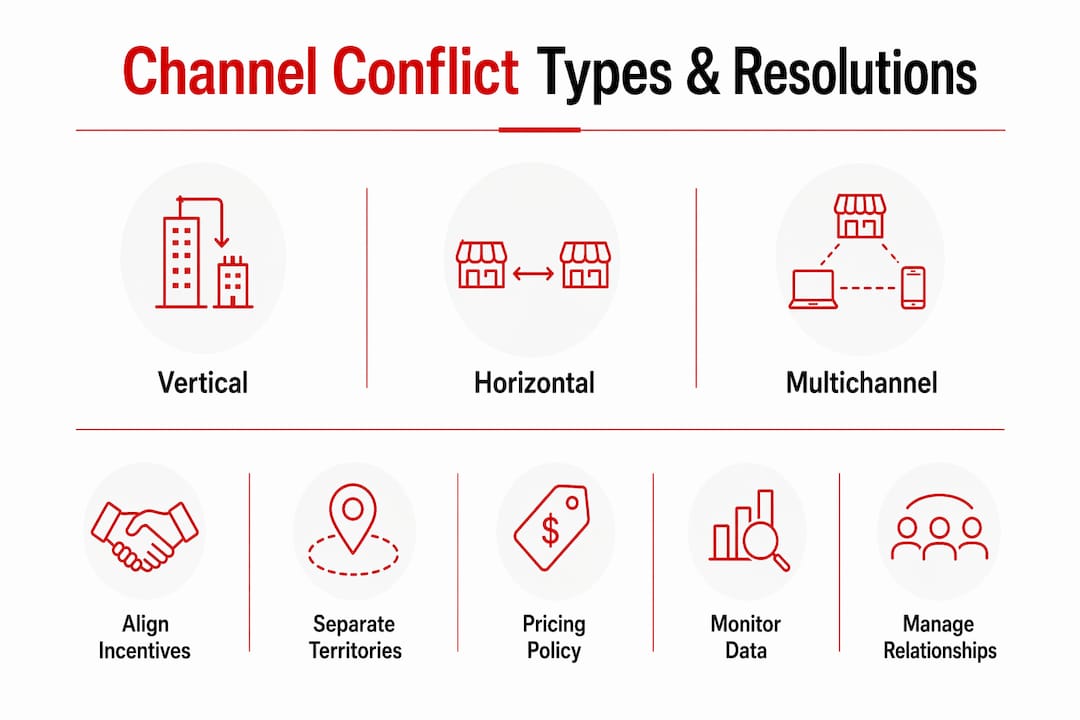
Channel conflict appears in three distinct forms, and confusing them leads to the wrong fix.
Vertical conflict occurs between different levels of the supply chain. The most common example is a manufacturer selling directly to consumers at a price that undercuts its own retail partners. A food brand that launches a DTC subscription at $18 per unit while its grocery retail price is $24 creates immediate friction with every store buyer carrying that product.
Horizontal conflict happens between partners at the same level of the distribution chain. Two regional distributors covering overlapping territories, or two authorized Amazon sellers listing the same SKU, are classic examples. This type tends to resolve faster because the parties involved have similar leverage and the fix is usually a territory or account assignment.
Multichannel conflict is the most complex form. It arises when a brand sells through multiple paths simultaneously, such as DTC, wholesale, and marketplace, and those paths collide on price, inventory, or customer ownership. Vertical conflicts resolve in 3–5 months; horizontal in 2–4 months; multichannel conflicts average 6–12 months to resolve. That timeline difference alone explains why multichannel brands need a proactive plan rather than a reactive one.
| Type | Parties involved | Primary cause | Typical resolution time |
|---|---|---|---|
| Vertical | Manufacturer vs. retailer | Price or territory overlap | 3–5 months |
| Horizontal | Distributor vs. distributor | Territory or account overlap | 2–4 months |
| Multichannel | Brand vs. all channel partners | Competing sales paths | 6–12 months |
For CPG brands scaling across multiple retail channels, recognizing which type you are dealing with determines how fast you can act and what resources you need to commit.
The financial damage from unresolved channel conflict is concrete and measurable. Launching a DTC channel priced 15% below authorized retailers is a documented trigger for margin erosion and partner friction. That 15% gap does not just cost you a retailer relationship. It signals to every partner in your network that you will compete against them with your own pricing.
The downstream effects compound quickly:
Conflict intensity increases as brands expand multichannel strategies, which means the problem does not self-correct with growth. It scales with growth.
Pro Tip: Set a pricing floor policy before you launch any new channel. Document the minimum advertised price (MAP) and enforce it consistently across Amazon, DTC, and wholesale from day one. Retrofitting a MAP policy after conflict has started is significantly harder than building it in at launch.
The strategic damage is equally serious. Partner-versus-direct conflict, where your own DTC channel competes head-to-head with your retail partners, is considered the most toxic form of channel friction. It rapidly destroys trust and can push long-term partners toward your competitors.
Resolving channel conflict requires both structural fixes and relationship management. Neither works alone.
The most durable resolution starts with incentive alignment. Balancing authoritative guidance with aligned rewards is what sustains partner trust through conflict. If your distributors earn more margin by pushing a competing brand, no amount of territory policy will keep them loyal. Audit your partner compensation structures before you address anything else.

Assigning distinct customer segments or geographic territories to each channel eliminates the overlap that causes most horizontal and vertical conflicts. A brand selling premium SKUs through specialty retail while offering value bundles through its DTC store serves different buyers through each path. The channels do not compete because they are not chasing the same customer.
A minimum advertised price policy is the single most effective structural tool for preventing price-driven conflict. It sets a floor that protects retailer margins while allowing your DTC channel to compete on experience, subscription value, or exclusive products rather than price.
Real-time pricing and inventory monitoring across channels catches conflict early. Brands that wait for a partner complaint to discover a pricing violation are already managing a relationship problem, not just a policy one. Automated price monitoring tools flag violations before they become disputes.
Not all conflict is destructive. Cognitive conflict, which is task-focused disagreement, can improve strategic outcomes. A distributor pushing back on your territory map because they have better regional data is cognitive conflict. It produces better decisions. Affective conflict, which is relationship-based friction driven by distrust or resentment, almost always harms financial performance. The goal is to encourage the first and eliminate the second.
Pro Tip: When a partner raises a pricing or territory concern, treat it as cognitive conflict first. Ask for their data before defending your policy. Partners who feel heard are far more likely to accept a compromise than those who feel dismissed.
Understanding sales channel diversification as a deliberate strategy, rather than an opportunistic one, reduces the likelihood of conflict from the start.
Preventing channel conflict from recurring requires ongoing discipline, not a one-time fix. Brands consistently underestimate the time and effort required to realign incentives and contracts, which is why many resolve a conflict only to face it again within 12 months.
The practices that sustain healthy channel relationships over time include:
For brands navigating multichannel retailing, the long-term goal is a channel architecture where each path serves a distinct purpose and partners see the overall system as fair. That perception of fairness is what keeps partners engaged when conflict does arise.
Understanding multichannel marketing dynamics also helps leaders anticipate where friction points emerge as they add new sales paths.
Channel conflict is a structural problem that requires structural solutions, and the brands that resolve it fastest are the ones that build pricing, territory, and incentive policies before conflict starts.
| Point | Details |
|---|---|
| Three distinct types exist | Vertical, horizontal, and multichannel conflicts each require different resolution approaches and timelines. |
| Multichannel conflict takes longest | Resolution averages 6–12 months, requiring sustained effort and strategic realignment across all partners. |
| Pricing gaps trigger the most damage | A DTC price 15% below retail is a documented cause of margin erosion and partner disengagement. |
| Not all conflict is harmful | Cognitive conflict improves strategy; affective conflict damages relationships and financial performance. |
| Prevention beats resolution | MAP policies, territory clarity, and joint planning prevent conflict more effectively than reactive fixes. |
Working with CPG brands across Amazon, Walmart, DTC, and wholesale, Reddog sees the same pattern repeatedly. A founder launches a DTC store to capture more margin. They price it below retail to drive conversion. Within 90 days, their top regional distributor is calling to renegotiate terms or threatening to drop the line.
The mistake is not launching DTC. The mistake is treating channel expansion as a marketing decision rather than a channel economics decision. Every new sales path you add changes the math for every existing partner. If you have not modeled what your DTC launch does to your retailer’s margin before you go live, you are already behind.
The other pattern Reddog sees is brands that try to resolve conflict through relationship management alone. Calls, apologies, and promises buy time. They do not fix the structural problem. The distributor who feels undercut will stay polite through two or three conversations and then quietly redirect their sales team toward a competing brand that does not compete against them.
The brands that manage channel conflict well are not the ones with the best relationships. They are the ones with the clearest policies, the most transparent communication, and the discipline to enforce their channel rules uniformly. Relationships matter, but they cannot substitute for structure.
— Reddog
Reddog works with CPG founders and operators in the $500K–$20M revenue range who are scaling across multiple channels and need clarity on where margin is leaking and why. Channel conflict is one of the most common and most costly sources of margin compression we see, and it rarely resolves without a structured approach to channel economics and partner alignment.
If you are managing friction between your DTC, Amazon, or wholesale channels and want a clear picture of what each channel actually contributes to profit, a free 30-minute strategy call is a practical place to start. Reddog’s CPG retail growth consulting covers contribution margin analysis, channel pricing strategy, and retail expansion planning for brands ready to grow without sacrificing profitability.
Channel conflict occurs when two or more sales channels within the same brand’s distribution network compete for the same customers, creating friction that damages partner relationships and profitability.
The three types are vertical conflict (manufacturer vs. retailer), horizontal conflict (distributor vs. distributor), and multichannel conflict (DTC vs. wholesale vs. marketplace). Multichannel conflict is the most complex and takes the longest to resolve.
Resolution timelines vary by type. Vertical conflicts typically resolve in 3–5 months, horizontal conflicts in 2–4 months, and multichannel conflicts average 6–12 months due to the number of parties and competing interests involved.
Channel conflict most often occurs when a brand launches a new sales channel, such as DTC or a marketplace, without aligning pricing and territory policies with existing partners. A DTC price set 15% below retail is a documented and common trigger.
Cognitive conflict, which is task-focused disagreement between channel partners, can produce better strategic decisions and improved channel design. Affective conflict, driven by distrust or resentment, is consistently harmful to financial performance and partner loyalty.
Leave a comment: