
Published: March 2020 | Last Updated:November 2025
© Copyright 2026, Reddog Consulting Group.

Did you know that almost 90 percent of customers say a clear brand positioning influences their buying decisions? In crowded markets, simply offering a product isn’t enough. Brands that claim a distinct spot in a customer’s mind enjoy greater loyalty and higher sales. Understanding what makes your positioning strategy stand out can help you connect, differentiate, and build lasting impact where it matters most.
| Point | Details |
|---|---|
| Effective Business Positioning | It’s essential to create a distinct brand space in customers’ minds through clarity, consistency, and relevance. |
| Major Positioning Strategies | Retail brands can distinguish themselves using strategies such as price leadership, quality positioning, and customer experience. |
| Impact on Market Performance | Effective positioning directly influences customer loyalty, pricing power, and revenue growth. |
| Avoid Common Mistakes | Brands should maintain clear messaging, consistent communication, and adaptability to avoid eroding customer trust. |
Business positioning is fundamentally about creating a distinctive space for your brand in customers’ minds. According to research from Clute Journals, successful positioning hinges on three core principles: clarity of message, consistency in delivery, and relevance to the target audience.
At its essence, positioning answers a critical question: Why should customers choose your brand over competitors? This isn’t just about describing what you sell, but communicating the unique value and emotional connection your brand represents. Think of positioning as your brand’s strategic fingerprint - a nuanced blend of perception, promise, and differentiation that sets you apart in crowded marketplaces.
The core elements of effective business positioning include:
A powerful positioning strategy transforms how potential customers perceive your offering. Read more about branding strategies that can amplify your market presence and create meaningful connections with your audience.
Retail brands have several strategic approaches to differentiate themselves in competitive markets. Positioning strategies are critical frameworks that help businesses create unique value propositions and connect meaningfully with their target customers. These strategies go beyond simple product descriptions and focus on crafting compelling narratives that resonate emotionally and functionally.
The primary positioning strategies for retail brands include:
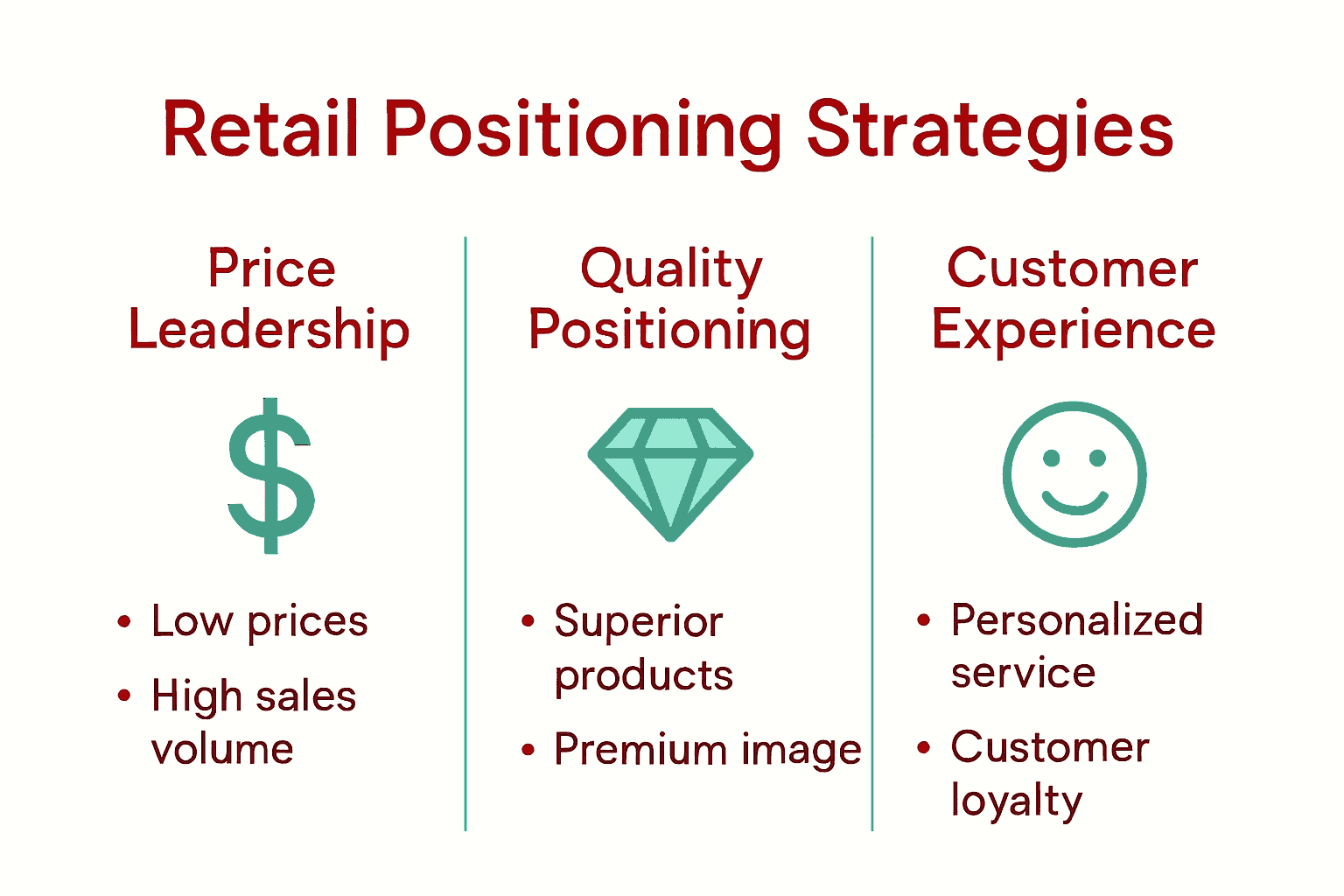
Here’s a comparison of the major positioning strategies for retail brands:
| Strategy | Core Focus | Typical Benefits |
|---|---|---|
| Price Leadership | Low prices Value propositions |
Attracts budget-conscious customers |
| Quality Positioning | Superior quality Premium image |
Builds trust Enables higher pricing |
| Innovation-Driven | New products Cutting-edge image |
Appeals to trendsetters Differentiation |
| Customer Experience | Service excellence Engagement |
Boosts loyalty Drives referrals |
| Lifestyle Alignment | Identity fit Aspirations |
Fosters emotional connections |
Successful retail positioning requires deep understanding of your target audience’s preferences, pain points, and aspirational goals. This means going beyond surface-level demographics and developing nuanced insights into customer motivations. Explore our comprehensive retail strategy guide to dive deeper into strategic market positioning techniques that can transform your brand’s market presence.
Effective positioning isn’t a one-time exercise but an ongoing process of refinement. Brands must continuously adapt their strategies, monitor market shifts, and realign their messaging to maintain relevance and competitive advantage. By implementing a thoughtful positioning approach, retail brands can create lasting connections that transcend transactional relationships and build genuine customer loyalty.

Market performance is directly influenced by how effectively a brand communicates its unique value proposition and differentiates itself from competitors. Strategic positioning isn’t just a marketing exercise - it’s a critical business driver that can significantly impact revenue, customer acquisition, and long-term brand sustainability.
The multifaceted impact of positioning manifests through several key performance indicators:
Effective positioning creates a powerful psychological framework that helps customers quickly understand why your brand matters. When done right, it transforms potential buyers from passive observers to active advocates. This means your brand doesn’t just compete on features or price, but on perceived value and emotional resonance. Small shifts in positioning can unlock substantial market opportunities, enabling businesses to command premium pricing or expand into new customer segments.
Learn more about strategic branding investments that can amplify your market performance. Ultimately, positioning is a dynamic process of continuous refinement - brands that remain agile, attentive to market shifts, and committed to authentic communication will consistently outperform competitors who rely on static, undifferentiated approaches.
Omnichannel positioning represents a sophisticated approach where brands create seamless, integrated experiences across multiple customer touchpoints. This strategy goes beyond traditional multichannel marketing by ensuring consistent messaging, personalized interactions, and fluid transitions between digital and physical platforms.
Practical examples of effective omnichannel positioning demonstrate how brands can transform customer engagement:
Successful omnichannel positioning requires sophisticated technological integration and a deep understanding of customer journey mapping. Brands must create frictionless experiences that feel intuitive and personalized, regardless of the interaction channel. Explore our comprehensive guide to omnichannel strategies to understand how leading brands are redefining customer engagement. The goal is to create a unified brand ecosystem where every touchpoint feels connected, responsive, and tailored to individual customer preferences.
Business positioning is a delicate strategic process where seemingly minor missteps can significantly undermine your brand’s market perception. Positioning errors can quickly erode customer trust, dilute brand value, and create confusion that drives potential customers away from your offerings.
The most critical positioning mistakes businesses frequently make include:
Successful brands understand that positioning is an ongoing dialogue with their market, not a static declaration. This requires continuous listening, agile adaptation, and genuine commitment to understanding customer needs. Learn more about avoiding branding pitfalls that can derail your business growth. The most resilient brands view positioning as a dynamic process of refinement, staying attuned to shifting customer expectations and maintaining authentic, compelling narratives that resonate deeply with their target audience.
Is your brand struggling to cut through the noise or stand out in a crowded marketplace? If you want your business to thrive in 2025 and beyond, strong positioning is more critical than ever. Many brands stumble with inconsistent messaging, generic value propositions, and missed opportunities across omnichannel platforms. The good news is you can turn these pain points into real growth and recognition.
Now is the moment to act. Reddog Group has helped over 50 brands master the art of business positioning through smart omnichannel retailing, digital marketing, and personalized brand growth strategies. When you partner with Reddog Group, you get access to proven solutions for marketplace management, DTC channels, and online-offline integration. Ready to clarify your message and win customer loyalty? Explore our strategic guidance services, or see real results for yourself by starting a conversation today. Your next step toward stronger revenue and brand identity is just a click away.
Business positioning refers to the strategic process of creating a unique space for a brand in customers’ minds to differentiate it from competitors. This involves clarifying the brand’s value proposition and emotional connection with the target audience.
Clarity of message ensures that customers understand the unique value and benefits of a brand. A clear message helps eliminate confusion and aids in forming a strong brand identity, making it easier for customers to recognize and choose your brand over others.
A brand can measure the effectiveness of its positioning strategy through key performance indicators such as customer recognition and recall, conversion rates, customer loyalty, pricing power, and reduced acquisition costs. Monitoring these metrics helps assess how well the brand communicates its unique value.
Common mistakes in business positioning include using generic messaging, inconsistent communication across channels, neglecting target audience research, overcomplicating the value proposition, and failing to adapt to changing market dynamics. Avoiding these pitfalls is crucial for maintaining a strong brand perception.
Leave a comment: