
Published: March 2020 | Last Updated:March 2026
© Copyright 2026, Reddog Consulting Group.

More than 2.6 billion consumers will shop online this year, yet many CPG founders still struggle to define what B2C ecommerce truly means for their brand. Is it just selling on Amazon? Building a Shopify store? The answer impacts every growth decision you make. This guide cuts through the confusion, explaining B2C ecommerce fundamentals and sharing proven strategies to scale profitably across marketplaces and direct channels in 2026.
| Point | Details |
|---|---|
| B2C ecommerce definition | Direct selling from brands to consumers online without middlemen or distributors. |
| Marketplace dominance | Amazon and Walmart control the majority of US eCommerce sales in 2026, driving traffic and conversions. |
| D2C opportunities | Direct-to-consumer channels offer higher margins and brand control but require strong infrastructure to scale. |
| Scaling strategies | Success requires data-driven merchandising, multichannel integration, and sustainable cost management. |
| Economic pressures | CPG brands must build resilient growth models to navigate inflation, tariffs, and margin compression. |
B2C ecommerce means selling directly to end consumers online without intermediaries. Unlike B2B models that involve business buyers and longer sales cycles, B2C transactions focus on individual consumers making purchase decisions quickly, often within minutes of discovering a product.
The market scale is staggering. Global eCommerce sales exceeded $5.8 trillion in 2023 and are projected to surpass $8 trillion by 2027. For CPG brands, this represents massive opportunity but also intense competition.
Several forces drive this growth:
The rise of cross-border ecommerce adds another dimension. CPG brands can now reach international consumers without establishing physical distribution in each market, though this introduces complexity around customs, regulations, and localized marketing.
Key insight: B2C ecommerce isn’t a single channel. It’s an ecosystem spanning marketplaces, direct-to-consumer sites, social commerce, and emerging platforms. Your growth strategy must account for how these channels work together, not in isolation.
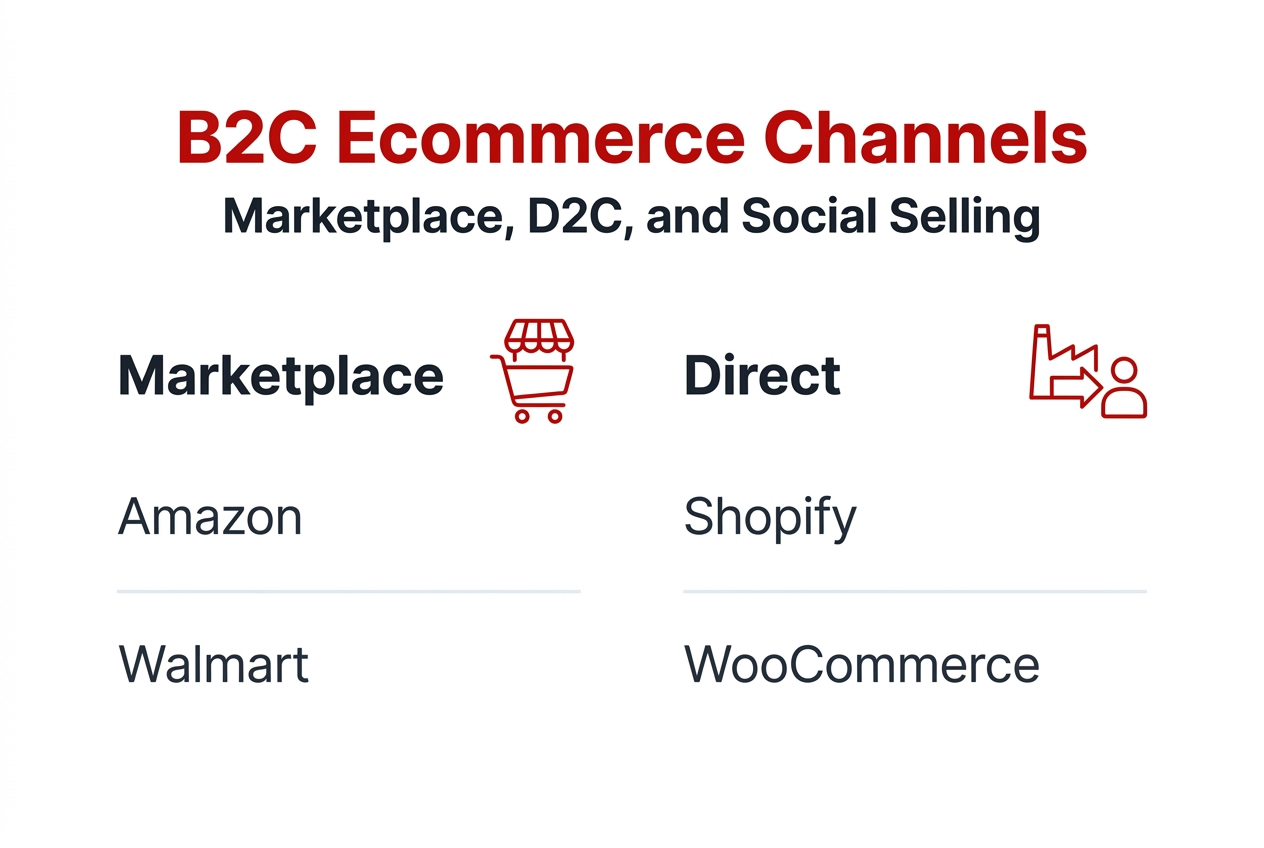
Amazon controls roughly 37-38% of US ecommerce sales in 2026, making it the undisputed leader. Even more striking, over 60% of product searches now start on Amazon rather than Google. For CPG brands, this means Amazon isn’t optional, it’s where your customers are actively looking to buy.
Walmart is closing the gap fast. Ecommerce sales jumped 26% year-over-year in 2025, driven by aggressive expansion of online grocery (32% market share) and improved seller tools. Walmart’s strength lies in combining online scale with 4,600+ physical stores for pickup and returns.
Amazon attracted 2.82 billion visits in July 2025 alone. That traffic volume translates to conversion rates 2-3x higher than typical D2C sites. When someone lands on Amazon, they’re ready to buy, not just browse.
| Metric | Amazon | Walmart |
|---|---|---|
| US ecommerce market share | 37-38% | Growing rapidly, 10-12% estimated |
| Monthly site traffic | 2.8+ billion visits | 400+ million visits |
| YoY growth rate (2025) | Steady, mature | 26% increase |
| Customer ownership | Amazon controls data | Walmart controls data |
| Seller focus | Massive scale, high fees | Growing tools, seller loyalty |
Walmart focuses on building seller loyalty by offering more predictable fees and less algorithmic volatility than Amazon. For CPG brands testing marketplace expansion, Walmart often provides better margins on similar products, though with lower overall traffic.
Pro Tip: Don’t treat Amazon and Walmart as interchangeable. Amazon excels at discovery and impulse purchases. Walmart wins on grocery replenishment and value perception. Tailor your ecommerce merchandising strategy to each platform’s shopper mindset.
D2C means selling through your own online store, typically via Shopify, WooCommerce, or custom platforms. You control the entire customer experience from discovery to delivery. D2C offers higher profit margins, complete brand control, and direct access to valuable consumer data that marketplaces don’t share.
Marketplace selling leverages existing traffic but at a cost. You pay referral fees (8-15% on Amazon), lose customer data ownership, and compete in a race-to-the-bottom pricing environment. As one expert put it, building solely on Amazon is “building on rented land.”
D2C benefits include:
But scaling D2C exposes hidden cracks, especially data quality issues. SKU duplication, inconsistent product information, and fragile integrations break as order volume grows. Many CPG founders underestimate the infrastructure investment required.
Steps to scale D2C profitably without breaking your systems:
Pro Tip: Treat D2C as commercial infrastructure, not just another sales channel. The brands that win long-term view D2C as their strategic growth foundation, using marketplaces for volume and D2C for margin and customer intelligence.
CPG companies face slowing consumer spending, persistent inflation, and tariff volatility in 2026. Scaling B2C ecommerce isn’t just about growth anymore, it’s about building resilient models that protect margins under economic pressure.

Start with trustworthy product data. Inconsistent SKU information, missing attributes, and poor image quality kill conversion rates across every channel. Brands that centralize product data see 20-30% improvement in time-to-market for new SKUs and fewer customer service issues.
Multichannel optimization drives results. Don’t think Amazon OR D2C, think Amazon AND D2C AND Walmart. Each channel serves different customer needs. Your multichannel workflow should sync inventory, pricing, and promotions while respecting each platform’s unique dynamics.
Key strategies for 2026:
Many cost-reduction programs fail because they chase short-term wins through siloed targets. Successful CPG brands take a long-term, cross-product approach, using analytics and AI including GenAI to drive sustainable improvements.
| Cost Reduction Pitfall | Best Practice |
|---|---|
| Short-term focus on quarterly targets | Long-term programs spanning 12-18 months |
| Siloed by department or product line | Cross-functional teams with shared goals |
| Generic cost cuts without analysis | Data-driven identification of margin leaks |
| Ignoring customer impact | Protect customer experience while reducing costs |
The brands winning in 2026 treat omnichannel success as table stakes. They sync merchandising across channels, use unified analytics dashboards, and adjust strategy based on real-time contribution margin data, not vanity metrics like total revenue.
Pro Tip: Cost reduction isn’t about cutting expenses randomly. Focus on cross-functional programs that improve efficiency without degrading customer experience. The best CPG operators balance growth investment with disciplined margin protection.
Scaling B2C ecommerce profitably requires more than good products. You need marketplace expertise, merchandising optimization, and margin-focused strategy across Amazon, Walmart, and D2C channels.
Partner with consultants who understand CPG economics. The right guidance helps you avoid common scaling pitfalls, optimize channel mix for contribution margin, and build omnichannel workflows that actually work. Whether you’re launching on Amazon or expanding from marketplaces into D2C, expert consulting accelerates profitable growth by applying proven frameworks to your specific brand challenges.
Pro Tip: Investing in professional guidance early prevents expensive mistakes later. The best time to engage experts is before problems compound, not after margin compression forces reactive decisions.
B2C ecommerce provides direct access to consumer data and insights, higher profit margins compared to traditional retail, and complete control over brand presentation. You can test new products faster, build customer relationships through email and SMS, and scale without geographic limitations. The challenge lies in managing infrastructure, maintaining data quality, and competing effectively across multiple channels simultaneously.
Marketplaces drive massive qualified traffic, Amazon controls 37-38% of US online sales while Walmart grew ecommerce 26% year-over-year in 2025. They provide instant credibility and conversion-optimized platforms but compress margins through fees and limit customer data access. Successful CPG brands treat marketplaces as volume drivers while building D2C channels for margin and customer intelligence.
Scaling D2C exposes data problems like SKU duplication, inconsistent product information, and fragile system integrations that break under volume. Infrastructure that works at 100 orders per day fails at 1,000 orders. Sustainable growth requires treating D2C as foundational commercial infrastructure, investing in product information management, fulfillment partnerships, and retention marketing before scaling traffic aggressively.
Focus on multichannel integration spanning marketplaces and D2C rather than choosing one or the other. Invest in trustworthy product data and AI-powered analytics to identify margin leaks by SKU and channel. Implement cross-functional cost management programs with 12-18 month horizons, not quarterly fire drills. Build resilient models that protect contribution margin during economic volatility while maintaining customer experience quality.
Leave a comment: