
Published: March 2020 | Last Updated:July 2026
© Copyright 2026, Reddog Consulting Group.

TL;DR:
- Effective assortment planning aligns product selection with financial goals and channel demand, avoiding stockouts and dead inventory. Implementing a five-step process with channel-specific allocation and in-season reallocation rules enhances retail performance. Using unified data and continuous adjustments improves profitability and prevents planning failures mid-season.
Assortment planning is defined as the strategic merchandising process of selecting which products to carry, in what quantities, across which channels, and in which seasons, all governed by Open-to-Buy budget constraints. Every retail manager who has stared at a markdown report at the end of a season has felt the cost of getting this wrong. The process answers four core questions: which products, how many units, for which channels, and in what season. Done well, it connects your financial plan to your shelf reality. Done poorly, it creates stockouts on winners and dead inventory on losers. This guide walks through the full assortment planning process, from frameworks and data to omnichannel execution and common mistakes.
Assortment planning is the strategic merchandising process of determining the breadth and depth of products by season, channel, or location. Breadth refers to how many distinct product categories or styles you carry. Depth refers to how many units or variants you stock within each category. Both dimensions must be calibrated together, because a wide but shallow assortment creates stockouts, while a narrow but deep one wastes capital on slow movers.

The process sits at the intersection of merchandising, finance, and supply chain. Open-to-Buy budgets set the financial ceiling for every buying decision. Without that constraint built into the plan from day one, teams overbuy in categories that feel exciting and underbuy in categories that actually sell. Assortment planning forces that discipline before purchase orders are placed.
For retail managers operating across Amazon, Walmart, DTC, and wholesale simultaneously, the complexity multiplies. Each channel has different velocity patterns, margin profiles, and customer expectations. A product that sells well on DTC at full price may cannibalize a wholesale account if priced identically. The assortment plan must account for those dynamics before the season begins, not after the first sell-through report lands.
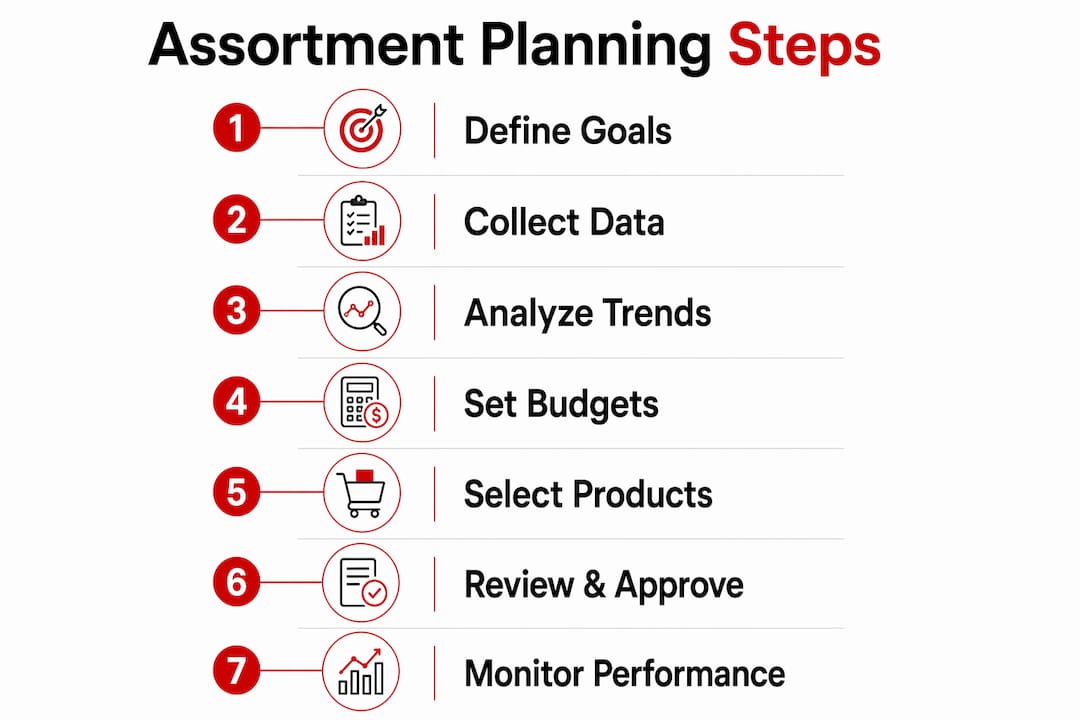
Professional assortment planning follows a five-step framework. Each step builds on the last, and skipping any one of them produces a plan that looks complete on paper but fails in execution.
Set objectives. Define the financial and merchandising goals for the season. This includes revenue targets, margin floors, inventory turn goals, and channel mix targets. Leadership sign-off at this stage prevents scope creep later.
Cluster locations or channels. Group stores, regions, or channels by shared demand patterns. A Texas regional distributor and a national Amazon listing have different velocity curves. Treating them identically produces the wrong depth for both.
Architect the assortment. Decide the product mix across categories, price tiers, and variants. A common portfolio target is 60–80% evergreen product and 20–40% seasonal product. Evergreen items anchor your inventory investment. Seasonal items drive newness and margin opportunity when timed correctly.
Translate capacity. Map your assortment choices against warehouse capacity, 3PL constraints, and supplier minimums. A plan that ignores physical capacity is a wish list, not a plan.
Forecast and buy. Build unit forecasts by SKU, channel, and week. Apply sell-through assumptions, seasonality curves, and event-driven demand spikes. Then place buys within the Open-to-Buy ceiling.
KPIs that govern the plan include sell-through rate, Gross Margin Return on Investment (GMROI), Weeks of Supply (WOS), and stockout rates. These metrics must be tracked throughout the season to enable continuous improvement and avoid costly inventory errors.
Pro Tip: Build leadership sign-off checkpoints between steps 2 and 3, and again between steps 4 and 5. These gates prevent financial misalignment from compounding through the buying process.
Omnichannel assortment planning integrates product selection across all sales channels from a single master plan with channel-specific allocations. This is fundamentally different from building separate plans per channel and trying to reconcile them afterward. Siloed plans create inventory conflicts, duplicate effort, and missed reallocation opportunities.
The practical difference shows up in allocation rules. A unified master plan lets you set explicit rules for how inventory flows between DTC, wholesale, marketplace, and physical retail. Without those rules, teams default to protecting their own channel’s inventory, which leaves stock stranded in one place while another channel stockouts.
Key principles for omnichannel assortment execution:
Retailers who unify physical and digital assortments in a single system of record reduce discounting and increase average basket size at full price. That outcome is the clearest financial argument for investing in omnichannel planning infrastructure.
Pro Tip: Use multichannel inventory management tools that give every channel team a live view of total inventory, not just their allocation. Visibility is the precondition for reallocation.
Data-driven assortment planning starts with consolidating point-of-sale (POS) data and digital sales data into a single system. Without that unified view, your sell-through numbers for DTC and wholesale live in separate spreadsheets, and you are always comparing last week’s data to last month’s data. That lag costs you reallocation opportunities.
Customer segmentation sharpens the plan further. Segment by demographics, purchase frequency, average order value, and category affinity. A brand selling into Texas regional grocery chains and Amazon simultaneously has two distinct customer profiles. Their assortment preferences, price sensitivity, and seasonal timing differ. The plan must reflect those differences at the channel level.
SKU scoring is the analytical core of the process. Score every SKU on the following criteria:
The financial KPIs that govern the full plan are GMROI, Weeks of Supply, inventory turnover, sell-through rate, and stockout rate. GMROI measures how many dollars of gross margin you generate per dollar of inventory investment. Weeks of Supply tells you how long current inventory will last at the current sales rate. Together, these two metrics tell you whether you are carrying the right amount of the right product. AI-based sales forecasting tools can accelerate SKU scoring and demand modeling, particularly for brands managing large catalogs across multiple channels.
The most common mistake in assortment planning is treating the plan as a static document. Most retail managers build a pre-season plan, place buys, and then react to sell-through data without a structured process for in-season adjustment. That reactive posture costs margin every season.
Common pitfalls to avoid:
The best practice that separates high-performing retail teams from average ones is building trigger rules for in-season reallocation. For example, if a DTC product exceeds its sell-through target by 20% at week three, a pre-defined rule reallocates inventory from the wholesale buffer to DTC. That rule does not require a meeting. It executes automatically against a threshold the team agreed to before the season started.
Pro Tip: Review your assortment plan at weeks four, eight, and twelve of every season. Use sell-through and WOS data to trigger SKU rationalization decisions before you are forced into markdowns.
Effective assortment planning requires a unified financial framework, channel-specific allocation rules, and iterative in-season adjustments to protect margin and prevent stockouts.
| Point | Details |
|---|---|
| Define breadth and depth together | Calibrate category width and unit depth simultaneously to avoid stockouts and dead inventory. |
| Follow the five-step framework | Set objectives, cluster channels, architect the assortment, translate capacity, then forecast and buy. |
| Build one master omnichannel plan | A single plan with channel-specific views eliminates inventory conflicts and reallocation delays. |
| Score SKUs on margin, not just velocity | Include return rates and cross-sell attachment in SKU scoring to avoid hidden margin losses. |
| Use trigger rules for in-season moves | Pre-defined sell-through thresholds let you reallocate inventory between channels without a meeting. |
Working with CPG brands across Amazon, Walmart, DTC, and wholesale, the pattern I see most often is not a bad plan. It is a good plan that nobody revisits. Teams spend weeks building a pre-season assortment, get sign-off, place buys, and then treat the plan as finished. The first sell-through report arrives at week four, and instead of triggering a structured reallocation, the team holds a meeting to discuss what happened. By week eight, the window for margin-protecting action has closed.
The brands that consistently outperform on sell-through and GMROI share one habit: they build the in-season rules before the season starts. They define, in writing, what a 20% sell-through overperformance triggers, what a 15% underperformance triggers, and who has authority to execute each move. That pre-commitment removes the friction that kills in-season agility.
The second thing I see consistently is the return rate blind spot. A brand will celebrate a SKU that is selling fast, then wonder why their margin is compressing. The answer is almost always a return rate that was never factored into the SKU score. Building assortment optimization around contribution margin rather than gross sales volume is the single most reliable way to protect profitability across a full season.
Omnichannel planning is where the operational complexity concentrates. The brands that manage it well are not necessarily using more sophisticated tools. They are using a single source of inventory truth and enforcing allocation rules that every channel team agreed to before the season began. That discipline is harder to build than any software implementation, but it is the actual source of the performance gap.
— Reddog
Retail managers who want to move from reactive markdown decisions to proactive assortment management need more than a framework. They need a structured review of their current channel economics, SKU performance, and inventory velocity before the next season’s buys are placed.
Reddog works with CPG brands in the $500K–$20M revenue range to build contribution-margin-first assortment plans across Amazon, Walmart, DTC, and wholesale. The work starts with a clear picture of what each channel actually contributes to profit, where inventory is stranded, and which SKUs are quietly eroding margin through returns or low velocity. If you want a practical 30-minute review of your assortment strategy, channel economics, or inventory velocity, book a free strategy call with the Reddog team. No pitch. Just a focused conversation about where your plan stands and what to fix before the next season starts.
Assortment planning is the process of deciding which products to carry, in what quantities, across which channels, and in which seasons, governed by Open-to-Buy budget constraints. It answers four core questions: which products, how many units, for which channels, and in what season.
The four critical KPIs are GMROI, Weeks of Supply, sell-through rate, and stockout rate. These metrics enable continuous in-season adjustment and prevent costly inventory errors.
Omnichannel assortment planning uses a single master plan with channel-specific allocation views, rather than separate plans per channel. This structure eliminates inventory conflicts and enables in-season reallocation between DTC, wholesale, and marketplace channels.
Most assortment plans fail because teams treat them as static documents rather than iterative frameworks. Without pre-defined trigger rules for in-season reallocation, teams react too slowly to sell-through data and lose the margin-protection window.
Exclusive products should represent 10–15% of total assortment. Beyond that threshold, exclusives fragment brand identity and create operational complexity that outweighs the channel differentiation benefit.
Leave a comment: