
Published: March 2020 | Last Updated:July 2026
© Copyright 2026, Reddog Consulting Group.

Affiliate marketing is a performance-based model where you earn a commission by promoting another company’s products or services. When someone clicks your unique affiliate link and completes a purchase or signs up, you get paid. No inventory. No customer service. Just results-driven promotion tied directly to your content. The global affiliate marketing industry is large and growing, with key sectors such as eCommerce, financial services, and iGaming leading spend. Three core players make the whole system run: the affiliate (you), the merchant (the brand selling the product), and the customer. The FTC requires affiliates to disclose financial relationships with brands clearly, so transparency is not optional.
The mechanics are straightforward once you see how the three roles connect. The merchant creates a product and sets up an affiliate program with defined commission rates. The affiliate joins that program, gets a unique tracking link, and promotes the product through content, ads, or email. The customer clicks the link, lands on the merchant’s site, and ideally buys. When that purchase is confirmed, the affiliate earns a commission.
Tracking is what holds the whole system together. Every affiliate link contains a unique identifier tied to your account. When a customer clicks, a cookie is stored in their browser, recording that you referred them. Cookie duration varies widely by program, ranging from 24 hours to lifetime attribution, and that window directly affects whether you get credit if the customer buys days later.
“Affiliate marketing is also called ‘performance marketing,’ in reference to how sales employees are typically compensated. Affiliates are not employed by the advertiser whose products or services they promote, but the compensation models are very similar to those used for people in the advertisers’ internal sales department.” — Wikipedia, Affiliate Marketing
Commission triggers vary too. Some programs pay on completed sales, others on leads (a form submission or free trial signup), and some on clicks alone. Most affiliate programs also sit inside a network such as ShareASale, CJ Affiliate, or Amazon Associates, which handles tracking, reporting, and payouts on behalf of the merchant.
Not every affiliate takes the same path to earning commissions. The approach you choose depends on your audience, your content skills, and how much time you can invest upfront.
Content marketing is the most common entry point. Bloggers and YouTubers create reviews, tutorials, and comparison articles that rank in search or accumulate views over time. The content does the selling passively once it is live.
Influencer marketing works differently. Social media creators with engaged followings promote products directly to their audience, often through sponsored posts or dedicated videos. The trust they have built with followers is the asset.
Coupon and deal sites aggregate discount codes and promotional offers, attracting high-intent buyers who are already close to purchasing. Margins are thinner here, but conversion rates tend to be higher.
Email marketing remains one of the most direct channels. Affiliates with owned email lists can promote products to a warm audience without depending on search algorithms or social feeds.

Video affiliate marketing is the fastest-growing format right now. Video content is an increasingly important format driving a significant portion of affiliate traffic, and TikTok Shop has created a model where creators earn commissions directly inside the platform without needing a website.
On the program side, the three main payment models are:
Niche specialization is what separates affiliates who build sustainable income from those who stay stuck. Broad, unfocused content rarely converts well. Picking a specific niche, whether personal finance, fitness equipment, or B2B software, lets you build genuine authority and attract the right audience.
Commission payments are typically a percentage of the sale price or a fixed amount per lead or click, and the range across verticals is wide. Commission rates vary widely across industries and programs, with eCommerce typically paying lower percentages, SaaS sometimes offering higher recurring commissions, and financial services often providing flat fees per qualified lead.
Cookie duration matters more than most beginners realize. Cookie durations vary by program, ranging from very short windows like a day to much longer ones extending over weeks or months, impacting commission eligibility.
Attribution models are also shifting. Last-click attribution, where the final affiliate link before purchase gets all the credit, has been the default for years. Multi-touch attribution, which splits credit across multiple affiliates who influenced the buyer’s journey, is growing in adoption and changes how commissions are calculated.

Payout schedules vary by program and network. Most pay monthly, with minimum thresholds ranging from $10 to $100 before a payment is released. Affiliates should also be aware of affiliate fraud risks, which include fake clicks and manipulated conversions. Working with reputable programs that use fraud detection software protects your account standing and ensures you are earning on legitimate activity.
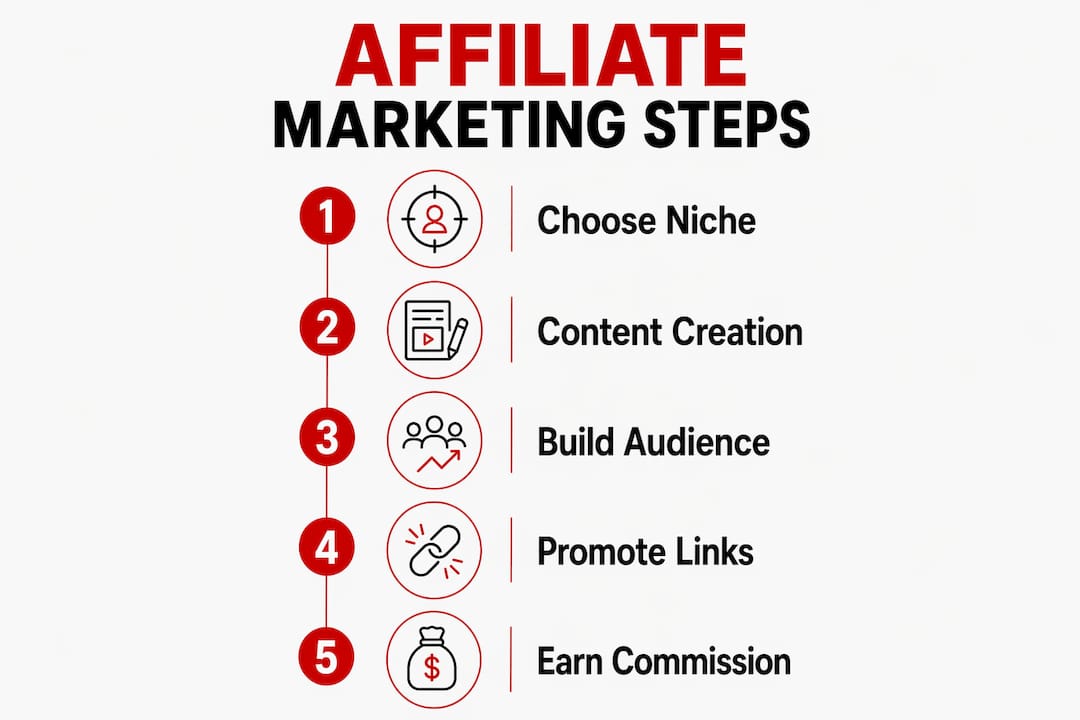
Getting started does not require a large budget or an existing audience. It does require a clear plan and consistent execution.
Choose a niche you can commit to. Pick a topic you understand and that has commercial intent. Finance, health, software, and home goods all have active affiliate programs with real buyer demand.
Select your primary platform. Blog, YouTube channel, TikTok, or email list. Beginners benefit most from focusing on one platform before expanding. Spreading across five channels at once dilutes your effort and slows growth.
Find and join affiliate programs. Start with affiliate networks like Amazon Associates, ShareASale, or Impact, which aggregate hundreds of programs in one place. Many SaaS companies and direct-to-consumer brands also run their own in-house programs with higher commission rates.
Create content that solves real problems. Reviews, how-to guides, and product comparisons work because they match what buyers are already searching for. Authentic integration of affiliate links inside genuinely useful content converts far better than promotional posts.
Add FTC-compliant disclosures. Every piece of content with an affiliate link needs a clear disclosure. The FTC requires this, and transparent disclosures also build audience trust, which improves long-term conversion rates.
Drive traffic with a focused strategy. SEO for blogs, YouTube search for video, and short-form content for social. The most effective affiliates combine short-form video with email newsletters and websites to reduce dependence on any single algorithm. AI-powered content tools can also help you scale production without sacrificing quality, and AI content marketing platforms are increasingly part of how top affiliates manage output.
Track performance and adjust. Monitor click-through rates, conversion rates, and earnings per click. The data tells you which content is working and where to double down.
Pro Tip: Build your email list from day one, even if it grows slowly. An owned audience is the one asset no algorithm update can take away from you, and it compounds in value over time.
Affiliate marketing has its own vocabulary. Getting familiar with these terms early saves confusion when you are reading program agreements or analyzing reports.
Affiliate link: A unique URL that tracks referrals from your content back to the merchant’s site.
Cookie: A small file stored in a user’s browser after they click your affiliate link, used to attribute a later purchase to you.
Cookie duration: The length of time a cookie remains active. Longer durations increase your chances of earning commission on delayed purchases.
Commission rate: The percentage of a sale or fixed dollar amount you earn per conversion.
Conversion rate: The percentage of clicks on your affiliate link that result in a completed action, such as a purchase or signup.
EPC (Earnings Per Click): Total earnings divided by total clicks. A useful metric for comparing the profitability of different programs.
Affiliate network: A platform that connects affiliates with multiple merchant programs, handling tracking, reporting, and payments in one place.
CPA (Cost Per Acquisition): A payment model where you earn a fixed amount each time a referred user completes a specific action.
Attribution: The method used to determine which affiliate gets credit for a conversion, especially when multiple affiliates influenced the buyer.
Payout threshold: The minimum earnings balance required before a payment is issued to the affiliate.
Affiliate marketing offers real upside, but it also comes with trade-offs that beginners often underestimate.
Advantages:
Brands favor affiliate programs because they operate on a pay-for-performance basis, meaning no marketing cost is incurred until results are delivered. For affiliates, the model offers low startup costs, no inventory requirements, and the ability to earn from content that stays live for months or years. Affiliate marketing returns about $12 for every $1 spent for brands, making it one of the most efficient customer acquisition channels available. For affiliates who build strong content assets and owned audiences, income can become genuinely recurring.
Disadvantages:
Income is not passive in the early stages. Affiliate income follows a power-law distribution, with the top 10% of affiliates earning roughly 90% of total revenue. Most beginners underestimate how long it takes to build traffic and trust. You also do not control the merchant’s commission structure. Programs can cut rates, change terms, or shut down entirely, which is why diversifying across multiple programs and owning your audience matters. Traffic volatility from search algorithm updates is the top challenge cited by publishers, which reinforces why a data-driven marketing approach and audience diversification are worth building from the start.
Affiliate marketing rewards consistent content creation, niche focus, and audience ownership far more than luck or timing.
| Point | Details |
|---|---|
| Industry scale | The global affiliate marketing industry is large and growing, projected to reach approximately $24.7 billion in 2026. |
| How you get paid | Commissions are a percentage of sale or fixed amount per lead; cookie duration (24 hours to lifetime) determines your eligibility window. |
| Income is concentrated | The top 10% of affiliates earn roughly 90% of total revenue, making niche selection and content quality the decisive factors. |
| Start focused | Beginners should pick one niche and one platform before expanding; diluting effort across multiple channels slows growth. |
| Disclosure is required | FTC rules require clear, conspicuous disclosure of affiliate relationships in every piece of content that contains affiliate links. |
If you are a CPG founder or operator thinking about how affiliate marketing fits into your broader channel strategy, contribution margin analysis is where that conversation starts. At Reddog, we work with brands in the $500K–$20M range to map channel economics, identify where margin is leaking, and build growth plans grounded in real numbers.

If you want a practical, no-pressure review of your channel mix, inventory velocity, or growth planning priorities, we invite you to book a free 30-minute strategy call with our team. We will focus on what the data actually shows, not generic recommendations.
Leave a comment: