
Published: March 2020 | Last Updated:June 2026
© Copyright 2026, Reddog Consulting Group.

TL;DR:
- Marketplace algorithms rank products based on relevance, quality, and real-time performance signals. Rankings change daily and depend heavily on sales velocity, conversion rates, and fulfillment reliability. Success requires focusing on operational excellence and consistent buyer satisfaction rather than just keyword optimization.
A marketplace algorithm is a ranking system that scores product listings based on their likelihood to satisfy buyers and drive successful transactions. Platforms like Amazon, Walmart, and Facebook Marketplace use these systems to decide which products appear at the top of search results and which get buried. Understanding marketplace algorithms explained in plain terms is the difference between a listing that sells and one that sits. The algorithm evaluates hundreds of signals across three categories: relevance, quality, and performance. Modern models have evolved from keyword matching to intent-based machine learning that reads browsing history, purchase patterns, and real-time buyer behavior.
Marketplace algorithms rank products by assessing three categories of signals: relevance, quality, and performance. Performance signals like click-through rate and conversion rate carry the most weight because they directly reflect buyer satisfaction. A listing that gets clicks but no purchases tells the algorithm something is wrong. A listing that converts consistently tells it something is right.

Relevance signals determine whether a listing is even considered for a search query. Accurate product titles, correct category placement, and valid product identifiers like UPCs or ASINs are the gatekeepers. Listings with inaccurate identifiers get filtered out before the ranking stage, regardless of how well everything else is optimized.
Quality signals cover the content of the listing itself. High-resolution images, complete product descriptions, item specifics, and clear return policies all contribute. Think of quality signals as the algorithm’s way of predicting whether a buyer will feel confident enough to purchase.
Performance signals are where rankings are won or lost. Sales velocity, conversion rate, click-through rate, inventory status, and return and cancellation rates all feed into this category. Sales velocity is the primary driver; products with consistent sales earn better placement. A stockout or a spike in returns can erase ranking gains built over weeks.
| Signal Category | Key Components | Impact on Ranking |
|---|---|---|
| Relevance | Titles, category, product identifiers | Gating: determines eligibility |
| Quality | Images, descriptions, item specifics, return policy | Mid-tier: affects click-through rate |
| Performance | Sales velocity, CTR, conversion rate, inventory | Highest: drives rank up or down daily |
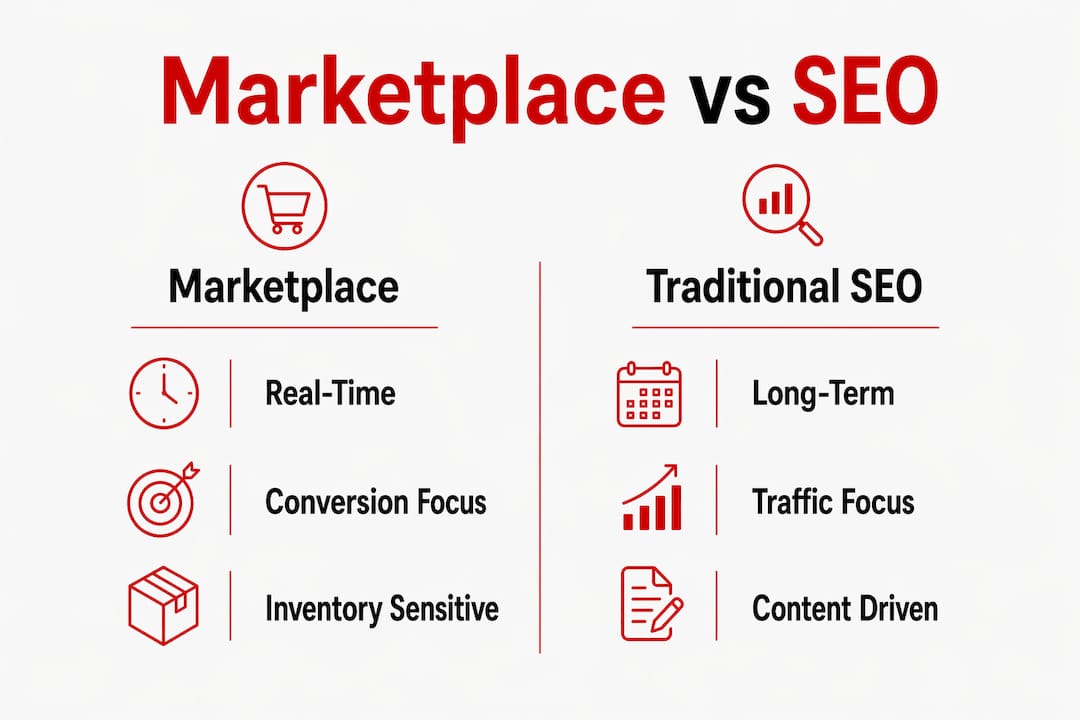
Marketplace SEO and traditional web SEO operate on fundamentally different timescales and reward different behaviors. Traditional SEO builds domain authority over months or years through backlinks, content depth, and site trust. Marketplace algorithms use daily performance feedback loops to adjust rankings based on immediate buying activity. A product that stops converting today can lose its top position by tomorrow.
Traditional SEO rewards patience. Marketplace algorithms reward consistency. That shift changes how sellers should think about optimization entirely. Keyword research still matters, but it is only the starting point. The real work is building what Reddog calls “conversion infrastructure”: the combination of pricing, availability, fulfillment speed, and listing quality that turns clicks into purchases.
Algorithms penalize keyword stuffing and reward accurate product data, fast fulfillment, and stable inventory. A listing with a perfectly crafted title but slow shipping or thin stock will lose rank to a competitor with a simpler title and reliable fulfillment. This is the most common mistake sellers make when they treat marketplace optimization like a content problem rather than an operations problem.
Pro Tip: If your listing ranks well but conversion is low, fix the listing. If your listing converts well but ranks low, fix your sales velocity through pricing, promotions, or inventory depth. Treat each problem separately.
No two shoppers see the same marketplace search results. Personalization means rankings vary by user profile, browsing history, past purchases, and location. Two sellers competing for the same keyword may rank first for one buyer segment and fifth for another. This is not a flaw in the system. It is the algorithm doing exactly what it is designed to do: predict which listing will satisfy each individual buyer.
The factors that shape personalized results include:
Machine learning models update these predictions in real time. A seller cannot control personalization directly, but maintaining strong performance metrics across all buyer segments keeps a listing visible to the widest possible audience. Ranking advantages are earned daily through consistent conversion and transaction activity, not through a one-time optimization effort.
Ranking higher on any marketplace starts with getting the fundamentals right before chasing advanced tactics. Most sellers underperform not because of missing keywords but because of gaps in their conversion infrastructure. The steps below follow the order the algorithm evaluates them.
Fix your relevance signals first. Confirm that product titles match buyer search intent, categories are accurate, and all product identifiers are correct. A listing with a mismatched category never reaches the ranking stage.
Upgrade listing quality. Use high-resolution images that show the product from multiple angles. Write descriptions that answer the most common buyer questions. Complete every item-specific field the platform offers.
Improve click-through rate. Test your main image and title against competitors. Competitive pricing relative to similar listings directly affects whether buyers click yours first.
Drive conversion rate up. Add customer reviews, answer buyer questions publicly, and make your return policy visible. Fulfillment speed is a core ranking factor; slow or unreliable shipping downgrades listings regardless of content quality.
Protect your inventory position. Even a few days of stockouts can cause significant ranking drops. Plan inventory levels around sales velocity, not just historical averages. Sellers using Amazon FBA or Walmart WFS benefit from platform-preferred fulfillment signals, which carry additional weight in ranking.
Monitor and reduce returns. High return rates signal buyer dissatisfaction to the algorithm. Accurate product descriptions and realistic images reduce return rates at the source.
Pro Tip: Find Amazon keywords that convert rather than just keywords with high search volume. A keyword that drives clicks but no purchases hurts your conversion rate and your rank.
Marketplace algorithms rank products based on real-time buyer behavior, and sellers who treat ranking as a conversion problem rather than a content problem consistently outperform those who focus on keywords alone.
| Point | Details |
|---|---|
| Performance signals dominate | Click-through rate, conversion rate, and sales velocity carry more ranking weight than titles or descriptions. |
| Relevance is a gating mechanism | Inaccurate product identifiers and wrong categories disqualify listings before ranking begins. |
| Rankings change daily | Stockouts, declining conversions, or rising return rates can erase ranking gains within days. |
| Personalization makes rankings dynamic | Each buyer sees different results based on history and behavior, so broad performance consistency matters. |
| Fulfillment is a ranking factor | Slow or unreliable shipping downgrades listings even when listing content is strong. |
Reddog works with CPG brands across Amazon and Walmart every week, and the pattern is consistent: sellers who obsess over listing copy while ignoring inventory velocity and fulfillment reliability keep losing ground to competitors who run tighter operations. The algorithm does not care how much time you spent on your title. It cares whether buyers clicked, purchased, and came back.
The most useful reframe is this: treat the marketplace algorithm as a sales performance scorecard, not a search filter. Every metric it tracks, from conversion rate to return frequency, maps directly to whether your brand is actually serving buyers well. When you fix the operations, the rankings follow.
What Reddog has seen work consistently is a margin-first approach to marketplace growth strategy. Brands that chase rank without understanding their contribution margin often win visibility and lose money. The goal is profitable rank, not just rank. That means knowing your FBA fee structure, your inventory carrying costs, and your conversion rate by SKU before you decide where to invest in optimization.
The eCommerce sellers who win long-term are the ones who build systems around consistent performance, not campaigns around temporary visibility. Algorithms change. Buyer behavior shifts. But a brand with stable inventory, strong fulfillment, and a genuine conversion rate advantage stays visible through every update.
— Reddog
Ranking on Amazon or Walmart is not just a marketing challenge. It is an operations and economics challenge that requires understanding how every decision affects your contribution margin and your algorithm standing.

Reddog works with CPG brands in the $500K–$20M revenue range to build the kind of marketplace optimization infrastructure that drives profitable, sustained ranking. That means reviewing your channel economics, inventory velocity, fulfillment setup, and listing performance together, not in isolation. If you want a clear picture of where your margin is leaking and what your algorithm performance actually looks like, book a free 30-minute strategy call with Reddog. No pitch. Just a practical review of your numbers and your next move.
A marketplace algorithm is a ranking system that scores product listings based on relevance, quality, and real-time sales performance to decide which products buyers see first in search results.
Marketplace algorithms use daily performance feedback loops tied to conversions and sales velocity, while Google SEO builds authority over months through content and backlinks. Marketplace rankings can shift within days based on buying activity.
Sales velocity and conversion rate are the strongest ranking signals. Products with consistent sales and high conversion rates earn better placement than listings with strong content but weak performance.
Marketplace algorithms personalize results based on each buyer’s browsing history, past purchases, location, and engagement patterns. The same search query can return different listings for different shoppers.
Yes. Even brief stockouts cause ranking drops because the algorithm treats unavailable inventory as a failure to serve buyers. Restoring stock does not automatically restore previous rank position.
Leave a comment: