
Published: March 2020 | Last Updated:August 2026
© Copyright 2026, Reddog Consulting Group.

A marketing agency is an external team that plans, creates, and manages marketing to help your business find, convert, and retain customers. The primary outcomes are brand awareness, qualified leads, revenue growth, and ongoing measurement that tells you what is working. Agencies operate either as a fully outsourced marketing department or as a specialist extension to your existing team, depending on what you need and how much internal capacity you already have.
The term “marketing agency” covers a wide range of firms, from small boutique agencies running paid ads to large full-service operations handling everything from brand identity to retail media. Understanding the role of digital marketing agencies before you engage one saves you from mismatched expectations and wasted budget.
The service menu varies by agency type, but most firms offer some combination of the following. Knowing what each service does helps you match agency capabilities to your actual business needs.
Pro Tip: Ask any agency to show you a specific campaign where they moved a measurable KPI, the tools they used, and what the result was in numbers. An agency that can’t answer that question concretely doesn’t own the skillset — they’re reselling it.
According to Upwork, agencies act as either a fully outsourced department or a specialist extension to an existing team. That distinction maps directly onto the major agency types.
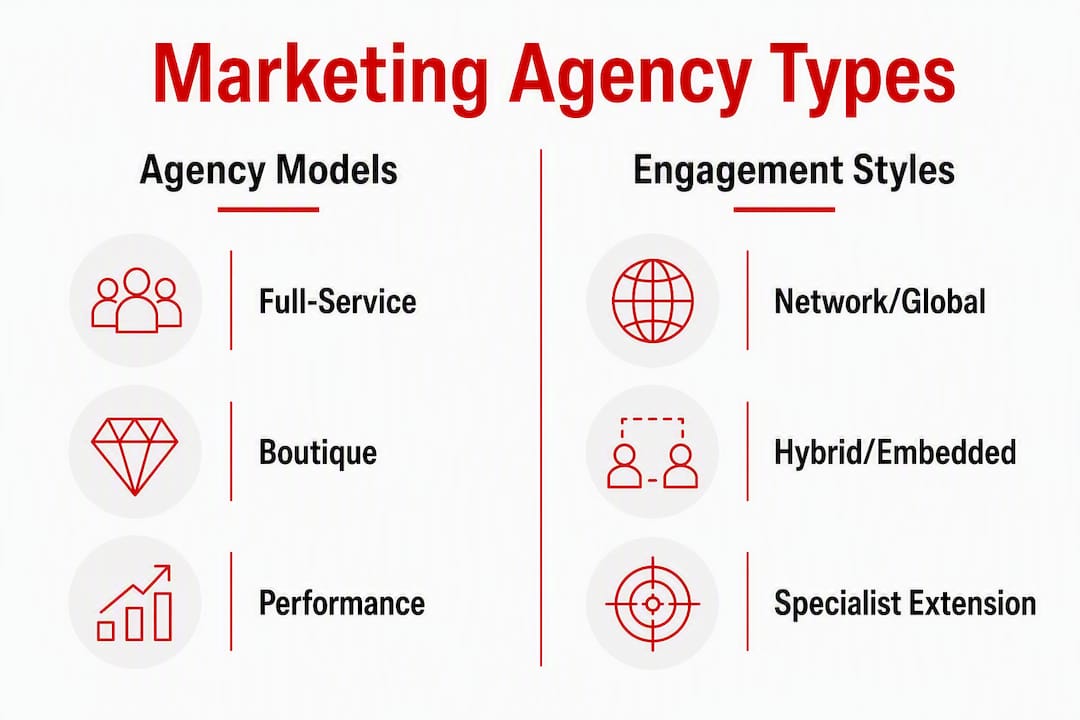
Full-service agencies handle multiple channels under one roof: strategy, creative, media, SEO, and analytics in a single engagement. The advantage is integration — one team owns the whole picture, so there are no gaps between your paid media and your landing page. The tradeoff is cost. Full-service agencies often charge between $5,000 and $25,000 or more per month, while specialists typically cost $2,500–$10,000 monthly depending on channel and complexity. The risk: you need to coordinate across multiple vendors yourself, which takes internal bandwidth.
Boutique agencies are small, often founder-led firms with 5–20 people. They tend to offer senior-level attention on every account, move faster than large shops, and are more willing to customize their process. They fit growth-stage brands that want a real partner, not a junior team managing a template.
Performance agencies price on results — a percentage of ad spend, a cost-per-acquisition fee, or a revenue share. They work best when you have clean attribution, short sales cycles, and reliable tracking. Without those, disputes over who gets credit for a sale become a recurring friction point.
Network or holding-company agencies (think large integrated groups) serve enterprise clients with complex global needs. For most emerging brands in the $500K–$20M range, the overhead and account-management layers make them a poor fit.
Hybrid and embedded models are increasingly common. An agency might place a dedicated strategist inside your team two days a week while the rest of the work happens at the agency. This blurs the line between outsourced and in-house and works well for brands that want knowledge transfer alongside execution.
The process at most agencies follows a recognizable arc, even if the labels differ.
Discovery (weeks 1–2). The agency audits your existing assets, analytics, and competitive position. You share brand guidelines, historical performance data, and business goals. This phase produces a brief that aligns the team on priorities.
Strategy and setup (weeks 2–4). The strategist builds a channel plan, the creative team develops concepts, and the technical team configures tracking. Nothing ships until measurement is in place.

Initial execution (weeks 4–12). Campaigns go live. The first 60 days are about establishing baselines, not hitting peak performance. PPC can show directional results within weeks; SEO and content take longer to compound.
Optimization and scale (months 3–6). With baseline data in hand, the team starts making informed decisions: which ad sets to scale, which content topics drive qualified traffic, where the funnel is leaking. This is where Amazon advertising management and paid media programs start showing real ROI patterns.
A reasonable ROI target for a well-matched agency is 3×–5× on marketing investment within 12–24 months, though timelines vary sharply by channel. PPC often produces faster returns in 1–3 months; SEO and content typically take 6–12 months to show meaningful results.
| Role | Primary Responsibility | Concrete Deliverable |
|---|---|---|
| Account Manager | Client communication and project coordination | Weekly status updates, meeting notes, timeline tracking |
| Strategist | Channel planning and goal alignment | 90-day growth plan, KPI framework |
| Creative Director | Brand voice, visual direction, and asset quality | Campaign concepts, ad creative, copy |
| Paid Media Specialist | Campaign setup, bidding, and optimization | Ad account structure, weekly performance report |
| SEO Specialist | Technical and content-driven organic growth | Keyword map, on-page recommendations, link plan |
| Developer | Site builds, landing pages, and tag implementation | Conversion-optimized landing pages, GA4 setup |
| Analyst | Data interpretation and attribution | Monthly dashboard, attribution model, test results |
Most agencies structure fees across five common pricing models: hourly, monthly retainer, project-based, performance-based, and value-based. Monthly retainers are the most common pricing model for agency relationships because they create predictable revenue for the agency and a consistent team for the client.
Here is how the models compare:
| Pricing Model | Typical Cost Range | Best For | Risk Profile |
|---|---|---|---|
| Hourly | Pay for time worked, tracked by the hour | Ad hoc work, audits, consulting | Unpredictable; costs spike with scope changes |
| Monthly retainer | Fixed monthly fee for defined scope or hours | Ongoing, multi-channel programs | Predictable; watch for scope creep |
| Project-based | Fixed fee for specific deliverable | One-off deliverables (brand identity, website) | Fixed cost; scope must be tight |
| Performance-based | Fee tied to results (% of spend, CPA, revenue share) | Mature brands with clean attribution | Low upfront; disputes if tracking is weak |
| Value-based | Custom pricing based on impact | High-growth brands with clear revenue targets | High ceiling; requires strong trust |
A retainer generally covers a defined scope of work monthly. Larger retainers fund a dedicated multi-channel program with a full team. Project-based pricing is often the best way to test an agency before converting to a retainer, and many agencies use a project-then-retainer hybrid for exactly this reason.
One thing to watch: retainers are rarely unlimited. They are scoped by deliverables or monthly hours, and if your strategy shifts mid-month, you will likely need a change order or an additional project fee. Get that in writing before you sign.
Contract norms worth knowing: most agencies ask for an initial term lasting several months, usually with a setup or onboarding fee for the first month, an exit clause typically requiring 30–60 days’ notice after the initial term, and a written scope-change policy. Match your pricing model to your business stage: hourly or project for early-stage, retainers for growth-stage, and performance or value-based for mature businesses with solid attribution.
Hiring an agency is not automatically better than building an internal team. The right answer depends on your stage, budget, and how much marketing complexity you are managing.
Benefits of hiring an agency:
Common tradeoffs:
Decision checklist:
Understanding what growth consulting looks like versus pure agency execution can also help you decide which type of partner fits your situation.
The selection process matters as much as the agency’s portfolio. A firm with impressive case studies can still be a poor fit if their process, communication style, or measurement approach doesn’t match yours.
Selection criteria checklist:
Interview questions worth asking:
Red flags to watch for:
Transparent scope, clear KPIs, and documented deliverables reduce disputes significantly. The number-one complaint in agency relationships is pricing that doesn’t match the perceived value delivered, and that mismatch almost always traces back to an unclear scope at the start.
Pro Tip: Run a paid pilot sprint before committing to a long retainer. A 4–8 week project with a single prioritized objective and a fixed fee gives you real evidence of how the agency thinks, communicates, and executes — far more reliable than a pitch deck.
Starting with a defined project-based sprint reduces risk and improves fit evaluation before you commit to a 12-month retainer. A well-structured pilot gives you a go/no-go decision point based on real work, not promises.
Pilot scope template:
A common pilot outcome: a brand running paid media with a fragmented account structure engages an agency for a four-week audit and rebuild. The agency consolidates campaigns, fixes conversion tracking, and reduces wasted spend within the pilot window. That result, documented and measurable, becomes the basis for a retainer conversation with both parties aligned on what “good” looks like.
Success criteria checklist for evaluating a pilot:
Even well-matched agency relationships run into friction. Knowing the common failure points helps you address them before they become expensive.
Scope creep. Retainers expand quietly. A request for “one extra email” becomes a pattern, and suddenly the agency is doing 40% more work than the contract covers. The fix: document every deliverable in the original scope and use a formal change-order process for anything outside it.
Misaligned brand voice. Agencies write for many clients. Without a detailed brand guide, a tone-of-voice document, and consistent feedback in the first 30 days, the creative will drift. Invest time in onboarding the creative team properly.
Reporting that doesn’t connect to business outcomes. Agencies often default to reporting on activity metrics (impressions, clicks, posts published) rather than business outcomes (revenue, contribution margin, customer acquisition cost). Require outcome-based reporting from day one, and specify the format in the contract.
Team turnover at the agency. The strategist who sold you the engagement may not be the one executing it. Ask during the pitch who will actually work on your account, and get their names in the contract if possible.
Attribution disputes. When multiple channels are running simultaneously, disagreements about which one drove a sale are common. Agree on an attribution model before campaigns launch, and use a consistent analytics platform to enforce it. Digital marketing tools like Triple Whale or Northbeam can help CPG brands track attribution across channels more reliably than last-click models.
Slow feedback loops. Agencies can only move as fast as you respond. If approvals take two weeks, campaign performance suffers. Set a 48-hour response standard for creative reviews and stick to it.
The contract is where expectations become enforceable. Most brands under-negotiate at this stage and pay for it later.
Define deliverables, not just hours. A retainer that specifies “up to 40 hours per month” is harder to manage than one that lists “four blog posts, two email campaigns, one monthly performance report, and one strategy call.” Deliverable-based contracts reduce ambiguity and make performance easy to evaluate.
Negotiate the exit clause early. Standard agency contracts often require 60–90 days’ notice after the initial term. Push for 30 days after month three if you are a smaller brand. An agency confident in their work will agree.
Cap scope-change fees. Ask for a written policy on how out-of-scope requests are priced. A flat hourly rate for overages ($150–$200/hour is common) is fairer than open-ended “we’ll invoice you” language.
Require a reporting cadence in writing. Monthly dashboards, quarterly strategy reviews, and explicit KPIs should be listed as contractual deliverables, not verbal commitments. This prevents the relationship from drifting into a “we’ll send you updates when something happens” dynamic.
Retain ownership of all assets. Your ad accounts, analytics properties, website files, and creative assets should be owned by your business, not the agency. Confirm this in writing. Agencies that resist this clause are a red flag.
Build in a performance review at 90 days. A formal review at the three-month mark, with the KPIs from the contract as the scorecard, gives both sides a structured moment to recalibrate or exit cleanly.
A marketing agency delivers the most value when scope, KPIs, and reporting cadence are defined in writing before the engagement starts.
| Point | Details |
|---|---|
| Define goals before you hire | Clear KPIs and measurable outcomes must exist before an agency can perform against them. |
| Match agency type to your need | Full-service agencies suit multi-channel programs at $5,000–$25,000+/month; specialists suit single-channel problems at $2,500–$10,000/month. |
| Run a pilot sprint first | A 4–8 week fixed-fee project reveals strategic fit and execution quality before a long retainer commitment. |
| Lock scope and reporting in the contract | Deliverable-based contracts with monthly dashboards and a 90-day review prevent scope creep and attribution disputes. |
| Reddog for CPG growth | Reddog helps CPG brands in the $500K–$20M range build contribution-margin-first strategies across Amazon, Walmart, DTC, and retail channels. |
Most of the guidance on hiring a marketing agency is written for software companies or service businesses with clean digital funnels. CPG is different, and the gap between generic agency advice and what actually works in retail and marketplace channels is wider than most founders expect.
The most common mistake we see at Reddog: brands hire an agency to grow top-line revenue without first understanding what each channel contributes to margin. A campaign that drives $200,000 in Amazon revenue can still destroy profitability if FBA fees, co-op allowances, and ad spend eat the margin. An agency optimizing for revenue without visibility into contribution margin is optimizing for the wrong number.
The second mistake is treating marketing measurement the same way across channels. On Amazon, the relevant KPIs are TACoS (total advertising cost of sale), conversion rate by ASIN, and organic rank movement. On DTC, you are watching customer acquisition cost, lifetime value, and return rate. In retail, it is velocity per store, promotional lift, and distribution coverage. An agency that reports a single blended ROAS across all three channels is giving you a number that obscures more than it reveals.
What CPG brands should prepare before onboarding any agency: a channel-level P&L showing revenue, COGS, and variable costs by channel; historical ad spend and attributed revenue by platform; current inventory velocity and any known stockout or overstock patterns; and a clear statement of which channel is the growth priority for the next 12 months. Brands that arrive with this data cut onboarding time in half and get to real strategy work faster. CPG marketing strategy examples that are built around margin, not just media spend, consistently outperform those that aren’t.

Reddog is a Houston-based CPG retail growth consultancy built for founders and operators who need more than a media agency. We focus on contribution-margin-first strategy across Amazon, Walmart, DTC, wholesale, and distribution, helping brands in the $500K–$20M revenue range understand what each channel actually contributes to profit and where margin is leaking.
Our work covers omnichannel strategy, marketplace management, brand positioning, SKU and catalog optimization, competitive analysis, and data-driven campaign planning. We don’t optimize for top-line growth at the expense of unit economics. Every recommendation we make is grounded in channel-level P&L analysis and measurable outcomes.
If you are a CPG founder or operator evaluating your marketing approach, we offer a free 30-minute strategy call focused on your contribution margin, channel economics, inventory velocity, or growth planning. It is a practical working session, not a sales pitch. Book your free strategy call and bring your channel data. We will tell you exactly where we see the opportunity.
Leave a comment: