
Published: March 2020 | Last Updated:August 2026
© Copyright 2026, Reddog Consulting Group.

A digital agency is a specialist company that helps brands grow online by managing channels like search, social, paid media, and email to drive traffic, leads, or sales. It works as an outsourced marketing team, bringing strategists, designers, and analysts together under one roof so a business doesn’t have to build that capability from scratch.
Startups, small businesses, and growth-stage brands hire digital agencies for different reasons, but the pattern repeats:
Whatever the trigger, the expected outcome is usually the same: more visibility, more qualified leads, and more revenue attributed directly to the channels the agency manages.
A digital agency succeeds by combining specialized channel expertise with accountability for measurable outcomes, and for CPG brands, that value only holds if reporting reaches contribution margin, not just top-line revenue.
| Point | Details |
|---|---|
| Core definition | A digital agency is an outsourced team managing channels like SEO, paid media, content, and email to drive growth. |
| Service scope varies | Full-service shops cover most channels, while specialists focus on one discipline like SEO or paid social. |
| Retainers range widely | Comprehensive agency retainers commonly run $3,000 to $15,000 per month. |
| Vetting matters most | Request case studies with real metrics and confirm who owns each KPI before signing. |
| CPG margin requires deeper reporting | Reddog recommends SKU-level, fee-adjusted reporting and offers a free strategy call to review contribution margin and channel economics. |
A digital marketing agency’s core job is running the channels that generate measurable demand. According to Upwork’s guide to digital agencies, a full-service shop typically fields specialists across design, SEO, paid media, and content, all coordinated to hit one set of goals rather than working in silos.
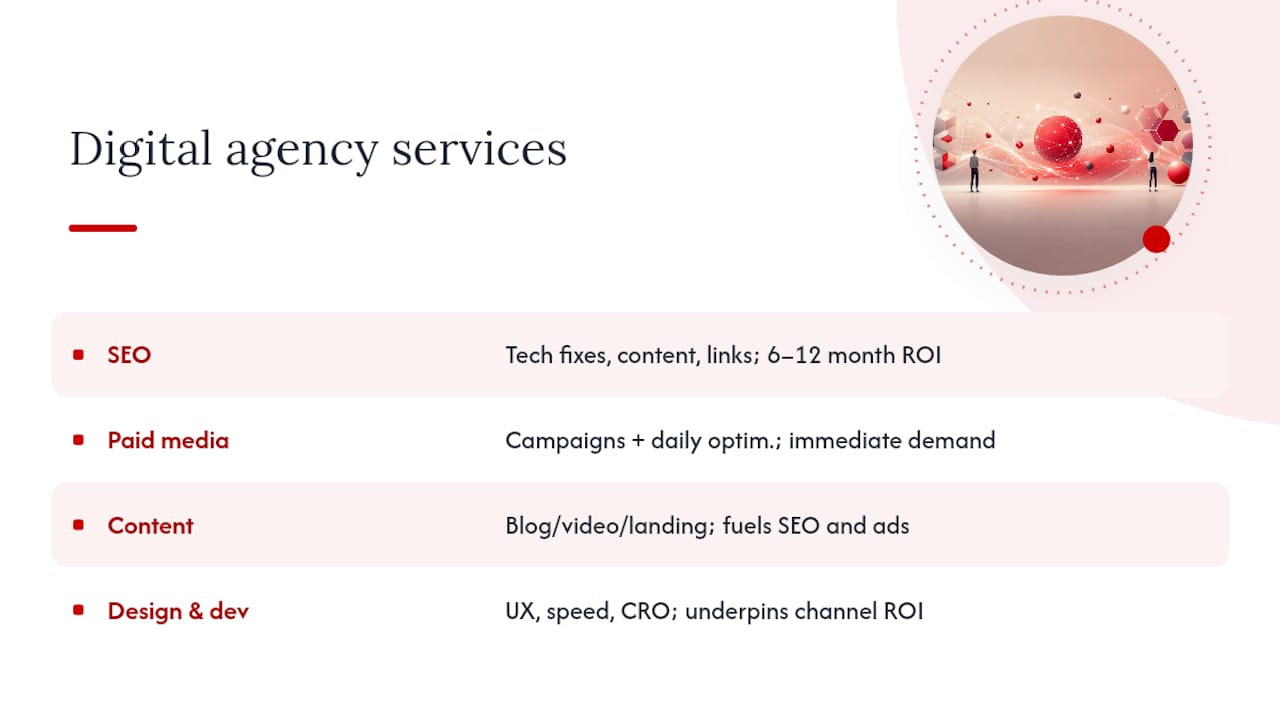
Search engine optimization covers technical fixes (site speed, crawlability), content built around search intent, and link building. Agencies usually prioritize SEO when a brand needs sustainable, non-paid traffic over a 6 to 12 month horizon rather than an immediate spike.
Paid media means building and managing campaigns across search, social, and programmatic display. “Management” here is not just setting a budget. It includes audience targeting, bid strategy, creative testing, and daily optimization based on what the data shows.
Content production spans blog posts, video, and landing pages. Good content does double duty: it feeds SEO by targeting keywords organically, and it feeds paid funnels by giving ads somewhere useful to send traffic.
Web design and development covers user experience, page speed, and conversion rate optimization (CRO). A site that loads slowly or confuses visitors kills the return on every other channel, so this work underpins everything else.

Email and lifecycle marketing recaptures visitors who didn’t convert on the first visit. Webopedia’s overview of digital marketing agencies lists email marketing alongside SEO and advertising as a standard service, and for good reason. There are more than 4 billion email users worldwide, which makes email one of the few channels with near-universal reach.
Analytics and reporting tie it all together. Every legitimate agency tracks conversions, cost per acquisition, and channel-level ROI, and reports on it against agreed KPIs. Without this layer, none of the other services can prove their worth.
Reddog’s own breakdown of digital marketing workflows for multichannel CPG growth shows how these services connect for physical product brands specifically, where channel mix affects margin as much as reach.
Every proposal lists roles, and each role owns a specific outcome. Knowing the vocabulary helps you evaluate whether a proposal is actually staffed to deliver.
Pro Tip: When you review a proposal, check the seniority of the people actually assigned to your account, not just the names in the agency’s case studies. “Team allocation” often means a senior strategist sets direction while junior staff execute daily tasks. Ask directly who touches your account weekly versus who signs off monthly.
Reddog’s guide to the role of digital marketing agencies breaks down how these roles typically split across full-service versus specialist shops, which matters once you start comparing quotes.
Not every agency does everything, and matching the model to your goal saves both time and money.
The right fit depends on whether you need broad coordination or narrow expertise, and whether your need is ongoing or tied to a single project.
The strongest argument for hiring an agency is economic: you get a full team’s output without a full team’s payroll.
Vetting an agency well takes about an hour of focused questions, and it saves months of misalignment later.
Pro Tip: Watch for agencies that won’t give you direct access to your own ad accounts or analytics dashboards. That’s a control tactic, not a security measure, and it makes it much harder to switch agencies later without losing your historical data.
Red flags worth walking away from: vague KPIs that never tie back to revenue, a rigid creative point of view with no willingness to test alternatives, and reluctance to share performance data in raw form. Reddog’s guide to building marketing campaigns for omnichannel brands offers a useful framework for structuring these conversations before you sign anything.
Pricing generally follows one of four models, and each fits a different situation. Monthly retainers cover ongoing management and suit brands that need continuous optimization; project-based fees cover one-off work like a website build; percent-of-ad-spend models (usually 10 to 20% of managed spend) align agency incentive with campaign scale but can get expensive as budgets grow; hourly billing suits small, defined tasks.
Full-service retainers commonly land between $3,000 and $15,000 per month, while specialist retainers for a single channel often sit toward the lower end of that range. Several factors push price higher: senior staffing on your account, custom software integrations, the sheer scale of ad spend under management, and how much original creative the retainer includes.
The smarter evaluation question isn’t “what does this cost” but “what does this return.” A $5,000 retainer that generates $40,000 in attributable revenue beats a $2,000 retainer that generates $6,000, even though the sticker price looks worse.
Reddog’s work with growth-stage CPG brands puts these agency services under a different lens: contribution margin, not just top-line traffic. A paid social campaign that drives Amazon sales can still lose money once FBA fees, ad spend, and returns are netted out, so digital work has to be judged against channel economics, not clicks alone.
When Reddog evaluates an agency for a marketplace-focused engagement, the questions get specific fast:
Top-line growth can hide margin compression if the reporting stops at revenue and never touches contribution margin, gross margin percentage, or sell-through rate. Those three numbers tell you whether the growth an agency generates is actually profitable growth.
If you’re weighing agency support against your own retail growth plan, Reddog’s contribution margin and channel economics resources go deeper into where digital spend and marketplace fees intersect.
Early-stage brands with a single core product usually get more value from an agency than from a first marketing hire, because the agency arrives with tested workflows instead of a learning curve. Once a brand crosses roughly $2 to $3 million in revenue and needs someone owning brand voice daily, a hybrid model tends to work better: one internal marketing lead paired with an agency handling execution and specialized channels.
Reddog typically recommends this hybrid path for growth-stage CPG brands, since marketplace and DTC channels move fast enough that you need both institutional knowledge in-house and specialist execution on tap. If you’re unsure which side of that line you’re on, the simplest test is this: can you name, today, what your last marketing dollar actually returned in contribution margin? If not, that’s the gap to close first.
— Reddog
Digital agencies solve for traffic, leads, and brand visibility, but for CPG brands selling across Amazon, Walmart, DTC, and wholesale, the harder question is what each channel actually contributes to profit after fees, freight, and returns. That’s the layer Reddog specializes in: not running your ad campaigns, but making sure the growth those campaigns generate doesn’t quietly erode your margin.

Reddog offers a free 30-minute strategy call for qualified CPG founders and operators, typically in the $500,000 to $20 million revenue range. The call is a practical review, not a sales pitch: bring your channel mix and we’ll walk through contribution margin, inventory velocity, and where growth planning should focus next. If you’re ready to see where your margin is actually leaking, book your free strategy call and get a clear next step for your business.
Leave a comment: